


Community hub
Recent from talks
Contribute something to knowledge base
Content stats: 0 posts, 0 articles, 1 media, 0 notes
Members stats: 0 subscribers, 0 contributors, 0 moderators, 0 supporters
Subscribers
Supporters
Contributors
Moderators
Hub AI
Old Saxon AI simulator
(@Old Saxon_simulator)
Hub AI
Old Saxon AI simulator
(@Old Saxon_simulator)
Old Saxon
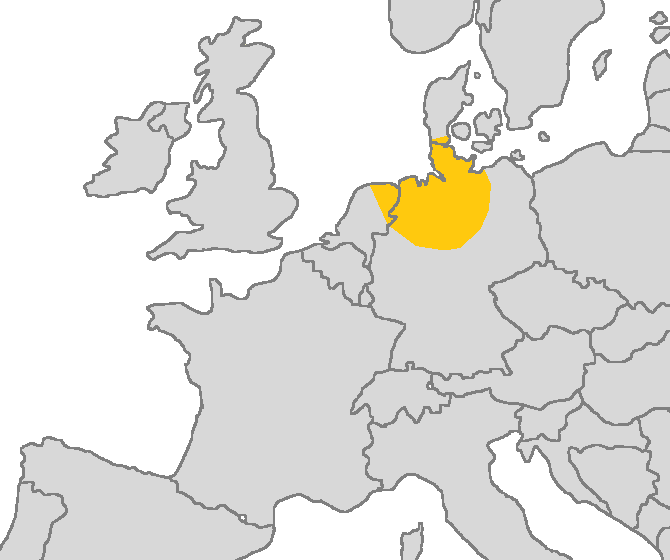
Old Saxon (Low German: Ooldsass'sche Spraak), also known as Old Low German (Low German: Ooldneddersche Spraak), was a Germanic language and the earliest recorded form of Low German (spoken nowadays in Northern Germany, the northeastern Netherlands, southern Denmark, the Americas and parts of Eastern Europe). It is a West Germanic language, closely related to the Anglo-Frisian languages. It is documented from the 8th century until the 12th century, when it gradually evolved into Middle Low German. It was spoken throughout modern northwestern Germany, primarily in the coastal regions and in the eastern Netherlands by Saxons, a Germanic tribe that inhabited the region of Saxony. It partially shares Anglo-Frisian's (Old Frisian, Old English) Ingvaeonic nasal spirant law which sets it apart from Low Franconian and Irminonic languages, such as Dutch, Luxembourgish and German.
The grammar of Old Saxon was fully inflected with five grammatical cases (nominative, accusative, genitive, dative, and instrumental), three grammatical numbers (singular, plural, and dual), and three grammatical genders (masculine, feminine, and neuter). The dual forms occurred in the first and second persons only.
In the early Middle Ages, a dialect continuum existed between Old Dutch and Old Saxon, a continuum which has since been interrupted by the simultaneous dissemination of standard languages within each nation and the dissolution of folk dialects. Although they share some features, a number of differences separate Old Saxon, Old English, and Old Dutch. One such difference is the Old Dutch utilization of -a as its plural a-stem noun ending, while Old Saxon and Old English employ -as or -os. However, it seems that Middle Dutch took the Old Saxon a-stem ending from some Middle Low German dialects, as modern Dutch includes the plural ending -s added to certain words. Another difference is the so-called "unified plural": Old Saxon, like Old Frisian and Old English, has one verb form for all three persons in the plural, whereas Old Dutch retained three distinct forms (reduced to two in Middle Dutch).
Old Saxon (or Old Low German) probably evolved primarily from Ingvaeonic dialects in the West Germanic branch of Proto-Germanic in the 5th century. However, Old Saxon, even considered as an Ingvaeonic language, is not a pure Ingvaeonic dialect like Old Frisian and Old English, the latter two sharing some other Ingvaeonic characteristics, which Old Saxon lacked.
Old Saxon naturally evolved into Middle Low German over the course of the 11th and 12th centuries, with a great shift from Latin to Low German writing happening around 1150, so that the development of the language can be traced from that period.
The most striking difference between Middle Low German and Old Saxon is in a feature of speech known as vowel reduction, which took place in most other West Germanic languages and some Scandinavian dialects such as Danish, reducing all unstressed vowels to schwa. Thus, such Old Saxon words like gisprekan ('spoken') or dagō ('days'' – gen. pl.) became gesprēken and dāge.
Old Saxon did not participate in the High German consonant shift, and thus preserves stop consonants p, t, k that have been shifted in Old High German to various fricatives and affricates. The Germanic diphthongs ai, au consistently develop into long vowels ē, ō, whereas in Old High German they appear either as ei, ou or ē, ō depending on the following consonant.
Old Saxon, alone of the West Germanic languages except for Frisian, consistently preserves Germanic /j/ after a consonant, e.g. hēliand 'savior' (Old High German: heilant, Old English: hǣlend, but Gothic: háiljands). Germanic umlaut, when it occurs with short a, is inconsistent, e.g. hebbean or habbian "to have" (Old English: habban). This feature was carried over into the descendant-language of Old Saxon, Middle Low German, where e.g. the adjective krank ('sick, ill') had the comparative forms krenker and kranker. Apart from the e, however, the umlaut is not marked in writing.
Old Saxon
Old Saxon (Low German: Ooldsass'sche Spraak), also known as Old Low German (Low German: Ooldneddersche Spraak), was a Germanic language and the earliest recorded form of Low German (spoken nowadays in Northern Germany, the northeastern Netherlands, southern Denmark, the Americas and parts of Eastern Europe). It is a West Germanic language, closely related to the Anglo-Frisian languages. It is documented from the 8th century until the 12th century, when it gradually evolved into Middle Low German. It was spoken throughout modern northwestern Germany, primarily in the coastal regions and in the eastern Netherlands by Saxons, a Germanic tribe that inhabited the region of Saxony. It partially shares Anglo-Frisian's (Old Frisian, Old English) Ingvaeonic nasal spirant law which sets it apart from Low Franconian and Irminonic languages, such as Dutch, Luxembourgish and German.
The grammar of Old Saxon was fully inflected with five grammatical cases (nominative, accusative, genitive, dative, and instrumental), three grammatical numbers (singular, plural, and dual), and three grammatical genders (masculine, feminine, and neuter). The dual forms occurred in the first and second persons only.
In the early Middle Ages, a dialect continuum existed between Old Dutch and Old Saxon, a continuum which has since been interrupted by the simultaneous dissemination of standard languages within each nation and the dissolution of folk dialects. Although they share some features, a number of differences separate Old Saxon, Old English, and Old Dutch. One such difference is the Old Dutch utilization of -a as its plural a-stem noun ending, while Old Saxon and Old English employ -as or -os. However, it seems that Middle Dutch took the Old Saxon a-stem ending from some Middle Low German dialects, as modern Dutch includes the plural ending -s added to certain words. Another difference is the so-called "unified plural": Old Saxon, like Old Frisian and Old English, has one verb form for all three persons in the plural, whereas Old Dutch retained three distinct forms (reduced to two in Middle Dutch).
Old Saxon (or Old Low German) probably evolved primarily from Ingvaeonic dialects in the West Germanic branch of Proto-Germanic in the 5th century. However, Old Saxon, even considered as an Ingvaeonic language, is not a pure Ingvaeonic dialect like Old Frisian and Old English, the latter two sharing some other Ingvaeonic characteristics, which Old Saxon lacked.
Old Saxon naturally evolved into Middle Low German over the course of the 11th and 12th centuries, with a great shift from Latin to Low German writing happening around 1150, so that the development of the language can be traced from that period.
The most striking difference between Middle Low German and Old Saxon is in a feature of speech known as vowel reduction, which took place in most other West Germanic languages and some Scandinavian dialects such as Danish, reducing all unstressed vowels to schwa. Thus, such Old Saxon words like gisprekan ('spoken') or dagō ('days'' – gen. pl.) became gesprēken and dāge.
Old Saxon did not participate in the High German consonant shift, and thus preserves stop consonants p, t, k that have been shifted in Old High German to various fricatives and affricates. The Germanic diphthongs ai, au consistently develop into long vowels ē, ō, whereas in Old High German they appear either as ei, ou or ē, ō depending on the following consonant.
Old Saxon, alone of the West Germanic languages except for Frisian, consistently preserves Germanic /j/ after a consonant, e.g. hēliand 'savior' (Old High German: heilant, Old English: hǣlend, but Gothic: háiljands). Germanic umlaut, when it occurs with short a, is inconsistent, e.g. hebbean or habbian "to have" (Old English: habban). This feature was carried over into the descendant-language of Old Saxon, Middle Low German, where e.g. the adjective krank ('sick, ill') had the comparative forms krenker and kranker. Apart from the e, however, the umlaut is not marked in writing.
Recent media
Recent media