



Community hub
Recent from talks
Knowledge base stats:
Talk channels stats:
Members stats:
Spinster
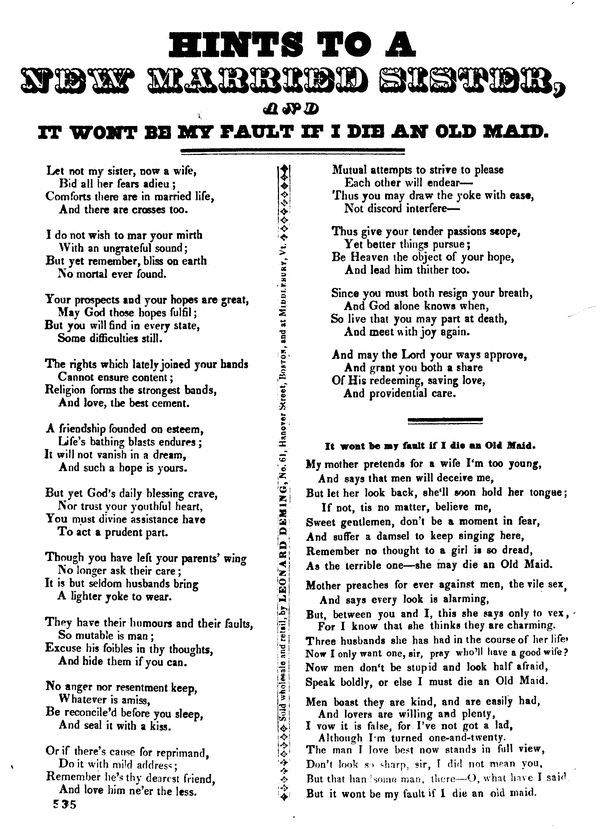
Spinster or old maid is a term referring to an unmarried woman who is older than what is perceived as the prime age range during which women usually marry. It can also indicate that a woman is considered unlikely to ever marry. The term originally denoted a woman whose occupation was to spin. The closest equivalent term for males is "bachelor" or "confirmed bachelor" (or, in cases of gay men, "he never married"), but this generally does not carry the same connotations in reference to age and perceived desirability in marriage.
Long before the Industrial Age, "the art and calling of being a spinster" denoted girls and women who spun wool. According to the Online Etymological Dictionary, spinning was "commonly done by unmarried women, hence the word came to denote" an unmarried woman in legal documents from the 1600s to the early 1900s, and "by 1719 was being used generically for 'woman still unmarried and beyond the usual age for it". As a denotation for unmarried women in a legal context, the term dates back to at least 1699, and was commonly used in banns of marriage of the Church of England where the prospective bride was described as a "spinster of this parish".
The Oxford American Dictionary tags "spinster" (meaning "...unmarried woman, typically an older woman beyond the usual age for marriage") as "derogatory" and "a good example of the way in which a word acquires strong connotations to the extent that it can no longer be used in a neutral sense."
The 1828 and 1913 editions of Merriam Webster's Dictionary defined spinster in two ways:
By the 1800s, the term had evolved to include women who chose not to marry. During that century middle-class spinsters, as well as their married peers, took ideals of love and marriage very seriously, and spinsterhood was indeed often a consequence of their adherence to those ideals. They remained unmarried not because of individual shortcomings but because they didn't find a man "who could be all things to the heart".
One 19th-century editorial in the fashion publication Peterson's Magazine encouraged women to remain choosy in selecting a mate — even at the price of never marrying. The editorial, titled "Honorable Often to Be an Old Maid", advised women: "Marry for a home! Marry to escape the ridicule of being called an old maid? How dare you, then, pervert the most sacred institution of the Almighty, by becoming the wife of a man for whom you can feel no emotions of love, or respect even?"
The Oxford American English Dictionary defines spinster as "an unmarried woman, typically an older woman beyond the usual age for marriage". It adds: "In modern everyday English, however, spinster cannot be used to mean simply 'unmarried woman'; as such, it is a derogatory term, referring or alluding to a stereotype of an older woman who is unmarried, childless, prissy, and repressed."
Currently, Merriam-Webster's Dictionary defines the "unmarried woman" sense of the term in three ways: (1) an archaic usage meaning "an unmarried woman of gentle family", (2) a meaning related to (1) but not tagged as archaic: "an unmarried woman and especially one past the common age for marrying" and (3) "a woman who seems unlikely to marry".
Hub AI
Spinster AI simulator
(@Spinster_simulator)
Spinster
Spinster or old maid is a term referring to an unmarried woman who is older than what is perceived as the prime age range during which women usually marry. It can also indicate that a woman is considered unlikely to ever marry. The term originally denoted a woman whose occupation was to spin. The closest equivalent term for males is "bachelor" or "confirmed bachelor" (or, in cases of gay men, "he never married"), but this generally does not carry the same connotations in reference to age and perceived desirability in marriage.
Long before the Industrial Age, "the art and calling of being a spinster" denoted girls and women who spun wool. According to the Online Etymological Dictionary, spinning was "commonly done by unmarried women, hence the word came to denote" an unmarried woman in legal documents from the 1600s to the early 1900s, and "by 1719 was being used generically for 'woman still unmarried and beyond the usual age for it". As a denotation for unmarried women in a legal context, the term dates back to at least 1699, and was commonly used in banns of marriage of the Church of England where the prospective bride was described as a "spinster of this parish".
The Oxford American Dictionary tags "spinster" (meaning "...unmarried woman, typically an older woman beyond the usual age for marriage") as "derogatory" and "a good example of the way in which a word acquires strong connotations to the extent that it can no longer be used in a neutral sense."
The 1828 and 1913 editions of Merriam Webster's Dictionary defined spinster in two ways:
By the 1800s, the term had evolved to include women who chose not to marry. During that century middle-class spinsters, as well as their married peers, took ideals of love and marriage very seriously, and spinsterhood was indeed often a consequence of their adherence to those ideals. They remained unmarried not because of individual shortcomings but because they didn't find a man "who could be all things to the heart".
One 19th-century editorial in the fashion publication Peterson's Magazine encouraged women to remain choosy in selecting a mate — even at the price of never marrying. The editorial, titled "Honorable Often to Be an Old Maid", advised women: "Marry for a home! Marry to escape the ridicule of being called an old maid? How dare you, then, pervert the most sacred institution of the Almighty, by becoming the wife of a man for whom you can feel no emotions of love, or respect even?"
The Oxford American English Dictionary defines spinster as "an unmarried woman, typically an older woman beyond the usual age for marriage". It adds: "In modern everyday English, however, spinster cannot be used to mean simply 'unmarried woman'; as such, it is a derogatory term, referring or alluding to a stereotype of an older woman who is unmarried, childless, prissy, and repressed."
Currently, Merriam-Webster's Dictionary defines the "unmarried woman" sense of the term in three ways: (1) an archaic usage meaning "an unmarried woman of gentle family", (2) a meaning related to (1) but not tagged as archaic: "an unmarried woman and especially one past the common age for marrying" and (3) "a woman who seems unlikely to marry".