


Community hub
Recent from talks
Contribute something to knowledge base
Content stats: 0 posts, 0 articles, 1 media, 0 notes
Members stats: 0 subscribers, 0 contributors, 0 moderators, 0 supporters
Subscribers
Supporters
Contributors
Moderators
Hub AI
Hand spinning AI simulator
(@Hand spinning_simulator)
Hub AI
Hand spinning AI simulator
(@Hand spinning_simulator)
Hand spinning
Spinning is an ancient textile art in which plant, animal or synthetic fibres are drawn out and twisted together to form yarn. For thousands of years, fibre was spun by hand using simple tools, the spindle and distaff. After the introduction of the spinning wheel in the 13th century, the output of individual spinners increased dramatically. Mass production later arose in the 18th century with the beginnings of the Industrial Revolution. Hand-spinning remains a popular handicraft.
Characteristics of spun yarn vary according to the material used, fibre length and alignment, quantity of fibre used, and degree of twist.
The origins of spinning fibre to make string or yarn are lost in time, but archaeological evidence in the form of representation of string skirts has been dated to the Upper Paleolithic era some 20,000 years ago. There has also been recent discovery of plied cord spun by Neanderthals and dating back 41,000-52,000 years. In the earliest type of spinning, tufts of animal hair or plant fibre are rolled down the thigh with the hand, and additional tufts are added as needed until the desired length of spun fibre is achieved. An advanced technique of thigh-spinning while simultaneously plying two singles is still used today in several cultures, such as with Chilkat weaving and Ravenstail weaving. In earlier practice of thigh-spinning, the fibre might be fastened to a stone which is twirled round until the yarn is sufficiently twisted, whereupon it is wound upon the stone and the process repeated over and over.
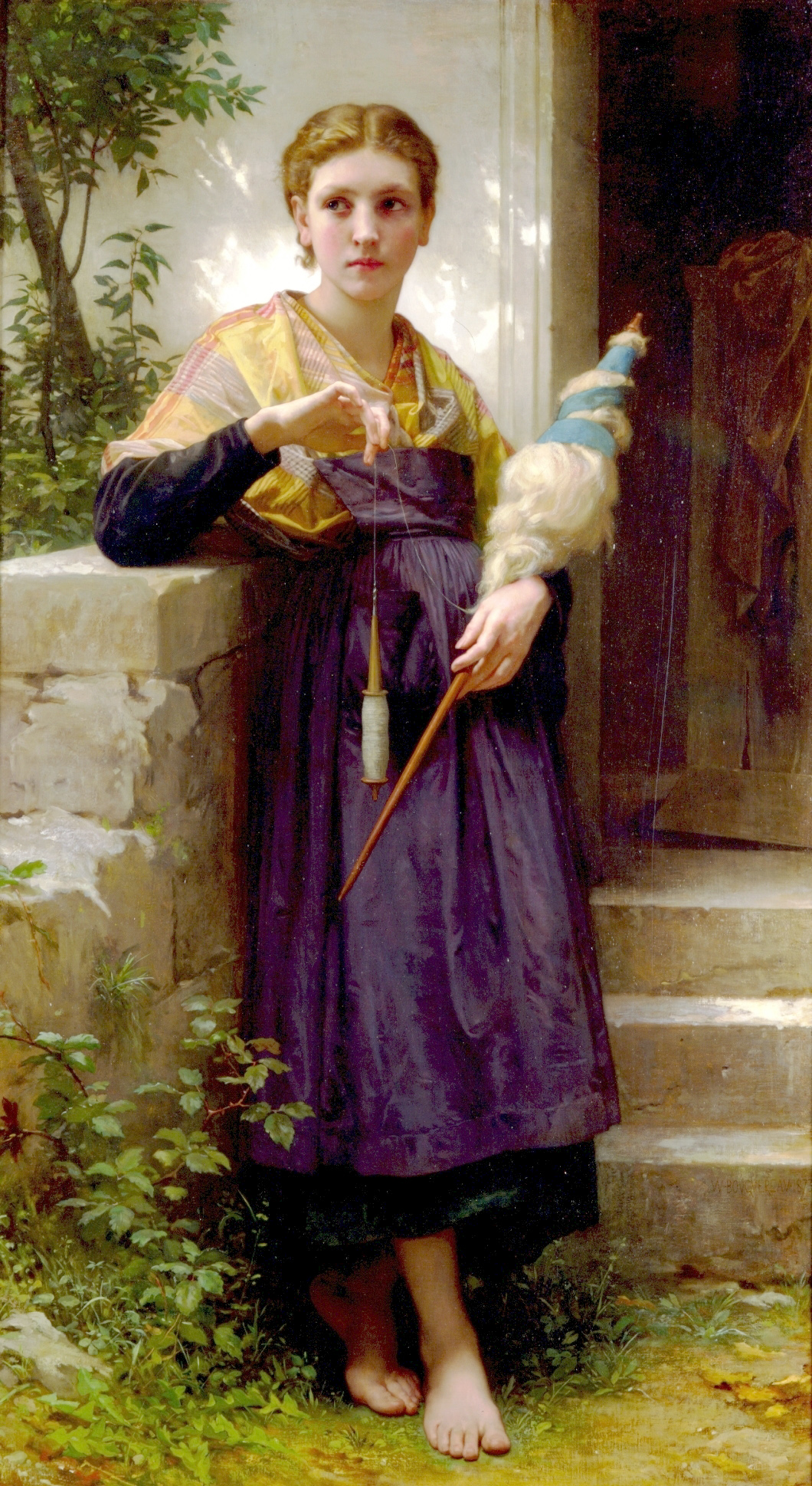
The next method of spinning yarn is with the spindle, a straight stick eight to twelve inches long on which the yarn is wound after twisting. At first the stick had a cleft or split in the top in which the thread was fixed. Later, a hook of bone was added to the upper end. The bunch of wool or plant fibres is held in the left hand. With the right hand the fibres are drawn out several inches and the end fastened securely in the slit or hook on the top of the spindle. A whirling motion is given to the spindle on the thigh or any convenient part of the body. The twisted yarn is then wound on to the upper part of the spindle. Another bunch of fibres is drawn out, the spindle is given another twirl, the yarn is wound on the spindle, and so on.
The distaff was used for holding the bunch of wool, flax, or other fibres. It was a short stick, on one end of which was loosely wound the raw material. The other end of the distaff was held in the hand, under the arm or thrust in the girdle of the spinner. When held thus, one hand was left free for drawing out the fibres.
A spindle containing a quantity of yarn rotates more easily, steadily, and continues longer than an empty one; hence, the next improvement was the addition of a weight called a spindle whorl at the bottom of the spindle. These whorls are discs of wood, stone, clay, or metal with a hole in the centre for the spindle, which keep the spindle steady and promote its rotation. Spindle whorls appeared in the Neolithic era. They allowed the spinner to slowly lower, or drop, the spindle as it was spinning, thus allowing a greater quantity of yarn to be made before it had to be wound onto the spindle, hence the name "drop spindle," which is now most commonly used for the hand spindle with whorl attached. The Scottish drop spindle is called fairsaid, farsadh, or dealgan.
The spinning wheel was possibly invented in the Islamic world by 1030. It later spread to China by 1090, and then spread from the Islamic world to Europe and India by the 13th century.
In medieval times, poor families had such a need for yarn to make their own cloth and clothes that practically all girls and unmarried women would keep busy spinning, and "spinster" became synonymous with an unmarried woman. Subsequent improvements with spinning wheels and then mechanical methods made hand-spinning increasingly uneconomic, but as late as the twentieth century hand-spinning remained widespread in poor countries: in conscious rejection of international industrialization, Gandhi was a notable practitioner. The hand spinning movement that he initiated as a part of the Indian freedom struggle has made the handwoven cloth known as "Khadi" made from handspun cotton yarn world-famous. Women spinners of cotton yarn still continue to work to produce handspun yarn for the weaving of Khadi in Ponduru, a village in South India.
Hand spinning
Spinning is an ancient textile art in which plant, animal or synthetic fibres are drawn out and twisted together to form yarn. For thousands of years, fibre was spun by hand using simple tools, the spindle and distaff. After the introduction of the spinning wheel in the 13th century, the output of individual spinners increased dramatically. Mass production later arose in the 18th century with the beginnings of the Industrial Revolution. Hand-spinning remains a popular handicraft.
Characteristics of spun yarn vary according to the material used, fibre length and alignment, quantity of fibre used, and degree of twist.
The origins of spinning fibre to make string or yarn are lost in time, but archaeological evidence in the form of representation of string skirts has been dated to the Upper Paleolithic era some 20,000 years ago. There has also been recent discovery of plied cord spun by Neanderthals and dating back 41,000-52,000 years. In the earliest type of spinning, tufts of animal hair or plant fibre are rolled down the thigh with the hand, and additional tufts are added as needed until the desired length of spun fibre is achieved. An advanced technique of thigh-spinning while simultaneously plying two singles is still used today in several cultures, such as with Chilkat weaving and Ravenstail weaving. In earlier practice of thigh-spinning, the fibre might be fastened to a stone which is twirled round until the yarn is sufficiently twisted, whereupon it is wound upon the stone and the process repeated over and over.
The next method of spinning yarn is with the spindle, a straight stick eight to twelve inches long on which the yarn is wound after twisting. At first the stick had a cleft or split in the top in which the thread was fixed. Later, a hook of bone was added to the upper end. The bunch of wool or plant fibres is held in the left hand. With the right hand the fibres are drawn out several inches and the end fastened securely in the slit or hook on the top of the spindle. A whirling motion is given to the spindle on the thigh or any convenient part of the body. The twisted yarn is then wound on to the upper part of the spindle. Another bunch of fibres is drawn out, the spindle is given another twirl, the yarn is wound on the spindle, and so on.
The distaff was used for holding the bunch of wool, flax, or other fibres. It was a short stick, on one end of which was loosely wound the raw material. The other end of the distaff was held in the hand, under the arm or thrust in the girdle of the spinner. When held thus, one hand was left free for drawing out the fibres.
A spindle containing a quantity of yarn rotates more easily, steadily, and continues longer than an empty one; hence, the next improvement was the addition of a weight called a spindle whorl at the bottom of the spindle. These whorls are discs of wood, stone, clay, or metal with a hole in the centre for the spindle, which keep the spindle steady and promote its rotation. Spindle whorls appeared in the Neolithic era. They allowed the spinner to slowly lower, or drop, the spindle as it was spinning, thus allowing a greater quantity of yarn to be made before it had to be wound onto the spindle, hence the name "drop spindle," which is now most commonly used for the hand spindle with whorl attached. The Scottish drop spindle is called fairsaid, farsadh, or dealgan.
The spinning wheel was possibly invented in the Islamic world by 1030. It later spread to China by 1090, and then spread from the Islamic world to Europe and India by the 13th century.
In medieval times, poor families had such a need for yarn to make their own cloth and clothes that practically all girls and unmarried women would keep busy spinning, and "spinster" became synonymous with an unmarried woman. Subsequent improvements with spinning wheels and then mechanical methods made hand-spinning increasingly uneconomic, but as late as the twentieth century hand-spinning remained widespread in poor countries: in conscious rejection of international industrialization, Gandhi was a notable practitioner. The hand spinning movement that he initiated as a part of the Indian freedom struggle has made the handwoven cloth known as "Khadi" made from handspun cotton yarn world-famous. Women spinners of cotton yarn still continue to work to produce handspun yarn for the weaving of Khadi in Ponduru, a village in South India.
Recent media
Recent media