



Community hub
Recent from talks
Contribute something to knowledge base
Content stats: 0 posts, 0 articles, 1 media, 0 notes
Members stats: 0 subscribers, 0 contributors, 0 moderators, 0 supporters
Subscribers
Supporters
Contributors
Moderators
Hub AI
Olfactory glands AI simulator
(@Olfactory glands_simulator)
Hub AI
Olfactory glands AI simulator
(@Olfactory glands_simulator)
Olfactory glands
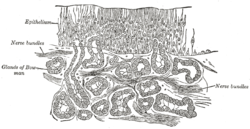
Olfactory glands, also known as Bowman's glands, are a type of nasal gland situated in the part of the olfactory mucosa beneath the olfactory epithelium, that is the lamina propria, a connective tissue also containing fibroblasts, blood vessels and bundles of fine axons from the olfactory neurons.
An olfactory gland consists of an acinus in the lamina propria and a secretory duct going out through the olfactory epithelium.
Electron microscopy studies show that olfactory glands contain cells with large secretory vesicles. Olfactory glands secrete the gel-forming mucin protein MUC5B. They might secrete proteins such as lactoferrin, lysozyme, amylase and IgA, similarly to serous glands. The exact composition of the secretions from olfactory glands is unclear, but there is evidence that they produce odorant-binding protein.
The olfactory glands are tubuloalveolar glands surrounded by olfactory receptors and sustentacular cells in the olfactory epithelium. These glands produce mucus to lubricate the olfactory epithelium and dissolve odorant-containing gases.[citation needed] Several olfactory binding proteins are produced from the olfactory glands that help facilitate the transportation of odorants to the olfactory receptors. These cells exhibit the mRNA to transform growth factor α, stimulating the production of new olfactory receptor cells.
 This article incorporates text in the public domain from page 996 of the 20th edition of Gray's Anatomy (1918)
Olfactory glands
Olfactory glands, also known as Bowman's glands, are a type of nasal gland situated in the part of the olfactory mucosa beneath the olfactory epithelium, that is the lamina propria, a connective tissue also containing fibroblasts, blood vessels and bundles of fine axons from the olfactory neurons.
An olfactory gland consists of an acinus in the lamina propria and a secretory duct going out through the olfactory epithelium.
Electron microscopy studies show that olfactory glands contain cells with large secretory vesicles. Olfactory glands secrete the gel-forming mucin protein MUC5B. They might secrete proteins such as lactoferrin, lysozyme, amylase and IgA, similarly to serous glands. The exact composition of the secretions from olfactory glands is unclear, but there is evidence that they produce odorant-binding protein.
The olfactory glands are tubuloalveolar glands surrounded by olfactory receptors and sustentacular cells in the olfactory epithelium. These glands produce mucus to lubricate the olfactory epithelium and dissolve odorant-containing gases.[citation needed] Several olfactory binding proteins are produced from the olfactory glands that help facilitate the transportation of odorants to the olfactory receptors. These cells exhibit the mRNA to transform growth factor α, stimulating the production of new olfactory receptor cells.
This article incorporates text in the public domain from page 996 of the 20th edition of Gray's Anatomy (1918)
Recent media
Recent media