



Community hub
Recent from talks
Knowledge base stats:
Talk channels stats:
Members stats:
Olive baboon
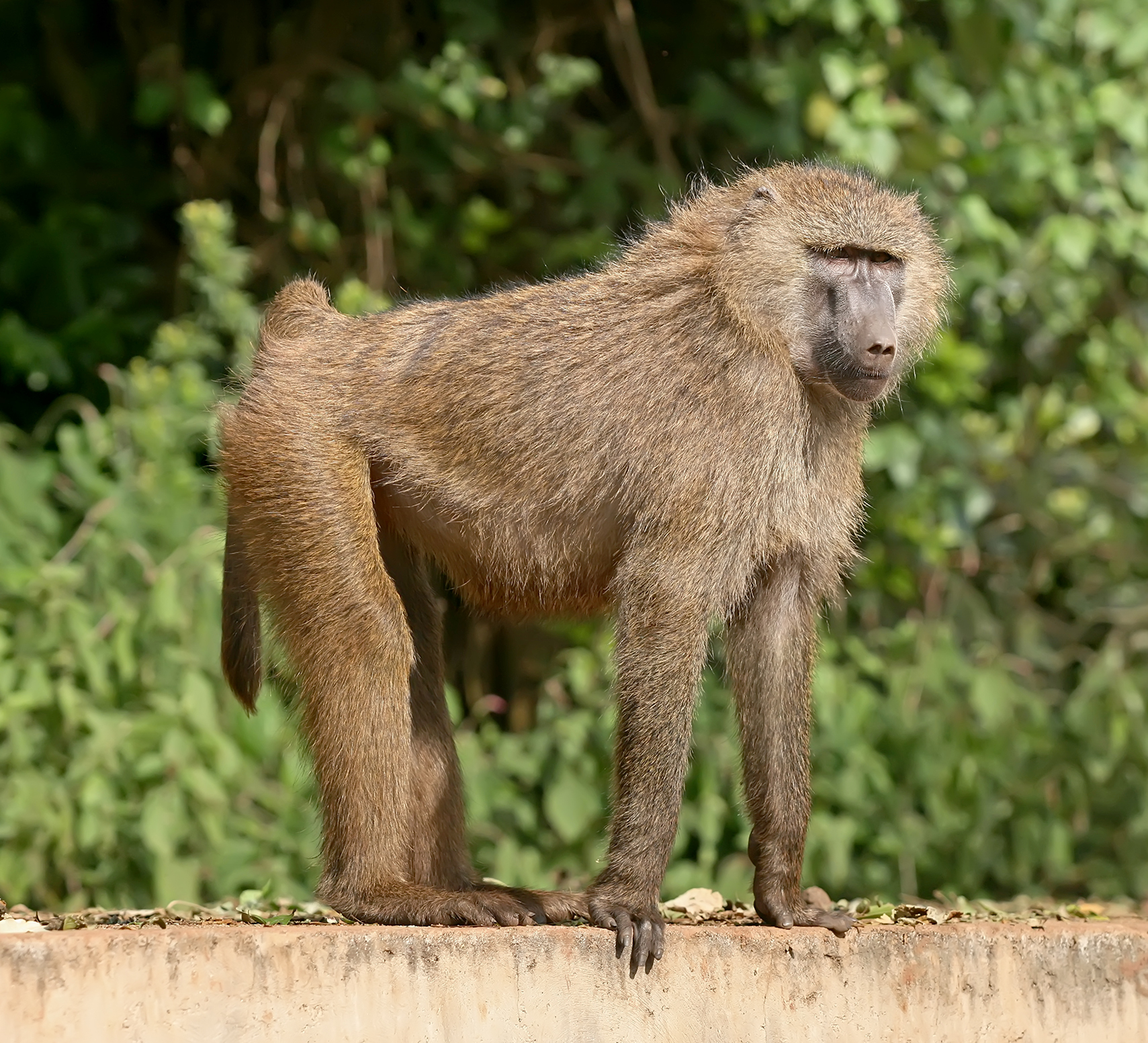
The olive baboon (Papio anubis), also called the Anubis baboon, is a member of the family Cercopithecidae Old World monkeys. The species is the most wide-ranging of all baboons, being native to 25 countries throughout Africa, extending from Mali eastward to Ethiopia and Tanzania. Isolated populations are also present in some mountainous regions of the Sahara. It inhabits savannahs, steppes, and forests. The common name is derived from its coat colour, which is a shade of green-grey at a distance. A variety of communications, vocal and non-vocal, facilitate a complex social structure.
The olive baboon is named for its coat, which, at a distance, is a shade of green-grey. At closer range, its coat is multicoloured, due to rings of yellow-brown and black on the hairs. The hair on the baboon's face is coarser and ranges from dark grey to black. This coloration is shared by both sexes, although males have a mane of longer hair that tapers down to ordinary length along the back.
Besides the mane, the male olive baboon differs from the female in terms of weight, body and canine tooth size; males are, on average, 70 cm (28 in) tall while standing and females measure 60 cm (24 in) in height. The olive baboon is one of the largest species of monkey; along with chacma baboons, mandrills, and muriquis. The head-and-body length can range from 50 to 114 cm (20 to 45 in), with a species average of around 85 cm (33 in). At the shoulder on all fours, females average 55 cm (22 in) against males, which average 70 cm (28 in). The typical weight range for both sexes is reportedly 10–37 kg (22–82 lb), with males averaging 24 kg (53 lb) and females averaging 14.7 kg (32 lb). Some males may weigh as much as 50 kg (110 lb).
Like other baboons, the olive baboon has an elongated, dog-like muzzle. Its 38 to 58 cm (15 to 23 in) long tail and four-legged gait can make it seem canine. The tail almost looks as if it is broken, as it is erect for the first quarter, after which it drops down sharply. The bare patch of a baboon's rump is smaller in the olive baboon than in the Hamadryas baboon or Guinea baboon. The olive baboon, like most cercopithecines, has a cheek pouch with which to store food.
The species inhabits a strip of 25 equatorial African countries, very nearly ranging from the east to west coasts of the continent. The exact boundaries of this strip are not clearly defined, as the species' territory overlaps with that of other baboon species. In many places, this has resulted in cross-breeding between species. For example, considerable hybridisation has occurred between the olive baboon and the hamadryas baboon in Ethiopia. Cross-breeding with the yellow baboon and the Guinea baboon has also been observed. Although this has been noted, the hybrids have not as yet been well studied.
Throughout its wide range, the olive baboon can be found in a number of different habitats. It is usually classified as savannah-dwelling, living in the wide plains of the grasslands. The grasslands, especially those near open woodland, do make up a large part of its habitat, but the baboon also inhabits rainforests and deserts. Uganda and the Democratic Republic of the Congo, for instance, both support olive baboon populations in dense tropical forests.
The olive baboon lives in groups of 15 to 150, made up of a few males, many females, and their young. Female social rank is determined largely by heredity, with daughters inheriting their rank in line with their mother's, and adult females forming the core of the social system. Female relatives form their own subgroups in the troop. Related females are largely friendly to each other. They tend to stay close together and groom one another, and team up in aggressive encounters within the troop. Female kin form these strong bonds because they do not emigrate from their natal groups.
Occasionally, groups may split up when they become so large that competition for resources is problematic, but even then, members of matrilines tend to stick together. Dominant females procure more food, matings, and supporters. Among olive baboons in Tanzania, high-ranking females give birth at shorter intervals to infants with a higher survival rate, and their daughters tend to mature faster than low-ranking females. These high-ranking females also appear to have a higher probability of miscarriages and some high-ranking matrilines have inexplicably low fertility. One theory suggests this occurs due to stress on the high-ranking females, although this theory is controversial. A recent study shows top-ranking females are at risk from male harassment. Males who have recently immigrated harass females in order to induce miscarriages in females they had not yet mated with, in order to impregnate them with an offspring that is his own faster. As females with living infants often have male allies protecting their infants, it makes more sense for a male to ignore infants and channel his aggression to the group's resident pregnant females who do not currently have infants instead.
Hub AI
Olive baboon AI simulator
(@Olive baboon_simulator)
Olive baboon
The olive baboon (Papio anubis), also called the Anubis baboon, is a member of the family Cercopithecidae Old World monkeys. The species is the most wide-ranging of all baboons, being native to 25 countries throughout Africa, extending from Mali eastward to Ethiopia and Tanzania. Isolated populations are also present in some mountainous regions of the Sahara. It inhabits savannahs, steppes, and forests. The common name is derived from its coat colour, which is a shade of green-grey at a distance. A variety of communications, vocal and non-vocal, facilitate a complex social structure.
The olive baboon is named for its coat, which, at a distance, is a shade of green-grey. At closer range, its coat is multicoloured, due to rings of yellow-brown and black on the hairs. The hair on the baboon's face is coarser and ranges from dark grey to black. This coloration is shared by both sexes, although males have a mane of longer hair that tapers down to ordinary length along the back.
Besides the mane, the male olive baboon differs from the female in terms of weight, body and canine tooth size; males are, on average, 70 cm (28 in) tall while standing and females measure 60 cm (24 in) in height. The olive baboon is one of the largest species of monkey; along with chacma baboons, mandrills, and muriquis. The head-and-body length can range from 50 to 114 cm (20 to 45 in), with a species average of around 85 cm (33 in). At the shoulder on all fours, females average 55 cm (22 in) against males, which average 70 cm (28 in). The typical weight range for both sexes is reportedly 10–37 kg (22–82 lb), with males averaging 24 kg (53 lb) and females averaging 14.7 kg (32 lb). Some males may weigh as much as 50 kg (110 lb).
Like other baboons, the olive baboon has an elongated, dog-like muzzle. Its 38 to 58 cm (15 to 23 in) long tail and four-legged gait can make it seem canine. The tail almost looks as if it is broken, as it is erect for the first quarter, after which it drops down sharply. The bare patch of a baboon's rump is smaller in the olive baboon than in the Hamadryas baboon or Guinea baboon. The olive baboon, like most cercopithecines, has a cheek pouch with which to store food.
The species inhabits a strip of 25 equatorial African countries, very nearly ranging from the east to west coasts of the continent. The exact boundaries of this strip are not clearly defined, as the species' territory overlaps with that of other baboon species. In many places, this has resulted in cross-breeding between species. For example, considerable hybridisation has occurred between the olive baboon and the hamadryas baboon in Ethiopia. Cross-breeding with the yellow baboon and the Guinea baboon has also been observed. Although this has been noted, the hybrids have not as yet been well studied.
Throughout its wide range, the olive baboon can be found in a number of different habitats. It is usually classified as savannah-dwelling, living in the wide plains of the grasslands. The grasslands, especially those near open woodland, do make up a large part of its habitat, but the baboon also inhabits rainforests and deserts. Uganda and the Democratic Republic of the Congo, for instance, both support olive baboon populations in dense tropical forests.
The olive baboon lives in groups of 15 to 150, made up of a few males, many females, and their young. Female social rank is determined largely by heredity, with daughters inheriting their rank in line with their mother's, and adult females forming the core of the social system. Female relatives form their own subgroups in the troop. Related females are largely friendly to each other. They tend to stay close together and groom one another, and team up in aggressive encounters within the troop. Female kin form these strong bonds because they do not emigrate from their natal groups.
Occasionally, groups may split up when they become so large that competition for resources is problematic, but even then, members of matrilines tend to stick together. Dominant females procure more food, matings, and supporters. Among olive baboons in Tanzania, high-ranking females give birth at shorter intervals to infants with a higher survival rate, and their daughters tend to mature faster than low-ranking females. These high-ranking females also appear to have a higher probability of miscarriages and some high-ranking matrilines have inexplicably low fertility. One theory suggests this occurs due to stress on the high-ranking females, although this theory is controversial. A recent study shows top-ranking females are at risk from male harassment. Males who have recently immigrated harass females in order to induce miscarriages in females they had not yet mated with, in order to impregnate them with an offspring that is his own faster. As females with living infants often have male allies protecting their infants, it makes more sense for a male to ignore infants and channel his aggression to the group's resident pregnant females who do not currently have infants instead.