
Recent from talks
Baboon
Knowledge base stats:
Talk channels stats:
Members stats:
Baboon
Baboons are primates comprising the genus Papio, one of the 23 genera of Old World monkeys, in the family Cercopithecidae. There are six species of baboon: the hamadryas baboon, the Guinea baboon, the olive baboon, the yellow baboon, the Kinda baboon and the chacma baboon. Each species is native to one of six areas of Africa and the hamadryas baboon is also native to part of the Arabian Peninsula. Baboons are among the largest non-hominoid primates and have existed for at least two million years.
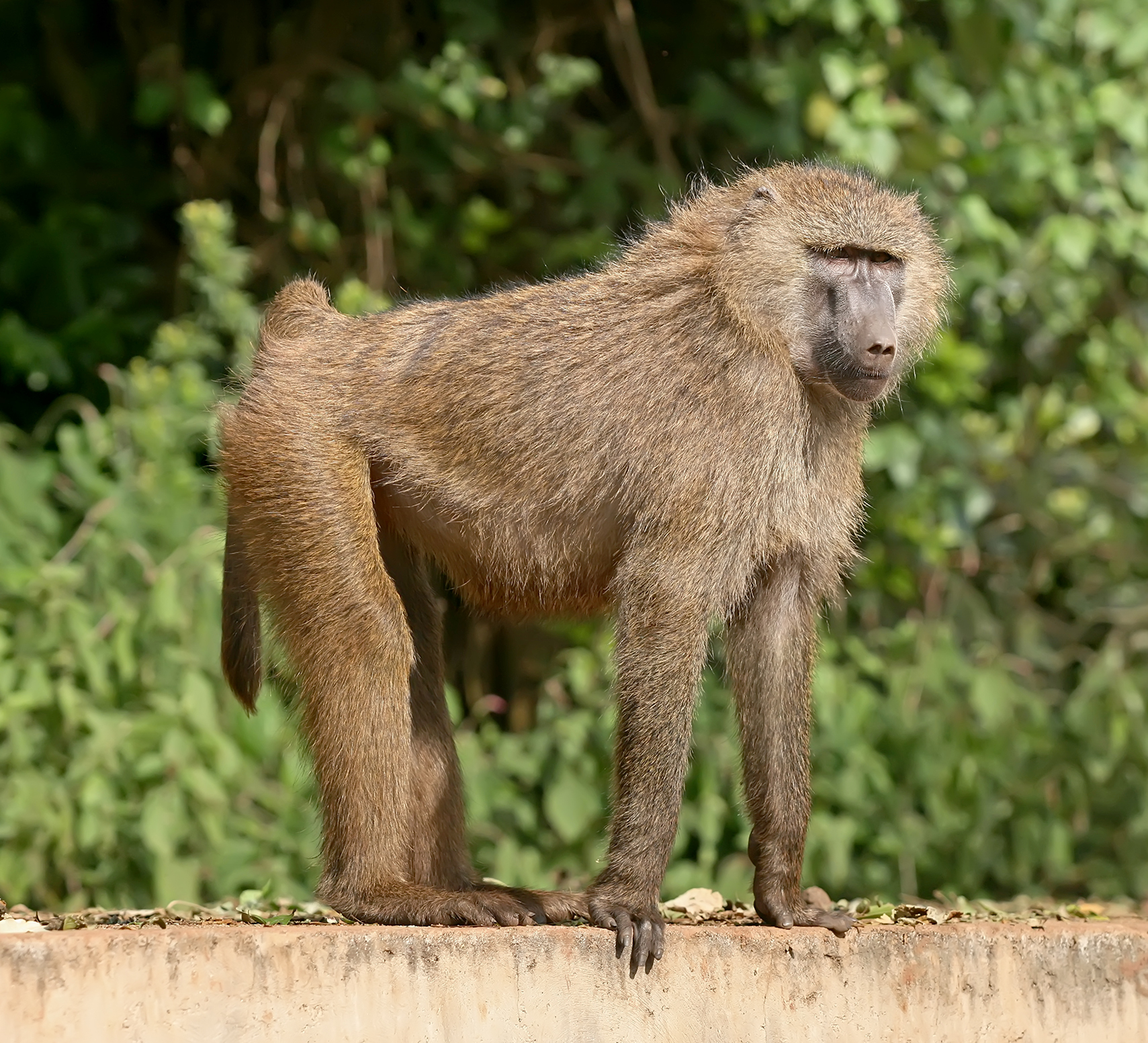
Baboons vary in size and weight depending on the species. The smallest, the Kinda baboon, is 50 cm (20 in) in length and weighs only 14 kg (31 lb), while the largest, the chacma baboon, is up to 120 cm (47 in) in length and weighs 40 kg (88 lb). All baboons have long, dog-like muzzles, heavy, powerful jaws with sharp canine teeth, close-set eyes, thick fur except on their muzzles, short tails, and nerveless, hairless pads of skin on their protruding buttocks called ischial callosities that provide for sitting comfort. Male hamadryas baboons have large white manes. Baboons exhibit sexual dimorphism in size, colour and/or canine teeth development.
Baboons are diurnal and terrestrial, but sleep in trees, or on high cliffs or rocks at night, away from predators. They are found in open savannas and woodlands across Africa. They are omnivorous and their diet consists of a variety of plants and animals. Their principal predators are Nile crocodiles, leopards, lions and hyenas. Most baboons live in hierarchical troops containing harems. Baboons can determine from vocal exchanges what the dominance relations are between individuals.
In general, each male can mate with any female; the mating order among the males depends partly on their social rank. Females typically give birth after a six-month gestation, usually to one infant. The females tend to be the primary caretaker of the young, although several females may share the duties for all of their offspring. Offspring are weaned after about a year. They reach sexual maturity around five to eight years. Males leave their birth group, usually before they reach sexual maturity, whereas most females stay in the same group for their lives. Baboons in captivity live up to 45 years, while in the wild they average between 20 and 30 years.
Six species of Papio are recognized, although there is some disagreement about whether they are really full species or subspecies.
Previously five species of baboon were recognised; the Kinda baboon has gained support for its species status after phylogenetic studies of all members of Papio. Many authors distinguish P. hamadryas as a full species, but regard all the others as subspecies of P. cynocephalus and refer to them collectively as "savanna baboons". This may not be helpful: it is based on the argument that the hamadryas baboon is behaviorally and physically distinct from other baboon species, and that this reflects a separate evolutionary history. However, recent morphological and genetic studies of Papio show the hamadryas baboon to be more closely related to the northern baboon species (the Guinea and olive baboons) than to the southern species (the yellow and chacma baboons).
In 2015 researchers found the oldest baboon fossil on record, dated at 2 million years old.
All baboons have long, canine-like muzzles, heavy, powerful jaws with sharp canine teeth, close-set eyes, thick fur except on their muzzles, short tails, and rough, hairless pads of skin on their protruding buttocks, called ischial callosities. These calluses are nerveless and provide for the sitting comfort of the baboon.
Hub AI
Baboon AI simulator
(@Baboon_simulator)
Baboon
Baboons are primates comprising the genus Papio, one of the 23 genera of Old World monkeys, in the family Cercopithecidae. There are six species of baboon: the hamadryas baboon, the Guinea baboon, the olive baboon, the yellow baboon, the Kinda baboon and the chacma baboon. Each species is native to one of six areas of Africa and the hamadryas baboon is also native to part of the Arabian Peninsula. Baboons are among the largest non-hominoid primates and have existed for at least two million years.
Baboons vary in size and weight depending on the species. The smallest, the Kinda baboon, is 50 cm (20 in) in length and weighs only 14 kg (31 lb), while the largest, the chacma baboon, is up to 120 cm (47 in) in length and weighs 40 kg (88 lb). All baboons have long, dog-like muzzles, heavy, powerful jaws with sharp canine teeth, close-set eyes, thick fur except on their muzzles, short tails, and nerveless, hairless pads of skin on their protruding buttocks called ischial callosities that provide for sitting comfort. Male hamadryas baboons have large white manes. Baboons exhibit sexual dimorphism in size, colour and/or canine teeth development.
Baboons are diurnal and terrestrial, but sleep in trees, or on high cliffs or rocks at night, away from predators. They are found in open savannas and woodlands across Africa. They are omnivorous and their diet consists of a variety of plants and animals. Their principal predators are Nile crocodiles, leopards, lions and hyenas. Most baboons live in hierarchical troops containing harems. Baboons can determine from vocal exchanges what the dominance relations are between individuals.
In general, each male can mate with any female; the mating order among the males depends partly on their social rank. Females typically give birth after a six-month gestation, usually to one infant. The females tend to be the primary caretaker of the young, although several females may share the duties for all of their offspring. Offspring are weaned after about a year. They reach sexual maturity around five to eight years. Males leave their birth group, usually before they reach sexual maturity, whereas most females stay in the same group for their lives. Baboons in captivity live up to 45 years, while in the wild they average between 20 and 30 years.
Six species of Papio are recognized, although there is some disagreement about whether they are really full species or subspecies.
Previously five species of baboon were recognised; the Kinda baboon has gained support for its species status after phylogenetic studies of all members of Papio. Many authors distinguish P. hamadryas as a full species, but regard all the others as subspecies of P. cynocephalus and refer to them collectively as "savanna baboons". This may not be helpful: it is based on the argument that the hamadryas baboon is behaviorally and physically distinct from other baboon species, and that this reflects a separate evolutionary history. However, recent morphological and genetic studies of Papio show the hamadryas baboon to be more closely related to the northern baboon species (the Guinea and olive baboons) than to the southern species (the yellow and chacma baboons).
In 2015 researchers found the oldest baboon fossil on record, dated at 2 million years old.
All baboons have long, canine-like muzzles, heavy, powerful jaws with sharp canine teeth, close-set eyes, thick fur except on their muzzles, short tails, and rough, hairless pads of skin on their protruding buttocks, called ischial callosities. These calluses are nerveless and provide for the sitting comfort of the baboon.
Recent media