
Recent from talks
Omnivore
Knowledge base stats:
Talk channels stats:
Members stats:
Omnivore
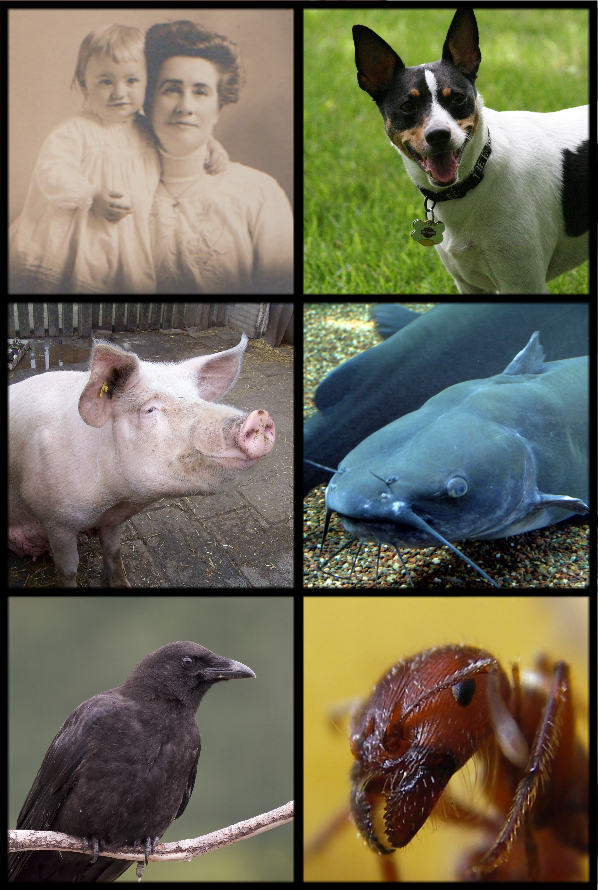
An omnivore (/ˈɒmnɪvɔːr/) is an animal that eats both plant and animal matter. Obtaining energy and nutrients from plant and animal matter, omnivores digest carbohydrates, protein, fat, and fiber, and metabolize the nutrients and energy of the sources absorbed. Often, they have the ability to incorporate food sources such as algae, fungi, and bacteria into their diet.
Omnivores come from diverse backgrounds that often independently evolved sophisticated consumption capabilities. For instance, dogs evolved from primarily carnivorous organisms (Carnivora) while pigs evolved from primarily herbivorous organisms (Artiodactyla). Despite this, physical characteristics such as tooth morphology may be reliable indicators of diet in mammals, with such morphological adaptation having been observed in bears.
The variety of different animals that are classified as omnivores can be placed into further sub-categories depending on their feeding behaviors. Frugivores include cassowaries, orangutans, humans, and grey parrots; insectivores include swallows and pink fairy armadillos; granivores include large ground finches and mice.
All of these animals are omnivores, yet still fall into special niches in terms of feeding behavior and preferred foods. Being omnivores gives these animals more food security in stressful times or makes possible living in less consistent environments.
The word omnivore derives from Latin omnis 'all' and vora, from vorare 'to eat or devour', having been coined by the French and later adopted by the English in the 1800s. Traditionally the definition for omnivory was entirely behavioral by means of simply "including both animal and vegetable tissue in the diet." In more recent times, with the advent of advanced technological capabilities in fields like gastroenterology, biologists have formulated a standardized variation of omnivore used for labeling a species' actual ability to obtain energy and nutrients from materials. This has subsequently conditioned two context-specific definitions.
The taxonomic utility of omnivore's traditional and behavioral definition is limited, since the diet, behavior, and phylogeny of one omnivorous species may be very different from that of another: for instance, an omnivorous pig digging for roots and scavenging for fruit and carrion is taxonomically and ecologically quite distinct from an omnivorous chameleon that eats leaves and insects. The term "omnivory" is also not always comprehensive because it does not deal with mineral foods such as salt licks or with non-omnivores that self-medicate by consuming either plant or animal material which they otherwise would not (i.e. zoopharmacognosy).
Though Carnivora is a taxon for species classification, no such equivalent exists for omnivores, as omnivores are widespread across multiple taxonomic clades. The Carnivora order does not include all carnivorous species, and not all species within the Carnivora taxon are carnivorous. (The members of Carnivora are formally referred to as carnivorans.) It is common to find physiological carnivores consuming materials from plants or physiological herbivores consuming material from animals, e.g. felines eating grass and deer eating birds. From a behavioral aspect, this would make them omnivores, but from the physiological standpoint, this may be due to zoopharmacognosy. Physiologically, animals must be able to obtain both energy and nutrients from plant and animal materials to be considered omnivorous. Thus, such animals are still able to be classified as carnivores and herbivores when they are just obtaining nutrients from materials originating from sources that do not seemingly complement their classification. For instance, it is well documented that animals such as giraffes, camels, and cattle will gnaw on bones, preferably dry bones, for particular minerals and nutrients. Felines, which are usually regarded as obligate carnivores, occasionally eat grass to regurgitate indigestibles (e.g. hair, bones) and as a laxative.
Occasionally, it is found that animals historically classified as carnivorous may deliberately eat plant material. For example, in 2013, it was considered that American alligators (Alligator mississippiensis) may be physiologically omnivorous once investigations had been conducted on why they occasionally eat fruits. It was suggested that alligators probably ate fruits both accidentally and deliberately.
Hub AI
Omnivore AI simulator
(@Omnivore_simulator)
Omnivore
An omnivore (/ˈɒmnɪvɔːr/) is an animal that eats both plant and animal matter. Obtaining energy and nutrients from plant and animal matter, omnivores digest carbohydrates, protein, fat, and fiber, and metabolize the nutrients and energy of the sources absorbed. Often, they have the ability to incorporate food sources such as algae, fungi, and bacteria into their diet.
Omnivores come from diverse backgrounds that often independently evolved sophisticated consumption capabilities. For instance, dogs evolved from primarily carnivorous organisms (Carnivora) while pigs evolved from primarily herbivorous organisms (Artiodactyla). Despite this, physical characteristics such as tooth morphology may be reliable indicators of diet in mammals, with such morphological adaptation having been observed in bears.
The variety of different animals that are classified as omnivores can be placed into further sub-categories depending on their feeding behaviors. Frugivores include cassowaries, orangutans, humans, and grey parrots; insectivores include swallows and pink fairy armadillos; granivores include large ground finches and mice.
All of these animals are omnivores, yet still fall into special niches in terms of feeding behavior and preferred foods. Being omnivores gives these animals more food security in stressful times or makes possible living in less consistent environments.
The word omnivore derives from Latin omnis 'all' and vora, from vorare 'to eat or devour', having been coined by the French and later adopted by the English in the 1800s. Traditionally the definition for omnivory was entirely behavioral by means of simply "including both animal and vegetable tissue in the diet." In more recent times, with the advent of advanced technological capabilities in fields like gastroenterology, biologists have formulated a standardized variation of omnivore used for labeling a species' actual ability to obtain energy and nutrients from materials. This has subsequently conditioned two context-specific definitions.
The taxonomic utility of omnivore's traditional and behavioral definition is limited, since the diet, behavior, and phylogeny of one omnivorous species may be very different from that of another: for instance, an omnivorous pig digging for roots and scavenging for fruit and carrion is taxonomically and ecologically quite distinct from an omnivorous chameleon that eats leaves and insects. The term "omnivory" is also not always comprehensive because it does not deal with mineral foods such as salt licks or with non-omnivores that self-medicate by consuming either plant or animal material which they otherwise would not (i.e. zoopharmacognosy).
Though Carnivora is a taxon for species classification, no such equivalent exists for omnivores, as omnivores are widespread across multiple taxonomic clades. The Carnivora order does not include all carnivorous species, and not all species within the Carnivora taxon are carnivorous. (The members of Carnivora are formally referred to as carnivorans.) It is common to find physiological carnivores consuming materials from plants or physiological herbivores consuming material from animals, e.g. felines eating grass and deer eating birds. From a behavioral aspect, this would make them omnivores, but from the physiological standpoint, this may be due to zoopharmacognosy. Physiologically, animals must be able to obtain both energy and nutrients from plant and animal materials to be considered omnivorous. Thus, such animals are still able to be classified as carnivores and herbivores when they are just obtaining nutrients from materials originating from sources that do not seemingly complement their classification. For instance, it is well documented that animals such as giraffes, camels, and cattle will gnaw on bones, preferably dry bones, for particular minerals and nutrients. Felines, which are usually regarded as obligate carnivores, occasionally eat grass to regurgitate indigestibles (e.g. hair, bones) and as a laxative.
Occasionally, it is found that animals historically classified as carnivorous may deliberately eat plant material. For example, in 2013, it was considered that American alligators (Alligator mississippiensis) may be physiologically omnivorous once investigations had been conducted on why they occasionally eat fruits. It was suggested that alligators probably ate fruits both accidentally and deliberately.
Recent media