
Recent from talks
One-man band
Knowledge base stats:
Talk channels stats:
Members stats:
One-man band
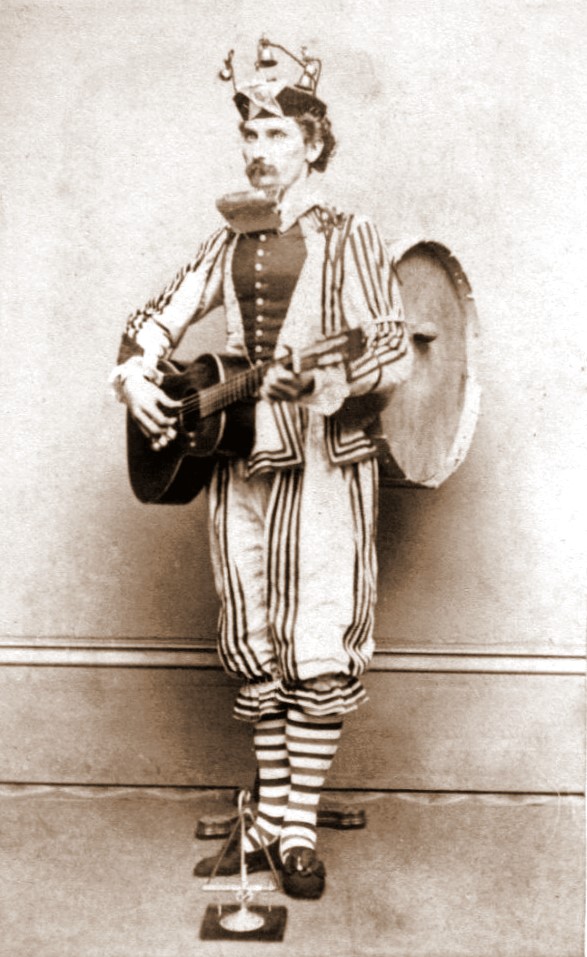
A one-man band is a musician who plays a number of instruments simultaneously using their hands, feet, limbs, and various mechanical or electronic contraptions. One-man bands also often sing while they perform.
The simplest type of "one-man band" is a singer accompanying themselves on acoustic guitar and playing a harmonica mounted in a metal "harp rack" below the mouth. This approach is often taken by buskers and folk music singer-guitarists. More complicated setups may include wind instruments strapped around the neck, a large bass drum mounted on the musician's back with a beater which is connected to a foot pedal, cymbals strapped between the knees or triggered by a pedal mechanism, tambourines and maracas tied to the limbs, and a stringed instrument strapped over the shoulders (e.g., a banjo, ukulele or guitar).
Since the development of Musical Instrument Digital Interface (MIDI) in the 1980s, musicians have also incorporated chest-mounted MIDI drum pads, foot-mounted electronic drum triggers, and electronic pedal keyboards into their set-ups. In the 2000s and 2010s, the availability of affordable digital looping pedals has enabled singer-musicians to record a riff or chord progression and then solo or sing over it.
The earliest known records of multiple musical instruments being played at the same time date from the 13th century, and were the pipe and tabor. The pipe was a simple three-holed flute that could be played with one hand; the tabor is more commonly known today as a snare drum. This type of playing can still be heard in parts of rural France, in England and Spain. An Elizabethan-era woodcut shows a clown playing the pipe and tabor. An 1820s watercolour painting shows a one-man band with a rhythm-making stick, panpipes around his neck and a bass drum and tambourine beside him. Henry Mayhew's history of London street life in the 1840s and 1850s described a blind street performer who played bells, the violin and accordions.
Guitarist Jim Garner played guitar with his hands and triangle with his feet, and Will Blankenship of the Blankenship family of North Carolina played harmonica, autoharp and triangle in shows during the 1930s. In the 1940s, entertainer and clown Benny Dougal used a crude "stump fiddle" (a single string stretched on a stick) with a footpedal-operated pair of cymbals. Blues singers such as "Daddy Stovepipe" (Johnny Watson) would sing, play guitar, and stomp their feet for rhythm, or used a foot pedal to play bass drum or cymbal.
One of the earliest modern exponents of multiple instruments was Jesse Fuller. Fuller developed a foot-operated bass instrument which he called the "footdella", which had six bass strings which were struck by hammers. In "one-man-band" shows, Fuller would use his "footdella", a footpedal-operated "sock" (hi-hat cymbal), a homemade neck harness (for a harmonica, kazoo and microphone), and a 12-string guitar. Fate Norris, of the Skillet Lickers, a hillbilly string band of the 1920s and early 1930s developed a geared mechanical contraption with footpedals that enabled him to play guitar, bells, bass fiddle, fiddle, autoharp and mouth harp.
Joe Barrick, who was born in Oklahoma in 1922, wanted a way of accompanying himself on fiddle, so he built a contraption with a guitar neck on a board with footpedals to operate the notes. Subsequent versions of this "piatar" also had bass guitar and banjo necks and a snare drum which are played by foot-operated hammers. To change notes on the guitar-family instruments, a foot treadle operates a mechanical fretting device. Two notable one-man blues bands active in Memphis in the 1950s were Doctor Ross and Joe Hill Louis, playing guitar, harmonica and bass drum/high-hat.
The simple guitar and harmonica combination (as used by such musicians as Tex Williams, Anton Newcombe, Jimmy Reed, Bob Dylan, Neil Young, and Ray Dorset of Mungo Jerry) is so common now that it is rarely considered to be a one-man band. British-born Don Partridge made the classic one-man band outfit (bass drum on the back, guitar and harmonica) famous in the streets of Europe, and was an early busker to enter the Top Ten of the UK Singles Chart, with his hit singles "Rosie" and "Blue Eyes" in 1968. Modern one-man bands include such performers as Hasil Adkins and Sterling Magee, better known as "Mister Satan," from Satan and Adam.[citation needed]
Hub AI
One-man band AI simulator
(@One-man band_simulator)
One-man band
A one-man band is a musician who plays a number of instruments simultaneously using their hands, feet, limbs, and various mechanical or electronic contraptions. One-man bands also often sing while they perform.
The simplest type of "one-man band" is a singer accompanying themselves on acoustic guitar and playing a harmonica mounted in a metal "harp rack" below the mouth. This approach is often taken by buskers and folk music singer-guitarists. More complicated setups may include wind instruments strapped around the neck, a large bass drum mounted on the musician's back with a beater which is connected to a foot pedal, cymbals strapped between the knees or triggered by a pedal mechanism, tambourines and maracas tied to the limbs, and a stringed instrument strapped over the shoulders (e.g., a banjo, ukulele or guitar).
Since the development of Musical Instrument Digital Interface (MIDI) in the 1980s, musicians have also incorporated chest-mounted MIDI drum pads, foot-mounted electronic drum triggers, and electronic pedal keyboards into their set-ups. In the 2000s and 2010s, the availability of affordable digital looping pedals has enabled singer-musicians to record a riff or chord progression and then solo or sing over it.
The earliest known records of multiple musical instruments being played at the same time date from the 13th century, and were the pipe and tabor. The pipe was a simple three-holed flute that could be played with one hand; the tabor is more commonly known today as a snare drum. This type of playing can still be heard in parts of rural France, in England and Spain. An Elizabethan-era woodcut shows a clown playing the pipe and tabor. An 1820s watercolour painting shows a one-man band with a rhythm-making stick, panpipes around his neck and a bass drum and tambourine beside him. Henry Mayhew's history of London street life in the 1840s and 1850s described a blind street performer who played bells, the violin and accordions.
Guitarist Jim Garner played guitar with his hands and triangle with his feet, and Will Blankenship of the Blankenship family of North Carolina played harmonica, autoharp and triangle in shows during the 1930s. In the 1940s, entertainer and clown Benny Dougal used a crude "stump fiddle" (a single string stretched on a stick) with a footpedal-operated pair of cymbals. Blues singers such as "Daddy Stovepipe" (Johnny Watson) would sing, play guitar, and stomp their feet for rhythm, or used a foot pedal to play bass drum or cymbal.
One of the earliest modern exponents of multiple instruments was Jesse Fuller. Fuller developed a foot-operated bass instrument which he called the "footdella", which had six bass strings which were struck by hammers. In "one-man-band" shows, Fuller would use his "footdella", a footpedal-operated "sock" (hi-hat cymbal), a homemade neck harness (for a harmonica, kazoo and microphone), and a 12-string guitar. Fate Norris, of the Skillet Lickers, a hillbilly string band of the 1920s and early 1930s developed a geared mechanical contraption with footpedals that enabled him to play guitar, bells, bass fiddle, fiddle, autoharp and mouth harp.
Joe Barrick, who was born in Oklahoma in 1922, wanted a way of accompanying himself on fiddle, so he built a contraption with a guitar neck on a board with footpedals to operate the notes. Subsequent versions of this "piatar" also had bass guitar and banjo necks and a snare drum which are played by foot-operated hammers. To change notes on the guitar-family instruments, a foot treadle operates a mechanical fretting device. Two notable one-man blues bands active in Memphis in the 1950s were Doctor Ross and Joe Hill Louis, playing guitar, harmonica and bass drum/high-hat.
The simple guitar and harmonica combination (as used by such musicians as Tex Williams, Anton Newcombe, Jimmy Reed, Bob Dylan, Neil Young, and Ray Dorset of Mungo Jerry) is so common now that it is rarely considered to be a one-man band. British-born Don Partridge made the classic one-man band outfit (bass drum on the back, guitar and harmonica) famous in the streets of Europe, and was an early busker to enter the Top Ten of the UK Singles Chart, with his hit singles "Rosie" and "Blue Eyes" in 1968. Modern one-man bands include such performers as Hasil Adkins and Sterling Magee, better known as "Mister Satan," from Satan and Adam.[citation needed]
Recent media