


Community hub
Recent from talks
Contribute something
Nothing was collected or created yet.
Street performance
View on Wikipedia

Street performance or busking is the act of performing in public places for gratuities. In many countries, the rewards are generally in the form of money but other gratuities such as food, drink or gifts may be given. Street performance is practiced all over the world and dates back to antiquity. People engaging in this practice are called street performers or buskers, although busker is generally not used in American English.[1][2]
Performances are anything that people find entertaining, including acrobatics, animal tricks, balloon twisting, caricatures, clowning, comedy, contortions, escapology, dance, singing, fire skills, flea circus, fortune-telling, juggling, magic, mime, living statue, musical performance, one man band, puppeteering, snake charming, storytelling or reciting poetry or prose, street art such as sketching and painting, street theatre, sword swallowing, ventriloquism, weightlifting and washboarding. Buskers may be solo performers or small groups.
Etymology
[edit]The term busking was first noted in the English language around the middle 1860s in Great Britain. The verb to busk, from the word busker, comes from the Spanish root word buscar, with the meaning "to seek".[3] The Spanish word buscar in turn evolved from the Indo-European word *bhudh-skō ("to win, conquer").[4] It was used for many street acts, and was the title of a famous Spanish book about one of them, El Buscón. Today, the word is still used in Spanish but mostly reserved for female street sex workers, or mistresses of married men.[citation needed]
History
[edit]

There have been performances in public places for gratuities in every major culture in the world, dating back to antiquity. For many musicians, street performance was the most common means of employment before the advent of recording and personal electronics.[5] Prior to that, a person had to produce any music or entertainment, save for a few mechanical devices such as the barrel organ, the music box, and the piano roll. Organ grinders were commonly found busking in the 19th century and early 20th century.
Busking is common among some Romani people. Romantic mention of Romani music, dancers and fortune tellers are found in all forms of song poetry, prose and lore. The Roma brought the word busking to England by way of their travels along the Mediterranean coast to Spain and the Atlantic Ocean and then up north to England and the rest of Europe.[citation needed]
In medieval France, buskers were known by the terms troubadours and jongleurs. In northern France, they were known as trouveres. In old German, buskers were known as Minnesingers and Spielleute. In obsolete French, it evolved to busquer for "seek, prowl" and was generally used to describe prostitutes. In Russia, buskers are called skomorokh, and their first recorded history appears around the 11th century.[citation needed]
Mariachis, Mexican bands that play a style of music by the same name, frequently busk when they perform while traveling through streets and plazas, as well as in restaurants and bars.[6]
We like playing for big crowds, and the goal all along has been for people to pay a little to come and see us. But it all started on street corners, and that is still very connected to what we do. It's such a validating musical experience. Busking is a very humble and brave act that takes courage to do well. It's also about the energy of music being alive outside in a city ... You can walk right by it right in front of you. Sure, to some people you're just another guy with his hand out, so sometimes busking can be great social barometer. You're able to gauge who you live with on earth.[7]
Around the mid-19th century Japanese Chindonya started to be seen using their skills for advertising, and these street performers are still occasionally seen in Japan. Another Japanese street performance form dating from the Edo period is Nankin Tamasudare, in which the performer creates large figures using a bamboo mat.
_p1.192_-_I_VIGGIANESI.jpg)
In the 19th century, Italian street musicians (mainly from Liguria, Emilia Romagna, Basilicata) began to roam worldwide in search of fortune. Musicians from Basilicata, especially the so-called Viggianesi, would later become professional instrumentalists in symphonic orchestras, especially in the United States.[8] The street musicians from Basilicata are sometimes cited as an influence on Hector Malot's Sans Famille.[9]
In the United States, medicine shows proliferated in the 19th century. They were traveling vendors selling elixirs and potions which purportedly improved people's health. They would often employ entertainment acts as a way of drawing in potential clients and relaxing them. The people would often associate this feeling of well-being with the products sold. After these performances, they would "pass the hat".[citation needed]
One-man bands have historically performed as buskers playing a variety of instruments simultaneously. One-man bands proliferated in urban areas in the 19th and early 20th centuries and still perform to this day. A current one-man band plays all their instruments acoustically usually combining a guitar, a harmonica, a drum and a tambourine. They may also include singing. Many still busk but some are booked to play at festivals and other events.[citation needed]
Folk music has always been an important part of the busking scene. Cafe, restaurant, bar and pub busking is a mainstay of this art form. The delta bluesmen were mostly itinerant musicians emanating from the Mississippi Delta region of the USA around the early 1940s and on. B.B. King is one famous example who came from these roots.[citation needed]

The counterculture of the hippies of the 1960s occasionally staged "be-ins", which resembled some present-day buskers festivals. Bands and performers would gather at public places and perform for free, passing the hat to make money. The San Francisco Bay Area was at the epicenter of this movement – be-ins were staged at Golden Gate Park and San Jose's Bee Stadium and other venues. Some of the bands that performed in this manner were Janis Joplin with Big Brother and the Holding Company, the Grateful Dead, Jefferson Airplane, Quicksilver Messenger Service, Country Joe and the Fish, Moby Grape and Jimi Hendrix.[citation needed]
Christmas caroling can also be a form of busking, as wassailing included singing for alms, wassail or some other form of refreshment such as figgy pudding. In the Republic of Ireland, the traditional Wren Boys, and in England Morris Dancing can be considered part of the busking tradition.[citation needed]
In India and Pakistan's Gujarati region, Bhavai is a form of street art where there are plays enacted in the village, the barot or the village singer also is part of the local entertainment scene.[citation needed]
In the 2000s, some performers have begun "Cyber Busking". Artists post work or performances on the Internet for people to download or "stream" and if people like it they make a donation using PayPal.[citation needed]
Forms
[edit]
There are three basic forms of street performance: circle shows, walk-by acts, and stoplight performances.
"Circle shows" are shows that tend to gather a crowd around them. They usually have a distinct beginning and end. Usually these are done in conjunction with street theatre, puppeteering, magicians, comedians, acrobats, jugglers and sometimes musicians. Circle shows can be the most lucrative. Sometimes the crowds attracted can be very large. A good busker will control the crowd so the patrons do not obstruct foot traffic.
"Walk-by acts" are acts where the busker performs a musical, living statue or other act that does not have a distinct beginning or end, and the public usually watches for a brief time. A walk-by act may turn into a circle show if the act is unusual or very popular.
"Stoplight performances" are performances in which performers present their act and get contributions from vehicle occupants on a crosswalk while the traffic lights are red. A variety of disciplines can be used in such a format (juggling, break dancing, even magic tricks). Because of the short period of time available to them, stoplight performers must have a very brief, condensed routine. This form is seen more commonly in Latin America than elsewhere.
Collecting money
[edit]Buskers collect donations and tips from the public in a variety of containers and by different methods depending on the type of busking they are performing. For walk-by acts, their open, empty instrument case or a special can, box, or hat is often used. For circle shows the performer will typically collect money at the end of the show, although some performers will also collect during the show, as some audience members do not stay for the entire performance.
Sometimes a performer will employ a bottler, hat man, or pitch man to collect money from the audience and encourage them to contribute, sometimes by cajoling them in a humorous fashion. The term bottler is a British term that originated from the use of the top half of a bottle to collect money. The bottle had a leather flap inserted in the bottleneck and a leather pouch attached. This design allowed coins to be put in the bottle but did not allow them to be removed easily without the coins jingling against the glass. The first use of such contrivances was recorded by the famous Punch and Judy troupe of puppeteers in early Victorian times.[10]
The increasing use of cashless payments in the 21st century, and the corresponding lessening of the amount of cash typically carried, has affected buskers, some of whom have begun using electronic payment systems including contactless payment terminals and web or app based payment systems (sometimes reachable by QR code). This trend accelerated after COVID-19 lockdowns, but predates this.[11][12]
Pitches
[edit]The place where a performance occurs is called a "pitch". A good pitch can be the key to success as a busker. An act that might make money at one place and time may not work at all in another setting. Popular pitches tend to be public places with large volumes of pedestrian traffic, high visibility, low background noise and as few elements of interference as possible. Good locations may include tourist spots, popular parks, entertainment districts including many restaurants, cafés, bars and pubs and theaters, subways and bus stops, outside the entrances to large concerts and sporting events, almost any plaza or town square as well as zócalos in Latin America and piazzas in other regions. Other places include shopping malls, strip malls, and outside supermarkets, although permission is usually required from management for these.
In her book, Underground Harmonies: Music and Politics in the Subways of New York, Susie J. Tanenbaum examined how the adage "Music hath charms to soothe the savage beast" plays out in regards to busking. Her sociological studies showed that in areas where buskers regularly perform, crime rates tended to go down, and that those with higher education attainment tended to have a more positive view of buskers than did those of lesser educational attainment.[13] Some cities encourage busking in particular areas,[14] giving preference to city government-approved buskers and even publishing schedules of performances.[15]
Many cities in the United States have particular areas known to be popular spots for buskers. Performers are found at many locations like Mallory Square in Key West, in New Orleans, in New York around Central Park, Washington Square, and the subway systems, in San Francisco, in Washington, D.C. around the transit centers, in Los Angeles around Venice Beach, the Santa Monica Third Street Promenade, and the Hollywood area, in Chicago on Maxwell Street, in the Delmar Loop district of St. Louis, and many other locations throughout the US. Busking is still quite common in Scotland, Ireland (Grafton Street, Dublin), and England with musicians and other street performers of varying talent levels.
Legislation
[edit]
The first recorded instances of laws affecting buskers were in ancient Rome in 462 BC. The Law of the Twelve Tables made it a crime to sing about or make parodies of the government or its officials in public places; the penalty was death.[16][17] Louis the Pious "excluded histriones and scurrae, which included all entertainers without noble protection, from the privilege of justice".[18] In 1530 Henry VIII ordered the licensing of minstrels and players, fortune-tellers, pardoners and fencers, as well as beggars who could not work. If they did not obey they could be whipped on two consecutive days.[19]
In the United States under constitutional law and most European common law, the protection of artistic free speech extends to busking. In the U.S. and many countries, the designated places for free speech behavior are the public parks, streets, sidewalks, thoroughfares and town squares or plazas. Under certain circumstances even private property may be open to buskers, particularly if it is open to the general public and busking does not interfere with its function and management allows it or other forms of free speech behaviors or has a history of doing so.[20]
While there is no universal code of conduct for buskers, there are common law practices that buskers must conform to. Most jurisdictions have corresponding statutory laws. In the UK busking regulation is not universal with most laws (if there are any) being governed by local councils.[21] Some towns in the British Isles limit the licenses issued to bagpipers because of the volume and difficulty of the instrument.[citation needed] In Great Britain places requiring licenses for buskers may also require auditions of anyone applying for a busking license.[citation needed] Oxford City Council have decided to enact a public spaces protection order. Some venues that do not regulate busking may still ask performers to abide by voluntary rules. Some places require a special permit to use electronically amplified sound and may have limits on the volume of sound produced.[22] It is common law that buskers or others should not impede pedestrian traffic flow, block or otherwise obstruct entrances or exits, or do things that endanger the public. It is common law that any disturbing or noisy behaviors may not be conducted after certain hours in the night. These curfew limitations vary from jurisdiction to jurisdiction. It is common law that "performing blue" (i.e. using material that is sexually explicit or any vulgar or obscene remarks or gestures) is generally prohibited unless performing for an adults-only environment such as in a bar or pub.
In London, busking is prohibited in the entire area of the City of London. The London Underground provides busking permits for up to 39 pitches across 25 central London stations.[23] Most London boroughs do not license busking, but they have optional powers, under the London Local Authorities Act 2000, if there is sufficient reason to do so. Where these powers have not been adopted, councils can rely on other legislation including the Environmental Protection Act 1990 to deal with noise nuisance from buskers and the Highways Act 1980 to deal with obstructions. Camden Council is currently looking into further options to control the problem of nuisance buskers and the playing of amplified music to the detriment of local residents and businesses.[24] The Westminster City Council banned busking in Leicester Square, previously a popular location, following a 2025 court ruling that busking was a "nuisance" and their repetitive performances were "psychological torture".[25]
Buskers may find themselves targeted by thieves due to the very open and public nature of their craft. Buskers may have their earnings, instruments or props stolen. One particular technique that thieves use against buskers is to pretend to make a donation while actually taking money out instead, a practice known as "dipping" or "skimming". George Burns described his days as a youthful busker this way:[26]
Sometimes the customers threw something in the hats. Sometimes they took something out of the hats. Sometimes they took the hats.
Notable performers
[edit]


- 5 Seconds of Summer, Australian pop rock band. Prior to achieving international fame, the band busked in Rouse Hill and other parts of Sydney.[27]
- Abby the Spoon Lady is a professional spoon player, street performer, and busking advocate who lives in Asheville, North Carolina.[28]
- Josephine Baker started street dancing to make money and was recruited for the St. Louis Chorus vaudeville show at the age of 15, which started her dancing career.
- Joshua Bell, a noted classical violinist, posed as a busker in the L'Enfant Plaza Metro station in Washington, D.C. at rush hour in 2007, as part of a feature in The Washington Post. In the 45 minutes that Bell played, only seven people out of over a thousand who passed by stopped to watch, and he took in just over $32. Gene Weingarten later won a Pulitzer Prize for the story.[29]
- Catfish the Bottleman a well-known busker from Sydney, Australia, so inspired Van McCann of Catfish and the Bottlemen that he named his band after him. He watched him perform as a child and said that it was his first memory of music.[30]
- Tracy Chapman began her career busking in Harvard Square in Cambridge, Massachusetts.
- Mike Doughty, former singer for Soul Coughing, released Busking, which contains 12 tracks from a 2007 busking performance in the 14th Street subway station in New York City.[31]
- Newton Faulkner has been known to busk and video footage of him busking has been made available on YouTube, including a full acoustic cover of Queen's "Bohemian Rhapsody".
- Benjamin Franklin, the American inventor and statesman, was a street performer. He composed songs, poetry and prose about current events and went out in public and performed them. He would then sell printed copies of them to the public. He was dissuaded from busking by his father who convinced him it was not worth the stigmas that some people attach to it. It was this experience that helped form his beliefs in free speech, which he wrote about in his journals.[5]
- G4, the British popera quartet, performed as buskers across London during their college days.[32][33]
- Mark Goffeney, aka 'Big Toe', known for playing guitar despite being born without arms.[34]
- Shannon Hoon, former singer for Blind Melon, was known to busk all over the U.S.[citation needed]
- Colin Huggins, a classical pianist who performs on a Steinway grand piano in Washington Square Park and other parks in Greenwich Village, New York City.[35]
- Henry Johnson (acrobat) (1806–1910), circus acrobat and street entertainer using acrobatics, tightrope-walking etc.
- Keytar Bear, a busker in Boston, Massachusetts, who wears a bear suit and plays a keytar.
- Guy Laliberté was a street performer when he founded the Cirque du Soleil theatrical company in 1984.[36]
- Loreena McKennitt, developing a passion for Celtic music, learned to play the Celtic harp and began busking at various places, including St. Lawrence Market in Toronto in order to earn money to record her first album.
- Edward McMichael was a celebrated street musician known as Seattle's "Tuba Man", who busked outside the city's various sports and performing arts venues. In 2008, he was killed by attackers who were attempting to rob him.
- Sterling Magee and Adam Gussow, AKA Satan and Adam, were busking on 125th Street in Harlem, New York City, in the summer of 1987 when the members of U2, accompanied by a film crew, paused to watch the blues duo. The scene later appeared in the film Rattle and Hum.[37]
- George Michael used to busk near the London Underground, performing songs such as '39 by Queen.[38]
- Peter Mulvey, the singer-songwriter, recorded an entire album down in the Boston subway, where he was a regular busker. In most cases, songs were recorded in one or two takes.[39]
- Kristyna Myles won the BBC Radio 5 Live Busker of the Year competition in 2005 and has gone on to sign a recording contract with Decca. Her debut album is due for release in September 2012.
- Paul Oscher, a famous Blues musician and harp player, has busked as "Brooklyn Slim" on the Venice Boardwalk to try out new material. Oscher, a two-time W.C Handy Award winner, was the harp player for Muddy Waters and his band in the late 1960s and early 1970s. He currently performs at blues festivals in the U.S. and internationally.
- Amanda Palmer, singer-songwriter, internet personality and founder of The Dresden Dolls started out performing as a living statue around the world.
- Don Partridge, an English singer and songwriter, known as the "king of the buskers". Achieved unexpected commercial success in the UK and Europe in the late 1960s with the songs "Rosie", "Blue Eyes" and "Breakfast On Pluto".
- Natalia Paruz, aka 'Saw Lady', who can be seen in movies such as Dummy and heard on many movie soundtracks, has been playing the musical saw in the New York City subway since 1994.[40]
- Surf/ska band the Red Elvises boosted their career by playing outside in Santa Monica, California, on the Third Street Promenade. Their manic performances attracted such large crowds that city officials asked them to stop.[41]
- Alice Tan Ridley, busked in New York City subway stations for 30 years; semi-finalist in America's Got Talent, mother of Gabourey Sidibe[42]
- Rodrigo y Gabriela, began their career by busking in Dublin, Ireland.
- Peg Leg Sam, a famous harmonica player from South Carolina, preferred busking over all other forms/venues. His most requested song was "John Henry".[citation needed]
- Daniel Seavey performed in the streets of Portland, Oregon, and subsequently joined boy band Why Don't We.
- Ketch Secor, whose group Old Crow Medicine Show started with busking and remains committed to it, has said: "People ... have short attention spans. ... So if you can get 'em to stop ... if you can get 'em to listen with a song, then you've got yourself a keeper."[43]
- The Piccadilly Rats, street performance group from Manchester, England
- Allie Sherlock sings on Grafton Street, Dublin
- Tuba Skinny, street band in New Orleans
- Rod Stewart began hanging around folk singer Wizz Jones and busking, at Leicester Square and other London spots in 1962.[44] On several trips over the next 18 months, Jones and Stewart took their act to Brighton and then to Paris, sleeping under bridges over the river Seine, and then finally to Barcelona.[44] Finally this resulted in Stewart being rounded up and deported from Spain for vagrancy during 1963.[44][45]
- Tash Sultana, an Australian singer-songwriter and multi-instrumentalist who busked on the streets of Melbourne.[46]
- SungBeats, a beatbox loop artist won the Amateur Night at the Apollo competition in 2014.
- Damo Suzuki, the singer of the band Can, was found by band members Czukay and Liebezeit busking outside a Munich café and was asked to perform with the band that same night.
- Tones and I, an Australian indie-pop singer-songwriter and musician.
- KT Tunstall, a popular Scottish singer, has been recorded busking in Glasgow.
- Nik Turner, former saxophonist with Hawkwind and Inner City Unit, continues to busk regularly in the streets of his adopted hometown Cardigan.
- T. Rex members Marc Bolan and Steve Peregrin Took first performed as an acoustic guitar/bongos duo when they went busking together in Hyde Park in summer 1967 after their electric equipment had been confiscated by Track Records and their two bandmates had both left. In this acoustic format, the duo would go on to release three albums.
- Unipiper, a performer in Portland, Oregon, is known for playing the bagpipes on a unicycle.
- Violent Femmes were discovered by James Honeyman-Scott (of The Pretenders) on 23 August 1981, when the band was busking on a street corner in front of the Oriental Theatre, the Milwaukee venue that The Pretenders would be playing later that night. Chrissie Hynde invited them to play a brief acoustic set after the opening act.
- Yamunabai Waikar, decorated Indian folk–Lavani–Tamasha artist busked with her mother as a child.[47]
- Billy Waters, a one-legged busker who rose to prominence in London during the nineteenth century.
- Hayley Westenra at one time busked on the streets of Christchurch, New Zealand.[48]
- The NYC BuskerBall; BuskerBall.com, is an annual event showcasing the worlds best buskers, NYC Buskerball INC is a registered non for profit (501(c)(b) that strives to educate the public on the art of busking and stages an annual festival in Brooklyn.
Gallery
[edit]-
 German street performers play for pedestrians in 1948
 -
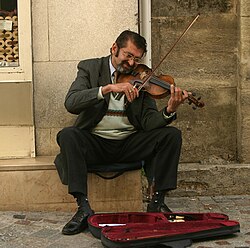 Classical fiddler in Arles, France
 -
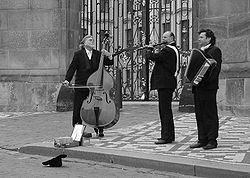 A street performance trio on their pitch outside Prague Castle
 -
 Mother and son busking in Lhasa, Tibet, 1993
 -
 Acrobat jumping over volunteers in Washington, D.C.
 -
 Violinist in Sutton High Street, Sutton, London
 -
 Street performer using a fire devilstick in São Paulo, Brazil
 -
 Street musician playing congas, Ann Arbor, Michigan
 -
 Street performer at Špancirfest, Croatia
 -
 Saxophonist in Balboa Park, San Diego


.jpg)


See also
[edit]
References
[edit]- ^ "Busker" Merriam-Webster Dictionary. Quote: "chiefly British"
- ^ "Busker" Cambridge Dictionary. Quote: "mainly UK"
- ^ "busker" Archived 27 September 2007 at the Wayback Machine Definition from the Merriam-Webster Online Dictionary
- ^ "buscar", Diccionario de la Lengua Española (in Spanish) (23rd ed.), Real Academia Española
- ^ a b Baird, Stephen (2000)."The History and Cultural Impact of Street Performing in America: Ben Franklin". Street Performers and Buskers Advocates. Retrieved 2010-06-10.
- ^ "mariachi" Definition from the Merriam-Webster Online Dictionary
- ^ Ferris, Jedd (25 September 2008). "Catching Up With ... Old Crow Medicine Show". Paste. Retrieved 28 September 2012.
- ^ International Council for Traditional Music, Report from the International Meeting of the International Council for Traditional Music's Study Group on Folk Musical Instruments, Volume 11, Musikmuseet, 1992, p. 54
- ^ Eva Bonitatibus. "L'arpa perduta - L'identità dei musicanti girovaghi" (PDF) (in Italian and English). consiglio.basilicata.it. Retrieved 22 June 2016.
- ^ Somerville, Chris (1997). "Who is Mr Punch". punchandjudy.com. Archived from the original on 24 February 2023. Retrieved 14 June 2010.
- ^ Wollaston, Sam (8 November 2018). "Where the streets have no change: how buskers are surviving in cashless times". The Guardian. Retrieved 16 August 2024.
- ^ Shular, Emma (8 March 2023). "Buskers change their tune with digital payments and promotion". Langara Voice. Retrieved 16 August 2024.
- ^ Tanenbaum, Susie, J. (1995). Underground Harmonies: Music and Politics in the Subways of New York. Google books; Cornell University Press. ISBN 0-8014-8222-4
- ^ Startz, Dick (25 May 2005). "What this town needs is a little street music". uwnews.org. University of Washington News and Information. Archived from the original on 4 April 2008.
- ^ MTA: Arts for Transit: Music Under New York. mta.info; Metropolitan Transportation Authority, New York. Retrieved 2016-07-15.
- ^ (Cohen and Greenwood 1981: 14) Smith, Murray (1996). Traditions, Stereotypes, and Tactics:: A History of Musical Buskers in Toronto. cjtm.icaap.org; Canadian Journal for Traditional Music. Retrieved 2010-06-10.
- ^ Blue, Niceol (27 June 2006). A History of Busking Archived 15 June 2006 at the Wayback Machine Pike Market Performer's Guild. Retrieved 2010-06-11.
- ^ (Krickeberg 1983 : 24). Smith, Murray (1996). Traditions, Stereotypes, and Tactics:: A History of Musical Buskers in Toronto. cjtm.icaap.org; Canadian Journal for Traditional Music. Retrieved 2010-06-10.
- ^ (Krickeberg 1983 : 62. Smith, Murray (1996). Traditions, Stereotypes, and Tactics:: A History of Musical Buskers in Toronto. cjtm.icaap.org; Canadian Journal for Traditional Music. Retrieved 2010-06-10.
- ^ Berger v. Seattle, C03-3238JLR (PDF). Decision, U.S. District Court, Western District of WA at Seattle, 22 April 2004. Retrieved 2010-06-11.
- ^ Why, Who (July 2014). "Who, what, why: Where is the hardest place in the UK to be a busker?". BBC News. Retrieved 9 October 2014.
- ^ "Street Performances in New York". 411newyork.org. 16 July 2007. Retrieved 19 July 2012.
- ^ Transport For London, Busking
- ^ Appleton, Natalie (7 February 2010). "The Big Busk: London Busking Explained". The London Insider. Archived from the original on 13 February 2010. Retrieved 15 June 2010.
- ^ Wolfe, Jonathan (18 April 2025). "'Psychological Torture': London Bans Busking in a Famed Tourist Hub". The New York Times. Retrieved 10 July 2025.
- ^ The Ultimate Cigar Aficionado: Ninety-eight-year-old George Burns Shares Memories of His Life Archived 7 March 2010 at the Wayback Machine , article and interview by Cigar Aficionado Online
- ^ Murray, Oliver (1 August 2014). "Video surfaces of band's humble beginnings". Daily Telegraph. Retrieved 26 August 2020.
- ^ "Living Portrait series: The Spoon Lady". Citizen Times. Retrieved 25 January 2017.
- ^ weingarten, Gene (April 8, 2008) "Pearls Before Breakfast: Can one of the nation's great musicians cut through the fog of a D.C. rush hour? Let's find out" The Washington Post
- ^ "Catfish and the Bottleman reveal touching Aussie story behind their band name". abc.net.au. Retrieved 3 July 2015.
- ^ "Mike Doughty". Archived from the original on 14 May 2011. Retrieved 26 November 2009.
- ^ "Classical group G4 announce split". 6 April 2007. Retrieved 12 September 2016 – via bbc.co.uk.
- ^ metrowebukmetro (24 February 2008). "X Factor star tops classical charts". Retrieved 12 September 2016.
- ^ "Mark Goffeney — There's No Business Like Toe Business". ABILITY Magazine. 2010. Archived from the original on 22 July 2022. Retrieved 2 September 2023.
- ^ Alex Vadukul (16 July 2020). "It's a Tough Time to Be a Street Musician With a 900-Pound Piano". The New York Times. Retrieved 6 November 2021.
- ^ From Busker To Billionaire: How Guy Laliberté Achieved Success EvanCarmichael.com.
- ^ Modern Blues Harmonica (6 March 2007). "Satan and Adam – Harlem, 1987 (in U2's Rattle and Hum)". Archived from the original on 7 November 2021. Retrieved 12 September 2016 – via YouTube.
- ^ A Night At The Opera Archived 10 May 2015 at the Wayback Machine QueenZone.com Retrieved 23 January 2013
- ^ Hansen, Liane (22 September 2002). "The Subterranean World of Peter Mulvey". Weekend Edition. National Public Radio. Retrieved 13 June 2010.
- ^ "Natalia Paruz, musical saw Player". subwaymusicblog.com (Vimeo). 15 March 2011. Retrieved 9 April 2011.
- ^ "Red Elvises". San Antonio. November 2023. Retrieved 25 January 2024.
- ^ "After Years Underground, a Subway Singer Gets the Spotlight" by Susan Hartman, The New York Times, 16 September 2016
- ^ Parton, Chris (19 July 2012). "Old Crow Medicine Show Carries Traditional Country New Album, Carry Me Back, Takes a Somber Approach". CMT News. Archived from the original on 22 July 2012. Retrieved 25 September 2012.
- ^ a b c Ewbank and Hildred, Rod Stewart: The New Biography, pp. 24–28.
- ^ Pareles, Jon; Romanowski, Patricia (1983). The Rolling Stone Encyclopedia of Rock & Roll. Rolling Stone Press/Summit Books. p. 530. ISBN 978-0-671-43457-1.
- ^ Lucy Cormack (19 October 2016). "Tash Sultana review: Welcome to the jungle of the one woman band". Sydney Morning Herald. Retrieved 26 January 2017.
- ^ "A tearjerker from Wai" by Navami Naik, The Times of India, 11 February 2002
- ^ Hayley Westenra Biography Archived 27 January 2010 at the Wayback Machine askmen.com; IGN Entertainment.
External links
[edit]

Organisations
- World Street Music – international project about street musicians
- Busker Central Calendar of worldwide busking events
- National Association of Street Artists UK
- Street Arts
- Photographs of buskers around the world by Tudor ApMadoc
- The Busking Project, celebrating and supporting buskers across the world.
Press
- "Striving to make music under the NYC streets". Daniel Strieff and Jon Sweeney. 24 August 2004. MSNBC.
- "What the ailing record industry can learn from a successful subway musician". Nicholas Thompson. December 2003. Washington Monthly.
- "The Real Piano Man" Steven Kurutz, 30 August 2008. The New York Times.
Other
- McKay, George (2007). "'A soundtrack to the insurrection': street music, marching bands and popular protest". Parallax. 13 (1): 20–31. doi:10.1080/13534640601094817. S2CID 143754205.
- Bennett, Elizabeth, and McKay, George. 2019. From Brass Bands to Buskers: Street Music in the UK. Norwich: AHRC/UEA. doi:10.13140/RG.2.2.18521.98408

Street performance
View on GrokipediaOrigins and Terminology
Etymology and Definition
Street performance, also known as busking, constitutes the practice of providing entertainment—such as music, juggling, magic, mime, or acrobatics—in public spaces for voluntary gratuities, primarily in the form of monetary tips from passersby.[9] This form of performance relies on spontaneous audience interaction without fixed venues or admission fees, distinguishing it from staged theater or concerts.[10] The term "busking" emerged in English slang around 1851, initially referring to performing music or comedy in public thoroughfares or taverns to solicit donations.[9] Its etymology traces to roots connoting "seeking" or "wandering," likely from the Spanish buscar ("to seek"), reflecting the performer's pursuit of alms or rewards, though alternative derivations include obsolete French busquer ("to prowl") or Italian buscare with similar implications of foraging.[11] Earlier uses of "busk" in the 17th century may link to piratical "cruising" for plunder, paralleling the itinerant hustler's quest for livelihood.[12] By the mid-19th century, "busker" denoted the itinerant entertainer, solidifying the association with street-level, tip-dependent artistry.[12]Historical Evolution
Ancient and Pre-Modern Roots
In ancient Egypt, performances akin to street entertainment, including clownish acts, are attested in royal court records dating to around 2500 BCE, with public displays likely extending to festivals and marketplaces as part of broader communal rituals.[13] Similar practices appeared in ancient Greece and India, where itinerant performers entertained in public squares during religious and civic gatherings, though specific archaeological evidence remains sparse.[14] The most documented early instances in the Western tradition occurred in ancient Rome, where street performers—encompassing jugglers, acrobats, musicians, mimes, and dancers—filled urban thoroughfares, plazas, and provincial markets with impromptu shows to solicit gratuities from passersby.[15] Contemporary accounts, such as those by Dio Chrysostom in the 1st-2nd century CE, describe flute players, singers, harpists, and dancers performing openly in Roman streets, often amid the city's bustling commerce.[16] The earliest known legal reference to such activity appears in Rome's Lex Duodecim Tabularum (Laws of the Twelve Tables) of 451 BCE, which regulated public performances to maintain order during festivals.[11] These acts proliferated during agricultural and religious festivals like the Lupercalia and Saturnalia, where performers drew crowds in temporary open-air settings, blending entertainment with ritual elements.[17] Transitioning into medieval Europe (circa 500–1500 CE), street performance evolved through itinerant entertainers such as minstrels, troubadours, jugglers, and puppeteers, who roved between towns and villages, performing ballads, feats of dexterity, and satirical skits in marketplaces and fairgrounds for coin or food.[8] Guilds and municipal authorities began formalizing roles by the late 14th century; for instance, from around 1370, European cities like those in Italy (with piffari) and Germany employed official town pipers and minstrels as salaried public performers, tasked with signaling events, accompanying processions, and entertaining citizens in streets during civic duties.[18] These practitioners often operated on the fringes of society, facing sporadic ecclesiastical bans on profane acts but persisting due to demand for accessible diversion in agrarian communities lacking fixed theaters.[19] By the Renaissance (14th–17th centuries), urban growth in places like Florence and London amplified such traditions, with commedia dell'arte troupes and folk acrobats adapting to expanding public spaces, though performances remained unregulated and vulnerable to vagrancy laws.[20]Modern Developments (18th-20th Centuries)
![Eugène Atget, Organ-grinder, 1898–99][float-right] In the 18th century, street performance in Europe evolved from earlier itinerant traditions toward more defined urban practices, with performers often operating as individuals rather than troupes. In London, glove-puppet shows featuring Punch and Judy emerged late in the century, drawing on Italian commedia dell'arte influences and incorporating slapstick violence and satire that appealed to crowds in public spaces.[21] These performances, typically announced by the puppeteer's drum or panpipes, became fixtures at fairs and street corners, reflecting a blend of folk entertainment and social commentary amid growing city populations.[21] The 19th century marked a peak in street performance due to rapid urbanization and immigration, particularly in industrial centers like London and New York. Organ grinders, often Italian immigrants using hand-cranked barrel organs introduced around the 1700s, proliferated as a novel mechanical form of busking, sometimes accompanied by trained monkeys to draw tips from passersby.[22] [23] By mid-century, complaints about noise led to regulatory efforts, such as London's 1864 campaign by composer Henry Mayhew to curb "street nuisances," resulting in partial silencing of musicians in the City of London.[3] Punch and Judy shows remained ubiquitous on British streets, with puppeteers like those documented in seaside towns sustaining the form through the Victorian era despite moral critiques of its violent content.[21] Into the early 20th century, street performance faced decline from competing entertainments like music halls, cinemas, and radio, alongside stricter urban ordinances. Organ grinding persisted in cities until bans, such as New York City's 1935 prohibition on street organs, which effectively ended the practice nationwide by curtailing immigrant musicians' livelihoods.[24] In Europe, post-World War I economic pressures and noise abatement laws further marginalized buskers, though isolated instances, like German street musicians entertaining pedestrians in 1948, highlighted residual traditions amid reconstruction.[25] Overall, the period saw a shift from unregulated ubiquity to controlled rarity, driven by technological alternatives and civic priorities favoring quiet public order over spontaneous artistry.[3]Post-1960s Revival and Contemporary Trends
The resurgence of street performance after the 1960s was closely tied to the countercultural movements of the era, particularly the folk music revival and anti-war protests, which encouraged public expressions of amateur and guerrilla theater as forms of dissent against established authority.[20] During the late 1960s, American protesters utilized street performances, including guerrilla theater, to challenge the Vietnam War, transforming urban spaces into platforms for political expression and fostering a renewed tolerance for unscripted public artistry.[26] In the 1970s, this momentum materialized in structured revivals, notably in London where community efforts against urban redevelopment in Covent Garden incorporated street theater to preserve the area's vibrancy, culminating in the first organized street theatre season in 1975 led by figures like Julia Pinhorn.[27] By the late 1970s, Covent Garden evolved into a formalized hub for buskers with designated pitches, marking a shift from sporadic acts to professionalized performances that drew crowds and influenced global models for managed street entertainment zones.[28] Contemporary trends reflect broader globalization and technological integration, with street performers increasingly employing loop pedals and portable amplification to create layered, one-person band effects, enhancing complexity while navigating amplification restrictions in many tourist districts.[8] Busking has become integral to urban tourism, as evidenced by field experiments showing that musical street performances increase perceptions of safety and activity in public spaces, drawing longer viewer dwell times—averaging 4.2 minutes for groups versus 1.8 for individuals—and boosting local foot traffic by up to 20% in tested areas.[2] Regulations have evolved with this growth, featuring audition-based licensing in cities like Edinburgh and New York to balance performer access with noise and congestion controls, though enforcement varies, with some locales reporting over 1,000 annual busking permits issued to sustain economic contributions estimated at millions in visitor spending.[14] Digital tools, including social media for promotion and live-streaming donations, further hybridize the practice, allowing performers to amplify reach beyond physical pitches while maintaining the core gratuity-based model.Performance Forms and Practices
Core Techniques and Acts
Street performances rely on a range of acts that demand physical dexterity, showmanship, and direct audience engagement to succeed in transient public settings. Musical performances form the most prevalent category, featuring solo instrumentalists or small ensembles playing acoustic guitars, violins, saxophones, or multi-instrument setups to captivate passersby with familiar tunes or improvisations.[8] Juggling, acrobatics, and fire manipulation constitute visual spectacle acts, often involving routines with balls, clubs, or devilsticks that escalate in complexity to build tension and applause.[29][30] Magic and sleight-of-hand tricks exploit misdirection and audience challenges, such as shell games, to foster interaction and wonder.[31] Comedy, mime, clowning, and living statues emphasize physicality and timing, with performers holding poses or enacting silent narratives until tipped for movement.[8][31] Less common variants include dance ensembles, poetry recitals, or hybrid forms blending music with comedy or props.[8] Core techniques center on the "circle show" format, prevalent in acts like juggling or magic, where performers demarcate a bounded space with rope or cones to corral spectators into a semi-circle, optimizing visibility and containment of crowds.[29][30] Routines follow a structured progression: initial crowd-gathering via prop displays or simple feats to spark curiosity, followed by an opener routine, mid-show engagement through humor or volunteers, a climactic "impossible" trick with deliberate tension (e.g., feigned drops), and concluding tip collection.[29] Audience interaction proves essential, incorporating eye contact, sing-alongs, or volunteer participation to convert passive onlookers into invested participants, while hat lines—humorous pleas like "Help keep starving jugglers on the streets"—prompt donations post-performance.[8][29] Performers cultivate stamina, improvisation, and vocal projection to sustain 10- to 20-minute sets amid distractions, adapting to hecklers or disruptions through character-driven banter.[29] Portable, reliable equipment and site-specific adaptations, such as leveraging acoustics for music or environmental props for site-specific work, further refine execution.[8][31]Audience Engagement and Monetization
Street performers engage audiences through direct interaction, including eye contact, smiles, and enthusiastic demeanor to foster connection and encourage stopping.[32] Performers often employ humor, banter between acts, and audience requests to maintain interest and build rapport, creating a lively atmosphere that heightens emotional and intellectual responses.[8] [2] Social proof, such as initial crowd formation, draws more onlookers by signaling an established event, with performers greeting passersby to outline viewing areas and sustain participation.[33] [34] Monetization relies primarily on voluntary tips collected via hat passes, open containers, or digital methods like QR codes, where engaged crowds yield higher donations through repeated mentions of contributions during performances.[29] [35] Strategies include selecting high-traffic pitches with visible tip receptacles, playing familiar material to appeal broadly, and selling merchandise such as recordings or branded items to supplement earnings.[36] [37] Field experiments indicate that strong audience experiences—encompassing novelty, interaction, and emotion—mediate positive perceptions of public spaces, indirectly supporting sustained tipping by enhancing performer visibility and appeal.[2] [1] Studies on audience attitudes reveal that interactive elements, like performer-audience dialogue, correlate with increased tipping motivations, as viewers respond to perceived effort and entertainment value in live settings.[38] Effective crowd-building over 15 to 30 minutes in pedestrian-heavy areas maximizes exposure, with performers adapting acts to local demographics for optimal financial returns.[39]Legal and Regulatory Landscape
Historical Controls and Bans
The earliest recorded regulations on street performance date to ancient Rome, where the Laws of the Twelve Tables, enacted around 451 BC, imposed restrictions on performers, likely to maintain public order and distinguish licensed entertainment from unlicensed solicitation.[11] These laws reflected concerns over vagrancy and disruption in urban spaces, associating itinerant entertainers with beggars.[17] In medieval Europe, ecclesiastical authorities often condemned street performers as promoters of immorality and idleness, linking minstrels and bards to vice and carnal temptation, which led to informal bans or social ostracism rather than codified laws.[17] During the Puritan era in 17th-century England, performances not aligned with religious edification were prohibited, confining busking to marginalized groups such as the urban poor or disabled, under broader suppression of secular entertainment.[17] By the 19th century, urban industrialization prompted stricter controls amid rising noise complaints and vagrancy fears. In London, the Metropolitan Police Act of 1839, Section 54, prohibited the use of noisy instruments in public for gathering crowds or soliciting alms within the Metropolitan Police District, effectively curbing many forms of street music to preserve tranquility.[40] This was reinforced by the Street Music (Metropolis) Act of 1864, which empowered householders to demand the cessation of performances disturbing their rest or work, targeting instruments like barrel organs amid widespread petitions against auditory nuisances.[3] In the United States, colonial-era vagrancy statutes, derived from English poor laws, criminalized "idle" persons without visible means of support, frequently ensnaring buskers perceived as beggars and subjecting them to arrest, fines, or confinement in poorhouses.[41] Such laws persisted into the 20th century, with New York City Mayor Fiorello La Guardia revoking busking licenses in 1936, imposing a de facto ban until its partial lift in 1970, justified by public order and economic displacement during the Great Depression.[26] These historical measures stemmed from causal tensions between spontaneous public expression and demands for regulated urban environments, where performers' reliance on voluntary gratuities blurred lines with begging, prompting authorities to prioritize resident complaints over artistic freedom.[4] Enforcement varied, but consistently reflected elite biases against lower-class entertainers, often conflating performance with poverty or disruption without empirical assessment of net societal value.[42]Current Laws and Enforcement
Street performance regulations vary widely by jurisdiction, typically emphasizing public order, noise control, and unobstructed access to sidewalks rather than outright bans. In the United States, busking is protected under the First Amendment as expressive activity, but local governments impose time, place, and manner restrictions through ordinances. Cities often require permits for amplified performances or designated zones to mitigate congestion; for instance, New York City mandates approval for subway performances via the Metropolitan Transportation Authority, while street rules focus on avoiding pedestrian blockage. Enforcement generally begins with verbal warnings from police or code officers, escalating to citations with fines ranging from $100 to $1,000 for repeat violations of noise limits or permit non-compliance, as seen in cases challenging overly broad restrictions in Chicago and Alexandria.[43][44] In the United Kingdom, local councils administer busking schemes, many requiring performers to register, audition, or adhere to codes of conduct specifying pitch allocations and volume limits to prevent disputes over prime locations. Performers must provide identification and proof of eligibility, such as National Insurance numbers for UK residents or work permits for non-EU citizens; non-compliance can result in instrument seizure or fines up to £1,000 under public nuisance laws. Enforcement relies on community reports and patrols, with authorities prioritizing de-escalation but applying penalties for persistent amplification or aggressive tipping solicitation, as in Edinburgh's tourist areas where unamplified acts are mandated.[45][46] Across Europe, regulations differ by country and municipality, with no uniform EU-wide framework; performers in France and Germany often operate without formal permits if avoiding obstruction, but face begging statutes or noise bylaws carrying fines of €35 to €750. In Spain and Italy, municipal bylaws designate busking zones and cap performance durations to manage crowds, enforced via municipal police who issue on-site warnings or evictions for violations. Broader enforcement trends highlight selective application, with higher scrutiny in high-tourism zones to balance artistic expression against commercial impacts, though court rulings in nations like Ireland have struck down overly restrictive licensing as disproportionate.[47] Globally, enforcement challenges include inconsistent application, where performers report arbitrary interventions influenced by local biases or tourism priorities, prompting advocacy for clearer guidelines. In contrast to stricter Asian contexts like Indonesia's €4,500 fines and jail terms for unlicensed busking, Western enforcement favors graduated responses to preserve public access while accommodating performers.[48]Constitutional and Rights-Based Conflicts
Street performances in public spaces frequently give rise to conflicts between performers' claims to constitutional protections for expressive conduct and governmental interests in regulating public order, noise, and traffic flow. In the United States, busking qualifies as protected speech under the First Amendment, encompassing both verbal and nonverbal elements like music and physical acts, as public sidewalks constitute traditional public forums where content-neutral time, place, and manner restrictions must be narrowly tailored to serve significant interests without undue burden on expression.[4][44] Courts have invalidated ordinances that impose prior restraints, such as mandatory permits applied selectively to performers but not other speakers, deeming them unconstitutional under standards established in cases like Forsyth County v. Nationalist Movement (1992), which prohibit licensing schemes granting officials unbridled discretion.[49] Litigation has centered on amplification restrictions, with inconsistent rulings but a trend toward recognizing performers' rights to use devices like speakers when alternatives like passive solicitation fail to convey messages effectively; absolute bans fail strict scrutiny if they suppress core speech without evidence of unavoidable harm, as seen in challenges to Chicago's 1983 Street Performance Ordinance in Friedrich v. City of Chicago (1985), where plaintiffs successfully contested manner-based limits lacking narrow tailoring.[50][5] In ACLU v. City of Sedalia (2013), a Missouri federal court issued an injunction against geographic and enforcement restrictions, affirming performers' access to public locations without content-based exclusions, thereby expanding venues beyond designated zones.[51] Similar disputes in Clark County, Nevada, highlight ongoing tensions, where ordinances prohibiting stationary performances conflict with ambulatory allowances for other activities, prompting ACLU-backed challenges arguing viewpoint discrimination.[52] Content-based regulations exacerbate conflicts, as in Houston's ordinance limiting busking to theater districts, which courts view as favoring certain artistic expressions over others, violating equal protection and free speech clauses by not applying uniformly to comparable activities like political rallies.[53] A Ninth Circuit ruling in Berkeley Community Action v. City of Berkeley (2009) influenced cases like Seattle's, striking down performer-specific rules that permitted other amplified speech, underscoring that regulations must avoid targeting artistic content to withstand intermediate scrutiny.[54] These rulings reflect a causal tension: while empirical data on noise complaints justifies some controls, overbroad enforcement risks chilling spontaneous expression, with studies indicating buskers' economic reliance on public access amplifies the stakes.[55] Internationally, analogous rights-based disputes invoke freedom of expression under frameworks like the European Convention on Human Rights (Article 10), though fewer litigated cases exist; in the UK, amplification bans in areas like Edinburgh have faced criticism for disproportionate interference, mirroring U.S. prior restraint concerns without equivalent constitutional overrides.[50] Performers' victories often hinge on demonstrating that alternatives, such as unamplified acts, inadequately protect the expressive interest, prioritizing empirical evidence of minimal disruption over blanket prohibitions.[55]Economic Realities
Earnings Potential and Financial Viability
Earnings for street performers vary significantly based on location, performance quality, audience demographics, weather, and time of day, often rendering the activity financially precarious as a primary income source. In high-traffic tourist areas, skilled performers can earn £70 to £200 per day in London spots like Leicester Square, Trafalgar Square, or Westminster Bridge, though these figures represent exceptional cases amid intense competition for pitches.[56] In Covent Garden, daily takes fluctuate from £10 to £100, influenced by short audience attention spans and the shift toward cashless payments, which reduces spontaneous donations.[57] Aggregated U.S. data estimates an average hourly rate of $21.70 for street performers, implying potential daily earnings of $100–$200 for several hours of work, but this encompasses outliers and does not account for downtime or inconsistent crowds.[58] Empirical studies highlight genre and contextual factors boosting yields. A 2021 field experiment in the Netherlands found buskers averaging €35 per hour on Sundays, rising to €45 with child involvement due to heightened paternalistic responses from passersby; classical music yielded €27 per hour versus €11 for rock, jazz, or pop, with cold weather amplifying donations on Sundays by fostering sympathy.[59] [60] These patterns underscore causal drivers like perceived cultural value and environmental cues over mere volume of foot traffic. Annual incomes for street musicians range from $1,000 to over $100,000, reflecting a skewed distribution where top earners in prime locations dominate, while most subsist below poverty thresholds without supplementary income.[60] Financial viability remains limited for the majority, as earnings depend on unregulated variables like seasonal tourism and economic conditions, lacking benefits such as health insurance or retirement savings typical of formal employment. Many performers treat busking as supplemental or promotional, with full-time reliance described as "precarious" even in viable hubs like Edinburgh's Royal Mile, where some report higher returns than structured tours but still face unpredictability.[57] Regulations, including pitch auctions and amplification bans, further constrain access to lucrative sites, often favoring established acts and diminishing overall sustainability.[57] Online extensions, such as donation platforms, offer marginal supplements but fail to replicate street dynamics, with data from platforms like The Busking Project showing dispersed micro-donations insufficient for stability.[61]Broader Market Dynamics and Local Impacts
Street performance integrates into broader entertainment market dynamics characterized by high variability in performer earnings and competition from formalized venues, online streaming platforms, and digital tipping alternatives. Full-time buskers in optimal urban locations may earn between $20,000 and $50,000 annually, though daily income fluctuates significantly, with reports of $98 for two hours on low nights and higher peaks during tourist seasons or events.[8][62] The shift toward cashless societies has disrupted traditional donation models, prompting performers to adopt QR codes, apps, and online platforms like The Busking Project for revenue, as cash usage declines globally.[63][61] This adaptation reflects causal pressures from economic changes, including reduced physical cash handling post-2010s, which has forced innovation but also widened income gaps between tech-savvy performers and others.[64] Locally, street performances often boost foot traffic and tourism by drawing crowds to public spaces, thereby stimulating adjacent spending at businesses; for instance, in revitalization efforts, U.S. cities have subsidized performers at up to $100 per hour since 2023 to counteract post-pandemic downtown vacancies and enhance economic vitality.[65] However, these activities can impose costs on local commerce through sidewalk congestion, noise, and perceived distractions that deter customers, leading businesses in areas like San Francisco's Fisherman's Wharf to lobby for restrictions as early as the 2010s.[66] Empirical observations indicate that while performers enhance urban vibrancy and indirect revenue via increased pedestrian presence, unregulated clustering risks negative externalities such as reduced accessibility for retail patrons and uncollected taxes on unreported earnings, contributing to societal welfare losses.[60][67] In gentrifying districts, tensions arise as rising property values amplify complaints from residents and owners viewing performances as quality-of-life detractors rather than assets.[68]Societal Role and Controversies
Cultural Contributions and Public Benefits
Street performance has historically served as a vehicle for cultural preservation and dissemination, originating in antiquity across civilizations such as Ancient Egypt, Rome, Greece, and India, where performers provided live entertainment as a primary means of artistic expression before modern recording technologies.[14] This tradition continues as a global staple of urban culture, showcasing local artists and maintaining diverse musical and performative practices in public settings, as evidenced by the London Underground's allocation of approximately 100,000 hours of annual busking time for over 3.5 million daily passengers.[69] Empirical research confirms that street performances enhance the environmental perception of public spaces, increasing perceived visitability, restorativeness, and preference among observers. In an online experiment involving 748 participants exposed to visuals of 12 public space types with and without buskers, ratings showed statistically significant improvements (p < 0.001) in visitability (mean increase 0.63), restorativeness (0.38), and preference (0.78).[70] A complementary field study in Hong Kong with 162 participants further demonstrated higher restorativeness scores in the presence of performers (mean 4.19 vs. 3.80, p = 0.016), with engaged audiences reporting even stronger positive effects compared to disengaged passersby (e.g., visitability p = 0.003).[70] Beyond perceptual enhancements, street performance fosters community vitality by transforming impersonal urban areas into interactive hubs, encouraging social connections such as spontaneous dancing or shared listening experiences, and acting as "eyes on the street" to promote perceived safety.[14] As a low-cost intervention requiring no infrastructure, it delivers high-impact rejuvenation of city centers, countering homogenization and bolstering cultural identity, as seen in self-regulated busking scenes in Glasgow's Buchanan Street and Melbourne's street auditions that ensure safe, vibrant public entertainment accessible to all socioeconomic groups.[71]Criticisms, Nuisances, and Social Costs
Street performances frequently elicit complaints about noise pollution, as amplified music or prolonged acts can disturb nearby residents and businesses. In the United Kingdom, local councils have intensified enforcement against buskers cited for excessive volume, with prosecutions rising due to resident reports of auditory intrusion disrupting daily life and commerce.[72] Regulations in areas like Fort Myers Beach, Florida, explicitly require performers to comply with noise ordinances, prohibiting artificial amplification to mitigate such disturbances.[73] Physical encroachments from crowds and equipment pose additional nuisances, obstructing pedestrian flow and access to public spaces. Observers have noted that performances can create auditory and spatial overload, reducing the usability of sidewalks for non-participants and heightening safety risks in high-traffic zones.[74] Local ordinances, such as those limiting sound levels to 50 decibels above background noise, aim to address these issues by curbing interference with passage and nearby activities.[5] Businesses report adverse effects, including deterred customers from chaotic scenes or competing sounds that undermine ambient atmospheres. In Winnipeg, proximity to commercial districts amplifies concerns over quality-of-life disruptions from persistent performances near offices and shops.[75] A 2021 public consultation in London's Royal Borough of Kensington and Chelsea documented 11 instances of feedback emphasizing busking's negative repercussions, such as noise impeding business operations and resident tranquility.[76] Broader social costs accumulate from these minor disturbances, as frequent low-level aggravations erode public space tolerability over time. Experimental assessments indicate that while some performances enhance perceptions, others diminish visitability, restorativeness, and overall preference in certain environments, particularly where acts clash with ambient calm.[70][1] The blurring boundary with begging further fuels perceptions of unlicensed solicitation, complicating regulatory efforts and public tolerance.[6] These factors contribute to territorial conflicts among performers and calls for stricter licensing to balance expression against communal burdens.[77]Notable Figures and Global Contexts
Prominent Performers and Achievements
William "Billy" Waters (c. 1778–1823), an African American former sailor who lost a leg in British naval service, became a renowned street performer in Regency London by fiddling, singing, and dancing outside theaters in a distinctive top hat adorned with a feather.[78] His act inspired numerous caricatures, songs, and theatrical depictions, establishing him as a cultural icon of the era despite dying in poverty at St. Giles workhouse.[79] In the 20th century, Edward "Tuba Man" McMichael (1955–2008) gained prominence in Seattle as a tuba player who performed at sports events and public gatherings for over two decades, supporting himself entirely through street performances while donning elaborate costumes.[80] Known for his energetic renditions and visibility at Seahawks and Mariners games, McMichael's iconic status ended tragically with his beating and death in 2008, prompting widespread mourning and tributes across the city.[81] Contemporary dedicated performers include Colin Huggins, who since 2007 has transported an 800-pound piano to Washington Square Park in New York City for daily classical performances lasting up to 12 hours, amassing large crowds and emotional responses from audiences.[82] His perseverance through physical demands and urban challenges has earned him local fame as "the piano man," with sessions often evoking tears via pieces like Chopin's nocturnes.[83] Arthur Nakane, performing as a one-man band since the 1970s in Los Angeles locations like Little Tokyo and Santa Monica Pier, plays guitar, drums, harmonica, and bass simultaneously, sustaining a career over 40 years and appearing on America's Got Talent in 2010.[84] His inventive setup and endurance into his 80s highlight sustained street artistry amid evolving urban environments.[85] Street performance has propelled several musicians to mainstream success, notably Ed Sheeran, who busked on London's Camden High Street from 2010, selling self-produced CDs and posting videos that garnered industry attention, leading to a 2011 Asylum Records deal.[86] His debut album + (2011) achieved 102 consecutive weeks at number one on the UK Albums Chart, with global sales exceeding 102 million copies across his discography by 2023.[87] Others, such as Tracy Chapman, busked folk tunes in Harvard Square, Cambridge, in the 1980s, which facilitated her signing with Elektra Records and the 1988 release of her self-titled debut featuring the Grammy-winning "Fast Car."[88] Similarly, B.B. King performed on street corners in Indianola, Mississippi, as a youth in the 1930s–1940s, honing blues skills that underpinned his later Hall of Fame induction and sales of over 20 million records.[89] These transitions underscore rare but documented pathways from impromptu public acts to commercial viability, often reliant on persistence and opportunistic recordings.International Variations and Adaptations
Street performance adapts to diverse cultural contexts worldwide, incorporating local musical traditions, regulatory frameworks, and urban dynamics. In European cities such as Edinburgh, Scotland, buskers during the annual Fringe festival perform high-energy circle shows and walk-by acts, managed through volunteer-coordinated pitch draws that accommodate up to one million visitors, preserving elements of Celtic heritage like lone pipers.[90] In contrast, Berlin features innovative fusions of electronic loops with classical violin, reflecting a regulated environment that encourages experimental styles amid historical sites.[91] Prague's street musicians similarly enhance the ambiance around tourist hotspots like Prague Castle, integrating into the local economy by drawing crowds to historic areas.[91] In Latin America, adaptations emphasize informality and regional genres. Rio de Janeiro's street musicians favor Brazilian forró and original compositions honoring local figures like Luiz Gonzaga, occupying public spaces like metro stations and squares with minimal regulation, fostering spontaneous social interactions and community education through performances.[92] This contrasts with Barcelona's structured system under the Music al Carrer project, where global pop covers target tourists in assigned pitches within areas like the Gothic Quarter, blending work discipline with occasional informal play in unregulated zones such as Park Güell.[92] In Mexico City's Xochimilco canals, mariachi bands perform on floating trajineras for tourists, adapting traditional ensembles to water-based venues despite informal legal status.[90] Asian variations often merge tradition with modern youth culture. In Seoul's Hongdae district, busking thrives as a government-supported practice featuring folk tunes alongside K-pop covers, integrated into daily urban life and amplified by live streaming on social media.[93] Tokyo buskers incorporate shamisen playing into the city's rhythm, navigating strict permit requirements amid high pedestrian traffic at sites like Shibuya Crossing.[91] [90] In North Africa, Marrakech's Djemaa el-Fna square hosts traditional acts like Gnawa musicians, snake charmers, and acrobats, where performer groups maintain territorial control akin to historical marketplace guilds, sustaining cultural rituals tied to Berber and Islamic heritage.[90] [94] These adaptations highlight how street performance evolves causally from local economic incentives, audience expectations, and policy constraints, often relying on migrant artists who infuse global influences into indigenous forms.[92]