



Community hub
Recent from talks
Contribute something to knowledge base
Content stats: 0 posts, 0 articles, 0 media, 0 notes
Members stats: 0 subscribers, 0 contributors, 0 moderators, 0 supporters
Subscribers
Supporters
Contributors
Moderators
Hub AI
One-way wave equation AI simulator
(@One-way wave equation_simulator)
Hub AI
One-way wave equation AI simulator
(@One-way wave equation_simulator)
One-way wave equation
A one-way wave equation is a first-order partial differential equation describing one wave traveling in a direction defined by the vector wave velocity. It contrasts with the second-order two-way wave equation describing a standing wavefield resulting from superposition of two waves in opposite directions (using the squared scalar wave velocity). In the one-dimensional case it is also known as a transport equation, and it allows wave propagation to be calculated without the mathematical complication of solving a 2nd order differential equation. Due to the fact that in the last decades no general solution to the 3D one-way wave equation could be found, numerous approximation methods based on the 1D one-way wave equation are used for 3D seismic and other geophysical calculations, see also the section § Three-dimensional case.
The scalar second-order (two-way) wave equation describing a standing wavefield can be written as: where is the coordinate, is time, is the displacement, and is the wave velocity.
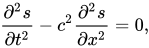


Due to the ambiguity in the direction of the wave velocity, , the equation does not contain information about the wave direction and therefore has solutions propagating in both the forward () and backward () directions. The general solution of the equation is the summation of the solutions in these two directions:




where and are the displacement amplitudes of the waves running in and direction.


When a one-way wave problem is formulated, the wave propagation direction has to be (manually) selected by keeping one of the two terms in the general solution.
Factoring the operator on the left side of the equation yields a pair of one-way wave equations, one with solutions that propagate forwards and the other with solutions that propagate backwards.

The backward- and forward-travelling waves are described respectively (for ),

![{\displaystyle {\begin{aligned}&{{\frac {\partial s}{\partial t}}-c{\frac {\partial s}{\partial x}}=0}\\[6pt]&{{\frac {\partial s}{\partial t}}+c{\frac {\partial s}{\partial x}}=0}\end{aligned}}}](https://wikimedia.org/api/rest_v1/media/math/render/svg/3a0066823bbbb87e9c912b048563c4c9bb42f747)
One-way wave equation
A one-way wave equation is a first-order partial differential equation describing one wave traveling in a direction defined by the vector wave velocity. It contrasts with the second-order two-way wave equation describing a standing wavefield resulting from superposition of two waves in opposite directions (using the squared scalar wave velocity). In the one-dimensional case it is also known as a transport equation, and it allows wave propagation to be calculated without the mathematical complication of solving a 2nd order differential equation. Due to the fact that in the last decades no general solution to the 3D one-way wave equation could be found, numerous approximation methods based on the 1D one-way wave equation are used for 3D seismic and other geophysical calculations, see also the section § Three-dimensional case.
The scalar second-order (two-way) wave equation describing a standing wavefield can be written as: where is the coordinate, is time, is the displacement, and is the wave velocity.
Due to the ambiguity in the direction of the wave velocity, , the equation does not contain information about the wave direction and therefore has solutions propagating in both the forward () and backward () directions. The general solution of the equation is the summation of the solutions in these two directions:
where and are the displacement amplitudes of the waves running in and direction.
When a one-way wave problem is formulated, the wave propagation direction has to be (manually) selected by keeping one of the two terms in the general solution.
Factoring the operator on the left side of the equation yields a pair of one-way wave equations, one with solutions that propagate forwards and the other with solutions that propagate backwards.
The backward- and forward-travelling waves are described respectively (for ),