



Community hub
Recent from talks
Knowledge base stats:
Talk channels stats:
Members stats:
One of Ours
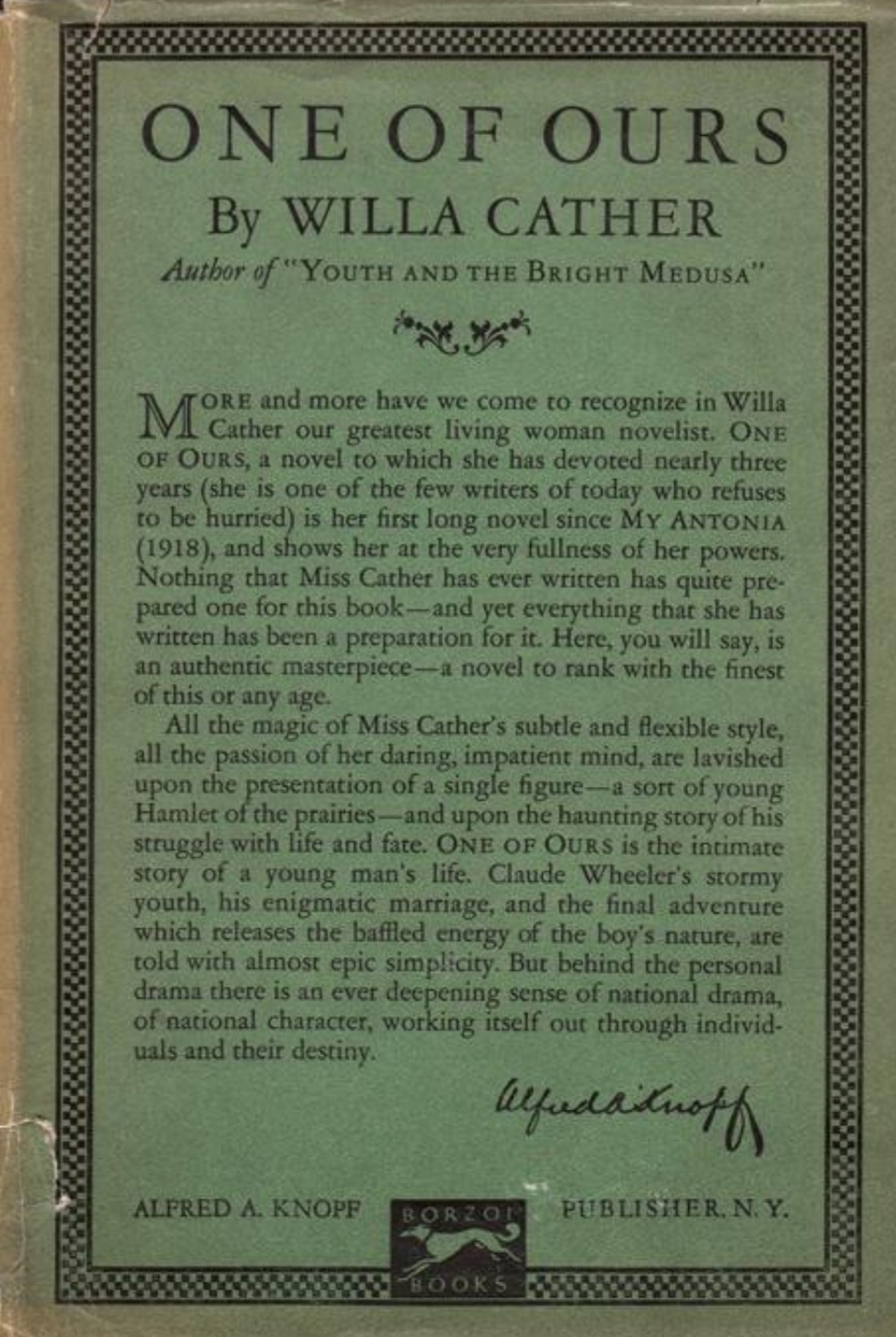
One of Ours is a 1922 novel by Willa Cather that won the 1923 Pulitzer Prize for the Novel. It tells the story of the life of Claude Wheeler, a Nebraska native in the first decades of the 20th century. The son of a successful farmer and an intensely pious mother, he is guaranteed a comfortable livelihood. Nevertheless, Wheeler views himself as a victim of his father's success and his own inexplicable malaise.
Cather's cousin Grosvenor P. (G.P.) Cather was born and raised on the farm that adjoined her own family's, and she combined parts of her own personality with Grosvenor's in the character of Claude. Cather explained in a letter to Dorothy Canfield Fisher:
We were very much alike, and very different. He could never escape from the misery of being himself, except in action, and whatever he put his hand to turned out either ugly or ridiculous.... I was staying on his father's farm when the war broke out. We spent the first week hauling wheat to town. On those long rides on the wheat, we talked for the first time in years, and I saw some of the things that were really in the back of his mind.... I had no more thought of writing a story about him than of writing about my own nose. It was all too painfully familiar. It was just to escape from him and his kind that I wrote at all.
Grosvenor was killed in action in World War I in 1918 during the Battle of Cantigny, France. Cather learned of his death while reading the newspaper in a hair salon. She wrote:
From that on, he was in my mind. The too-personal-ness, the embarrassment of kinship, was gone. But he was in my mind so much that I couldn't get through him to other things ... some of me was buried with him in France, and some of him was left alive in me.
He was awarded the Distinguished Service Cross and a Silver Star citation for bravery under fire, of which Cather wrote:
That anything so glorious could have happened to anyone so disinherited of hope. Timidly, angrily, he used to ask me about the geography of France on the wheat wagon. Well, he learned it, you see.
Cather was unhappy that the novel "will be classed as a war story", which was not her intention. She departed from her previous practice of writing about the western life she knew well to write this story set partly in military life and overseas only because "it stood between me and anything else."
Hub AI
One of Ours AI simulator
(@One of Ours_simulator)
One of Ours
One of Ours is a 1922 novel by Willa Cather that won the 1923 Pulitzer Prize for the Novel. It tells the story of the life of Claude Wheeler, a Nebraska native in the first decades of the 20th century. The son of a successful farmer and an intensely pious mother, he is guaranteed a comfortable livelihood. Nevertheless, Wheeler views himself as a victim of his father's success and his own inexplicable malaise.
Cather's cousin Grosvenor P. (G.P.) Cather was born and raised on the farm that adjoined her own family's, and she combined parts of her own personality with Grosvenor's in the character of Claude. Cather explained in a letter to Dorothy Canfield Fisher:
We were very much alike, and very different. He could never escape from the misery of being himself, except in action, and whatever he put his hand to turned out either ugly or ridiculous.... I was staying on his father's farm when the war broke out. We spent the first week hauling wheat to town. On those long rides on the wheat, we talked for the first time in years, and I saw some of the things that were really in the back of his mind.... I had no more thought of writing a story about him than of writing about my own nose. It was all too painfully familiar. It was just to escape from him and his kind that I wrote at all.
Grosvenor was killed in action in World War I in 1918 during the Battle of Cantigny, France. Cather learned of his death while reading the newspaper in a hair salon. She wrote:
From that on, he was in my mind. The too-personal-ness, the embarrassment of kinship, was gone. But he was in my mind so much that I couldn't get through him to other things ... some of me was buried with him in France, and some of him was left alive in me.
He was awarded the Distinguished Service Cross and a Silver Star citation for bravery under fire, of which Cather wrote:
That anything so glorious could have happened to anyone so disinherited of hope. Timidly, angrily, he used to ask me about the geography of France on the wheat wagon. Well, he learned it, you see.
Cather was unhappy that the novel "will be classed as a war story", which was not her intention. She departed from her previous practice of writing about the western life she knew well to write this story set partly in military life and overseas only because "it stood between me and anything else."