



Community hub
Recent from talks
Knowledge base stats:
Talk channels stats:
Members stats:
Operation Black Buck
Operations Black Buck 1 to Black Buck 7 were seven extremely long-range airstrikes conducted during the 1982 Falklands War by Royal Air Force (RAF) Vulcan bombers of the RAF Waddington Wing, comprising aircraft from Nos. 44, 50 and 101 Squadrons, against Argentine positions in the Falkland Islands. Five of the missions completed attacks. The objective of the missions was to attack Port Stanley Airport and its associated defences. The raids, at almost 6,600 nautical miles (7,600 mi; 12,200 km) and 16 hours for the round trip, were the longest-ranged bombing raids in history at that time.
The Operation Black Buck raids were staged from RAF Ascension Island, close to the Equator. The Vulcan was designed for medium-range missions in Europe and lacked the range to fly to the Falklands without refuelling several times. The RAF's tanker planes were mostly converted Handley Page Victor bombers with similar range, so they too had to be refuelled in the air. A total of eleven tankers were required for two Vulcans (one primary and one reserve), a daunting logistical effort as all aircraft had to use the same runway.
The Vulcans carried either twenty-one 1,000-pound (450 kg) bombs internally or two or four Shrike anti-radar missiles externally. Of the five Black Buck raids flown to completion, three were against Stanley Airfield's runway and operational facilities, while the other two were anti-radar missions using Shrike missiles against a Westinghouse AN/TPS-43 long-range 3D radar in the Port Stanley area. Shrikes hit two of the less valuable and rapidly replaced secondary fire control radars, causing some casualties among the Argentine crews. One Vulcan was almost lost when a breakdown of its refueling system forced it to land in Brazil.
The raids did minimal damage to the runway and damage to radars was quickly repaired. A single crater was produced on the runway, rendering it impossible for the airfield to be used by fast jets. Argentine ground crew repaired the runway within twenty-four hours, to a level of quality suitable for C-130 Hercules transports. The British were aware that the runway remained in use. It has been suggested that the Black Buck raids were undertaken by the RAF because the British armed forces had been cut in the late 1970s and the RAF may have desired a greater role in the conflict to prevent further cuts.
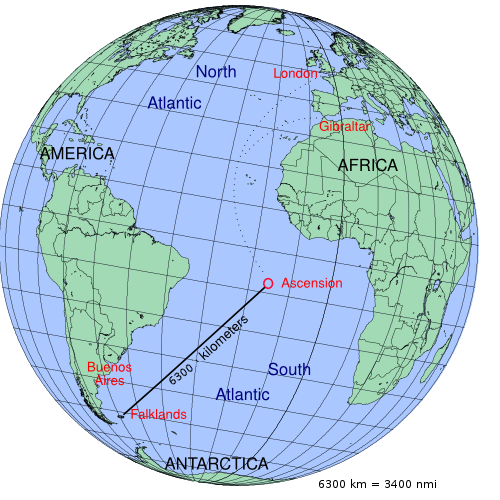
During the early 1980s, British defence planning was focused on the Cold War confrontation with the Soviet Union. Nonetheless, at six-monthly intervals the Defence chiefs reviewed other possible areas of conflict around the globe, including the Falkland Islands. The consensus was that they were indefensible. The nearest airfield usable for operations was on Ascension Island, a British territory in the South Atlantic not far from the equator with a single 10,000-foot (3,000 m) runway at Wideawake airfield that lay 3,700 nautical miles (4,300 mi; 6,900 km) from the UK and 3,300 nautical miles (3,800 mi; 6,100 km) from the Falklands. Without aircraft able to cover the long distance, the Royal Air Force (RAF) could not envisage carrying out operations in the South Atlantic. Activities in the South Atlantic would be carried out by the Royal Navy and the British Army, with the RAF's role restricted to the Hawker Siddeley Nimrod maritime patrol aircraft and logistic support of the base at Ascension by Vickers VC10 and Lockheed C-130 Hercules transport aircraft.
Argentine codes had been broken, and in March 1982 intelligence warnings about possible Argentine activity in the South Atlantic accumulated. The RAF began examining whether it was possible to carry out long-range operations with Avro Vulcan bombers using aerial refuelling. In 1961, a Vulcan had flown non-stop from the UK to RAAF Base Richmond near Sydney in Australia, a much greater distance, but that was with pre-positioned aerial tankers along the route, which would not be possible flying from Ascension. All consideration at this point was about how it could be done; no targets were identified in the Falklands or Argentina.
After Argentina invaded the Falkland Islands on 2 April 1982, the British Government resolved to recapture them.
Long-range operations were entirely dependent upon the RAF's fleet of Handley Page Victor K2 tankers. Originally 34 Victors had been built as bombers; 24 had subsequently been converted to tankers. One had been lost in an accident at RAF Marham on 28 September 1976, leaving the RAF with a force of just 23. These were the only tankers in British service in April 1982; nine VC10s were in the process of being converted to tankers, but conversion of the first was not completed until 22 June. Of these, twelve were assigned to No. 55 Squadron and eleven to No. 57 Squadron.
Hub AI
Operation Black Buck AI simulator
(@Operation Black Buck_simulator)
Operation Black Buck
Operations Black Buck 1 to Black Buck 7 were seven extremely long-range airstrikes conducted during the 1982 Falklands War by Royal Air Force (RAF) Vulcan bombers of the RAF Waddington Wing, comprising aircraft from Nos. 44, 50 and 101 Squadrons, against Argentine positions in the Falkland Islands. Five of the missions completed attacks. The objective of the missions was to attack Port Stanley Airport and its associated defences. The raids, at almost 6,600 nautical miles (7,600 mi; 12,200 km) and 16 hours for the round trip, were the longest-ranged bombing raids in history at that time.
The Operation Black Buck raids were staged from RAF Ascension Island, close to the Equator. The Vulcan was designed for medium-range missions in Europe and lacked the range to fly to the Falklands without refuelling several times. The RAF's tanker planes were mostly converted Handley Page Victor bombers with similar range, so they too had to be refuelled in the air. A total of eleven tankers were required for two Vulcans (one primary and one reserve), a daunting logistical effort as all aircraft had to use the same runway.
The Vulcans carried either twenty-one 1,000-pound (450 kg) bombs internally or two or four Shrike anti-radar missiles externally. Of the five Black Buck raids flown to completion, three were against Stanley Airfield's runway and operational facilities, while the other two were anti-radar missions using Shrike missiles against a Westinghouse AN/TPS-43 long-range 3D radar in the Port Stanley area. Shrikes hit two of the less valuable and rapidly replaced secondary fire control radars, causing some casualties among the Argentine crews. One Vulcan was almost lost when a breakdown of its refueling system forced it to land in Brazil.
The raids did minimal damage to the runway and damage to radars was quickly repaired. A single crater was produced on the runway, rendering it impossible for the airfield to be used by fast jets. Argentine ground crew repaired the runway within twenty-four hours, to a level of quality suitable for C-130 Hercules transports. The British were aware that the runway remained in use. It has been suggested that the Black Buck raids were undertaken by the RAF because the British armed forces had been cut in the late 1970s and the RAF may have desired a greater role in the conflict to prevent further cuts.
During the early 1980s, British defence planning was focused on the Cold War confrontation with the Soviet Union. Nonetheless, at six-monthly intervals the Defence chiefs reviewed other possible areas of conflict around the globe, including the Falkland Islands. The consensus was that they were indefensible. The nearest airfield usable for operations was on Ascension Island, a British territory in the South Atlantic not far from the equator with a single 10,000-foot (3,000 m) runway at Wideawake airfield that lay 3,700 nautical miles (4,300 mi; 6,900 km) from the UK and 3,300 nautical miles (3,800 mi; 6,100 km) from the Falklands. Without aircraft able to cover the long distance, the Royal Air Force (RAF) could not envisage carrying out operations in the South Atlantic. Activities in the South Atlantic would be carried out by the Royal Navy and the British Army, with the RAF's role restricted to the Hawker Siddeley Nimrod maritime patrol aircraft and logistic support of the base at Ascension by Vickers VC10 and Lockheed C-130 Hercules transport aircraft.
Argentine codes had been broken, and in March 1982 intelligence warnings about possible Argentine activity in the South Atlantic accumulated. The RAF began examining whether it was possible to carry out long-range operations with Avro Vulcan bombers using aerial refuelling. In 1961, a Vulcan had flown non-stop from the UK to RAAF Base Richmond near Sydney in Australia, a much greater distance, but that was with pre-positioned aerial tankers along the route, which would not be possible flying from Ascension. All consideration at this point was about how it could be done; no targets were identified in the Falklands or Argentina.
After Argentina invaded the Falkland Islands on 2 April 1982, the British Government resolved to recapture them.
Long-range operations were entirely dependent upon the RAF's fleet of Handley Page Victor K2 tankers. Originally 34 Victors had been built as bombers; 24 had subsequently been converted to tankers. One had been lost in an accident at RAF Marham on 28 September 1976, leaving the RAF with a force of just 23. These were the only tankers in British service in April 1982; nine VC10s were in the process of being converted to tankers, but conversion of the first was not completed until 22 June. Of these, twelve were assigned to No. 55 Squadron and eleven to No. 57 Squadron.