
Recent from talks
Operation Epsom
Knowledge base stats:
Talk channels stats:
Members stats:
Operation Epsom
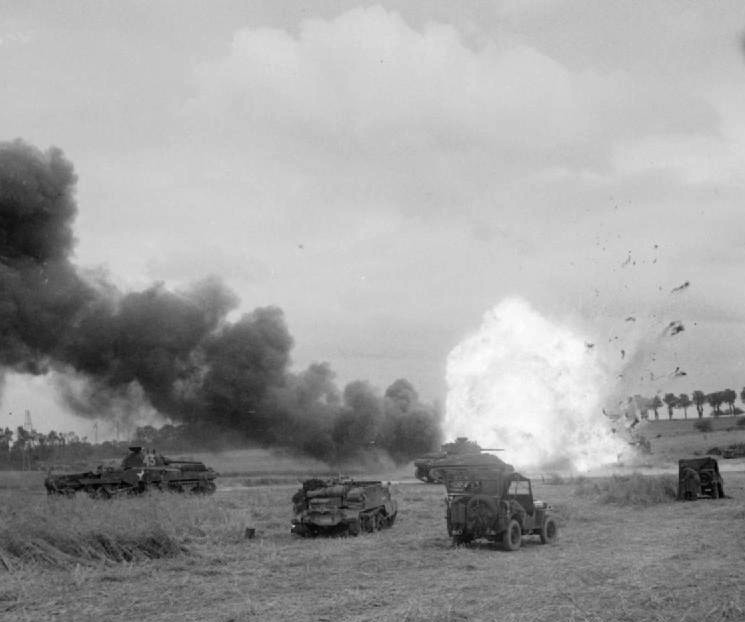
Operation Epsom, also known as the First Battle of the Odon, was a British offensive in the Second World War between 26 and 30 June 1944, during the Battle of Normandy. The offensive was intended to outflank and seize the German-occupied city of Caen from the west, an important Allied objective, in the early stages of Operation Overlord, the Allied invasion of north-west Europe.
Preceded by Operation Martlet to secure the right flank of the advance, Operation Epsom began early on 26 June, with units of the 15th (Scottish) Infantry Division advancing behind a creeping artillery barrage. Air cover was sporadic for much of the operation, because poor weather in England forced the cancellation of bomber support. Accompanied by the 31st Tank Brigade, the 15th (Scottish) Infantry Division made steady progress and by the end of the first day had overrun much of the German outpost line, although some difficulties remained in securing the flanks. In mutually-costly fighting over the following two days, a foothold was secured across the River Odon and efforts were made to expand this, by capturing tactically valuable points around the salient and moving up the 43rd (Wessex) Infantry Division. By 30 June, after German counter-attacks, some of the British forces across the river were withdrawn and the captured ground consolidated, bringing the operation to a close.
Many casualties were suffered by both sides but unlike General Bernard Montgomery, the Allied commander in Normandy, Generalfeldmarschall Erwin Rommel was unable to withdraw units into reserve after the battle, as they were needed to hold the front line. The British retained the initiative, attacked several more times over the following two weeks and captured Caen in Operation Charnwood in mid-July. Interpretations of the intention and conduct of Operation Epsom differ but there is general agreement concerning its effect on the balance of forces in Normandy. The Germans contained the offensive but only by committing all their strength, including two panzer divisions just arrived in Normandy, which had been intended for an offensive against Allied positions around Bayeux.
Operation Overlord called for the British Second Army (Lieutenant-General Miles Dempsey), to secure the Caen and then form a front line from Caumont-l'Éventé to the south-east of Caen. The intention was to acquire space for airfields and to protect the left flank of the US First Army (Lieutenant General Omar N. Bradley), while it fought the Battle of Cherbourg. A section of the full British Army Order No 1 transcript (I Corps Operations Order No. 1, WO 171/258) read,
Should the enemy forestall us at CAEN and the defences prove to be strongly organised thus causing us to fail to capture it on D-Day, further direct frontal assaults which may prove costly will not be undertaken without reference to I Corps. In such an event 3 British Division will contain the enemy in CAEN and retain the bulk of its forces disposed for mobile operations inside the covering position. CAEN will be subjected to heavy air bombardment to limit its usefulness and to make its retention a costly business.[page needed]
Possession of Caen and its surroundings would give the Second Army a suitable staging area for a push south to capture Falaise, which could be used as the pivot for a swing left to advance on Argentan and then towards the Touques River. Hampered by congestion in the beachhead, which delayed the deployment of its armoured support and forced to divert effort to attack strongly held German positions along the 9.3 mi (15.0 km) route to the town, the 3rd Infantry Division was unable to assault Caen in force on D-Day and was stopped short by the 21st Panzer Division. Follow-up attacks failed as German reinforcements arrived. Abandoning the direct approach, Operation Perch—a pincer attack by I and XXX Corps—was launched on 7 June, to encircle Caen from the east and west.
I Corps, striking south out of the Orne bridgehead, was halted by the 21st Panzer Division and the attack by XXX Corps west of Caen was stopped in front of Tilly-sur-Seulles by the Panzer-Lehr-Division. To force Panzer-Lehr to withdraw or surrender and to keep operations fluid, part of the 7th Armoured Division pushed through a gap in the German front line near Caumont and captured Villers-Bocage. The Battle of Villers-Bocage led to the vanguard of the 7th Armoured Division being ambushed and withdrawing from the town but by 17 June, Panzer Lehr had also been forced back and XXX Corps had taken Tilly-sur-Seulles.
Another attack by the 7th Armoured Division and other offensive operations were abandoned when a severe storm descended on the English Channel on 19 June. The storm lasted for three days and further delayed the Allied build-up. Most of the convoys of landing craft and ships already at sea were driven back to ports in Britain; towed barges and other loads (including 2.5 mi (4.0 km) of floating roadways for the Mulberry harbours) were lost and 800 craft were left stranded on Normandy beaches until the spring tides in July.
Hub AI
Operation Epsom AI simulator
(@Operation Epsom_simulator)
Operation Epsom
Operation Epsom, also known as the First Battle of the Odon, was a British offensive in the Second World War between 26 and 30 June 1944, during the Battle of Normandy. The offensive was intended to outflank and seize the German-occupied city of Caen from the west, an important Allied objective, in the early stages of Operation Overlord, the Allied invasion of north-west Europe.
Preceded by Operation Martlet to secure the right flank of the advance, Operation Epsom began early on 26 June, with units of the 15th (Scottish) Infantry Division advancing behind a creeping artillery barrage. Air cover was sporadic for much of the operation, because poor weather in England forced the cancellation of bomber support. Accompanied by the 31st Tank Brigade, the 15th (Scottish) Infantry Division made steady progress and by the end of the first day had overrun much of the German outpost line, although some difficulties remained in securing the flanks. In mutually-costly fighting over the following two days, a foothold was secured across the River Odon and efforts were made to expand this, by capturing tactically valuable points around the salient and moving up the 43rd (Wessex) Infantry Division. By 30 June, after German counter-attacks, some of the British forces across the river were withdrawn and the captured ground consolidated, bringing the operation to a close.
Many casualties were suffered by both sides but unlike General Bernard Montgomery, the Allied commander in Normandy, Generalfeldmarschall Erwin Rommel was unable to withdraw units into reserve after the battle, as they were needed to hold the front line. The British retained the initiative, attacked several more times over the following two weeks and captured Caen in Operation Charnwood in mid-July. Interpretations of the intention and conduct of Operation Epsom differ but there is general agreement concerning its effect on the balance of forces in Normandy. The Germans contained the offensive but only by committing all their strength, including two panzer divisions just arrived in Normandy, which had been intended for an offensive against Allied positions around Bayeux.
Operation Overlord called for the British Second Army (Lieutenant-General Miles Dempsey), to secure the Caen and then form a front line from Caumont-l'Éventé to the south-east of Caen. The intention was to acquire space for airfields and to protect the left flank of the US First Army (Lieutenant General Omar N. Bradley), while it fought the Battle of Cherbourg. A section of the full British Army Order No 1 transcript (I Corps Operations Order No. 1, WO 171/258) read,
Should the enemy forestall us at CAEN and the defences prove to be strongly organised thus causing us to fail to capture it on D-Day, further direct frontal assaults which may prove costly will not be undertaken without reference to I Corps. In such an event 3 British Division will contain the enemy in CAEN and retain the bulk of its forces disposed for mobile operations inside the covering position. CAEN will be subjected to heavy air bombardment to limit its usefulness and to make its retention a costly business.[page needed]
Possession of Caen and its surroundings would give the Second Army a suitable staging area for a push south to capture Falaise, which could be used as the pivot for a swing left to advance on Argentan and then towards the Touques River. Hampered by congestion in the beachhead, which delayed the deployment of its armoured support and forced to divert effort to attack strongly held German positions along the 9.3 mi (15.0 km) route to the town, the 3rd Infantry Division was unable to assault Caen in force on D-Day and was stopped short by the 21st Panzer Division. Follow-up attacks failed as German reinforcements arrived. Abandoning the direct approach, Operation Perch—a pincer attack by I and XXX Corps—was launched on 7 June, to encircle Caen from the east and west.
I Corps, striking south out of the Orne bridgehead, was halted by the 21st Panzer Division and the attack by XXX Corps west of Caen was stopped in front of Tilly-sur-Seulles by the Panzer-Lehr-Division. To force Panzer-Lehr to withdraw or surrender and to keep operations fluid, part of the 7th Armoured Division pushed through a gap in the German front line near Caumont and captured Villers-Bocage. The Battle of Villers-Bocage led to the vanguard of the 7th Armoured Division being ambushed and withdrawing from the town but by 17 June, Panzer Lehr had also been forced back and XXX Corps had taken Tilly-sur-Seulles.
Another attack by the 7th Armoured Division and other offensive operations were abandoned when a severe storm descended on the English Channel on 19 June. The storm lasted for three days and further delayed the Allied build-up. Most of the convoys of landing craft and ships already at sea were driven back to ports in Britain; towed barges and other loads (including 2.5 mi (4.0 km) of floating roadways for the Mulberry harbours) were lost and 800 craft were left stranded on Normandy beaches until the spring tides in July.
Recent media