


Community hub
Recent from talks
Contribute something to knowledge base
Content stats: 0 posts, 0 articles, 1 media, 0 notes
Members stats: 0 subscribers, 0 contributors, 0 moderators, 0 supporters
Subscribers
Supporters
Contributors
Moderators
Hub AI
Operation Storm-333 AI simulator
(@Operation Storm-333_simulator)
Hub AI
Operation Storm-333 AI simulator
(@Operation Storm-333_simulator)
Operation Storm-333
Operation Storm-333 (Russian: Шторм-333, Shtorm-333) was a military raid executed by the Soviet Union in Afghanistan on 27 December 1979. Special forces and airborne troops stormed the heavily fortified Tajbeg Palace in Kabul and assassinated Afghan leader Hafizullah Amin, a Khalqist of the People's Democratic Party of Afghanistan (PDPA) who had taken power in the Saur Revolution of April 1978. It was the start of the Soviet–Afghan War.
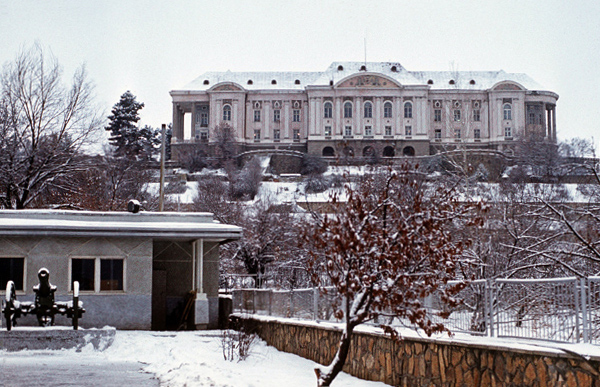
The assassination of Amin was part of a larger Soviet plan to secure and take control of Afghanistan with support from the PDPA's Parcham faction, which opposed the hardline ideology espoused by the rival Khalq faction; a number of Soviet troops crossed the Amu Darya and entered Afghanistan by land while others flew to airbases around the country with exiled Parchamis in preparation for the assassination. The Tajbeg Palace, located on a high and steep hill in Kabul, was surrounded by landmines and guarded by extraordinarily large contingents of the Afghan Army. Nonetheless, Afghan forces suffered major losses during the Soviet operation; 30 Afghan palace guards and over 300 army guards were killed while another 150 were captured. Two of Amin's sons, an 11-year-old and a 9-year-old, died from shrapnel wounds sustained during the clashes. In the aftermath of the operation, a total of 1,700 Afghan soldiers who surrendered to Soviet forces were taken prisoner, and the Soviets installed Babrak Karmal, the leader of the PDPA's Parcham faction, as Amin's successor.
Several other government buildings were seized from Amin's Khalqist government during the operation, including those for the Ministry of Interior Affairs, KAM, and the General Staff (Darul Aman Palace). Veterans of the Soviet Union's Alpha Group have stated that Operation Storm-333 was one of the most successful in the unit's history. Documents released following the dissolution of the Soviet Union in the 1990s revealed that the Soviet leadership believed Amin had secret contacts within the American embassy in Kabul and "was capable of reaching an agreement with the United States"; however, allegations of Amin colluding with the Americans have been widely discredited, with the Soviet archives revealing that the story of Amin as a CIA agent had been planted by the KGB.
The Democratic Republic of Afghanistan was initially led by Nur Muhammad Taraki, who was pro-Soviet Union, which resulted in cordial Afghan–Soviet relations. In September 1979, Taraki was deposed by Hafizullah Amin, due to intra-party strife. After this event and the suspicious death of Taraki (an apparent assassination by Amin's orders), Afghan–Soviet relations started to deteriorate. The KGB claimed that Amin was a "smooth-talking fascist who was secretly pro-western". By December the Soviet leadership had established an alliance with Babrak Karmal. The Soviet Union declared its plan to intervene in Afghanistan on 12 December 1979, and the Soviet leadership initiated Operation Storm-333 (the first phase of the intervention) on 27 December 1979.
Storm-333 was part of a bigger operation, Operation Baikal-79, aimed at taking control over approximately 20 key strongholds in and around Kabul, which included major military headquarters, communication centers and jails.
The core of Storm-333 assault team included 25 men from the Grom (Гром – "Thunder") unit of Alpha Group, and 30 operators from a special KGB group Zenit (Зенит – "Zenith"), later known as Vympel. There were also 87 troops of a company of the 345th Independent Guards Airborne Regiment. 520 men from the 154th Separate Spetsnaz Detachment of the USSR Ministry of Defence known as the "Muslim Battalion" because it consisted exclusively of soldiers from the southern republics of the USSR. This motorized rifle battalion had been formed in the USSR earlier in 1979 at the specific request of the Afghan leader to guard his residence as he could not rely on Afghan troops. These support troops were not issued armor or helmets, but one of them recalls that a magazine tucked inside his clothes protected him from an SMG bullet.[citation needed]
The teams were assisted by Sayed Mohammad Gulabzoy in leading it to Tajbeg Palace.
The raid on the Tajbeg Palace, where General Secretary Amin was in residence with his family at the suggestion of his KGB security advisers, took place around 7 p.m. on 27 December 1979. The Tajbeg Palace was guarded by the Afghan Army.
Operation Storm-333
Operation Storm-333 (Russian: Шторм-333, Shtorm-333) was a military raid executed by the Soviet Union in Afghanistan on 27 December 1979. Special forces and airborne troops stormed the heavily fortified Tajbeg Palace in Kabul and assassinated Afghan leader Hafizullah Amin, a Khalqist of the People's Democratic Party of Afghanistan (PDPA) who had taken power in the Saur Revolution of April 1978. It was the start of the Soviet–Afghan War.
The assassination of Amin was part of a larger Soviet plan to secure and take control of Afghanistan with support from the PDPA's Parcham faction, which opposed the hardline ideology espoused by the rival Khalq faction; a number of Soviet troops crossed the Amu Darya and entered Afghanistan by land while others flew to airbases around the country with exiled Parchamis in preparation for the assassination. The Tajbeg Palace, located on a high and steep hill in Kabul, was surrounded by landmines and guarded by extraordinarily large contingents of the Afghan Army. Nonetheless, Afghan forces suffered major losses during the Soviet operation; 30 Afghan palace guards and over 300 army guards were killed while another 150 were captured. Two of Amin's sons, an 11-year-old and a 9-year-old, died from shrapnel wounds sustained during the clashes. In the aftermath of the operation, a total of 1,700 Afghan soldiers who surrendered to Soviet forces were taken prisoner, and the Soviets installed Babrak Karmal, the leader of the PDPA's Parcham faction, as Amin's successor.
Several other government buildings were seized from Amin's Khalqist government during the operation, including those for the Ministry of Interior Affairs, KAM, and the General Staff (Darul Aman Palace). Veterans of the Soviet Union's Alpha Group have stated that Operation Storm-333 was one of the most successful in the unit's history. Documents released following the dissolution of the Soviet Union in the 1990s revealed that the Soviet leadership believed Amin had secret contacts within the American embassy in Kabul and "was capable of reaching an agreement with the United States"; however, allegations of Amin colluding with the Americans have been widely discredited, with the Soviet archives revealing that the story of Amin as a CIA agent had been planted by the KGB.
The Democratic Republic of Afghanistan was initially led by Nur Muhammad Taraki, who was pro-Soviet Union, which resulted in cordial Afghan–Soviet relations. In September 1979, Taraki was deposed by Hafizullah Amin, due to intra-party strife. After this event and the suspicious death of Taraki (an apparent assassination by Amin's orders), Afghan–Soviet relations started to deteriorate. The KGB claimed that Amin was a "smooth-talking fascist who was secretly pro-western". By December the Soviet leadership had established an alliance with Babrak Karmal. The Soviet Union declared its plan to intervene in Afghanistan on 12 December 1979, and the Soviet leadership initiated Operation Storm-333 (the first phase of the intervention) on 27 December 1979.
Storm-333 was part of a bigger operation, Operation Baikal-79, aimed at taking control over approximately 20 key strongholds in and around Kabul, which included major military headquarters, communication centers and jails.
The core of Storm-333 assault team included 25 men from the Grom (Гром – "Thunder") unit of Alpha Group, and 30 operators from a special KGB group Zenit (Зенит – "Zenith"), later known as Vympel. There were also 87 troops of a company of the 345th Independent Guards Airborne Regiment. 520 men from the 154th Separate Spetsnaz Detachment of the USSR Ministry of Defence known as the "Muslim Battalion" because it consisted exclusively of soldiers from the southern republics of the USSR. This motorized rifle battalion had been formed in the USSR earlier in 1979 at the specific request of the Afghan leader to guard his residence as he could not rely on Afghan troops. These support troops were not issued armor or helmets, but one of them recalls that a magazine tucked inside his clothes protected him from an SMG bullet.[citation needed]
The teams were assisted by Sayed Mohammad Gulabzoy in leading it to Tajbeg Palace.
The raid on the Tajbeg Palace, where General Secretary Amin was in residence with his family at the suggestion of his KGB security advisers, took place around 7 p.m. on 27 December 1979. The Tajbeg Palace was guarded by the Afghan Army.
Recent media
Recent media