


Community hub
Recent from talks
Contribute something
Nothing was collected or created yet.
Amu Darya
View on Wikipedia| Amu Darya Oxus, Wehrōd, Amu River | |
|---|---|
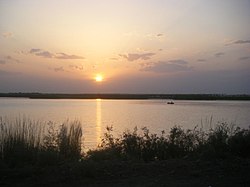
 Looking at the Amu Darya from Turkmenistan | |
 Map of area around the Aral Sea. Aral Sea boundaries are c. 2008. The Amu Darya drainage basin is in orange, and the Syr Darya basin in yellow. | |
 | |
| Etymology | Named for the city of Āmul (now Türkmenabat) |
| Native name | |
| Location | |
| Countries | |
| Region | Central Asia |
| Physical characteristics | |
| Source | Pamir River/Panj River |
| • location | Lake Zorkul, Pamir Mountains, Afghanistan/Tajikistan |
| • coordinates | 37°27′04″N 73°34′21″E / 37.45111°N 73.57250°E |
| • elevation | 4,130 m (13,550 ft) |
| 2nd source | Kyzylsu River/Vakhsh River |
| • location | Alay Valley, Pamir Mountains, Tajikistan |
| • coordinates | 39°13′27″N 72°55′26″E / 39.22417°N 72.92389°E |
| • elevation | 4,525 m (14,846 ft) |
| Source confluence | Kerki |
| • location | Tajikistan |
| • coordinates | 37°06′35″N 68°18′44″E / 37.10972°N 68.31222°E |
| • elevation | 326 m (1,070 ft) |
| Mouth | Aral Sea |
• location | Amudarya Delta, Uzbekistan |
• coordinates | 44°06′30″N 59°40′52″E / 44.10833°N 59.68111°E |
• elevation | 28 m (92 ft) |
| Length | 2,400 km (1,500 mi) |
| Basin size | 534,739 km2 (206,464 sq mi) |
| Discharge | |
| • average | 2,525 m3/s (89,200 cu ft/s)[1] |
| • minimum | 420 m3/s (15,000 cu ft/s) |
| • maximum | 5,900 m3/s (210,000 cu ft/s) |
| Basin features | |
| Tributaries | |
| • left | Panj River |
| • right | Vakhsh River, Surkhan Darya, Sherabad River, Zeravshan River |
The Amu Darya (/ˌɑːmuː ˈdɑːrjə/ AH-moo DAR-yə;[a] Persian: آمو دریا), also shortened to Amu and historically known as the Oxus (/ˈɒksəs/ OK-səss),[2][b] is a major river in Central Asia which flows through Tajikistan, Turkmenistan, Uzbekistan, and Afghanistan. Rising in the Pamir Mountains, north of the Hindu Kush, the Amu Darya is formed by the confluence of the Vakhsh and Panj rivers, in the Tigrovaya Balka Nature Reserve on the border between Afghanistan and Tajikistan, and flows from there north-westwards into the southern remnants of the Aral Sea. In its upper course, the river forms part of Afghanistan's northern border with Tajikistan, Uzbekistan, and Turkmenistan. In ancient history, the river was regarded as the boundary of Greater Iran with Turan, which roughly corresponded to present-day Central Asia.[3] The Amu Darya has a flow of about 70 cubic kilometres per year on average.[4]
Names
[edit]
In classical antiquity, the river was known as the Ōxus in Latin and Ὦξος (Ôxos) in Greek — a clear derivative of Vakhsh, the name of the largest tributary of the river.[5] In Sanskrit texts, the river is also referred to as Vakṣu (वक्षु). The Brahmanda Purana refers to the river as Chaksu (चक्षु) which means 'an eye' in sanskrit.[6] The Avestan texts too refer to the river as Yakhsha/Vakhsha (and Yakhsha Arta ('Upper Yakhsha'), referring to the Jaxartes/Syr Darya twin river to Amu Darya). In Middle Persian sources of the Sasanian period the river is known as Wehrōd[3] (lit. 'good river').
The name Amu is said to have come from the medieval city of Āmul (later Chahar Joy/Charjunow, and now known as Türkmenabat) in modern Turkmenistan, with Daryā being the Persian word for 'lake' or 'sea'.
Identification with the Gihon
[edit]Medieval Arabic and Islamic sources call the river Jeyhoun (Arabic: جَيْحُون, romanized: Jayḥūn), which is derived from Gihon, the biblical name for one of the four rivers of the Garden of Eden.[7][8] The Amu Darya passes through one of the world's highest deserts.[9]
As the river Gozan
[edit]Western travelers in the 19th century mentioned that one of the names by which the river was known in Afghanistan was Gozan, and that this name was used by Greek, Mongol, Chinese, Persian, Jewish, and Afghan historians. However, this name is no longer used.[10]
- "Hara (Bokhara) and to the river of Gozan (that is to say, the Amu, (called the Oxus by Europeans )) ..."[11]
- "the Gozan River is the River Balkh, i.e. the Oxus or the Amu Darya ..."[12]
Description
[edit] | This section needs additional citations for verification. (February 2021) |

The river has a total length of 2,400 kilometres (1,500 mi), and its drainage basin covers 534,739 square kilometres (206,464 sq mi), providing a mean discharge of about 97.4 cubic kilometres (23.4 cu mi)[1] of water per year. The river is navigable for over 1,450 kilometres (900 mi). All of the water comes from the high mountains in the south where annual precipitation can be over 1,000 mm (39 in). Even before large-scale irrigation began, high summer evaporation meant that not all of this discharge reached the Aral Sea – though there is some evidence the large Pamir glaciers provided enough meltwater for the Aral to overflow during the 13th and 14th centuries.
Since the end of the 19th century, there have been four different claimants as the true source of the Oxus:
- The Pamir River, which emerges from Lake Zorkul (once also known as Lake Victoria) in the Pamir Mountains (ancient Mount Imeon), and flows west to Qila-e Panja, where it joins the Wakhan River to form the Panj River.
- The Sarhad or Little Pamir River flowing down the Little Pamir in the High Wakhan
- Lake Chamaktin, which discharges to the east into the Aksu River, which in turn becomes the Murghab and then Bartang rivers, and which eventually joins the Panj Oxus branch 350 km downstream at Roshan Vomar in Tajikistan.
- An ice cave at the end of the Wakhjir valley, in the Wakhan Corridor, in the Pamir Mountains, near the border with Pakistan.

A glacier turns into the Wakhan River and joins the Pamir River about 50 kilometres (31 mi) downstream.[14] Bill Colegrave's expedition to Wakhan in 2007 found that both claimants 2 and 3 had the same source, the Chelab stream, which bifurcates on the watershed of the Little Pamir, half flowing into Lake Chamaktin and half into the parent stream of the Little Pamir/Sarhad River. Therefore, the Chelab stream may be properly considered the true source or parent stream of the Oxus.[15] The Panj River forms the border of Afghanistan and Tajikistan. It flows west to Ishkashim where it turns north and then north-west through the Pamirs passing the Tajikistan–Afghanistan Friendship Bridge. It subsequently forms the border of Afghanistan and Uzbekistan for about 200 kilometres (120 mi), passing Termez and the Afghanistan–Uzbekistan Friendship Bridge. It delineates the border of Afghanistan and Turkmenistan for another 100 kilometres (62 mi) before it flows into Turkmenistan at Atamurat. It flows across Turkmenistan south to north, passing Türkmenabat, and forms the border of Turkmenistan and Uzbekistan from Halkabat. It is then split by the Tuyamuyun Hydro Complex into many waterways that used to form the river delta joining the Aral Sea, passing Urgench, Daşoguz, and other cities, but it does not reach what is left of the sea any more and is lost in the desert. Use of water from the Amu Darya for irrigation has been a major contributing factor to the shrinking of the Aral Sea since the late 1950s. Historical records state that in different periods, the river flowed into the Aral Sea (from the south), into the Caspian Sea (from the east), or both, similar to the Syr Darya (Jaxartes, in Ancient Greek). Partly based on such records, first Tsarist and later Soviet engineers proposed to divert the Amu Darya to the Caspian Sea by constructing the Transcaspian Canal.[16][17]
Watershed
[edit]
The 534,769 square kilometres (206,475 sq mi) of the Amu Darya drainage basin include most of Tajikistan, the southwest corner of Kyrgyzstan, the northeast corner of Afghanistan, a narrow portion of eastern Turkmenistan and the western half of Uzbekistan. Part of the Amu Darya basin divide in Tajikistan forms that country's border with China (in the east) and Pakistan (to the south). About 61% of the drainage lies within Tajikistan, Uzbekistan and Turkmenistan, while 39% is in Afghanistan.[18]
The abundant water flowing in the Amu Darya comes almost entirely from glaciers in the Pamir Mountains and Tian Shan,[19] which, standing above the surrounding arid plain, collect atmospheric moisture which otherwise would probably escape elsewhere. Without its mountain water sources, the Amu Darya would not exist—because it rarely rains in the lowlands through which most of the river flows. Of the total drainage area, only about 200,000 square kilometres (77,000 sq mi) actively contribute water to the river.[20] This is because many of the river's major tributaries (especially the Zeravshan River) have been diverted, and much of the river's drainage is arid. Throughout most of the steppe, the annual rainfall is about 300 millimetres (12 in).[18][21]
History
[edit] | This section needs additional citations for verification. (February 2021) |

.jpg)
The ancient Greeks called the Amu Darya the Oxus. In ancient times, the river was regarded as the boundary between Greater Iran and Ṫūrān (Persian: تُوران).[3] The river's drainage lies in the area between the former empires of Genghis Khan and Alexander the Great, although they occurred at very different times. When the Mongols came to the area, they used the water of the Amu Darya to flood Konye-Urgench.[22] One southern route of the Silk Road ran along part of the Amu Darya northwestward from Termez before going westwards to the Caspian Sea.
According to the Quaternary International, it is possible that the Amu Darya's course across the Karakum Desert has gone through several major shifts in the past few thousand years.[23] Much of the time – most recently from the 13th century to the late 16th century – the Amu Darya emptied into both the Aral and the Caspian Seas, reaching the latter via a large distributary called the Uzboy River. The Uzboy splits off from the main channel just south of the river's delta. Sometimes the flow through the two branches was more or less equal, but often most of the Amu Darya's flow split to the west and flowed into the Caspian.
People began to settle along the lower Amu Darya and the Uzboy in the 5th century, establishing a thriving chain of agricultural lands, towns, and cities. In about AD 985, the massive Gurganj Dam at the bifurcation of the forks started to divert water to the Aral. Genghis Khan's troops destroyed the dam in 1221, and the Amu Darya shifted to distributing its flow more or less equally between the main stem and the Uzboy.[24] But in the 18th century, the river again turned north, flowing into the Aral Sea, a path it has taken since. Less and less water flowed down the Uzboy. When Russian explorer Bekovich-Cherkasski surveyed the region in 1720, the Amu Darya did not flow into the Caspian Sea anymore.[25]

By the 1800s, the ethnographic makeup of the region was described by Peter Kropotkin as the communities of "the vassal Khanates of Maimene, Khulm, Kunduz, and even the Badakshan and Wahkran."[26] An Englishman, William Moorcroft, visited the Oxus around 1824 during the Great Game period.[27] Another Englishman, a naval officer called John Wood, came with an expedition to find the source of the river in 1839. He found modern-day Lake Zorkul, called it Lake Victoria, and proclaimed he had found the source.[28] Then, the French explorer and geographer Thibaut Viné collected a lot of information about this area during five expeditions between 1856 and 1862.
The question of finding a route between the Oxus valley and India has been of concern historically. A direct route crosses extremely high mountain passes in the Hindu Kush and isolated areas like Kafiristan. Some in Britain feared that the Empire of Russia, which at the time wielded great influence over the Oxus area, would overcome these obstacles and find a suitable route through which to invade British India – but this never came to pass.[29] The area was taken over by Russia during the Russian conquest of Turkestan.
The Soviet Union became the ruling power in the early 1920s and expelled Mohammed Alim Khan. It later put down the Basmachi movement and killed Ibrahim Bek. A large refugee population of Central Asians, including Turkmen, Tajiks, and Uzbeks, fled to northern Afghanistan.[30] In the 1960s and 1970s the Soviets started using the Amu Darya and the Syr Darya to irrigate extensive cotton fields in the Central Asian plain. Before this time, water from the rivers was already being used for agriculture, but not on this massive scale. The Qaraqum Canal, Karshi Canal, and Bukhara Canal were among the largest of the irrigation diversions built. However, the Main Turkmen Canal, which would have diverted water along the dry Uzboy River bed into central Turkmenistan, was never built. In the course of the Soviet–Afghan War in the 1970s, Soviet forces used the valley to invade Afghanistan through Termez.[31] The Soviet Union fell in the 1990s and Central Asia split up into the many smaller countries that lie within or partially within the Amu Darya basin.[32]
During the Soviet era, a resource-sharing system was instated in which Kyrgyzstan and Tajikistan shared water originating from the Amu and Syr Daryas with Kazakhstan, Turkmenistan, and Uzbekistan in summer. In return, Kyrgyzstan and Tajikistan received Kazakh, Turkmen, and Uzbek coal, gas, and electricity in winter. After the fall of the Soviet Union this system disintegrated and the Central Asian nations have failed to reinstate it. Inadequate infrastructure, poor water management, and outdated irrigation methods all exacerbate the issue.[33]
Siberian Tiger Introduction Project
[edit]The Caspian tiger used to occur along the river's banks.[34] After its extirpation, the Amu Darya's delta was suggested as a potential site for the introduction of its closest surviving relative, the Siberian tiger. A feasibility study was initiated to investigate if the area is suitable and if such an initiative would receive support from relevant decision makers. A viable tiger population of about 100 animals would require at least 5,000 km2 (1,900 sq mi) of large tracts of contiguous habitat with rich prey populations. Such habitat is not available at this stage and cannot be provided in the short term. The proposed region is therefore unsuitable for the reintroduction, at least at this stage.[35]
Resource extraction
[edit]Since March 2022, the building of the 285 km Qosh Tepa Canal has been underway in northern Afghanistan to divert water from the Amu Darya.[36] Uzbekistan has expressed concern that the canal will have an adverse effect on its agriculture.[37] The canal is also expected to make the Aral Sea disaster worse, and in 2023 Uzbek officials held talks on the canal with the Taliban.[38] The Taliban has made the canal a priority, with images supplied by Planet Labs demonstrate that from April 2022 to February 2023, more than 100 km of canal was excavated.[39] According to the Taliban, the initiative is expected to convert 550,000 hectares of desert into farmland.[39]
In January 2023, the Xinjiang Central Asia Petroleum and Gas Company (aka CAPEIC) signed a $720 million four-year investment deal with the Taliban government of Afghanistan for extraction on its side of the Amu Darya basin. The deal will see a 15% royalty given to the Afghan government over the course of its 25-year term.[40][41][42][43][44][45][46][47][48] The Chinese see this basin as the third-largest potential gas field in the world.[48]
Literature
[edit]The clashing noise of battle reached the sky
The blood of the Bengalees flowed like the river Jaihun.
~ Mirza Nathan describing a battle between the Mughals and Musa Khan of Bengal (translated by M. I. Borah)
The Oxus river, and Arnold's poem, fire the imaginations of the children who adventure with ponies over the moors of the West Country in the 1930s children's book The Far-Distant Oxus. There were two sequels, Escape to Persia and Oxus in Summer.[50]
Robert Byron's 1937 travelogue, The Road to Oxiana, describes its author's journey from the Levant through Persia to Afghanistan, with the Oxus as his stated goal, "to see certain famous monuments, chiefly the Gonbad-e Qabus, a tower built as a mausoleum for an ancient king."[51]
George MacDonald Fraser's Flashman at the Charge (1973), places Flashman on the Amu Darya and the Aral Sea during the (fictitious) Russian advance on India during The Great Game period.[citation needed] Bill Colegrave's Halfway House to Heaven (2010), describes the 2007 expedition that finally determined the true source of the river.
But the majestic River floated on,
Out of the mist and hum of that low land,
Into the frosty starlight, and there moved,
Rejoicing, through the hushed Chorasmian waste,
Under the solitary moon: — he flowed
Right for the polar star, past Orgunjè,
Brimming, and bright, and large: then sands begin
To hem his watery march, and dam his streams,
And split his currents; that for many a league
The shorn and parcelled Oxus strains along
Through beds of sand and matted rushy isles —
Oxus, forgetting the bright speed he had
In his high mountain-cradle in Pamere,
A foiled circuitous wanderer: — till at last
The longed-for dash of waves is heard, and wide
His luminous home of waters opens, bright
And tranquil, from whose floor the new-bathed stars
Emerge, and shine upon the Aral Sea.

See also
[edit]Notes
[edit]- ^ Persian: آمودریا/Âmudaryâ [ɒːˈmuː dæɾˈjɒː]
Tajik: Амударё/Amudaryo/امودریا
Mazanderani: Jeyhun/جیحون
Turkmen: Amyderýa/Амыдеря
Uzbek: Amudaryo/Амударё/امودریا
Karakalpak: Әмиўдәря/Ámiwdárya
Pashto: د آمو سيند/də Āmū Sīnd
Punjabi: آمو دریا/ਆਮੂ ਦਰਿਆ/Āmū Daryā
Azerbaijani: Amudərya/آمودریا
Turkish: Amu Derya / Ceyhun
Arabic: Jayḥūn/جيحون
Russian: Амударья/Amudaria - ^ Latin: Ōxus; Ancient Greek: Ὦξος, romanized: Ôxos
References
[edit]- ^ a b Daene C. McKinney (18 November 2003). "Cooperative management of transboundary water resources in Central Asia" (PDF). Archived (PDF) from the original on 2022-10-09. Retrieved 2014-10-03.
- ^ "Strabo, Geography, Book 11, chapter 7, section 4". www.perseus.tufts.edu.
- ^ a b c B. Spuler, Āmū Daryā, in Encyclopædia Iranica, online ed., 2009
- ^ Glantz, Michael H. (2005-01-01). "Water, Climate, and Development Issues in the Amu Darya Basin". Mitigation and Adaptation Strategies for Global Change. 10 (1): 23–50. doi:10.1007/s11027-005-7829-8. ISSN 1573-1596. S2CID 154617195.
- ^ Page, Geology (2015-02-19). "Amu Darya River". Geology Page. Retrieved 2021-05-28.
- ^ "चक्षु", Wiktionary, the free dictionary, 2025-02-18, retrieved 2025-08-05
- ^ William C. Brice. 1981. Historical Atlas of Islam (Hardcover). Leiden with support and patronage from Encyclopaedia of Islam. ISBN 90-04-06116-9.
- ^ "Amu Darya". Encyclopædia Britannica Online.
- ^ "Amu Darya". geography.name. Archived from the original on 2020-07-17. Retrieved 2020-07-16.
- ^ "Afghanistan Virtual Jewish History Tour". www.jewishvirtuallibrary.org. Retrieved 2022-02-05.
- ^ George Passman Tate, The Kingdom of Afghanistan: a historical sketch, p. 11
- ^ Moshe Gil; David Strassler, Jews in Islamic countries in the Middle Ages, p. 428
- ^ Michael Shterenshis, Tamerlane and the Jews, p. xxiv
- ^ Mock, J.; O'Neil, K. (2004), Expedition Report
- ^ Colegrave, Bill (2011). Halfway House to Heaven. London: Bene Factum Publishing. p. 176. ISBN 978-1-903071-28-1. Archived from the original on 2018-11-06. Retrieved 2018-11-06.
- ^ Peterson, Maya K. (2019). Pipe Dreams: Water and Empire in Central Asia's Aral Sea Basin. Cambridge, United Kingdom: Cambridge University Press. ISBN 978-1-108-46854-1.
- ^ Kadyrov, Abrar (2011). Дума о воде – взгляд в былое и немного о будущем (PDF) (in Russian). Tashkent: Interstate Commission for Water Coordination of Central Asia. Retrieved 4 April 2024.
- ^ a b Rakhmatullaev, Shavkat; Huneau, Frédéric; Jusipbek, Kazbekov; Le Coustumer, Philippe; Jumanov, Jamoljon; El Oifi, Bouchra; Motelica-Heino, Mikael; Hrkal, Zbynek. "Groundwater resources use and management in the Amu Darya River Basin (Central Asia)" (PDF). Environmental Earth Sciences. Archived (PDF) from the original on 2022-10-09. Retrieved 2010-02-09.[dead link]
- ^ "Basin Water Organization "Amudarya"". Interstate Commission for Water Coordination of Central Asia. Archived from the original on 2004-06-18. Retrieved 2010-02-11.
- ^ Agaltseva, N.A.; Borovikova, L.N.; Konovalov, V.G. (1997). "Automated system of runoff forecasting for the Amudarya River basin" (PDF). Destructive Water: Water-Caused Natural Disasters, their Abatement and Control. International Association of Hydrological Sciences. Archived (PDF) from the original on 2022-10-09. Retrieved 2010-02-09.
- ^ "Amudarya River Basin Morphology". Central Asia Water Information. Archived from the original on 2010-10-17. Retrieved 2010-02-09.
- ^ Sykes, Percy (1921). A History of Persia. London: Macmillan and Company. p. 64.
- ^ Létolle, René; Micklin, Philip; Aladin, Nikolay; Plotnikov, Igor (October 2007). "Uzboy and the Aral regressions: A hydrological approach". Quaternary International. 173–174: 125–136. Bibcode:2007QuInt.173..125L. doi:10.1016/j.quaint.2007.03.003.
- ^ Volk, Sylvia (2000-11-11). "The Course of the Oxus River". University of Calgary. Archived from the original on 2009-12-23. Retrieved 2010-02-08.
- ^ Kozubov, Robert (November 2007). "Uzboy". Turkmenistan Analytic Magazine. Retrieved 2010-02-08.
- ^ Peter Kropotkin (1913). "The Coming War". The Nineteenth Century: A monthly Review. Archived from the original on 2019-10-16. Retrieved 2020-01-04.
- ^ Peter Hopkirk, The Great Game, 1994, page 100
- ^ Keay, J. (1983) When Men and Mountains Meet ISBN 0-7126-0196-1 Chapter 9
- ^ See for example Can Russia invade India? by Henry Bathurst Hanna, 1895, (Google eBook), or The Káfirs of the Hindu-Kush, Sir George Scott Robertson, Illustrated by Arthur David McCormick, Lawrence & Bullen, Limited, 1896, (Google eBook)
- ^ Taliban and Talibanism in Historical Perspective, M Nazif Shahrani, chapter 4 of The Taliban And The Crisis of Afghanistan, 2008 Harvard Univ Press, edited by Robert D Crews and Amin Tarzi
- ^ Termez – See the Soviet–Afghan War article
- ^ Pavlovskaya, L. P. "Fishery in the Lower Amu Darya Under the Impact of Irrigated Agriculture". Karakalpak Branch. Academy of Sciences of Uzbekistan. Retrieved 2010-02-09.
- ^ International Crisis Group. "Water Pressures in Central Asia Archived 2016-05-20 at the Wayback Machine", CrisisGroup.org. 11 September 2014. Retrieved 6 October 2014.
- ^ Heptner, V. G.; Sludskii, A. A. (1992) [1972]. Mlekopitajuščie Sovetskogo Soiuza. Moskva: Vysšaia Škola [Mammals of the Soviet Union, Volume II, Part 2]. Washington DC: Smithsonian Institution and the National Science Foundation. pp. 83–202. ISBN 90-04-08876-8.
- ^ Jungius, H., Chikin, Y., Tsaruk, O., Pereladova, O. (2009). Pre-Feasibility Study on the Possible Restoration of the Caspian Tiger in the Amu Darya Delta Archived 2016-10-22 at the Wayback Machine. WWF Russia
- ^ "Uzbekistan pursues dialogue with Afghanistan on fraught canal project". Eurasianet. 24 March 2023. Retrieved 26 March 2023.
- ^ Safarov, Ilyos (10 February 2023). ""Толибон"ни Ўзбекистон учун фожиали канални қуришдан тўхтатиб бўладими? — экспертлар билан суҳбат" (in Uzbek). Kun. Retrieved 26 March 2023.
- ^ Duffy, Seamus (19 April 2023). "What Afghanistan's Qosh Tepa Canal Means for Central Asia". The Diplomat. Retrieved 18 May 2023.
- ^ a b "The Taliban are digging an enormous canal". The Economist. 16 February 2023. Retrieved 26 March 2023.
- ^ Hoyt, Conrad (6 January 2023). "Chinese company signs oil extraction deal with Taliban". Washington Examiner.
- ^ "Times of India". Bennett, Coleman & Co. Bloomberg. 6 January 2023.
- ^ "Afghanistan's Taliban administration signs oil production deal with China". Verdict Media Limited. Offshore Technology. 6 January 2023.
- ^ Gul, Ayaz (5 January 2023). "Taliban Seal Afghan Oil Deal With China". Voice of America.
- ^ Madhok, Diksha; Popalzai, Ehsan; Popalzai, Masoud (6 January 2023). "A Chinese company has signed an oil extraction deal with Afghanistan's Taliban". Cable News Network. Warner Bros. Discovery.
- ^ Yawar, Mohammad Yunus (5 January 2023). "Afghanistan's Taliban administration in oil extraction deal with Chinese company". Reuters.
- ^ "Afghanistan signs oil extraction deal with Chinese company". Al Jazeera Media Network. 6 January 2023.
- ^ Hoskins, Peter (6 January 2023). "Taliban and China firm agree Afghanistan oil extraction deal". BBC.
- ^ a b SEIBT, Sébastian (10 January 2023). "Pourquoi la Chine se laisse tenter par le pétrole des Taliban" (in French). France24.
- ^ Nathan, Mirza (1936). M. I. Borah (ed.). Baharistan-I-Ghaybi – Volume II. Gauhati, Assam, British Raj: Government of Assam. p. 58.
- ^ "Oxus Series by Katharine Hull". www.goodreads.com. Retrieved 2021-06-07.
- ^ "The Road to Oxiana. By Robert Byron". washingtonpost.com. Retrieved 2023-05-12.
Further reading
[edit]- Curzon, George Nathaniel. 1896. The Pamirs and the Source of the Oxus. Royal Geographical Society, London. Reprint: Elibron Classics Series, Adamant Media Corporation. 2005. ISBN 1-4021-5983-8 (pbk; ISBN 1-4021-3090-2 (hbk).
- Gordon, T. E. 1876. The Roof of the World: Being the Narrative of a Journey over the high plateau of Tibet to the Russian Frontier and the Oxus sources on Pamir. Edinburgh. Edmonston and Douglas. Reprint by Ch'eng Wen Publishing Company. Taipei. 1971.
- Toynbee, Arnold J. 1961. Between Oxus and Jumna. London. Oxford University Press.
- Wood, John, 1872. A Journey to the Source of the River Oxus. With an essay on the Geography of the Valley of the Oxus by Colonel Henry Yule. London: John Murray.
External links
[edit]
- Drying of the Aral Sea: Timelapse on YouTube
- The Amu Darya Basin Network Archived 2013-08-07 at the Wayback Machine
| Rivers | |
|---|---|
| Canal | |
| River (extinct) | |


| International | |
|---|---|
| National | |
| Geographic | |
| Other | |

Amu Darya
View on GrokipediaEtymology and Historical Names
Ancient Identifications and Mythological Associations
The Amu Darya was identified in ancient Greek sources as the Oxus River, described by Herodotus in the 5th century BCE as forming the northern boundary of Bactria and flowing northwest into the sea beyond Sogdia.[10] [3] This identification persisted in classical geography, with the river's Avestan name recorded as Waxš, connoting "the wild one," reflecting its turbulent character in early Iranian linguistic traditions.[3] In Persian and later Islamic texts, it was known as Jayhun, a name derived from ancient Iranian roots and emphasizing its role as a demarcation between Iranian lands and Turan to the north.[11] [12] In Zoroastrian cosmology, as preserved in the Avesta, the river—referred to under variants of Waxš—held symbolic importance as a life-sustaining waterway associated with purity and the primordial order of creation, integral to the mythical landscape of Airyanem Vaejah, the Indo-Iranian homeland.[13] [14] These texts portray such rivers as conduits of divine favor, contrasting with demonic forces in the dualistic framework, though specific mythological narratives link it more to geographical than purely fantastical events.[11] Biblical associations with the Amu Darya remain speculative and based primarily on phonetic resemblances between Jayhun and Gihon, one of the four rivers emanating from Eden in Genesis 2:13, which encircled Cush; some exegetes have proposed this linkage due to the river's eastern extent and ancient descriptions of surrounding arid lands.[15] However, mainstream identifications favor nearer rivers like the Karun for Gihon, with no direct ancient textual evidence equating the Oxus to biblical waterways.[16] Claims tying it to Gozan of 2 Kings 17:6, a site of Assyrian exile, lack substantiation, as Gozan aligns with Mesopotamian tributaries rather than Central Asian flows.[17]Modern and Regional Names
The modern international name Amu Darya originates from Persian Āmū Daryā, where Āmū derives from the ancient city of Āmul (present-day Türkmenabat in Turkmenistan) and daryā denotes a large river (cognate with "sea" in broader usage).[12][18] This nomenclature, rooted in Persian linguistic tradition, has persisted across Central Asia despite phonetic adaptations in Turkic languages, reflecting organic evolution rather than imposed changes.[19] Regional variants align with post-Soviet national languages: in Uzbek and Tajik (both using Cyrillic historically, with Latin transitions in Uzbekistan), it is Amudaryo (Амударё); in Turkmen, Amu Daryja or Amyderya.[20][21] Russian usage, standardized as Амударья (Amudar'ya) following the Empire's conquest of Turkestan between 1865 and 1885, adopted local Persian-Turkic forms without alteration, maintaining consistency through Soviet administration and into contemporary geopolitical contexts.[12] These designations underscore linguistic continuity tied to ethnic and territorial identities, with no evidence of politically driven renamings post-1991 independence, as boundaries formalized existing riparian divisions among Tajikistan, Turkmenistan, Uzbekistan, and Afghanistan.[21]Physical Geography
Course and Morphology
The Amu Darya originates at the confluence of the Panj and Vakhsh rivers in the Tigrovaya Balka Nature Reserve, located in the Pamir Mountains of Tajikistan near the border with Afghanistan.[22] This junction occurs at an approximate elevation of 950 meters above sea level, marking the start of the river's course from high-altitude glacial and snowmelt sources.[23] The total length of the Amu Darya, measured from the headwaters of the Panj River to its termination, spans 2,540 kilometers.[24] From its origin, the river flows generally westward and northwestward, initially forming the international boundary between Tajikistan on the north bank and Afghanistan on the south bank for roughly the first 800 kilometers of its course.[25] It continues as a border river, delineating Afghanistan's northern frontier with Uzbekistan and then Turkmenistan, before crossing fully into the territories of Uzbekistan and Turkmenistan around the vicinity of Termez. In the middle reaches, the river traverses the piedmont zones, transitioning from confined mountain valleys to broader alluvial fans. The lower course winds through the flat expanses of the Kyzylkum Desert in Uzbekistan and Turkmenistan, characterized by low topographic relief and extensive sediment deposition.[9] Morphologically, the upper reaches exhibit a steep longitudinal gradient exceeding 1 meter per kilometer, with a narrow, incised channel confined by rugged terrain and resistant bedrock, promoting rapid flow and limited lateral migration.[26] As the gradient diminishes to less than 0.1 meter per kilometer in the lower plains, the channel widens significantly—reaching widths of up to 1 kilometer—and adopts a sinuous, meandering pattern prone to frequent shifts and avulsions due to high sediment loads and unconsolidated alluvial substrates.[27] The terminal delta, historically covering about 5,000 square kilometers adjacent to the Aral Sea, features a network of distributary channels and levees that facilitated sediment progradation into the sea basin prior to modern desiccation.[28]Basin Extent and Topography
The Amu Darya basin encompasses an area of approximately 534,740 km², spanning the territories of Tajikistan, southwestern Kyrgyzstan, northeastern Afghanistan, southern Uzbekistan, and western Turkmenistan.[29] This watershed extends from the high-altitude Pamir Plateau and Hindu Kush ranges in the east to the arid lowlands of the Kyzylkum Desert and the former Aral Sea bed in the west, transitioning across diverse climatic zones from alpine highlands to steppe and desert terrains.[29] Topographically, the basin features a pronounced elevation gradient, descending from peaks exceeding 7,000 meters above sea level in the Pamirs—such as the 7,134-meter high point noted in upstream surveys—to near sea level in the delta region.[29] The physiographic zones include mountainous headwaters dominating the eastern and southern portions, where rugged terrain and glacial coverage prevail; intervening foothills with moderate slopes; and expansive lowland plains and deserts in the north and west.[12] These zones reflect a shift from snow- and glacier-fed highlands to sediment-laden alluvial plains, with the mountainous areas comprising roughly half of the basin's extent and serving as primary water yield sources.[12] The Pamir, Hindu Kush, and western Tian Shan ranges exert a strong orographic influence on precipitation distribution, elevating moisture capture through uplift mechanisms that result in annual totals surpassing 1,000 mm in high-elevation zones based on gauge and satellite observations, while lowlands receive under 200 mm.[30] This topographic variability funnels meltwater and runoff downstream, concentrating hydrological inputs in upstream sectors and constraining overall basin water availability amid arid downstream conditions.[31]Hydrology and Flow Regime
Discharge Patterns and Variability
The Amu Darya exhibits a strongly seasonal discharge regime, with average annual flow at the Kerki gauge measured at 1,696 m³/s based on long-term hydrological records. Peak discharges occur during July and August, driven primarily by glacier melt in the Pamir and Hindu Kush mountains, reaching maxima up to 7,470 m³/s in extreme years. Minimum flows are recorded in winter months, typically dropping to around 312 m³/s, reflecting reduced precipitation and negligible melt contributions during colder periods. Spring months carry elevated flood risks due to rapid snowmelt onset, though empirical data indicate the primary high-flow season shifts to summer under dominant glacial influences.[32][33][34] Flow variability arises from a combination of glacial melt, which contributes 38-60% of total annual discharge depending on upstream sub-basin gauging sites, snowmelt, and variable precipitation in headwater regions. Glacier and snowmelt dominate the hydrograph, with meltwater fractions amplifying summer peaks while precipitation events introduce interannual fluctuations of up to 20-30% in total volume. Long-term records show a decline in basin-wide discharge since the 1960s, with reductions of approximately 20-30% attributable to upstream diversions for irrigation and reservoir impoundment, rather than isolated climatic shifts absent supporting trend isolation in raw data. These extractions have progressively lowered downstream flows, exacerbating winter minima and altering flood frequency without evidence of uniform climate-driven causation in pre-diversion baselines.[34][35][36]Major Tributaries and Sources
The Amu Darya originates at the confluence of the Panj and Vakhsh rivers near Qurgonteppa in Tajikistan, where these two upper tributaries merge to form the main stem.[4] The Panj River, spanning 921 km with a basin area of 114,000 km², contributes approximately 34.3 km³ annually, primarily from Tajik (31.1 km³) and Afghan (3.2 km³) headwaters in the Pamir Mountains.[4] Its flow derives mainly from snowmelt and glacial melt, with headstreams like the Pamir and Baljuvan rivers fed by high-altitude glaciers.[37] The Vakhsh River, 786 km long and originating in Kyrgyzstan's Alay Range before flowing through Tajikistan, adds about 20 km³ per year, accounting for roughly 27% of the Amu Darya's total flow of approximately 74 km³ annually.[4] Its hydrology is dominated by seasonal snow and glacier melt, with average discharge of 538 m³/s exhibiting high variability—peaking above 1,500 m³/s in summer and dropping to 150 m³/s in winter.[4] Tributaries such as the Muksu River, sourced from the Fedchenko Glacier (the longest non-polar glacier at 77 km), channel meltwater into the Vakhsh, enhancing upper basin contributions.[38] Together, the Panj and Vakhsh provide 70-75% of the Amu Darya's flow, underscoring the Pamirs' role as the primary hydrological source via glacier and snowmelt, with negligible rainfall input from lower arid zones.[4][37] Downstream tributaries like the Kafirnigan (387 km, 5.5 km³/year from Tajikistan's Gissar Range) and Surkhan Darya (3.3 km³/year, spanning Tajikistan and Uzbekistan) join within the first 180 km, augmenting flow but with lesser volumes.[4] The Kunduz River from Afghanistan introduces additional seasonal variability through snowmelt-dominated inputs near the confluence site.[7] These upper and mid-basin inflows, reliant on Pamir snowpack and glaciers covering significant headwater areas, dominate the river's regime, while lower-basin rainfall contributes minimally to overall volume.[39]Historical Development
Pre-Modern Utilization and Civilizations
The Amu Darya, anciently termed the Oxus River, facilitated early human settlements and agriculture through its fertile floodplains and tributaries, enabling irrigation-dependent civilizations in regions like Bactria and Khorezm from at least the Achaemenid period onward.[40] In the Achaemenid Empire (c. 550–330 BCE), Bactria—located south of the Oxus—was a key satrapy characterized by well-watered lands supporting intensive farming via rudimentary canals and river diversions, which sustained grain production and pastoral economies without evidence of widespread environmental degradation.[41] Archaeological surveys reveal irrigation traces dating to this era, including channels along the river's banks that distributed water for crops like wheat and barley, fostering urban centers such as those near modern Termez.[42] Alexander the Great crossed the Oxus in 329 BCE during his campaign into Central Asia, utilizing makeshift rafts to advance from Bactria into Sogdiana, highlighting the river's strategic role as a natural barrier and transport artery.[43] This crossing preceded the establishment of the Greco-Bactrian Kingdom (c. 250–125 BCE), where Hellenistic settlers enhanced local irrigation networks, integrating Greek engineering with indigenous systems to bolster agriculture in the Oxus valley and support trade outposts.[44] The subsequent Kushan Empire (c. 30–375 CE) expanded these efforts, with evidence of advanced canal infrastructure promoting cotton cultivation, handicrafts, and overland commerce, as the river demarcated fertile oases amid surrounding steppes. As a vital artery of the Silk Road, the Amu Darya underpinned transcontinental exchange by nourishing oasis cities like those in Khorezm, where riverine ports facilitated the movement of silk, spices, and metals from China to the Mediterranean, with archaeological remnants of warehouses and harbors attesting to sustained economic vitality.[45] In the medieval Islamic era (c. 8th–13th centuries CE), polities such as the Khwarazmian Empire developed extensive surface canals—some exceeding 300 km in length by late antiquity—and fortified köshks along the banks for defense against nomadic incursions, enabling resilient rice and fruit orchards without precipitating delta desiccation.[46][47] Excavations of these pre-Mongol systems indicate adaptive water management that maintained agricultural productivity across millennia, contrasting sharply with later industrial-scale diversions.[48]Soviet-Era Transformations and Irrigation Expansion
The Soviet Union pursued aggressive irrigation expansion in the Amu Darya basin from the 1920s through the 1980s, prioritizing cotton monoculture to support industrial textile needs and reduce import dependence.[49] This involved constructing extensive canal networks, reservoirs, and pumping systems, with water withdrawals rising approximately 1.8-fold between 1960 and 1990 to sustain agricultural intensification.[50] Irrigated land in the broader Aral Sea basin, where the Amu Darya provided the majority of inflows, expanded from 2.9 million hectares in 1950 to 7.2 million hectares by the late 1980s, enabling cultivation on previously arid steppes and deserts.[34] In the Amu Darya basin specifically, irrigated areas grew by about 150% during the 1970s alone through such projects.[51] A flagship initiative was the Karakum Canal, begun in 1954 and extended progressively through the 1960s and 1970s, which diverted 13-18 cubic kilometers of water annually from the Amu Darya near Kerki, comprising 10-25% of the river's typical flow volume of 60-70 cubic kilometers per year.[52] [53] [54] This canal irrigated over 1 million hectares in Turkmenistan's Karakum Desert, facilitating cotton and grain production while integrating hydropower elements.[9] Complementary systems, such as the Qarshi Cascade completed between 1973 and 1988, pumped an additional 5 cubic kilometers yearly to support 400,000 hectares of farmland.[9] These transformations yielded substantial economic gains, rendering the USSR self-sufficient in cotton by leveraging Central Asian output, which met domestic textile demands and generated export revenues.[55] Cotton cultivation employed millions across Uzbekistan, Turkmenistan, and Tajikistan, with Soviet agricultural statistics documenting yield improvements—such as doubled per-hectare outputs in irrigated zones—due to expanded water access and mechanized farming.[56] Basin-wide water use for irrigation averaged 53 cubic kilometers annually from the 1950s to 1980s, underpinning food security quotas and rural industrialization.[9] Hydrological records indicate that Amu Darya discharges to the Aral Sea, averaging 38-62 cubic kilometers yearly pre-1960, were initially sustained by balanced allocations but declined sharply after mid-decade overextractions for new canal systems, dropping to around 10 cubic kilometers by the 1980s.[9] [34] This shift prioritized upstream agricultural demands over downstream delta replenishment, reflecting centralized planning that favored short-term productivity metrics over long-term basin equilibrium.[57]Post-Independence Conflicts and Agreements
The Almaty Agreement of February 18, 1992, signed by Kazakhstan, Kyrgyzstan, Tajikistan, Turkmenistan, and Uzbekistan, established the Interstate Commission for Water Coordination (ICWC) to oversee joint management of transboundary rivers including the Amu Darya, affirming Soviet-era quotas that allocate roughly 43 billion cubic meters annually to downstream users, with Turkmenistan and Uzbekistan receiving the largest shares of approximately 40-50% each, while upstream states like Tajikistan hold smaller portions tied to hydropower needs.[58][59] This framework excluded Afghanistan, which originates 20-30% of the Amu Darya's total flow via tributaries like the Panj but has historically utilized less than 2-5 cubic kilometers annually due to protracted conflict and limited infrastructure, leaving its potential share largely untapped and fostering downstream apprehensions over future diversions.[60][29][61] Tensions escalated in the 2000s over Tajikistan's Rogun Dam on the Vakhsh River, a key Amu Darya tributary, where construction—initiated in the Soviet era but accelerated post-independence—prompted Uzbekistan to protest potential reductions in downstream flows critical for its cotton irrigation, estimating risks to agricultural output and leading to retaliatory measures such as border restrictions and gas supply halts from 2009 to 2016.[62][63] Uzbekistan argued that the dam's 360-meter height and 13.1 cubic kilometers reservoir capacity could withhold water during peak irrigation seasons, exacerbating existing deficits from inefficient upstream usage.[64] By the 2010s, downstream shortages intensified, with Uzbekistan documenting Amu Darya inflows dropping to as low as 50-60% of allocated volumes in dry years due to upstream accumulations and losses, straining agriculture across 4 million hectares of irrigated land and prompting bilateral talks under ICWC auspices, though enforcement remained weak amid non-compliance penalties outlined in 1992 protocols.[65][66] In the 2020s, Afghanistan's Qosh Tepe Canal project, initiated by the Taliban in 2022 to irrigate 500,000 hectares, has reignited disputes by potentially diverting 10-20% of the river's flow—equivalent to 10-20 cubic kilometers annually—without regional consultation, eliciting warnings from Uzbekistan of heightened scarcity for its 14 million Amu-dependent residents.[67][68] Unlike partial restorations in the Syr Darya basin via the 2005 Kokaral Dam, which raised North Aral Sea levels by 3-4 meters and revived local fisheries, the Amu Darya-fed South Aral remains irreversibly diminished, with no equivalent interstate infrastructure to mitigate desiccation from post-1991 overuse.[69][70] Recent diplomacy, including 2023-2025 Central Asian summits, has yielded provisional data-sharing pacts but no binding revisions to quotas, underscoring persistent asymmetries where upstream hydropower ambitions clash with downstream irrigation imperatives.[71]Resource Extraction and Infrastructure
Dams, Canals, and Water Diversions
The Amu Darya basin features several major dams primarily on its key tributaries, designed for hydropower generation and flow regulation. The Nurek Dam, located on the Vakhsh River, stands at 300 meters in height and was completed in 1980 after construction began in 1961, with the first turbine operational by 1972; its reservoir holds 10.5 cubic kilometers, enabling seasonal storage that moderates downstream flows for irrigation demands.[72][34] The Rogun Dam, also on the Vakhsh River and currently under construction, is planned to reach 335 meters in height with a reservoir capacity of 13 cubic kilometers, positioning it as a significant regulator of the basin's hydrology once finished, though its development has involved phased power unit installations since initial works in the 1970s.[73][74] Extensive canal networks divert substantial volumes from the Amu Darya, altering its natural course and reducing downstream discharge. The Karakum Canal, the basin's largest, extends approximately 1,100 kilometers from its intake near the Turkmenistan-Uzbekistan border, channeling about 18 cubic kilometers annually to irrigate arid southern regions, with hydrological impacts including seepage into desert sands and evaporation that diminish effective delivery.[53] This diversion, part of broader Soviet-era infrastructure, contributes to overall basin extractions estimated at 61.5 cubic kilometers per year under 1987 protocols, sharply curtailing the river's terminal flow from historical averages exceeding 50 cubic kilometers to near negligible levels by the 1980s.[75] These structures impose immediate hydrological effects such as attenuated peak discharges and amplified low-flow periods downstream, with reservoirs like Nurek enabling winter storage releases that support summer withdrawals but exacerbate seasonal variability in unregulated reaches. Canal systems, prone to high conveyance losses through unlined sections, further deplete mainstem volumes, with diversions intercepting up to 80 percent of the Amu Darya's mean annual discharge of around 77 cubic kilometers.[76][53]Agricultural and Industrial Uses
The Amu Darya supports extensive irrigation agriculture across its basin, primarily in Uzbekistan and Turkmenistan, where approximately 90% of withdrawn water is allocated to farming. Cotton cultivation dominates, accounting for the majority of irrigated acreage and water demand, alongside wheat and rice; in Uzbekistan, which irrigates over 4.3 million hectares basin-wide, cotton fields consume an estimated 80% of agricultural withdrawals due to its high water intensity in arid conditions. The basin's total irrigated area spans 3.8 to 4.0 million hectares, enabling Uzbekistan to produce around 3-4 million tons of raw cotton annually, though yields vary from 1 to 3.8 Mg/ha depending on upstream location and management.[65][7][77][78] Industrial applications include hydropower generation, with the basin hosting over 9 GW of installed capacity, predominantly in upstream Tajikistan, supporting electricity exports and seasonal energy needs. Mining and other extractive industries draw minor volumes for processing, but these contribute limited direct withdrawals compared to agriculture, often leading to localized pollution rather than bulk consumption. Agriculture in the basin drives 20-30% of GDP in key riparian states like Uzbekistan, where it employs 27% of the workforce and underpins export revenues from cotton, though overall water productivity remains low at 0.5-1 kg/m³ for cotton, with marginal gains from post-2000 drip irrigation adoption increasing efficiency by 35-100% in pilot areas.[1][79][9][80][81]Economic Benefits and Productivity Gains
Irrigation systems drawing from the Amu Darya have substantially expanded arable land in the basin, increasing from approximately 4.5 million hectares in 1961 to 7 million hectares by the late 20th century, primarily supporting cotton cultivation as a staple export crop.[82] This expansion facilitated Uzbekistan's position as the world's seventh-largest cotton producer and third-largest exporter, with annual production exceeding 3 million metric tons in peak years, contributing significantly to foreign exchange earnings.[83] In Turkmenistan, cotton exports account for about 8% of GDP and employ nearly half the workforce, underscoring the river's role in sustaining large-scale agricultural employment.[84] These developments have driven productivity gains by enabling intensive farming on previously marginal lands, supporting food security and economic output for a population that grew from around 14 million in the mid-20th century to over 33 million in the Aral Sea basin by the 1990s, with further increases to approximately 50 million across the Amu Darya riparian states today. Relative to pre-Soviet eras of nomadic pastoralism and limited yields, irrigation infrastructure reduced vulnerability to subsistence crises, employing millions in agriculture—such as 28% of Uzbekistan's labor force—and fostering poverty alleviation through stable rural incomes. Water diversions thus causally enabled demographic expansion and industrialization, prioritizing human utility via caloric and economic surplus over unaltered ecosystems. Infrastructure spillovers include hydropower from dams on Amu Darya tributaries, powering electrification in Tajikistan and Uzbekistan, which supported urban growth in cities like Urgench and Termez along the river's course. Overall, these gains have bolstered regional GDP, with agriculture from basin irrigation contributing up to 25% in key economies, countering baselines of lower productivity and higher famine risk prior to systematic development.[85]Environmental Consequences
Aral Sea Desiccation and Causal Factors
The desiccation of the Aral Sea, which has resulted in the loss of approximately 90% of its original water volume since the 1960s, stems predominantly from the drastic reduction in freshwater inflows from its two main tributaries, the Amu Darya and Syr Darya rivers.[86] Prior to intensive human interventions, the Aral Sea received an average annual inflow of 50-60 km³, with the Amu Darya supplying roughly 70% of this volume, maintaining a stable water balance despite net evaporation rates of around 60-70 km³ per year.[34][87] By the 1990s, total inflows had plummeted to less than 5 km³ annually, as diversions upstream captured nearly all river discharge for agricultural use.[88] Soviet-era policies were the primary drivers of these diversions, particularly the expansion of irrigated cotton cultivation to meet central planning quotas, which intensified from the 1950s onward.[89] The Virgin Lands Campaign of 1954 and subsequent irrigation projects, including massive canals like the Karakum Canal drawing from the Amu Darya, redirected over 90% of the river's flow by the 1980s to support cotton monoculture across Uzbekistan, Turkmenistan, and Tajikistan.[90] These systems suffered from severe inefficiencies, with conveyance and application losses estimated at 40-60% due to unlined canals, seepage, and outdated flood irrigation methods, exacerbating the shortfall to the sea.[91] Quantitative assessments confirm that anthropogenic factors, rather than climatic variability, account for the overwhelming majority of the desiccation. Studies analyzing runoff trends and water use data attribute less than 10-20% of the inflow decline to natural fluctuations in precipitation and glacier melt, while human withdrawals explain 80-90% of the variance.[92] For instance, hydrological modeling shows that even under average climatic conditions, pre-diversion river flows would have sustained the sea, underscoring engineered diversions as the dominant causal mechanism.[93] This empirical evidence counters claims overemphasizing climate, highlighting policy-driven irrigation as the root cause without verifiable support for equivalent natural desiccation rates in prior millennia.[92]Desertification, Climate Interactions, and Health Impacts
The desiccation of the Aral Sea, driven predominantly by diversions of Amu Darya waters for irrigation since the 1960s, has exposed roughly 50,000 km² of seabed, forming the Aralkum Desert and accelerating desertification across the basin.[94] This newly arid land, enriched with salts, pesticides, and heavy metals from prior agricultural runoff, generates recurrent dust and salt storms that mobilize toxics, degrading soils and reducing arable land in adjacent areas.[95] Salinity in the remnant Aral Sea waters has surged approximately tenfold, from around 10 g/L pre-1960 to over 100 g/L in the South Aral by the 2000s, rendering much of the sea hypersaline and inhospitable to aquatic life.[96] These storms impact over 5 million residents in the basin's lowlands, particularly in Uzbekistan's Karakalpakstan region, where airborne particulates deposit salts that salinize soils and groundwater, further entrenching land degradation.[97] Health consequences include elevated respiratory ailments from inhaled dust, with studies documenting increased prevalence of chronic bronchitis, asthma, and throat diseases; for instance, cough rates among schoolchildren near the former sea reached 32% in surveys from the late 1990s.[98] The fisheries collapse, which eliminated a key protein source supplying up to 10% of regional needs, has contributed to widespread micronutrient deficiencies, anemia, and stunted growth, particularly affecting children and pregnant women in the 1990s and beyond.[99] While the Amu Darya basin has warmed at about 1.5°C per century—faster than the global average due to continental effects—contributing to higher evaporation rates and glacier melt variability, this climatic factor remains secondary to irrigation extractions, which diverted over 90% of the river's flow to the sea, as the primary causal driver of both desertification and associated health burdens.[100][101]Biodiversity Decline and Restoration Initiatives
The Amu Darya delta and adjacent Aral Sea historically supported a rich aquatic ecosystem, including spawning grounds for migratory species such as the Aral sturgeon (Acipenser nudiventris) and Aral bream, contributing to an annual fishery yield of 35,000 to 40,000 tons in the 1950s.[102][103] Wetlands in the delta also served as key habitats for diverse waterbirds, with the Amudarya State Nature Reserve alone hosting 59 waterbird species, including migratory and wintering populations of Pallas's fish-eagle (Haliaeetus leucoryphus) and white-tailed eagle (Haliaeetus albicilla).[104] Intensive irrigation diversions from the 1960s onward caused salinization and desiccation, leading to the extinction of all but one of the Aral Sea's 20 endemic fish species by the mid-1980s and the complete halt of commercial fishing by 1982.[102] Restoration efforts in the 2000s focused on localized interventions, such as wetland reflooding in the Amu Darya delta by Uzbekistan, which aimed to rehabilitate habitats through targeted water releases, though many projects yielded limited ecological recovery due to ongoing salinity issues and insufficient inflow.[105] Fish stocking programs were implemented across Central Asian waterbodies, including the lower Amu Darya, to bolster depleted stocks, but success was constrained by persistent pollution and habitat degradation.[106] In the North Aral Sea, the completion of the Kokaral Dam in August 2005 separated it from the south, reducing salinity by a factor of five and enabling the return of seven fish species, with annual catches rising 10 to 12 times from pre-dam lows.[107] Causal factors, primarily upstream water diversions exceeding natural recharge, rendered biodiversity losses in the South Aral Sea largely irreversible, with the basin incapable of supporting fish populations since the late 1990s due to hypersalinity exceeding 70 g/L. In contrast, the North Aral's partial revival demonstrates adaptive gains from infrastructure like the dam, which stabilized water levels and fisheries, though broader delta ecosystems remain degraded without systemic inflow restoration.[69] These initiatives highlight empirical limits: localized engineering can yield measurable recoveries in fish abundance, but irreversible salinization in southern reaches underscores the dominance of hydrological deficits over mitigation efforts.[108]Geopolitical and Management Challenges
Interstate Water Sharing Disputes
The Interstate Fund for Saving the Aral Sea (IFAS), established in 1993 by the five Central Asian states (Kazakhstan, Kyrgyzstan, Tajikistan, Turkmenistan, and Uzbekistan), provides a multilateral framework for coordinating Amu Darya water management, though Afghanistan joined observer status in 2009 without full allocation rights.[109] Complementing IFAS, the Interstate Commission for Water Coordination (ICWC), formed in 1992, sets annual usage quotas based on Soviet-era protocols from 1987, allocating volumes primarily for irrigation: Uzbekistan receives approximately 16 billion cubic meters (bcm), Turkmenistan 15.5 bcm, and Tajikistan a smaller share for domestic needs, with total basin flow averaging 70-80 bcm annually.[78] [110] These quotas remain non-binding, lacking enforcement mechanisms, which has fueled disputes as upstream states prioritize hydropower over seasonal downstream releases.[51] Tajikistan's upstream hydropower developments, particularly the Rogun Dam on the Vakhsh tributary, have intensified tensions by altering flow regimes; completed phases since the 2010s store water for winter generation, potentially reducing summer downstream flows in the Amu Darya by 10-19%, according to World Bank assessments, exacerbating irrigation shortfalls in Uzbekistan and Turkmenistan.[111] Uzbekistan has protested these projects, citing violations of prior consultation norms under the 1992 UN Watercourses Convention (though not ratified by all riparians), leading to diplomatic standoffs, including Uzbekistan's 2009-2010 electricity cutoffs to Tajikistan in retaliation for dam construction.[112] Similarly, Afghanistan's Qosh Tepa Canal, initiated in 2022 under Taliban rule and projected for 2028 completion, aims to divert up to 20% of the Amu Darya's flow for northern irrigation, prompting Uzbekistan and Turkmenistan to warn of severe downstream deficits without bilateral agreements.[67] [113] Afghanistan maintains sovereign rights to undeveloped shares—estimated at 20% of basin potential—but has not integrated into IFAS quotas, heightening flashpoints amid its non-recognition by Central Asian states.[114] These disputes have manifested in acute shortages during dry years, such as the 2010s droughts when Amu Darya inflows fell below quotas by 10-15% in scarcity periods, straining agricultural sectors and prompting localized tensions, though comprehensive UN migration data ties such events more broadly to regional water stress rather than direct interstate displacement.[53] Efforts at resolution, including 2023-2024 ICWC protocols adjusting quotas amid climate variability, underscore ongoing negotiations, yet upstream infrastructure unilateralism persists as a core challenge to equitable sharing.[115]Climate Change Projections and Adaptations
Projections for the Amu Darya basin indicate an initial increase in river flow through mid-century due to enhanced glacier melt from rising temperatures, followed by a net decline of 7-15% by 2050 as glacier retreat accelerates and precipitation patterns shift toward reduced winter snowfall and increased evapotranspiration.[116] Hydrological models aligned with IPCC assessments project complex runoff changes in glacier-fed basins like the Amu Darya, with decreased surface runoff overall in Central Asia driven by drier conditions, intensified heatwaves, and more frequent droughts.[117] These trends are amplified by historical observations of precipitation-driven flow declines outweighing temperature-induced melt gains, underscoring that basin hydrology remains sensitive to variability in upstream snow and ice storage.[118] Adaptation strategies emphasize improving water use efficiency to mitigate projected shortages, including pilots for drip irrigation and modernized canal linings in Uzbekistan and Turkmenistan, which have demonstrated potential savings of up to 20-30% in conveyance losses compared to traditional furrow systems.[81] Basin-wide initiatives, such as the Asian Development Bank's Resilient Amu Darya program launched in 2024, integrate climate-resilient infrastructure like automated monitoring stations and data-sharing protocols among riparian states to enhance real-time forecasting and allocation.[80] Hydrological modeling further reveals that inefficiencies in agricultural withdrawals—accounting for over 90% of diversions—exacerbate climate vulnerabilities, prompting calls for reformed quotas and transboundary cooperation to prioritize high-value cropping over low-efficiency practices.[119]Controversies Over Upstream-Downstream Allocations
Downstream riparian states Uzbekistan and Turkmenistan have historically abstracted the majority of the Amu Darya's flow, with Turkmenistan irrigating 1.7 million hectares and Uzbekistan relying heavily on the river for cotton production, establishing economic dependencies that upstream states argue should not preclude their development rights.[68][120] Tajikistan and Afghanistan, contributing significant portions of the river's discharge—Afghanistan around 30%—have utilized far less, with Afghanistan extracting only a fraction of its potential amid underinvestment in infrastructure.[60] This disparity fuels debates over equity, as upstream nations invoke sovereign rights to harness resources for hydropower and agriculture, while downstream counterparts prioritize maintaining established allocations from Soviet-era protocols that distributed quotas primarily among Central Asian republics, excluding or limiting Afghanistan.[51] The Rogun Dam in Tajikistan exemplifies upstream-downstream friction, with Uzbekistan opposing the project since the 1990s over fears of diminished summer irrigation flows—critical for agriculture comprising 90% of regional water use—and heightened flood risks from winter releases to meet peak energy demands, potentially inundating downstream areas.[112][121] Dam proponents in Tajikistan highlight energy independence benefits, rejecting downstream claims as attempts to perpetuate unequal Soviet hydro-hegemony where upstream states controlled headwaters but downstream extracted most for irrigation.[62] Seismic vulnerabilities in the region amplify concerns, though independent assessments commissioned by the World Bank in 2011 aimed to quantify transboundary impacts without resolving underlying allocation disputes.[122][123] Afghanistan's assertions of untapped rights under international water law intensify tensions, drawing on the 1958 agreement with the USSR that allocated it up to 2 cubic kilometers annually for border canals, yet subsequent protocols like 1987's Protocol 566 largely overlooked enforcement amid Afghanistan's instability.[124][75] Recent initiatives, such as the Taliban-led Qosh Tepa Canal started in 2022, seek to divert 10-20 billion cubic meters—potentially one-third of available flow—for irrigating 500,000 hectares in northern provinces, prompting Uzbekistan and Turkmenistan to decry violations of customary prior use and warn of agricultural collapse without regional consultation.[125][126] Afghanistan counters that international principles of equitable utilization, as in the 1997 UN Watercourses Convention (though not ratified by all riparians), entitle it as an under-developing basin state to increase abstractions from historically underused inflows, rejecting downstream vetoes rooted in post-colonial dependencies rather than legal primacy.[127] These disputes lack a binding basin-wide treaty incorporating all riparians, with downstream states emphasizing causal links between upstream restraint and their GDP-contributing irrigation economies—Uzbekistan's agriculture alone accounts for 25% of GDP—against upstream sovereignty claims that historical extractions reflect Soviet engineering priorities, not perpetual entitlements.[51][9] No framework mandates preferential environmental flows over human uses, leaving allocations vulnerable to unilateral actions amid Afghanistan's non-recognition and Tajikistan's energy imperatives, though bilateral talks, such as Uzbekistan-Tajikistan dialogues post-2017, have occasionally de-escalated rhetoric without altering quotas.[128]Ecology and Wildlife
Native Flora and Fauna
The riparian ecosystems along the Amu Darya feature tugai forests, a distinctive Central Asian woodland type characterized by dense gallery forests dominated by poplars such as Populus pruinosa and Populus euphratica, alongside willows (Salix spp.) and Russian olive (Elaeagnus angustifolia).[104] These formations, endemic to riverine floodplains in the region, also include tamarisk shrubs (Tamarix spp.) and saxaul trees (Haloxylon spp.) on the periphery, supporting a total of around 86 plant species in preserved gallery areas.[129][104] The native fish fauna of the Amu Darya includes several endemic sturgeon species within the genus Pseudoscaphirhynchus, such as the Amu Darya shovelnose sturgeon (P. kaufmanni) and dwarf sturgeon (P. hermanni), which inhabit shallow, turbid river channels with sandy or pebbly bottoms.[130] Other characteristic species encompass the spiny sturgeon (P. piscator), large and small shovelnose sturgeons, pike asp (Aspiolucius esocinus), and historically the Aral salmon (Salmo trutta aralensis), with the basin supporting up to 44 fish species in its unaltered state.[104][131] Avian diversity in the Amu Darya delta and riparian zones historically encompassed over 100 nesting bird species, including waterfowl and hydrophilous species adapted to wetland habitats, with the broader basin serving as a key corridor for migratory birds.[104] Mammalian fauna tied to these ecosystems features wild boar (Sus scrofa) and Bukhara deer (Cervus hanglu bactrianus) in tugai woodlands, alongside semi-aquatic species utilizing floodplain meadows.[104] Many endemic species in the Amu Darya basin, particularly fish like the shovelnose sturgeons, are classified as threatened by the IUCN, with estimates indicating 20-30% of regional endemics at risk due to their restricted distributions and specialized habitats.[132][130]Historical and Proposed Reintroduction Efforts
The Caspian tiger (Panthera tigris virgata), historically distributed along the Amu Darya's riparian forests and floodplains, was extirpated from the river's lower reaches by the early 1970s, with the last confirmed sightings in the Aral Sea region occurring amid widespread habitat conversion for cotton irrigation and direct persecution.[133] This subspecies, which preyed on species like wild boar and deer in the delta's tugai woodlands, played a key role in maintaining trophic structure by curbing herbivore overbrowsing and promoting vegetation diversity.[133] Post-extirpation assessments, including a 2009 pre-feasibility study by WWF Russia, evaluated the Amu Darya delta as a candidate site for reintroducing Amur tigers (Panthera tigris altaica) as genetic proxies, given morphological and ecological similarities to the Caspian form; the delta's remaining wetlands were deemed capable of supporting 20-30 tigers if prey bases were restored, though water diversion had reduced suitable habitat to fragmented patches totaling under 1,000 km².[134] [133] A 2010 WWF feasibility report expanded this analysis across Central Asia, prioritizing the Amu Darya alongside the Ili-Balkhash region for pilot releases, estimating that Amur tigers could reestablish apex predation to regulate ungulate densities and indirectly enhance riparian forest regeneration via reduced grazing pressure.[133] These studies emphasized ecological restoration prerequisites, such as bolstering saiga and goitered gazelle populations, but highlighted risks from ongoing desiccation limiting contiguous territories.[133] In 2024, Kazakhstan advanced regional tiger recovery by translocating two captive Amur tigers—a male named Bogdan and a female named Kuma—from a Dutch sanctuary to the 650,000-hectare Ile-Balkhash Nature Reserve, adjacent to the broader Aral basin watershed; this marks the first step toward a self-sustaining population of 50 individuals by 2035, building on the same feasibility frameworks that flagged the site as an Amu Darya alternative amid Turkmenistan-Uzbekistan transboundary constraints.[135] [136] Initial monitoring post-release confirmed adaptation to semi-wild conditions, with potential for gene flow to nearby areas if breeding succeeds, though experts note that without addressing Amu Darya-specific fragmentation—exacerbated by Soviet-era dams—delta reintroductions remain stalled at the proposal stage.[136] Such efforts underscore tigers' prospective role in countering mesopredator release and fostering biodiversity resilience, yet success hinges on securing at least 5,000 km² of linked habitat per subpopulation, a threshold unmet in the degraded Amu Darya corridor.[133]Cultural and Strategic Significance
Role in Literature, Mythology, and Trade
In Zoroastrian texts, the Amu Darya, anciently called the Oxus, is linked to the Avestan river Vahvi Dāityā, a waterway associated with religious law and the northeastern frontiers of the Iranian world.[14] Archaeological evidence from sites like the Oxus Temple suggests localization of this mythical river in the Bactrian region, underscoring its ritual significance in pre-Islamic Central Asia.[137] Pre-Islamic Bactrian traditions revered a local river deity known as Oxus-Wakhsh, embodying the waterway's dominance in the landscape and its spiritual role among ancient inhabitants.[138] Legends surrounding Alexander the Great's campaigns immortalize the Oxus as a formidable barrier overcome in 329 BCE, when his army ferried across the river in five days using boats improvised from tent hides and leather during the conquest of Bactria.[139] This crossing, detailed in historical accounts, marked a pivotal advance into Sogdiana and symbolized the river's strategic centrality in Hellenistic narratives of expansion.[43] The Oxus features prominently in Persian epic literature, such as Ferdowsi's Shahnameh (completed circa 1010 CE), where it delineates the mythic boundary between Iran and Turan, influencing conflicts and migrations in tales of heroes like Rostam.[140] Sufi poet Jalaluddin Rumi (1207–1273 CE), born near a tributary of the Amu Darya, evokes the river—known as Jeyhun—in his Divan-e Shams ghazals, using its flowing imagery to metaphorize spiritual journeys and divine unity, as in references to its currents carrying signs of the eternal.[141] In Uzbek and Tajik oral traditions, the river persists in folklore as a divider of realms, with stories tracing ethnic origins to figures like Turaj, whose descendants settled beyond its banks, reflecting enduring cultural divides.[142] Prior to the 20th century, the Amu Darya anchored vital trade corridors, including a southern Silk Road branch that traced its northwest course from Termez toward the Caspian, facilitating exchanges of silk, spices, and precious metals between Central Asian oases and Persian Khorasan.[11] Caravan routes crossed the river at ancient fords like Āmol, linking Bactrian markets to Transoxianan hubs and supporting pre-industrial commerce in crops such as early cotton varieties cultivated along its fertile margins.[143] Sogdian merchants, dominant in regional trade from the 4th to 8th centuries CE, leveraged these pathways paralleling the Oxus to extend networks from China to the Mediterranean.[144]Contemporary Economic and Security Implications
The Amu Darya basin underpins key economic sectors in riparian states, with agriculture irrigating approximately 2.3 million hectares in Uzbekistan and 1.7 million hectares in Turkmenistan, primarily for water-intensive crops like cotton and wheat that form a substantial portion of these countries' GDPs.[51][68] In upstream Tajikistan, tributaries of the Amu Darya support hydropower generation, contributing to over 90% of the country's electricity production and bolstering energy exports.[145] These activities account for a major share of regional economic output, with irrigation-dependent farming driving rural employment and food security across the basin.[146] Water scarcity poses acute vulnerabilities, as evidenced by droughts and overuse that reduced downstream flows in recent years, impacting irrigation yields and hydropower output; for instance, projections indicate that Afghanistan's Qosh Tepa Canal, construction of which accelerated under Taliban control starting in 2022, could diminish Amu Darya water availability by up to 29.4% in the basin by 2030 due to diversion for Afghan agriculture.[147][148] This infrastructure, designed to irrigate 500,000 hectares in northern Afghanistan, exacerbates tensions over allocations, potentially slashing agricultural productivity in downstream Uzbekistan and Turkmenistan where the river supplies over 80% of irrigation water.[147][51] Security implications arise from the river's role as a transboundary resource and border, delineating Afghanistan from Uzbekistan and Turkmenistan over hundreds of kilometers, where upstream diversions heighten risks of interstate friction and internal instability.[114] The Taliban's assertion of riparian rights to divert Amu Darya flows, bypassing 1992-1998 Soviet-era protocols on equitable sharing, has prompted diplomatic protests from downstream states and warnings of broader conflict vectors amid climate-induced scarcity.[114][60] Control over these waters reinforces state leverage, enabling upstream regimes to prioritize domestic needs while challenging downstream economic dependencies, as seen in Uzbekistan's heightened border vigilance and calls for multilateral mediation since the Taliban's 2021 takeover.[149][75]