
Recent from talks
Opisthotonus
Knowledge base stats:
Talk channels stats:
Members stats:
Opisthotonus
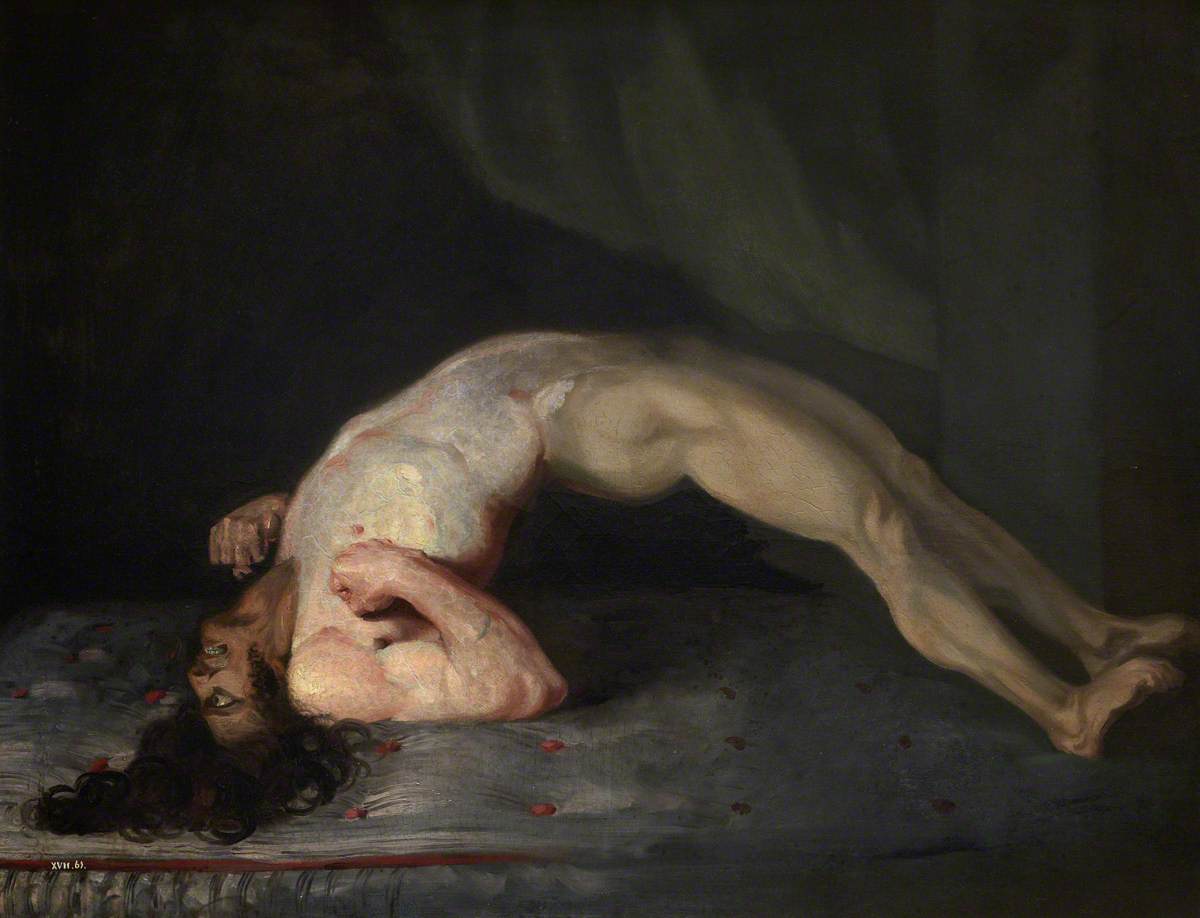
Opisthotonus or opisthotonos (from Ancient Greek: ὄπισθεν, romanized: opisthen, lit. 'behind' and τόνος, tonos, 'tension') is a state of severe hyperextension and spasticity in which an individual's head, neck and spinal column enter into a complete "bridging" or "arching" position.
This extreme arched pose is an extrapyramidal effect and is caused by spasm of the axial muscles along the spinal column. Among extant animals it naturally occurs in birds, snakes suffering from advanced boid inclusion body disease, and placental mammals; it is also observed in some articulated dinosaur fossils.
Opisthotonus is a symptom of some cases of severe cerebral palsy and traumatic brain injury, or as a result of the severe muscular spasms associated with tetanus. It can be a feature of severe acute hydrocephalus, poisoning, and drowning.[citation needed]
Opisthotonus is more pronounced in infants. Opisthotonus in the neonate may be a symptom of meningitis, tetanus, severe kernicterus, or the rare maple syrup urine disease. This marked extensor tone can cause infants to "rear backwards" and stiffen out as the mother or nurse attempts to hold or feed them. Individuals with opisthotonus are quite challenging to position, especially in wheelchairs and car seats.[citation needed]
Opisthotonus can be triggered by any attempt at movement, such as smiling, feeding, speech, or by involuntary movement, such as seizures. A similar tonic posturing may be seen in Sandifer syndrome.[citation needed]
Opisthotonus can sometimes be seen in lithium intoxication. It is a rare extrapyramidal side effect of phenothiazines, haloperidol, and metoclopramide.[citation needed]
Opisthotonus with the presence of the risus sardonicus is also a symptom of strychnine poisoning and prussic acid (hydrogen cyanide) poisoning.[citation needed]
Opisthotonus is seen with drowning victims – called the "opisthotonic death pose". This pose is also common in complete dinosaur skeletal fossils and it has been suggested that this is due to the animal drowning or being immersed in water soon after death.
Hub AI
Opisthotonus AI simulator
(@Opisthotonus_simulator)
Opisthotonus
Opisthotonus or opisthotonos (from Ancient Greek: ὄπισθεν, romanized: opisthen, lit. 'behind' and τόνος, tonos, 'tension') is a state of severe hyperextension and spasticity in which an individual's head, neck and spinal column enter into a complete "bridging" or "arching" position.
This extreme arched pose is an extrapyramidal effect and is caused by spasm of the axial muscles along the spinal column. Among extant animals it naturally occurs in birds, snakes suffering from advanced boid inclusion body disease, and placental mammals; it is also observed in some articulated dinosaur fossils.
Opisthotonus is a symptom of some cases of severe cerebral palsy and traumatic brain injury, or as a result of the severe muscular spasms associated with tetanus. It can be a feature of severe acute hydrocephalus, poisoning, and drowning.[citation needed]
Opisthotonus is more pronounced in infants. Opisthotonus in the neonate may be a symptom of meningitis, tetanus, severe kernicterus, or the rare maple syrup urine disease. This marked extensor tone can cause infants to "rear backwards" and stiffen out as the mother or nurse attempts to hold or feed them. Individuals with opisthotonus are quite challenging to position, especially in wheelchairs and car seats.[citation needed]
Opisthotonus can be triggered by any attempt at movement, such as smiling, feeding, speech, or by involuntary movement, such as seizures. A similar tonic posturing may be seen in Sandifer syndrome.[citation needed]
Opisthotonus can sometimes be seen in lithium intoxication. It is a rare extrapyramidal side effect of phenothiazines, haloperidol, and metoclopramide.[citation needed]
Opisthotonus with the presence of the risus sardonicus is also a symptom of strychnine poisoning and prussic acid (hydrogen cyanide) poisoning.[citation needed]
Opisthotonus is seen with drowning victims – called the "opisthotonic death pose". This pose is also common in complete dinosaur skeletal fossils and it has been suggested that this is due to the animal drowning or being immersed in water soon after death.
Recent media