
.jpg/250px-Trimeresurus_sabahi_fucatus,_Banded_pit_viper_-_Takua_Pa_District,_Phang-nga_Province_(46710893582).jpg)


.jpg/2000px-Trimeresurus_sabahi_fucatus,_Banded_pit_viper_-_Takua_Pa_District,_Phang-nga_Province_(46710893582).jpg)
Community hub
Recent from talks
Contribute something
Nothing was collected or created yet.
Snake
View on Wikipedia
 | This article may require cleanup to meet Wikipedia's quality standards. The specific problem is: uncited text, undue weight and bad structure. (June 2024) |
| Snake | |
|---|---|
.jpg)
| |
| Trimeresurus sabahi | |
Scientific classification 
| |
| Kingdom: | Animalia |
| Phylum: | Chordata |
| Class: | Reptilia |
| Order: | Squamata |
| Clade: | Toxicofera |
| Clade: | Ophidia |
| Suborder: | Serpentes Linnaeus, 1758 |
| Infraorders | |
| |

| |
| Approximate world distribution of snakes, all species | |
Snakes are elongated limbless reptiles of the suborder Serpentes (/sɜːrˈpɛntiːz/).[2] Cladistically squamates, snakes are ectothermic, amniote vertebrates covered in overlapping scales much like other members of the group. Many species of snakes have skulls with several more joints than their lizard ancestors and relatives, enabling them to swallow prey much larger than their heads (cranial kinesis). To accommodate their narrow bodies, snakes' paired organs (such as kidneys) appear one in front of the other instead of side by side, and most only have one functional lung. Some species retain a pelvic girdle with a pair of vestigial claws on either side of the cloaca. Lizards have independently evolved elongate bodies without limbs or with greatly reduced limbs at least twenty-five times via convergent evolution, leading to many lineages of legless lizards.[3] These resemble snakes, but several common groups of legless lizards have eyelids and external ears, which snakes lack, although this rule is not universal (see Amphisbaenia, Dibamidae, and Pygopodidae).
Living snakes are found on every continent except Antarctica, and on most smaller land masses; exceptions include some large islands, such as Ireland, Iceland, Greenland, and the islands of New Zealand, as well as many small islands of the Atlantic and central Pacific oceans.[4] Additionally, sea snakes are widespread throughout the Indian and Pacific oceans. Around thirty families are currently recognized, comprising about 520 genera and about more than 4,170 species.[5] They range in size from the tiny, 10.4 cm-long (4.1 in) Barbados threadsnake[6] to the reticulated python of 6.95 meters (22.8 ft) in length.[7] The fossil species Titanoboa cerrejonensis was 12.8 meters (42 ft) long.[8] Snakes are thought to have evolved from either burrowing or aquatic lizards, perhaps during the Jurassic period, with the earliest known fossils dating to between 143 and 167 Ma ago.[9][10] The diversity of modern snakes appeared during the Paleocene epoch (c. 66 to 56 Ma ago, after the Cretaceous–Paleogene extinction event). The oldest preserved descriptions of snakes can be found in the Brooklyn Papyrus.
Most species of snake are nonvenomous and those that have venom use it primarily to kill and subdue prey rather than for self-defense. Some possess venom that is potent enough to cause painful injury or death to humans. Nonvenomous snakes either swallow prey alive or kill by constriction.
Etymology
[edit]The English word snake comes from Old English snaca, itself from Proto-Germanic *snak-an- (cf. Germanic Schnake 'ring snake', Swedish snok 'grass snake'), from Proto-Indo-European root *(s)nēg-o- 'to crawl to creep', which also gave sneak as well as Sanskrit nāgá 'snake'.[11] The word ousted adder, as adder went on to narrow in meaning, though in Old English næddre was the general word for snake.[12] The other term, serpent, is from French, ultimately from Indo-European *serp- 'to creep',[13] which also gave Ancient Greek ἕρπω (hérpō) 'I crawl' and Sanskrit sarpá 'snake'.[14]
Taxonomy
[edit]All modern snakes are grouped within the suborder Serpentes in Linnean taxonomy, part of the order Squamata, though their precise placement within squamates remains controversial.[15]
The two infraorders of Serpentes are Alethinophidia and Scolecophidia.[15] This separation is based on morphological characteristics and mitochondrial DNA sequence similarity. Alethinophidia is sometimes split into Henophidia and Caenophidia, with the latter consisting of "colubroid" snakes (colubrids, vipers, elapids, hydrophiids, and atractaspids) and acrochordids, while the other alethinophidian families comprise Henophidia.[16] While not extant today, the Madtsoiidae, a family of giant, primitive, python-like snakes, lived until 50,000 years ago in Australia, represented by genera such as Wonambi.[17]
Recent molecular studies support the monophyly of the clades of modern snakes, scolecophidians, typhlopids + anomalepidids, alethinophidians, core alethinophidians, uropeltids (Cylindrophis, Anomochilus, uropeltines), macrostomatans, booids, boids, pythonids and caenophidians.[18]
Families
[edit]| Infraorder Alethinophidia 25 families | |||||
| Family[5] | Taxon author[5] | Genera[5] | Species[5] | Common name | Geographic range[19] |
|---|---|---|---|---|---|
| Acrochordidae | Bonaparte, 1831 | 1 | 3 | Wart snakes | Western India and Sri Lanka through tropical Southeast Asia to the Philippines, south through the Indonesian/Malaysian island group to Timor, east through New Guinea to the northern coast of Australia to Mussau Island, the Bismarck Archipelago and Guadalcanal Island in the Solomon Islands. |
| Aniliidae | Stejneger, 1907 | 1 | 1 | False coral snake | Tropical South America. |
| Anomochilidae | Cundall, Wallach, 1993 | 1 | 3 | Dwarf pipe snakes | West Malaysia and on the Indonesian island of Sumatra. |
| Atractaspididae | Günther, 1858 | 12 | 72 | Burrowing asps | Africa and the Middle East |
| Boidae | Gray, 1825 | 14 | 61 | Boas | Northern, Central and South America, the Caribbean, southeastern Europe and Asia Minor, Northern, Central and East Africa, Madagascar and Reunion Island, the Arabian Peninsula, Central and southwestern Asia, India and Sri Lanka, the Moluccas and New Guinea through to Melanesia and Samoa. |
| Bolyeriidae | Hoffstetter, 1946 | 2 | 2 | Splitjaw snakes | Mauritius. |
| Colubridae | Oppel, 1811 | 258[5] | 2055[5] | Typical snakes | Widespread on all continents, except Antarctica.[20] |
| Cyclocoridae | Weinell & Brown, 2017 | 5 | 8 | Cyclocorids | The Philippines |
| Cylindrophiidae | Fitzinger, 1843 | 1 | 14 | Asian pipe snakes | Sri Lanka east through Myanmar, Thailand, Cambodia, Vietnam and the Malay Archipelago to as far east as Aru Islands off the southwestern coast of New Guinea. Also found in southern China (Fujian, Hong Kong and on Hainan Island) and in Laos. |
| Elapidae | Boie, 1827 | 55 | 389 | Elapids | On land, worldwide in tropical and subtropical regions, except in Europe. Sea snakes occur in the Indian Ocean and the Pacific.[21] |
| Homalopsidae | Bonaparte, 1845 | 28 | 53 | Homalopsids | Southeastern Asia and northern Australia. |
| Lamprophiidae | Fitzinger, 1843 | 16 | 89 | Lamprophiids (formerly included Atracaspididae, Psammophiidae, and several other families) | Africa (including the Seychelles) |
| Loxocemidae | Cope, 1861 | 1 | 1 | Mexican burrowing snake | Along the Pacific versant from Mexico south to Costa Rica. |
| Micrelapidae | Das et al., 2023 | 1 | 4 | Two-headed snakes | Eastern Africa and the Levant |
| Pareidae | Romer, 1956 | 3 | 20 | Snail-eating snakes | Southeast Asia and islands on the Sunda Shelf (Sumatra, Borneo, Java, and their surrounding smaller islands). |
| Prosymnidae | Kelly, Barker, Villet & Broadley, 2009 | 1 | 16 | Shovel-snout snakes | Subsaharan Africa |
| Psammodynastidae | Das et al., 2024 | 1 | 2 | Mock vipers | Tropical Asia |
| Psammophiidae | Bourgeois, 1968 | 8 | 55 | Psammophiids | Africa (including Madagascar), Asia and southern Europe |
| Pseudaspididae | Cope, 1893 | 2 | 2 | Pseudaspidids | Subsaharan Africa |
| Pseudoxyrhophiidae | Dowling, 1975 | 22 | 89 | Pseudoxyrhophiids | Mostly Madagascar and the Comoros; 5 species in subsaharan Africa, 1 in Socotra |
| Pythonidae | Fitzinger, 1826 | 8 | 40 | Pythons | Subsaharan Africa, India, Myanmar, southern China, Southeast Asia and from the Philippines southeast through Indonesia to New Guinea and Australia. |
| Tropidophiidae | Brongersma, 1951 | 2 | 34 | Dwarf boas | West Indies; also Panama and northwestern South America, as well as in northwestern and southeastern Brazil. |
| Uropeltidae | Müller, 1832 | 8 | 55 | Shield-tailed snakes | Southern India and Sri Lanka. |
| Viperidae | Oppel, 1811 | 35 | 341 | Vipers | The Americas, Africa, and Eurasia east to Wallace's Line. |
| Xenodermidae | Cope, 1900 | 6 | 18 | Dragon and odd-scaled snakes | East Asia, Southern and southeastern Asia, and islands on the Sunda Shelf (Sumatra, Borneo, Java, and their surrounding smaller islands). |
| Xenopeltidae | Bonaparte, 1845 | 1 | 2 | Sunbeam snakes | Southeast Asia from the Andaman and Nicobar Islands, east through Myanmar to southern China, Thailand, Laos, Cambodia, Vietnam, the Malay Peninsula and the East Indies to Sulawesi, as well as the Philippines. |
| Xenophidiidae | Wallach & Günther, 1998 | 1 | 2 | Spine-jawed snakes | Borneo and peninsular Malaysia. |
| Infraorder Scolecophidia 5 families | |||||
| Family[5] | Taxon author[5] | Genera[5] | Species[5] | Common name | Geographic range[19] |
|---|---|---|---|---|---|
| Anomalepidae | Taylor, 1939 | 4 | 18 | Primitive blind snakes | From southern Central America to northwestern South America. Disjunct populations in northeastern and southeastern South America. |
| Gerrhopilidae | Vidal, Wynn, Donnellan and Hedges 2010 | 2 | 18 | Indo-Malayan blindsnakes | Southern and southeastern Asia, including Sri Lanka, the Philippines, and New Guinea. |
| Leptotyphlopidae | Stejneger, 1892 | 13 | 139 | Slender blind snakes | Africa, western Asia from Turkey to northwestern India, on Socotra Island, from the southwestern United States south through Mexico and Central to South America, though not in the high Andes. In Pacific South America they occur as far south as southern coastal Peru, and on the Atlantic side as far as Uruguay and Argentina. In the Caribbean they are found on the Bahamas, Hispaniola and the Lesser Antilles. |
| Typhlopidae | Merrem, 1820 | 18 | 266 | Typical blind snakes | Most tropical and many subtropical regions around the world, particularly in Africa, Madagascar, Asia, islands in the Pacific, tropical America and in southeastern Europe. |
| Xenotyphlopidae | Vidal, Vences, Branch and Hedges 2010 | 1 | 1 | Round-nosed blindsnake | Northern Madagascar. |
Legless lizards
[edit]While snakes are limbless reptiles, evolved from (and grouped with) lizards, there are many other species of lizards that have lost their limbs independently but which superficially look similar to snakes. These include the slowworm, glass snake, and amphisbaenians.[22]
Evolution
[edit]| A family level phylogenetic overview of modern snakes. | |||
|
The fossil record of snakes is relatively poor because snake skeletons are typically small and fragile making fossilization uncommon. Fossils readily identifiable as snakes (though often retaining hind limbs) first appear in the fossil record during the Cretaceous period.[24] The earliest known true snake fossils (members of the crown group Serpentes) come from the marine simoliophiids, the oldest of which is the Late Cretaceous (Cenomanian age) Haasiophis terrasanctus from the West Bank,[1] dated to between 112 and 94 million years old.[25]
Based on genomic analysis it is certain that snakes descend from lizards.[23] This conclusion is also supported by comparative anatomy, and the fossil record.[26]: 11 [27][23]
Pythons and boas—primitive groups among modern snakes—have vestigial hind limbs: tiny, clawed digits known as anal spurs, which are used to grasp during mating.[26]: 11 [28] The families Leptotyphlopidae and Typhlopidae also possess remnants of the pelvic girdle, appearing as horny projections when visible.
Front limbs are nonexistent in all known snakes. This is caused by the evolution of their Hox genes, controlling limb morphogenesis. The axial skeleton of the snakes' common ancestor, like most other tetrapods, had regional specializations consisting of cervical (neck), thoracic (chest), lumbar (lower back), sacral (pelvic), and caudal (tail) vertebrae. Early in snake evolution, the Hox gene expression in the axial skeleton responsible for the development of the thorax became dominant. As a result, the vertebrae anterior to the hindlimb buds (when present) all have the same thoracic-like identity (except from the atlas, axis, and 1–3 neck vertebrae). In other words, most of a snake's skeleton is an extremely extended thorax. Ribs are found exclusively on the thoracic vertebrae. Neck, lumbar and pelvic vertebrae are very reduced in number (only 2–10 lumbar and pelvic vertebrae are present), while only a short tail remains of the caudal vertebrae. However, the tail is still long enough to be of important use in many species, and is modified in some aquatic and tree-dwelling species.[citation needed]
Many modern snake groups originated during the Paleocene, alongside the adaptive radiation of mammals following the extinction of (non-avian) dinosaurs. The expansion of grasslands in North America also led to an explosive radiation among snakes.[29] Previously, snakes were a minor component of the North American fauna, but during the Miocene, the number of species and their prevalence increased dramatically with the first appearances of vipers and elapids in North America and the significant diversification of Colubridae (including the origin of many modern genera such as Nerodia, Lampropeltis, Pituophis, and Pantherophis).[29]
Fossils
[edit]There is fossil evidence to suggest that snakes may have evolved from burrowing lizards during the Cretaceous Period.[30][31] An early fossil snake relative, Najash rionegrina, was a two-legged burrowing animal with a sacrum, and was fully terrestrial.[32] Najash, which lived 95 million years ago, also had a skull with several features typical for lizards, but had evolved some of the mobile skull joints that define the flexible skull in most modern snakes. The species did not show any resemblances to the modern burrowing blind snakes, which have often been seen as the most primitive group of extant forms.[33] One extant analog of these putative ancestors is the earless monitor Lanthanotus of Borneo (though it is also semiaquatic).[34] Subterranean species evolved bodies streamlined for burrowing, and eventually lost their limbs.[34] According to this hypothesis, features such as the transparent, fused eyelids (brille) and loss of external ears evolved to cope with fossorial difficulties, such as scratched corneas and dirt in the ears.[31][34] Some primitive snakes are known to have possessed hindlimbs, but their pelvic bones lacked a direct connection to the vertebrae. These include fossil species like Haasiophis, Pachyrhachis and Eupodophis, which are slightly older than Najash.[28]
This hypothesis was strengthened in 2015 by the discovery of a 113-million-year-old fossil of a four-legged snake in Brazil that has been named Tetrapodophis amplectus. It has many snake-like features, is adapted for burrowing and its stomach indicates that it was preying on other animals.[35] It is currently uncertain if Tetrapodophis is a snake or another species, in the squamate order, as a snake-like body has independently evolved at least 26 times. Tetrapodophis does not have distinctive snake features in its spine and skull.[36][37] A study in 2021 places the animal in a group of extinct marine lizards from the Cretaceous period known as dolichosaurs and not directly related to snakes.[38]
An alternative hypothesis, based on morphology, suggests the ancestors of snakes were related to mosasaurs—extinct aquatic reptiles from the Cretaceous—forming the clade Pythonomorpha.[27] According to this hypothesis, the fused, transparent eyelids of snakes are thought to have evolved to combat marine conditions (corneal water loss through osmosis), and the external ears were lost through disuse in an aquatic environment. This ultimately led to an animal similar to today's sea snakes. In the Late Cretaceous, snakes recolonized land, and continued to diversify into today's snakes. Fossilized snake remains are known from early Late Cretaceous marine sediments, which is consistent with this hypothesis; particularly so, as they are older than the terrestrial Najash rionegrina. Similar skull structure, reduced or absent limbs, and other anatomical features found in both mosasaurs and snakes lead to a positive cladistical correlation, although some of these features are shared with varanids.[citation needed]
Genetic studies in recent years have indicated snakes are not as closely related to monitor lizards as was once believed—and therefore not to mosasaurs, the proposed ancestor in the aquatic scenario of their evolution. However, more evidence links mosasaurs to snakes than to varanids. Fragmented remains found from the Jurassic and Early Cretaceous indicate deeper fossil records for these groups, which may potentially refute either hypothesis.[39][40]
-
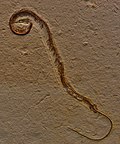
-

-

-
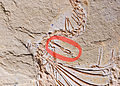 Eupodophis descouensi hind leg


Genetic basis of snake evolution
[edit]Both fossils and phylogenetic studies demonstrate that snakes evolved from lizards, hence the question became which genetic changes led to limb loss in the snake ancestor. Limb loss is actually very common in extant reptiles and has happened dozens of times within skinks, anguids, and other lizards.[41]
In 2016, two studies reported that limb loss in snakes is associated with DNA mutations in the Zone of Polarizing Activity Regulatory Sequence (ZRS), a regulatory region of the sonic hedgehog gene which is critically required for limb development. More advanced snakes have no remnants of limbs, but basal snakes such as pythons and boas do have traces of highly reduced, vestigial hind limbs. Python embryos even have fully developed hind limb buds, but their later development is stopped by the DNA mutations in the ZRS.[42][43][44][45]
Distribution
[edit]There are about 3,900 species of snakes,[46] ranging as far northward as the Arctic Circle in Scandinavia and southward through Australia.[27] Snakes can be found on every continent except Antarctica, as well as in the sea, and as high as 16,000 feet (4,900 m) in the Himalayan Mountains of Asia.[27][47]: 143 There are numerous islands from which snakes are absent, such as Ireland, Iceland, and New Zealand[4][47] (although New Zealand's northern waters are infrequently visited by the yellow-bellied sea snake and the banded sea krait).[48]
Biology
[edit]
Size
[edit]The now extinct Titanoboa cerrejonensis was 12.8 m (42 ft) in length.[8] By comparison, the largest extant snakes are the reticulated python, measuring about 6.95 m (22.8 ft) long,[7] and the green anaconda, which measures about 5.21 m (17.1 ft) long and is considered the heaviest snake on Earth at 97.5 kg (215 lb).[49]
At the other end of the scale, the smallest extant snake is Leptotyphlops carlae, with a length of about 10.4 cm (4.1 in).[6] Most snakes are fairly small animals, approximately 1 m (3.3 ft) in length.[50]
Perception
[edit]The sensory systems of snakes, particularly those of the Crotalidae family, commonly known as pit vipers, are among the most specialized in the animal kingdom. Pit vipers, which include rattlesnakes and related species, possess all the sensory organs found in other snakes, as well as additional adaptations. These include specialized infrared-sensitive receptors, known as pits, located on either side of the head between the nostrils and eyes. These pits, which resemble an additional pair of nostrils, are highly developed and allow pit vipers to detect minute temperature changes. Each pit consists of two cavities: a larger outer cavity positioned just behind and below the nostril, and a smaller inner cavity. These cavities are connected internally by a membrane containing nerves highly sensitive to thermal variations. The forward-facing pits create a combined field of detection, enabling pit vipers to distinguish objects from their surroundings and accurately judge distances. The sensitivity of these pits allows them to detect temperature differences as small as one-third of a degree Fahrenheit. Other infrared-sensitive snakes, such as those in the Boidae family, possess multiple smaller labial pits along the upper lip, just below the nostrils.[51]
Snakes rely heavily on their sense of smell to track prey. They collect particles from the air, ground, or water using their forked tongue, which are then transferred to the vomeronasal organ (also known as Jacobson's organ) in the mouth for analysis.[51] The forked structure of the tongue provides directional information of smell which helps locate prey or predators. In aquatic species, such as the anaconda, the tongue functions efficiently underwater.[51] When the tongue is retracted, the forked tips are pressed into the cavities of the Jacobson's organ, enabling a combined taste-smell analysis that provides the snake with detailed information about its environment.[52][page needed][51]

Until the mid-20th century, it was widely believed that snakes were unable to hear.[53][54] However, snakes possess two distinct auditory systems. One system, the somatic system, involves the transmission of vibrations through ventral skin receptors to the spine. The other system involves vibrations transmitted through the snake's elongated lung to the brain via cranial nerves. Snakes exhibit high sensitivity to vibrations, allowing them to detect even subtle sounds, such as soft speech, in quiet environments.[53][51][54]
Snake vision varies significantly among species. While some snakes have keen eyesight, others can only distinguish light from dark. However, most snakes possess visual acuity sufficient to track movement.[55] Arboreal snakes generally have better vision than burrowing species. Some snakes, such as the Asian vine snake, possess binocular vision, enabling both eyes to focus on the same point. Most snakes focus by moving the lens back and forth relative to the retina. Diurnal snakes typically have round pupils, while many nocturnal species have slit pupils. Most snakes possess three visual pigments, allowing them to perceive two primary colors in daylight. Certain species, such as the annulated sea snake and members of the genus Helicops, have regained significant color vision as an adaptation to their aquatic environments.[56][57] Research suggests that the last common ancestor of all snakes had UV-sensitive vision. However, many diurnal snakes have evolved lenses that filter out UV light, likely improving contrast and sharpening their vision.[58][59]
Skin
[edit]The skin of a snake is covered in scales. Contrary to the popular notion of snakes being slimy (because of possible confusion of snakes with worms), snakeskin has a smooth, dry texture. Most snakes use specialized belly scales to travel, allowing them to grip surfaces. The body scales may be smooth, keeled, or granular. The eyelids of a snake are transparent "spectacle" scales, also known as brille, which remain permanently closed.[citation needed]
For a snake, the skin has been modified to its specialized form of locomotion. Between the inner layer and the outer layer lies the dermis, which contains all the pigments and cells that make up the snake's distinguishing pattern and color. The epidermis, or outer layer, is formed of a substance called keratin, which in mammals is the same basic material that forms nails, claws, and hair. The snake's epidermis of keratin provides it with the armor it needs to protect its internal organs and reduce friction as it passes over rocks. Parts of this keratin armor are rougher than others. The less restricted portion overlaps the front of the scale beneath it. Between them lies a folded back connecting material, also of keratin, also part of the epidermis. This folded back material gives as the snake undulates or eats things bigger than the circumference of its body.[52][page needed]
The shedding of scales is called ecdysis (or in normal usage, molting or sloughing). Snakes shed the complete outer layer of skin in one piece.[60] Snake scales are not discrete, but extensions of the epidermis—hence they are not shed separately but as a complete outer layer during each molt, akin to a sock being turned inside out.[61]
Snakes have a wide diversity of skin coloration patterns which are often related to behavior, such as the tendency to have to flee from predators. Snakes that are at a high risk of predation tend to be plain, or have longitudinal stripes, providing few reference points to predators, thus allowing the snake to escape without being noticed. Plain snakes usually adopt active hunting strategies, as their pattern allows them to send little information to prey about motion. Blotched snakes usually use ambush-based strategies, likely because it helps them blend into an environment with irregularly shaped objects, like sticks or rocks. Spotted patterning can similarly help snakes to blend into their environment.[62]
The shape and number of scales on the head, back, and belly are often characteristic and used for taxonomic purposes. Scales are named mainly according to their positions on the body. In "advanced" (Caenophidian) snakes, the broad belly scales and rows of dorsal scales correspond to the vertebrae, allowing these to be counted without the need for dissection.[citation needed]
Molting
[edit]
Molting (or "ecdysis") serves a number of purposes - it allows old, worn skin to be replaced and can be synced to mating cycles, as with other animals. Molting occurs periodically throughout the life of a snake. Before each molt, the snake regulates its diet and seeks defensible shelter. Just before shedding, the skin becomes grey and the snake's eyes turn silvery. The inner surface of the old skin liquefies, causing it to separate from the new skin beneath it. After a few days, the eyes clear and the snake reaches out of its old skin, which splits. The snake rubs its body against rough surfaces to aid in the shedding of its old skin. In many cases, the castaway skin peels backward over the body from head to tail in one piece, like taking the dust jacket off a book, revealing a new, larger, brighter layer of skin which has formed underneath.[61][63] Renewal of the skin by molting supposedly increases the mass of some animals such as insects, but in the case of snakes this has been disputed.[61][64] Shedding skin can release pheromones and revitalize color and patterns of the skin to increase attraction of mates.[65]

Snakes may shed four or five times a year, depending on the weather conditions, food supply, age of the snake, and other factors.[52][page needed][63] It is theoretically possible to identify the snake from its cast skin if it is reasonably intact.[61] Mythological associations of snakes with symbols of healing and medicine, as pictured in the Rod of Asclepius, are derivative of molting.[66]
One can attempt to identify the sex of a snake when the species is not distinctly sexually dimorphic by counting scales. The cloaca is probed and measured against the subcaudal scales.[67] Counting scales determines whether a snake is a male or female, as the hemipenes of a male being probed is usually longer.[67][clarification needed]
Skeleton
[edit]_skull_1_(cropped).jpg)
The skull of a snake differs from a lizards in several ways. Snakes have more flexible jaws, that is, instead of a juncture at the upper and lower jaw, the snake's jaws are connected by a bone hinge that is called the quadrate bone. Between the two halves of the lower jaw at the chin there is an elastic ligament that allows for a separation. This allows the snake to swallow food larger in proportion to their size and go longer without it, since snakes ingest relatively more in one feeding.[68] Because the sides of the lower jaw can move independently of one another, a snake resting its jaw on a surface has stereo auditory perception, used for detecting the position of prey. The jaw–quadrate–stapes pathway is capable of detecting vibrations on the angstrom scale, despite the absence of an outer ear and the lack of an impedance matching mechanism—provided by the ossicles in other vertebrates.[69][70] In a snake's skull the brain is well protected. As brain tissues could be damaged through the palate, this protection is especially valuable. The solid and complete neurocranium of snakes is closed at the front.[52][page needed][71]

The skeleton of most snakes consists solely of the skull, hyoid, vertebral column, and ribs, though henophidian snakes retain vestiges of the pelvis and rear limbs. The hyoid is a small bone located posterior and ventral to the skull, in the 'neck' region, which serves as an attachment for the muscles of the snake's tongue, as it does in all other tetrapods. The vertebral column consists of between 200 and 400 vertebrae, or sometimes more. The body vertebrae each have two ribs articulating with them. The tail vertebrae are comparatively few in number (often less than 20% of the total) and lack ribs. The vertebrae have projections that allow for strong muscle attachment, enabling locomotion without limbs.[citation needed]
Caudal autotomy (self-amputation of the tail), a feature found in some lizards, is absent in most snakes.[72] In the rare cases where it does exist in snakes, caudal autotomy is intervertebral (meaning the separation of adjacent vertebrae), unlike that in lizards, which is intravertebral, i.e. the break happens along a predefined fracture plane present on a vertebra.[73][74]
In some snakes, most notably boas and pythons, there are vestiges of the hindlimbs in the form of a pair of pelvic spurs. These small, claw-like protrusions on each side of the cloaca are the external portion of the vestigial hindlimb skeleton, which includes the remains of an ilium and femur.[citation needed]
Snakes are polyphyodonts with teeth that are continuously replaced.[75]
Internal organs
[edit]
- esophagus
- trachea
- tracheal lungs
- rudimentary left lung
- right lung
- heart
- liver
- stomach
- air sac
- gallbladder
- pancreas
- spleen
- intestine
- testicles
- kidneys
Snakes and other non-archosaur (crocodilians, dinosaurs + birds and allies) reptiles have a three-chambered heart that controls the circulatory system via the left and right atrium, and one ventricle.[76] Internally, the ventricle is divided into three interconnected cavities: the cavum arteriosum, the cavum pulmonale, and the cavum venosum.[77] The cavum venosum receives deoxygenated blood from the right atrium and the cavum arteriosum receives oxygenated blood from the left atrium. Located beneath the cavum venosum is the cavum pulmonale, which pumps blood to the pulmonary trunk.[78]
The snake's heart is encased in a sac, called the pericardium, located at the bifurcation of the bronchi. The heart is able to move around, owing to the lack of a diaphragm; this adjustment protects the heart from potential damage when large ingested prey is passed through the esophagus. The spleen is attached to the gall bladder and pancreas and filters the blood. The thymus, located in fatty tissue above the heart, is responsible for the generation of immune cells in the blood. The cardiovascular system of snakes is unique for the presence of a renal portal system in which the blood from the snake's tail passes through the kidneys before returning to the heart.[79]
The circulatory system of a snake is basically like those of any other vertebrae. However, snakes do not regulate internally the temperature of their blood. Called cold-blooded, snakes actually have blood that is responsive to the varying temperature of the immediate environment. Snakes can regulate blood temperature by moving. Too long in direct sunlight, the snakes' blood is heated beyond tolerance. Left in the ice or snow, the snake may freeze. In temperate zones with pronounced seasonal changes, snakes denning together have adapted to the onslaught of winter.[52][page needed]
The vestigial left lung is often small or sometimes even absent, as snakes' tubular bodies require all of their organs to be long and thin.[79] In the majority of species, only one lung is functional. This lung contains a vascularized anterior portion and a posterior portion that does not function in gas exchange.[79] This 'saccular lung' is used for hydrostatic purposes to adjust buoyancy in some aquatic snakes and its function remains unknown in terrestrial species.[79] Many organs that are paired, such as kidneys or reproductive organs, are staggered within the body, one located ahead of the other.[79]
The snake with its particular arrangement of organs may achieve a greater efficiency.[compared to?] For example, the lung encloses at the part nearest the head and throat an oxygen intake organ, while the other half is used for air reserve. The esophagus-stomach-intestine arrangement is a straight line. It ends where intestinal, urinary, and reproductive tracts open, in a chamber called the cloaca.[52][page needed]
Snakes have no lymph nodes.[79]
Venom
[edit]1.jpg)

Cobras, vipers, and closely related species use venom to immobilize, injure, or kill their prey. The venom is modified saliva, delivered through fangs.[26][80]: 243 The fangs of 'advanced' venomous snakes like viperids and elapids are hollow, allowing venom to be injected more effectively, and the fangs of rear-fanged snakes such as the boomslang simply have a groove on the posterior edge to channel venom into the wound. Snake venoms are often prey-specific, and their role in self-defense is secondary.[26][80]: 243
Venom, like all salivary secretions, is a predigestant that initiates the breakdown of food into soluble compounds, facilitating proper digestion. Even nonvenomous snakebites (like any animal bite) cause tissue damage.[26][80]: 209
.jpg)
Certain birds, mammals, and other snakes (such as kingsnakes) that prey on venomous snakes have developed resistance and even immunity to certain venoms.[26]: 243 Venomous snakes include three families of snakes, and do not constitute a formal taxonomic classification group.[citation needed]
The colloquial term "poisonous snake" is generally an incorrect label for snakes. A poison is inhaled or ingested, whereas venom produced by snakes is injected into its victim via fangs.[81] There are, however, two exceptions: Rhabdophis sequesters toxins from the toads it eats, then secretes them from nuchal glands to ward off predators; and a small unusual population of garter snakes in the US state of Oregon retains enough toxins in their livers from ingested newts to be effectively poisonous to small local predators (such as crows and foxes).[82]
Snake venoms are complex mixtures of proteins,[80] and are stored in venom glands at the back of the head.[82] In all venomous snakes, these glands open through ducts into grooved or hollow teeth in the upper jaw.[26]: 243 [81] The proteins can potentially be a mix of neurotoxins (which attack the nervous system), hemotoxins (which attack the circulatory system), cytotoxins (which attack the cells directly), bungarotoxins (related to neurotoxins, but also directly affect muscle tissue), and many other toxins that affect the body in different ways.[81][80] Almost all snake venom contains hyaluronidase, an enzyme that ensures rapid diffusion of the venom.[26]: 243
Venomous snakes that use hemotoxins usually have fangs in the front of their mouths, making it easier for them to inject the venom into their victims.[80][81] Some snakes that use neurotoxins (such as the mangrove snake) have fangs in the back of their mouths, with the fangs curled backwards.[83] This makes it difficult both for the snake to use its venom and for scientists to milk them.[81] Elapids, however, such as cobras and kraits are proteroglyphous—they possess hollow fangs that cannot be erected toward the front of their mouths, and cannot "stab" like a viper. They must actually bite the victim.[26]: 242
It has been suggested that all snakes may be venomous to a certain degree, with harmless snakes having weak venom and no fangs.[84] According to this theory, most snakes that are labelled "nonvenomous" would be considered harmless because they either lack a venom delivery method or are incapable of delivering enough to endanger a human. The theory postulates that snakes may have evolved from a common lizard ancestor that was venomous, and also that venomous lizards like the gila monster, beaded lizard, monitor lizards, and the now-extinct mosasaurs, may have derived from this same common ancestor. They share this "venom clade" with various other saurian species.[citation needed]
Venomous snakes are classified in two taxonomic families:
- Elapids – cobras including king cobras, kraits, mambas, Australian copperheads, sea snakes, and coral snakes.[83]
- Viperids – vipers, rattlesnakes, copperheads/cottonmouths, and bushmasters.[83]
There is a third family containing the opistoglyphous (rear-fanged) snakes (as well as the majority of other snake species):
- Colubrids – boomslangs, tree snakes, vine snakes, cat snakes, although not all colubrids are venomous.[26]: 209 [83]
Reproduction
[edit]
Although a wide range of reproductive modes are used by snakes, all employ internal fertilization. This is accomplished by means of paired, forked hemipenes, which are stored, inverted, in the male's tail.[85] The hemipenes are often grooved, hooked, or spined—designed to grip the walls of the female's cloaca.[86][85] The clitoris of the female snake consists of two structures located between the cloaca and the scent glands.[87]
Most species of snakes lay eggs which they abandon shortly after laying. However, a few species (such as the king cobra) construct nests and stay in the vicinity of the hatchlings after incubation.[85] Most pythons coil around their egg-clutches and remain with them until they hatch.[88] A female python will not leave the eggs, except to occasionally bask in the sun or drink water. She will even "shiver" to generate heat to incubate the eggs.[88]
Some species of snake are ovoviviparous and retain the eggs within their bodies until they are almost ready to hatch.[89][90] Several species of snake, such as the boa constrictor and green anaconda, are fully viviparous, nourishing their young through a placenta as well as a yolk sac; this is highly unusual among reptiles, and normally found in requiem sharks or placental mammals.[89][90] Retention of eggs and live birth are most often associated with colder environments.[85][90]

Sexual selection in snakes is demonstrated by the 3,000 species that each use different tactics in acquiring mates.[91] Ritual combat between males for the females they want to mate with includes topping, a behavior exhibited by most viperids in which one male will twist around the vertically elevated fore body of its opponent and force it downward. It is common for neck-biting to occur while the snakes are entwined.[92]
Facultative parthenogenesis
[edit]Parthenogenesis is a natural form of reproduction in which growth and development of embryos occur without fertilization. Agkistrodon contortrix (copperhead) and Agkistrodon piscivorus (cottonmouth) can reproduce by facultative parthenogenesis, meaning that they are capable of switching from a sexual mode of reproduction to an asexual mode.[93] The most likely type of parthenogenesis to occur is automixis with terminal fusion, a process in which two terminal products from the same meiosis fuse to form a diploid zygote. This process leads to genome-wide homozygosity, expression of deleterious recessive alleles, and often to developmental abnormalities. Both captive-born and wild-born copperheads and cottonmouths appear to be capable of this form of parthenogenesis.[93]
Reproduction in squamate reptiles is almost exclusively sexual. Males ordinarily have a ZZ pair of sex-determining chromosomes, and females a ZW pair. However, the Colombian Rainbow boa (Epicrates maurus) can also reproduce by facultative parthenogenesis, resulting in production of WW female progeny.[94] The WW females are likely produced by terminal automixis.[citation needed]
Embryonic development
[edit]
Snake embryonic development initially follows similar steps as any vertebrate embryo. The snake embryo begins as a zygote, undergoes rapid cell division, forms a germinal disc, also called a blastodisc, then undergoes gastrulation, neurulation, and organogenesis.[96] Cell division and proliferation continues until an early snake embryo develops and the typical body shape of a snake can be observed.[96] Multiple features differentiate the embryologic development of snakes from other vertebrates, two significant factors being the elongation of the body and the lack of limb development.[citation needed]

The elongation in snake body is accompanied by a significant increase in vertebra count (mice have 60 vertebrae, whereas snakes may have over 300).[95] This increase in vertebrae is due to an increase in somites during embryogenesis, leading to an increased number of vertebrae which develop.[95] Somites are formed at the presomitic mesoderm due to a set of oscillatory genes that direct the somitogenesis clock. The snake somitogenesis clock operates at a frequency 4 times that of a mouse (after correction for developmental time), creating more somites, and therefore creating more vertebrae.[95] This difference in clock speed is believed to be caused by differences in Lunatic fringe gene expression, a gene involved in the somitogenesis clock.[97]
There is ample literature focusing on the limb development/lack of development in snake embryos and the gene expression associated with the different stages. In basal snakes, such as the python, embryos in early development exhibit a hind limb bud that develops with some cartilage and a cartilaginous pelvic element, however this degenerates before hatching.[98] This presence of vestigial development suggests that some snakes are still undergoing hind limb reduction before they are eliminated.[99] There is no evidence in basal snakes of forelimb rudiments and no examples of snake forelimb bud initiation in embryo, so little is known regarding the loss of this trait.[99] Recent studies suggest that hind limb reduction could be due to mutations in enhancers for the SSH gene,[99] however other studies suggested that mutations within the Hox Genes or their enhancers could contribute to snake limblessness.[95] Since multiple studies have found evidence suggesting different genes played a role in the loss of limbs in snakes, it is likely that multiple gene mutations had an additive effect leading to limb loss in snakes[100]
Behavior and life history
[edit]
Winter dormancy
[edit]
In regions where winters are too cold for snakes to tolerate while remaining active, local species will enter a period of brumation. Unlike hibernation, in which the dormant mammals are actually asleep, brumating reptiles are awake but inactive. Individual snakes may brumate in burrows, under rock piles, or inside fallen trees, or large numbers of snakes may clump together in hibernacula.[101]
Feeding and diet
[edit]


All snakes are strictly carnivorous, preying on small animals including lizards, frogs, other snakes, small mammals, birds, eggs, fish, snails, worms, and insects.[26]: 81 [27][102] Snakes cannot bite or tear their food to pieces so must swallow their prey whole. The eating habits of a snake are largely influenced by body size; smaller snakes eat smaller prey. Juvenile pythons might start out feeding on lizards or mice and graduate to small deer or antelope as an adult, for example.[citation needed]
The snake's jaw is a complex structure. Contrary to the popular belief that snakes can dislocate their jaws, they have an extremely flexible lower jaw, the two halves of which are not rigidly attached, and numerous other joints in the skull, which allow the snake to open its mouth wide enough to swallow prey whole, even if it is larger in diameter than the snake itself.[102] For example, the African egg-eating snake has flexible jaws adapted for eating eggs much larger than the diameter of its head.[26]: 81 This snake has no teeth, but does have bony protrusions on the inside edge of its spine, which it uses to break the shell when eating eggs.[26]: 81
The majority of snakes eat a variety of prey animals, but there is some specialization in certain species. King cobras and the Australian bandy-bandy consume other snakes. Species of the family Pareidae have more teeth on the right side of their mouths than on the left, as they mostly prey on snails and the shells usually spiral clockwise.[26]: 184 [103][104]
Some snakes have a venomous bite, which they use to kill their prey before eating it.[102][105] Other snakes kill their prey by constriction,[102] while some swallow their prey when it is still alive.[26]: 81 [102]
After eating, snakes become dormant to allow the process of digestion to take place;[67] this is an intense activity, especially after consumption of large prey. In species that feed only sporadically, the entire intestine enters a reduced state between meals to conserve energy. The digestive system is then 'up-regulated' to full capacity within 48 hours of prey consumption. Being ectothermic ("cold-blooded"), the surrounding temperature plays an important role in the digestion process. The ideal temperature for snakes to digest food is 30 °C (86 °F). There is a huge amount of metabolic energy involved in a snake's digestion, for example the surface body temperature of the South American rattlesnake (Crotalus durissus) increases by as much as 1.2 °C (2.2 °F) during the digestive process.[106] If a snake is disturbed after having eaten recently, it will often regurgitate its prey to be able to escape the perceived threat. When undisturbed, the digestive process is highly efficient; the snake's digestive enzymes dissolve and absorb everything but the prey's hair (or feathers) and claws, which are excreted along with waste.[citation needed]
Hooding and spitting
[edit]Hooding (expansion of the neck area) is a visual deterrent, mostly seen in cobras (elapids), and is primarily controlled by rib muscles.[107] Hooding can be accompanied by spitting venom towards the threatening object,[108] and producing a specialized sound; hissing. Studies on captive cobras showed that 13–22% of the body length is raised during hooding.[109]
Locomotion
[edit]The lack of limbs does not impede the movement of snakes. They have developed several different modes of locomotion to deal with particular environments. Unlike the gaits of limbed animals, which form a continuum, each mode of snake locomotion is discrete and distinct from the others; transitions between modes are abrupt.[110][111]
Lateral undulation
[edit]
Lateral undulation is the sole mode of aquatic locomotion, and the most common mode of terrestrial locomotion.[111] In this mode, the body of the snake alternately flexes to the left and right, resulting in a series of rearward-moving "waves".[110] While this movement appears rapid, snakes have rarely been documented moving faster than two body-lengths per second, often much less.[112] This mode of movement has the same net cost of transport (calories burned per meter moved) as running in lizards of the same mass.[113]
Terrestrial lateral undulation is the most common mode of terrestrial locomotion for most snake species.[110] In this mode, the posteriorly moving waves push against contact points in the environment, such as rocks, twigs, irregularities in the soil, etc.[110] Each of these environmental objects, in turn, generates a reaction force directed forward and towards the midline of the snake, resulting in forward thrust while the lateral components cancel out.[114] The speed of this movement depends upon the density of push-points in the environment, with a medium density of about 8[clarification needed] along the snake's length being ideal.[112] The wave speed is precisely the same as the snake speed, and as a result, every point on the snake's body follows the path of the point ahead of it, allowing snakes to move through very dense vegetation and small openings.[114]
When swimming, the waves become larger as they move down the snake's body, and the wave travels backwards faster than the snake moves forwards.[115] Thrust is generated by pushing their body against the water, resulting in the observed slip. In spite of overall similarities, studies show that the pattern of muscle activation is different in aquatic versus terrestrial lateral undulation, which justifies calling them separate modes.[116] All snakes can laterally undulate forward (with backward-moving waves), but only sea snakes have been observed reversing the motion (moving backwards with forward-moving waves).[110]
Sidewinding
[edit]
Most often employed by colubroid snakes (colubrids, elapids, and vipers) when the snake must move in an environment that lacks irregularities to push against (rendering lateral undulation impossible), such as a slick mud flat, or a sand dune, sidewinding is a modified form of lateral undulation in which all of the body segments oriented in one direction remain in contact with the ground, while the other segments are lifted up, resulting in a peculiar "rolling" motion.[117][118] The sidewinder moves forward by throwing a loop of itself and then pulling itself up by it. By lowering its head the snake gets leverage, straightening itself out and pressing itself against the ground, it brings itself forward and at an angle that leaves it ready for the next jump. The head and the loop are in effect the two feet upon which the snake walks. The snake's body, appearing roughly perpendicular to its direction, may bewilder the observer, since preconception may lead one to associate snake movement with a head that leads and a body that follows. It appears the sidewinder is going sideways - but precisely where the snake is going, where it wants to go, the head gives clear indication. The snake leaves behind a trail that looks like a series of hooks one after the next. Snakes can move backwards to retreat from an enemy, though they normally do not.[52][page needed] This mode of locomotion overcomes the slippery nature of sand or mud by pushing off with only static portions on the body, thereby minimizing slipping.[117] The static nature of the contact points can be shown from the tracks of a sidewinding snake, which show each belly scale imprint, without any smearing. This mode of locomotion has very low caloric cost, less than 1⁄3 of the cost for a lizard to move the same distance.[113] Contrary to popular belief, there is no evidence that sidewinding is associated with the sand being hot.[117]
Concertina
[edit]When push-points are absent, but there is not enough space to use sidewinding because of lateral constraints, such as in tunnels, snakes rely on concertina locomotion.[110][118] In this mode, the snake braces the posterior portion of its body against the tunnel wall while the front of the snake extends and straightens.[117] The front portion then flexes and forms an anchor point, and the posterior is straightened and pulled forwards. This mode of locomotion is slow and very demanding, up to seven times the cost of laterally undulating over the same distance.[113] This high cost is due to the repeated stops and starts of portions of the body as well as the necessity of using active muscular effort to brace against the tunnel walls.[citation needed]
Arboreal
[edit]
The movement of snakes in arboreal habitats has only recently been studied.[119] While on tree branches, snakes use several modes of locomotion depending on species and bark texture.[119] In general, snakes will use a modified form of concertina locomotion on smooth branches, but will laterally undulate if contact points are available.[119] Snakes move faster on small branches and when contact points are present, in contrast to limbed animals, which do better on large branches with little 'clutter'.[119]
Gliding snakes (Chrysopelea) of Southeast Asia launch themselves from branch tips, spreading their ribs and laterally undulating as they glide between trees.[117][120][121] These snakes can perform a controlled glide for hundreds of feet depending upon launch altitude and can even turn in midair.[117][120]
Rectilinear
[edit]The slowest mode of snake locomotion is rectilinear locomotion, which is also the only one where the snake does not need to bend its body laterally, though it may do so when turning.[122] In this mode, the belly scales are lifted and pulled forward before being placed down and the body pulled over them. Waves of movement and stasis pass posteriorly, resulting in a series of ripples in the skin.[122] The ribs of the snake do not move in this mode of locomotion and this method is most often used by large pythons, boas, and vipers when stalking prey across open ground as the snake's movements are subtle and harder to detect by their prey in this manner.[117]
Interactions with humans
[edit]
Bite
[edit]
Snakes do not ordinarily prey on humans. Unless startled or injured, most snakes prefer to avoid contact and will not attack humans. With the exception of large constrictors, nonvenomous snakes are not a threat to humans. The bite of a nonvenomous snake is usually harmless; their teeth are not adapted for tearing or inflicting a deep puncture wound, but rather grabbing and holding. Although the possibility of infection and tissue damage is present in the bite of a nonvenomous snake, venomous snakes present far greater hazard to humans.[26]: 209 The World Health Organization (WHO) lists snakebite under the "other neglected conditions" category.[125]
Documented deaths resulting from snake bites are uncommon. Nonfatal bites from venomous snakes may result in the need for amputation of a limb or part thereof. Of the roughly 725 species of venomous snakes worldwide, only 250 are able to kill a human with one bite. Australia averages only one fatal snake bite per year. In India, 250,000 snakebites are recorded in a single year, with as many as 50,000 recorded initial deaths.[126] The WHO estimates that on the order of 100,000 people die each year as a result of snake bites, and around three times as many amputations and other permanent disabilities are caused by snakebites annually.[127]
The health of people is seriously threatened by snakebites, especially in areas where there is a great diversity of snakes and little access to medical care such as the Amazon Rainforest region in South America.[128] Snakebite is classified by the World Health Organization (WHO) as "other neglected conditions".[129] Although there aren't many recorded snakebite deaths, the bites can cause serious complications and permanent impairments.[129] The most successful treatment for snakebites is still antivenom, which is made from snake venom.[129] However, access to antivenom differs greatly by location, with rural areas frequently experiencing difficulties with both cost and availability.[130] Clinical studies, serum preparation, and venom extraction are among the intricate procedures involved in the manufacturing of antivenom.[130] The development of alternative treatments and increased accessibility and affordability of antivenom are essential for reducing the global impact of snake bites on human populations.[131]
Snake charmers
[edit]
In some parts of the world, especially in India, snake charming is a roadside show performed by a charmer. In such a show, the snake charmer carries a basket containing a snake that he seemingly charms by playing tunes with his flutelike musical instrument, to which the snake responds.[132] The snake is in fact responding to the movement of the flute, not the sound it makes, as snakes lack external ears (though they do have internal ears).[132]
The Wildlife Protection Act of 1972 in India technically prohibits snake charming on the grounds of reducing animal cruelty. Other types of snake charmers use a snake and mongoose show, where the two animals have a mock fight; however, this is not very common, as the animals may be seriously injured or killed. Snake charming as a profession is dying out in India because of competition from modern forms of entertainment and environment laws proscribing the practice. Many Indians have never seen snake charming and it is becoming a folktale of the past.[132][133][134][135]
Trapping
[edit]The Irulas tribe of Andhra Pradesh and Tamil Nadu in India have been hunter-gatherers in the hot, dry plains forests, and have practiced the art of snake catching for generations. They have a vast knowledge of snakes in the field. They generally catch the snakes with the help of a simple stick. Earlier, the Irulas caught thousands of snakes for the snake-skin industry. After the complete ban of the snake-skin industry in India and protection of all snakes under the Indian Wildlife (Protection) Act 1972, they formed the Irula Snake Catcher's Cooperative and switched to catching snakes for removal of venom, releasing them in the wild after four extractions. The venom so collected is used for producing life-saving antivenom, biomedical research and for other medicinal products.[136] The Irulas are also known to eat some of the snakes they catch and are very useful in rat extermination in the villages.[citation needed]
Despite the existence of snake charmers, there have also been professional snake catchers or wranglers. Modern-day snake trapping involves a herpetologist using a long stick with a V-shaped end. Some television show hosts, like Bill Haast, Austin Stevens, Steve Irwin, and Jeff Corwin, prefer to catch them using bare hands.[citation needed]
Consumption
[edit]
Consuming snake flesh and related goods is a reflection of many cultures around the world, especially in Asian nations like China, Taiwan, Thailand, Indonesia, Vietnam, and Cambodia. Because of its supposed health benefits and aphrodisiac qualities, snake meat is frequently regarded as a delicacy and ingested.[137] It is customary to drink wine laced with snake blood in an attempt to increase virility and vigor.[137] Traditional Chinese medicine holds that snake wine, a traditional beverage infused with whole snakes, offers medicinal uses.[137] Snake wine's origins are in Chinese culture. However, using snake goods creates moral questions about conservation and animal welfare.[138] It is important to pay attention to and regulate the sustainable harvesting of snakes for human food, particularly in areas where snake populations are in decline as a result of habitat degradation and overexploitation.[138]
Pets
[edit]In the Western world, some snakes are kept as pets, especially docile species such as the ball python and corn snake. To meet the demand, a captive breeding industry has developed. Snakes bred in captivity are considered preferable to specimens caught in the wild and tend to make better pets.[139] Compared with more traditional types of companion animal, snakes can be very low-maintenance pets; they require minimal space, as most common species do not exceed 5 feet (1.5 m) in length, and can be fed relatively infrequently—usually once every five to fourteen days. Certain snakes have a lifespan of more than 40 years if given proper care.[citation needed]
Symbolism
[edit]

In ancient Mesopotamia, Nirah, the messenger god of Ištaran, was represented as a serpent on kudurrus, or boundary stones.[140] Representations of two intertwined serpents are common in Sumerian art and Neo-Sumerian artwork[140] and still appear sporadically on cylinder seals and amulets until as late as the thirteenth century BC.[140] The horned viper (Cerastes cerastes) appears in Kassite and Neo-Assyrian kudurrus[140] and is invoked in Assyrian texts as a magical protective entity.[140] A dragon-like creature with horns, the body and neck of a snake, the forelegs of a lion, and the hind-legs of a bird appears in Mesopotamian art from the Akkadian Period until the Hellenistic Period (323 BC–31 BC).[140] This creature, known in Akkadian as the mušḫuššu, meaning "furious serpent", was used as a symbol for particular deities and also as a general protective emblem.[140] It seems to have originally been the attendant of the Underworld god Ninazu,[140] but later became the attendant to the Hurrian storm-god Tishpak, as well as, later, Ninazu's son Ningishzida, the Babylonian national god Marduk, the scribal god Nabu, and the Assyrian national god Ashur.[140]
In Egyptian history, the snake occupies a primary role with the Nile cobra adorning the crown of the pharaoh in ancient times. It was worshipped as one of the gods and was also used for sinister purposes: murder of an adversary and ritual suicide (Cleopatra).[141] The ouroboros was a well-known ancient Egyptian symbol of a serpent swallowing its own tail.[142] The precursor to the ouroboros was the "Many-Faced",[142] a serpent with five heads, who, according to the Amduat, the oldest surviving Book of the Afterlife, was said to coil around the corpse of the sun god Ra protectively.[142] The earliest surviving depiction of a "true" ouroboros comes from the gilded shrines in the tomb of Tutankhamun.[142] In the early centuries AD, the ouroboros was adopted as a symbol by Gnostic Christians[142] and chapter 136 of the Pistis Sophia, an early Gnostic text, describes "a great dragon whose tail is in its mouth".[142] In medieval alchemy, the ouroboros became a typical western dragon with wings, legs, and a tail.[142]
In the Bible, King Nahash of Ammon, whose name means "Snake", is depicted very negatively, as a particularly cruel and despicable enemy of the ancient Hebrews.[citation needed]

The ancient Greeks used the Gorgoneion, a depiction of a hideous face with serpents for hair, as an apotropaic symbol to ward off evil.[143] In a Greek myth described by Pseudo-Apollodorus in his Bibliotheca, Medusa was a Gorgon with serpents for hair whose gaze turned all those who looked at her to stone and was slain by the hero Perseus.[144][145][146] In the Roman poet Ovid's Metamorphoses, Medusa is said to have once been a beautiful priestess of Athena, whom Athena turned into a serpent-haired monster after she was raped by the god Poseidon in Athena's temple.[147] In another myth referenced by the Boeotian poet Hesiod and described in detail by Pseudo-Apollodorus, the hero Heracles is said to have slain the Lernaean Hydra,[148][149] a multiple-headed serpent which dwelt in the swamps of Lerna.[148][149]
The legendary account of the foundation of Thebes mentioned a monster snake guarding the spring from which the new settlement was to draw its water. In fighting and killing the snake, the companions of the founder Cadmus all perished—leading to the term "Cadmean victory" (i.e. a victory involving one's own ruin).[150]

Three medical symbols involving snakes that are still used today are Bowl of Hygieia, symbolizing pharmacy, and the Caduceus and Rod of Asclepius, which are symbols denoting medicine in general.[66]
One of the etymologies proposed for the common female first name Linda is that it might derive from Old German Lindi or Linda, meaning a serpent.[citation needed]
India is often called the land of snakes and is steeped in tradition regarding snakes.[151] Snakes are worshipped as gods even today with many women pouring milk on snake pits (despite snakes' aversion for milk).[151] The cobra is seen on the neck of Shiva and Vishnu is depicted often as sleeping on a seven-headed snake or within the coils of a serpent.[152] There are also several temples in India solely for cobras sometimes called Nagraj (King of Snakes) and it is believed that snakes are symbols of fertility. There is a Hindu festival called Nag Panchami each year on which day snakes are venerated and prayed to. See also Nāga.[153]
The snake is one of the 12 celestial animals of Chinese zodiac, in the Chinese calendar.[154]
Many ancient Peruvian cultures worshipped nature.[155] They emphasized animals and often depicted snakes in their art.[156]
Religion
[edit]
Snakes are used in Hinduism as a part of ritual worship.[158] In the annual Nag Panchami festival, participants worship either live cobras or images of Nāgas. Lord Shiva is depicted in most images with a snake coiled around his neck.[159] Puranic literature includes various stories associated with snakes, for example Shesha is said to hold all the planets of the Universe on his hoods and to constantly sing the glories of Vishnu from all his mouths. Other notable snakes in Hinduism are Vasuki, Takshaka, Karkotaka, and Pingala. The term Nāga is used to refer to entities that take the form of large snakes in Hinduism and Buddhism.[160]
Snakes have been widely revered in many cultures, such as in ancient Greece where the serpent was seen as a healer.[161] Asclepius carried a serpent wound around his wand, a symbol seen today on many ambulances.[162] In Judaism, the snake of brass is also a symbol of healing, of one's life being saved from imminent death.[163]
In religious terms, the snake and jaguar were arguably the most important animals in ancient Mesoamerica.[164] "In states of ecstasy, lords dance a serpent dance; great descending snakes adorn and support buildings from Chichen Itza to Tenochtitlan, and the Nahuatl word coatl meaning serpent or twin, forms part of primary deities such as Mixcoatl, Quetzalcoatl, and Coatlicue."[165] In the Maya and Aztec calendars, the fifth day of the week was known as Snake Day.[citation needed]
In some parts of Christianity, the redemptive work of Jesus Christ is compared to saving one's life through beholding the Nehushtan (serpent of brass).[166] Snake handlers use snakes as an integral part of church worship, to demonstrate their faith in divine protection. However, more commonly in Christianity, the serpent has been depicted as a representative of evil and sly plotting, as seen in the description in Genesis of a snake tempting Eve in the Garden of Eden.[167] Saint Patrick is purported to have expelled all snakes from Ireland while converting the country to Christianity in the 5th century, thus explaining the absence of snakes there.[168]
In Christianity and Judaism, the snake makes its infamous appearance in the first book of the Bible when a serpent appears before Adam and Eve and tempts them with the forbidden fruit from the Tree of Knowledge.[167] The snake returns in the Book of Exodus when Moses turns his staff into a snake as a sign of God's power, and later when he makes the Nehushtan, a bronze snake on a pole that when looked at cured the people of bites from the snakes that plagued them in the desert. The serpent makes its final appearance symbolizing Satan in the Book of Revelation: "And he laid hold on the dragon the old serpent, which is the devil and Satan, and bound him for a thousand years."[169]
In Neo-Paganism and Wicca, the snake is seen as a symbol of wisdom and knowledge.[170] Additionally, snakes are sometimes associated with Hecate, the Greek goddess of witchcraft.[171]
Medicine
[edit]Several compounds from snake venoms are being researched as potential treatments or preventatives for pain, cancers, arthritis, stroke, heart disease, hemophilia, and hypertension, as well as to control bleeding (e.g., during surgery).[172][173][174]
See also
[edit]- Limbless vertebrates
- List of Serpentes families
- List of snakes
- Ophiology
- Snakebot
- Snake detection theory
- Spinal osteoarthropathy (reptile disease)
- The New Encyclopedia of Snakes
- The Snakes of Europe and Snakes of Europe Wikibooks:Snakes of Europe, a wikibook
References
[edit]- ^ a b Hsiang AY, Field DJ, Webster TH, Behlke AD, Davis MB, Racicot RA, Gauthier JA (May 2015). "The origin of snakes: revealing the ecology, behavior, and evolutionary history of early snakes using genomics, phenomics, and the fossil record". BMC Evolutionary Biology. 15 (1): 87. Bibcode:2015BMCEE..15...87H. doi:10.1186/s12862-015-0358-5. PMC 4438441. PMID 25989795.
- ^ Reeder TW, Townsend TM, Mulcahy DG, Noonan BP, Wood PL, Sites JW, Wiens JJ (2015). "Integrated analyses resolve conflicts over squamate reptile phylogeny and reveal unexpected placements for fossil taxa". PLOS ONE. 10 (3) e0118199. Bibcode:2015PLoSO..1018199R. doi:10.1371/journal.pone.0118199. ISSN 1932-6203. PMC 4372529. PMID 25803280.
- ^ Wiens JJ, Brandley MC, Reeder TW (January 2006). "Why does a trait evolve multiple times within a clade? Repeated evolution of snakelike body form in squamate reptiles" (PDF). Evolution; International Journal of Organic Evolution. 60 (1): 123–41. doi:10.1554/05-328.1. PMID 16568638. S2CID 17688691. Archived (PDF) from the original on 2 February 2023. Retrieved 21 January 2023.
- ^ a b Bauchot, Roland, ed. (1994). Snakes: A Natural History. New York: Sterling Publishing Co., Inc. p. 220. ISBN 978-1-4027-3181-5.
- ^ a b c d e f g h i j k Uetz, Peter; Hallermann, Jakob (eds.). "Search results for Higher taxa: snake". The Reptile Database. Hamburg Museum of Zoology. Retrieved 7 February 2025.
- ^ a b Hedges SB (4 August 2008). "At the lower size limit in snakes: two new species of threadsnakes (Squamata: Leptotyphlopidae: Leptotyphlops) from the Lesser Antilles" (PDF). Zootaxa. 1841: 1–30. doi:10.11646/zootaxa.1841.1.1. Archived (PDF) from the original on 13 August 2008. Retrieved 4 August 2008.
- ^ a b Fredriksson, G. M. (2005). "Predation on Sun Bears by Reticulated Python in East Kalimantan, Indonesian Borneo". Raffles Bulletin of Zoology. 53 (1): 165–168. Archived from the original on 9 July 2014.
- ^ a b Head JJ, Bloch JI, Hastings AK, Bourque JR, Cadena EA, Herrera FA, et al. (February 2009). "Giant boid snake from the Palaeocene neotropics reveals hotter past equatorial temperatures". Nature. 457 (7230): 715–7. Bibcode:2009Natur.457..715H. doi:10.1038/nature07671. PMID 19194448. S2CID 4381423.
- ^ Perkins S (27 January 2015). "Fossils of oldest known snakes unearthed". news.sciencemag.org. Archived from the original on 30 January 2015. Retrieved 29 January 2015.
- ^ Caldwell MW, Nydam RL, Palci A, Apesteguía S (January 2015). "The oldest known snakes from the Middle Jurassic-Lower Cretaceous provide insights on snake evolution". Nature Communications. 6 (5996): 5996. Bibcode:2015NatCo...6.5996C. doi:10.1038/ncomms6996. hdl:11336/37995. PMID 25625704.
- ^ Proto-IE: *(s)nēg-o-, Meaning: snake, Old Indian: nāgá- m. 'snake', Germanic: *snēk-a- m., *snak-an- m., *snak-ō f.; *snak-a- vb., Russ. meaning: жаба (змея), References: WP (Vergleichendes Wörterbuch der indogermanischen Sprachen) II 697 f.
- ^ "snake (n.)". etymonline.com. Archived from the original on 19 July 2010. Retrieved 22 September 2009.
- ^ "Definition of serpent". Merriam-Webster Online Dictionary. Archived from the original on 17 October 2007. Retrieved 12 October 2006.
- ^ Gamkrelidze, Thomas V.; Ivanov, Vjaceslav V. (2010). Indo-European and the Indo-Europeans: A Reconstruction and Historical Analysis of a Proto-Language and Proto-Culture. Walter de Gruyter. p. 193. ISBN 978-3-11-081503-0.
- ^ a b "Serpentes". Integrated Taxonomic Information System. Retrieved 4 April 2017.
- ^ Pough FH (2002) [1992]. Herpetology: Third Edition. Pearson Prentice Hall. ISBN 978-0-13-100849-6.
- ^ Datta, Debajit; Bajpai, Sunil (18 April 2024). "Largest known madtsoiid snake from warm Eocene period of India suggests intercontinental Gondwana dispersal". Scientific Reports. 14 (1): 8054. Bibcode:2024NatSR..14.8054D. doi:10.1038/s41598-024-58377-0. ISSN 2045-2322. PMC 11549349. PMID 38637509.
- ^ Lee MS, Hugall AF, Lawson R, Scanlon JD (2007). "Phylogeny of snakes (Serpentes): combining morphological and molecular data in likelihood, Bayesian and parsimony analyses". Systematics and Biodiversity. 5 (4): 371–389. Bibcode:2007SyBio...5..371L. doi:10.1017/S1477200007002290. hdl:2440/44258. S2CID 85912034.
- ^ a b McDiarmid RW, Campbell JA, Touré T. 1999. Snake Species of the World: A Taxonomic and Geographic Reference, vol. 1. Herpetologists' League. 511 pp. ISBN 1-893777-00-6 (series). ISBN 1-893777-01-4 (volume).
- ^ Spawls, S.; Howell, K.; Drewes, R.; Ashe, J. (2004). A Field Guide To The Reptiles Of East Africa. London: A & C Black Publishers Ltd. ISBN 0-7136-6817-2.
- ^ Elapidae at the Reptarium.cz Reptile Database. Accessed 3 December 2008.
- ^ Bush, Brian; Maryan, Brad; Browne-Cooper, Robert; Robinson, David (2007). Reptiles and Frogs in the Bush: Southwestern Australia. University of Western Australia Press. pp. 243, 244. ISBN 978-1-920694-74-6.
- ^ a b c Title, Pascal O.; Singhal, Sonal; Grundler, Michael C.; Costa, Gabriel C.; Pyron, R. Alexander; Colston, Timothy J.; Grundler, Maggie R.; Prates, Ivan; Stepanova, Natasha; Jones, Marc E. H.; Cavalcanti, Lucas B. Q.; Colli, Guarino R.; Di-Poï, Nicolas; Donnellan, Stephen C.; Moritz, Craig; Mesquita, Daniel O.; Pianka, Eric R.; Smith, Stephen A.; Vitt, Laurie J.; Rabosky, Daniel L. (23 February 2024). "The macroevolutionary singularity of snakes". Science. 383 (6685): 918–923. Bibcode:2024Sci...383..918T. doi:10.1126/science.adh2449. PMID 38386744. Retrieved 22 March 2024.
- ^ Durand, J.F. (2004). The origin of snakes. Geoscience Africa. Vol. Abstract. Johannesburg, South Africa: University of the Witwatersrand. p. 187.
- ^ Vidal, N.; Rage, J.-C.; Couloux, A.; Hedges, S.B. (2009). "Snakes (Serpentes)". In Hedges, S. B.; Kumar, S. (eds.). The Timetree of Life. Oxford University Press. pp. 390–397.
- ^ a b c d e f g h i j k l m n o p Mehrtens, J. M. (1987). Living Snakes of the World in Color. New York: Sterling Publishers. ISBN 0-8069-6460-X.
- ^ a b c d e Sanchez A. "Diapsids III: Snakes". Father Sanchez's Web Site of West Indian Natural History. Archived from the original on 27 November 2007. Retrieved 26 November 2007.
- ^ a b "New Fossil Snake With Legs". UNEP WCMC Database. Washington, D.C.: American Association for the Advancement of Science. Archived from the original on 25 December 2007. Retrieved 29 November 2007.
- ^ a b Holman JA (2000). Fossil Snakes of North America (First ed.). Bloomington, IN: Indiana University Press. pp. 284–323. ISBN 978-0-253-33721-4.
- ^ Yi, Hongyu; Norell, Mark A. (2015). "The burrowing origin of modern snakes". Science Advances. 1 (10) e1500743. Bibcode:2015SciA....1E0743Y. doi:10.1126/sciadv.1500743. PMC 4681343. PMID 26702436. S2CID 8912706.
- ^ a b Mc Dowell S (1972). "The Evolution of the Tongue of Snakes, and its Bearing on Snake Origins". Evolutionary Biology. Vol. 6. pp. 191–273. doi:10.1007/978-1-4684-9063-3_8. ISBN 978-1-4684-9065-7.
- ^ Apesteguía S, Zaher H (April 2006). "A Cretaceous terrestrial snake with robust hindlimbs and a sacrum". Nature. 440 (7087): 1037–40. Bibcode:2006Natur.440.1037A. doi:10.1038/nature04413. PMID 16625194. S2CID 4417196. Archived from the original on 18 December 2007.
- ^ "Extraordinary skull fossil reveals secrets of snake evolution". 20 November 2019. Archived from the original on 24 February 2024. Retrieved 24 February 2024.
- ^ a b c Mertens R (1961). "Lanthanotus: an important lizard in evolution". Sarawak Museum Journal. 10: 320–322.
- ^ Jonathan W (24 July 2014). "Four-legged snake ancestor 'dug burrows'". BBC Science & Environment. Archived from the original on 26 July 2015. Retrieved 24 July 2015.
- ^ Yong E (23 July 2015). "A Fossil Snake With Four Legs". National Geographic. Archived from the original on 23 July 2015. Retrieved 24 July 2015.
- ^ Martill DM, Tischlinger H, Longrich NR (July 2015). "EVOLUTION. A four-legged snake from the Early Cretaceous of Gondwana". Science. 349 (6246): 416–9. Bibcode:2015Sci...349..416M. doi:10.1126/science.aaa9208. PMID 26206932. S2CID 25822461. Archived from the original on 2 August 2021. Retrieved 20 March 2020.
- ^ "Famous Discovery of Four-Legged Snake Fossil Turns Out to Have a Twist in The Tale". www.msn.com. Archived from the original on 18 November 2021. Retrieved 18 November 2021.
- ^ Vidal N, Hedges SB (May 2004). "Molecular evidence for a terrestrial origin of snakes". Proceedings. Biological Sciences. 271 (Suppl 4): S226-9. doi:10.1098/rsbl.2003.0151. PMC 1810015. PMID 15252991.
- ^ Caldwell MW, Nydam RL, Palci A, Apesteguía S (January 2015). "The oldest known snakes from the Middle Jurassic-Lower Cretaceous provide insights on snake evolution". Nature Communications. 6 (1): 5996. Bibcode:2015NatCo...6.5996C. doi:10.1038/ncomms6996. hdl:11336/37995. PMID 25625704.
- ^ Bergmann, Philip J.; Morinaga, Gen (March 2019). "The convergent evolution of snake-like forms by divergent evolutionary pathways in squamate reptiles". Evolution. 73 (3): 481–496. doi:10.1111/evo.13651. PMID 30460998.
- ^ "What a Legless Mouse Tells Us About Snake Evolution". The Atlantic. Archived from the original on 24 October 2016. Retrieved 25 October 2016.
- ^ "Snakes Used to Have Legs and Arms … Until These Mutations Happened". Live Science. Archived from the original on 22 October 2016. Retrieved 22 October 2016.
- ^ Leal F, Cohn MJ (November 2016). "Loss and Re-emergence of Legs in Snakes by Modular Evolution of Sonic hedgehog and HOXD Enhancers". Current Biology. 26 (21): 2966–2973. Bibcode:2016CBio...26.2966L. doi:10.1016/j.cub.2016.09.020. PMID 27773569.
- ^ Kvon EZ, Kamneva OK, Melo US, Barozzi I, Osterwalder M, Mannion BJ, et al. (October 2016). "Progressive Loss of Function in a Limb Enhancer during Snake Evolution". Cell. 167 (3): 633–642.e11. doi:10.1016/j.cell.2016.09.028. PMC 5484524. PMID 27768887.
- ^ "The Reptile Database". www.reptile-database.org. Archived from the original on 2 November 2015. Retrieved 6 March 2021.
- ^ a b Conant R, Collins J (1991). A Field Guide to Reptiles and Amphibians Eastern/Central North America. Boston: Houghton Mifflin Company. ISBN 978-0-395-58389-0.
- ^ Natural History Information Centre; Auckland War Memorial Museum. "Natural History Questions". Auckland War Memorial Museum | Tamaki Paenga Hira. Auckland, New Zealand: Auckland War Memorial Museum. Q. Are there any snakes in New Zealand?. Archived from the original on 12 July 2012. Retrieved 26 April 2012.
- ^ Rivas JA (2000). The life history of the green anaconda (Eunectes murinus), with emphasis on its reproductive Biology (PDF) (Ph.D. thesis). University of Tennessee. Archived from the original (PDF) on 3 March 2016. Retrieved 12 December 2014.
- ^ Boback SM, Guyer C (February 2003). "Empirical evidence for an optimal body size in snakes". Evolution; International Journal of Organic Evolution. 57 (2): 345–51. doi:10.1554/0014-3820(2003)057[0345:EEFAOB]2.0.CO;2. PMID 12683530. S2CID 198156987.
- ^ a b c d e Cogger & Zweifel 1992, p. 180.
- ^ a b c d e f g Campbell & Shaw 1974.
- ^ a b Campbell & Shaw 1974, p. 19.
- ^ a b Zdenek, Christina N.; Staples, Timothy; Hay, Chris; Bourke, Lachlan N.; Candusso, Damian (2023). "Sound garden: How snakes respond to airborne and groundborne sounds". PLOS ONE. 18 (2) e0281285. Bibcode:2023PLoSO..1881285Z. doi:10.1371/journal.pone.0281285. PMC 9928108. PMID 36787306.
- ^ "Reptile Senses: Understanding Their World". Petplace.com. 18 May 2015. Archived from the original on 19 February 2015. Retrieved 9 January 2016.
- ^ "Sea Snakes Regained Color Vision via Rare Genetic Evolution". 12 July 2023. Archived from the original on 28 September 2023. Retrieved 28 September 2023.
- ^ "Some sea snakes have re-evolved the ability to see more colours". Archived from the original on 28 September 2023. Retrieved 28 September 2023.
- ^ "Snake eyes: New insights into visual adaptations". ScienceDaily. 16 August 2016. Archived from the original on 18 December 2019. Retrieved 18 December 2019.
- ^ Simões, Bruno F.; et al. (October 2016). "Visual Pigments, Ocular Filters and the Evolution of Snake Vision". Molecular Biology and Evolution. 33 (10). Oxford University Press: 2483–2495. doi:10.1093/molbev/msw148. hdl:1983/2008257f-b043-4206-a44b-39ebbdd1bea8. PMID 27535583. Archived from the original on 23 March 2021. Retrieved 1 March 2021.
- ^ Smith, Malcolm A. The Fauna of British India, Including Ceylon and Burma. Vol I, Loricata and Testudines. p. 30.
- ^ a b c d "Are Snakes Slimy?". szgdocent.org. Archived from the original on 5 August 2006.
- ^ Allen WL, Baddeley R, Scott-Samuel NE, Cuthill IC (2013). "The evolution and function of pattern diversity in snakes". Behavioral Ecology. 24 (5): 1237–1250. doi:10.1093/beheco/art058. ISSN 1465-7279.
- ^ a b "General Snake Information". sdgfp.info. Archived from the original on 25 November 2007.
- ^ "ZooPax: A Matter of Scale: Part III". Whozoo.org. Archived from the original on 16 January 2016. Retrieved 9 January 2016.
- ^ Bauwens, Dirk; Van Damme, Raoul; Verheyen, Rudolf F. (1989). "Synchronization of Spring Molting with the Onset of Mating Behavior in Male Lizards, Lacerta vivipara". Journal of Herpetology. 23 (1): 89–91. doi:10.2307/1564326. ISSN 0022-1511. JSTOR 1564326.
- ^ a b Wilcox RA, Whitham EM (April 2003). "The symbol of modern medicine: why one snake is more than two". Annals of Internal Medicine. 138 (8): 673–7. CiteSeerX 10.1.1.731.8485. doi:10.7326/0003-4819-138-8-200304150-00016. PMID 12693891. S2CID 19125435.
- ^ a b c Rosenfeld (1989), p. 11.
- ^ Campbell & Shaw 1974, p. 11.
- ^ Friedel P, Young BA, van Hemmen JL (February 2008). "Auditory localization of ground-borne vibrations in snakes". Physical Review Letters. 100 (4) 048701. Bibcode:2008PhRvL.100d8701F. doi:10.1103/physrevlett.100.048701. PMID 18352341.
- ^ Zyga L (13 February 2008). "Desert Snake Hears Mouse Footsteps with its Jaw". Phys.org. Archived from the original on 10 October 2011.
- ^ Hartline PH (April 1971). "Physiological basis for detection of sound and vibration in snakes" (PDF). The Journal of Experimental Biology. 54 (2): 349–71. Bibcode:1971JExpB..54..349H. doi:10.1242/jeb.54.2.349. PMID 5553415. Archived (PDF) from the original on 17 December 2008.
- ^ Cogger, H 1993 Fauna of Australia. Vol. 2A Amphibia and Reptilia. Australian Biological Resources Studies, Canberra.
- ^ Arnold EN (1984). "Evolutionary aspects of tail shedding in lizards and their relatives". Journal of Natural History. 18 (1): 127–169. Bibcode:1984JNatH..18..127A. doi:10.1080/00222938400770131.
- ^ Ananjeva NB, Orlov NL (1994). "Caudal autotomy in Colubrid snake Xenochrophis piscator from Vietnam". Russian Journal of Herpetology. 1 (2).
- ^ Gaete M, Tucker AS (2013). "Organized emergence of multiple-generations of teeth in snakes is dysregulated by activation of Wnt/beta-catenin signalling". PLOS ONE. 8 (9) e74484. Bibcode:2013PLoSO...874484G. doi:10.1371/journal.pone.0074484. PMC 3760860. PMID 24019968.
- ^ Jensen B, Moorman AF, Wang T (May 2014). "Structure and function of the hearts of lizards and snakes". Biological Reviews of the Cambridge Philosophical Society. 89 (2): 302–36. doi:10.1111/brv.12056. PMID 23998743. S2CID 20035062.
- ^ Burggren WW (1 February 1987). "Form and Function in Reptilian Circulations". Integrative and Comparative Biology. 27 (1): 5–19. doi:10.1093/icb/27.1.5. ISSN 1540-7063.
- ^ Mathur P (1944). "The anatomy of the reptilian heart. Part I. Varanus monitor (Linn.)". Proc. Ind. Acad. Sci. Sect. B 20: 1–29. Archived from the original on 10 May 2019. Retrieved 10 May 2019.
- ^ a b c d e f Mader D (June 1995). "Reptilian Anatomy". Reptiles. 3 (2): 84–93.
- ^ a b c d e f Oliveira, Ana L.; Viegas, Matilde F.; da Silva, Saulo L.; Soares, Andreimar M.; Ramos, Maria J.; Fernandes, Pedro A. (July 2022). "The chemistry of snake venom and its medicinal potential". Nature Reviews Chemistry. 6 (7): 451–469. doi:10.1038/s41570-022-00393-7. ISSN 2397-3358. PMC 9185726. PMID 35702592.
- ^ a b c d e Freiberg & Walls 1984, p. 125.
- ^ a b Freiberg & Walls 1984, p. 123.
- ^ a b c d Freiberg & Walls 1984, p. 126.
- ^ Fry BG, Vidal N, Norman JA, Vonk FJ, Scheib H, Ramjan SF, et al. (February 2006). "Early evolution of the venom system in lizards and snakes". Nature. 439 (7076): 584–8. Bibcode:2006Natur.439..584F. doi:10.1038/nature04328. PMID 16292255. S2CID 4386245.
- ^ a b c d Capula (1989), p. 117.
- ^ Aldridge RD, Sever DM (19 April 2016). Reproductive Biology and Phylogeny of Snakes. CRC Press. ISBN 978-1-4398-5833-2 – via Google Books.
- ^ Fowell, Megan J.; Sanders, Kate L.; Brennan, Patricia L. R.; Crowe-Riddell, Jenna M. (21 December 2022). "First evidence of hemiclitores in snakes". Proceedings of the Royal Society B. 289 (1989). doi:10.1098/rspb.2022.1702. PMC 9748774. PMID 36515117.
- ^ a b Cogger & Zweifel 1992, p. 186.
- ^ a b Capula (1989), p. 118.
- ^ a b c Cogger & Zweifel 1992, p. 182.
- ^ Shine R, Langkilde T, Mason RT (2004). "Courtship tactics in garter snakes: How do a male's morphology and behaviour influence his mating success?". Animal Behaviour. 67 (3): 477–83. doi:10.1016/j.anbehav.2003.05.007. S2CID 4830666.
- ^ Blouin-Demers G, Gibbs HL, Weatherhead PJ (2005). "Genetic evidence for sexual selection in black ratsnakes, Elaphe obsoleta". Animal Behaviour. 69 (1): 225–34. doi:10.1016/j.anbehav.2004.03.012. S2CID 3907523.
- ^ a b Booth W, Smith CF, Eskridge PH, Hoss SK, Mendelson JR, Schuett GW (December 2012). "Facultative parthenogenesis discovered in wild vertebrates". Biology Letters. 8 (6): 983–5. doi:10.1098/rsbl.2012.0666. PMC 3497136. PMID 22977071.
- ^ Booth W, Million L, Reynolds RG, Burghardt GM, Vargo EL, Schal C, et al. (2011). "Consecutive virgin births in the new world boid snake, the Colombian rainbow Boa, Epicrates maurus". The Journal of Heredity. 102 (6): 759–63. doi:10.1093/jhered/esr080. PMID 21868391.
- ^ a b c d e f Woltering, Joost M. (2012). "From Lizard to Snake; Behind the Evolution of an Extreme Body Plan". Current Genomics. 13 (4): 289–299. doi:10.2174/138920212800793302. PMC 3394116. PMID 23204918.
- ^ a b Zehr, David R. (20 July 1962). "Stages in the Normal Development of the Common Garter Snake, Thamnophis sirtalis sirtalis". Copeia. 1962 (2): 322–329. doi:10.2307/1440898. JSTOR 1440898.
- ^ Gomez, Céline; Özbudak, Ertuğrul M.; Wunderlich, Joshua; Baumann, Diana; Lewis, Julian; Pourquié, Olivier (17 July 2008). "Control of segment number in vertebrate embryos". Nature. 454 (7202): 335–339. Bibcode:2008Natur.454..335G. doi:10.1038/nature07020. ISSN 0028-0836. PMID 18563087. S2CID 4373389. Archived from the original on 26 March 2023. Retrieved 30 April 2022.
- ^ Boughner, Julia C.; Buchtová, Marcela; Fu, Katherine; Diewert, Virginia; Hallgrímsson, Benedikt; Richman, Joy M. (June 2007). "Embryonic development of Python sebae – I: Staging criteria and macroscopic skeletal morphogenesis of the head and limbs". Zoology. 110 (3): 212–230. Bibcode:2007Zool..110..212B. doi:10.1016/j.zool.2007.01.005. PMID 17499493.
- ^ a b c Leal, Francisca; Cohn, Martin J. (January 2018). "Developmental, genetic, and genomic insights into the evolutionary loss of limbs in snakes". Genesis. 56 (1) e23077. doi:10.1002/dvg.23077. PMID 29095557. S2CID 4510082.
- ^ Kvon, Evgeny Z.; Kamneva, Olga K.; Melo, Uirá S.; Barozzi, Iros; Osterwalder, Marco; Mannion, Brandon J.; Tissières, Virginie; Pickle, Catherine S.; Plajzer-Frick, Ingrid; Lee, Elizabeth A.; Kato, Momoe (October 2016). "Progressive Loss of Function in a Limb Enhancer during Snake Evolution". Cell. 167 (3): 633–642.e11. doi:10.1016/j.cell.2016.09.028. PMC 5484524. PMID 27768887.
- ^ Gabriel, Angeli (30 November 2022). "Where do snakes go in the winter?". FOX Weather. Retrieved 30 April 2025.
- ^ a b c d e Behler & King 1979, p. 581.
- ^ Hoso M, Asami T, Hori M (April 2007). "Right-handed snakes: convergent evolution of asymmetry for functional specialization". Biology Letters. 3 (2): 169–72. doi:10.1098/rsbl.2006.0600. PMC 2375934. PMID 17307721.
- ^ Pyron RA, Burbrink FT, Wiens JJ (April 2013). "A phylogeny and revised classification of Squamata, including 4161 species of lizards and snakes". BMC Evolutionary Biology. 13 (1): 93. Bibcode:2013BMCEE..13...93P. doi:10.1186/1471-2148-13-93. PMC 3682911. PMID 23627680.
- ^ Freiberg & Walls 1984, pp. 125–127.
- ^ Tattersall GJ, Milsom WK, Abe AS, Brito SP, Andrade DV (February 2004). "The thermogenesis of digestion in rattlesnakes". The Journal of Experimental Biology. 207 (Pt 4): 579–85. Bibcode:2004JExpB.207..579T. doi:10.1242/jeb.00790. PMID 14718501.
- ^ Young, Bruce A.; Kardong, Kenneth V. (May 2010). "The functional morphology of hooding in cobras". Journal of Experimental Biology. 213 (9): 1521–1528. Bibcode:2010JExpB.213.1521Y. doi:10.1242/jeb.034447. PMID 20400637.
- ^ Young, Bruce A.; Dunlap, Karen; Koenig, Kristen; Singer, Meredith (15 September 2004). "The buccal buckle: the functional morphology of venom spitting in cobras". Journal of Experimental Biology. 207 (20): 3483–3494. Bibcode:2004JExpB.207.3483Y. doi:10.1242/jeb.01170. PMID 15339944.
- ^ Nasoori, Alireza; Shahbazzadeh, Delavar; Tsubota, Toshio; Young, Bruce A. (Winter 2016). "The defensive behaviour of Naja oxiana, with comments on the visual displays of cobras". The Herpetological Bulletin (138). Archived from the original on 3 May 2021. Retrieved 3 May 2021.
- ^ a b c d e f Cogger & Zweifel 1992, p. 175.
- ^ a b Gray J (December 1946). "The mechanism of locomotion in snakes". The Journal of Experimental Biology. 23 (2): 101–20. Bibcode:1946JExpB..23..101G. doi:10.1242/jeb.23.2.101. PMID 20281580.
- ^ a b Hekrotte C (1967). "Relations of Body Temperature, Size, and Crawling Speed of the Common Garter Snake, Thamnophis s. sirtalis". Copeia. 23 (4): 759–763. doi:10.2307/1441886. JSTOR 1441886.
- ^ a b c Walton M, Jayne BC, Bennet AF (August 1990). "The energetic cost of limbless locomotion". Science. 249 (4968): 524–7. Bibcode:1990Sci...249..524W. doi:10.1126/science.249.4968.524. PMID 17735283. S2CID 17065200.
- ^ a b Gray, J.; Lissmann, H. W. (February 1950). "The Kinetics of Locomotion of the Grass-Snake". Journal of Experimental Biology. 26 (4): 354–367. Bibcode:1950JExpB..26..354G. doi:10.1242/jeb.26.4.354.
- ^ Gray J (1953). "Undulatory propulsion". Quarterly Journal of Microscopical Science. 94: 551–578.
- ^ Jayne BC (August 1988). "Muscular mechanisms of snake locomotion: an electromyographic study of lateral undulation of the Florida banded water snake (Nerodia fasciata) and the yellow rat snake (Elaphe obsoleta)". Journal of Morphology. 197 (2): 159–81. doi:10.1002/jmor.1051970204. PMID 3184194. S2CID 25729192.
- ^ a b c d e f g Cogger & Zweifel 1992, p. 177.
- ^ a b Jayne BC (1986). "Kinematics of terrestrial snake locomotion". Copeia. 1986 (4): 915–927. doi:10.2307/1445288. JSTOR 1445288.
- ^ a b c d Astley HC, Jayne BC (November 2007). "Effects of perch diameter and incline on the kinematics, performance and modes of arboreal locomotion of corn snakes (Elaphe guttata)". The Journal of Experimental Biology. 210 (Pt 21): 3862–72. Bibcode:2007JExpB.210.3862A. doi:10.1242/jeb.009050. PMID 17951427. S2CID 18129284.
- ^ a b Freiberg & Walls 1984, p. 135.
- ^ Socha JJ (August 2002). "Gliding flight in the paradise tree snake". Nature. 418 (6898): 603–4. Bibcode:2002Natur.418..603S. doi:10.1038/418603a. PMID 12167849. S2CID 4424131.
- ^ a b Cogger & Zweifel 1992, p. 176.
- ^ a b "Snake bites". MedlinePlus.gov. Archived from the original on 4 December 2010. Retrieved 9 March 2010. from Tintinalli JE, Kelen GD, Stapcynski JS, eds. Emergency Medicine: A Comprehensive Study Guide. 6th ed. New York, NY: McGraw Hill; 2004. Update Date: 2/27/2008. Updated by: Stephen C. Acosta, MD, Department of Emergency Medicine, Portland VA Medical Center, Portland, OR. Review provided by VeriMed Healthcare Network. Also reviewed by David Zieve, MD, MHA, Medical Director, A.D.A.M., Inc.
- ^ "Snake Bite First Aid – Snakebite". Health-care-clinic.org. Archived from the original on 16 January 2016. Retrieved 9 January 2016.
- ^ WHO. "The 17 neglected tropical diseases". WHO. World Health Organization. Archived from the original on 22 February 2014. Retrieved 24 October 2014.
- ^ Sinha K (25 July 2006). "No more the land of snake charmers..." The Times of India. Archived from the original on 11 August 2011.
- ^ "Snakebite envenoming". World Health Organization. Archived from the original on 18 April 2017. Retrieved 27 October 2017.
- ^ "The Amazon Rainforest". education.nationalgeographic.org. Retrieved 23 March 2024.
- ^ a b c "Snakebite". www.who.int. Retrieved 23 March 2024.
- ^ a b Warrell, David A (January 2010). "Snake bite". The Lancet. 375 (9708): 77–88. doi:10.1016/S0140-6736(09)61754-2. PMID 20109866.
- ^ Williams, David J.; Faiz, Mohd Abul; Abela-Ridder, Bernadette; Ainsworth, Stuart; Bulfone, Tommaso C.; Nickerson, Andrea D.; Habib, Abdulrazaq G.; Junghanss, Thomas; Fan, Hui Wen; Turner, Michael; Harrison, Robert A.; Warrell, David A. (21 February 2019). "Strategy for a globally coordinated response to a priority neglected tropical disease: Snakebite envenoming". PLOS Neglected Tropical Diseases. 13 (2) e0007059. doi:10.1371/journal.pntd.0007059. ISSN 1935-2735. PMC 6383867. PMID 30789906.
- ^ a b c Bagla P (23 April 2002). "India's Snake Charmers Fade, Blaming Eco-Laws, TV". National Geographic News. Archived from the original on 18 December 2007. Retrieved 26 November 2007.
- ^ Harding L (2 April 2002). "Snake tricks lose their charm". The Guardian. Archived from the original on 16 May 2020. Retrieved 16 April 2020.
- ^ Chandra S (12 November 2013). "India's snake-charmers sway on the edge of extinction". India Today. Archived from the original on 3 May 2020. Retrieved 16 April 2020.
- ^ Burton, Maurice; Burton, Robert (2002). "Snake charmer's bluff". International Wildlife Encyclopedia. Vol. 4 (3rd ed.). Marshall Cavendish. p. 482. ISBN 978-0-7614-7270-4. Archived from the original on 18 August 2016 – via Google Books.
- ^ Whitaker, Romulus; Captain, Ashok (2004). Snakes of India: The Field Guide. pp. 11–13.
- ^ a b c "The wine that comes with added bite". www.bbc.com. 25 February 2022. Retrieved 8 March 2024.
- ^ a b "Articles tagged as Snakes | Smithsonian Magazine". www.smithsonianmag.com. Retrieved 8 March 2024.
- ^ Ernest C, Zug GR, Griffin MD (1996). Snakes in Question: The Smithsonian Answer Book. Washington, D.C.: Smithsonian Books. p. 203. ISBN 978-1-56098-648-5.
- ^ a b c d e f g h i Black J, Green A (1992). Gods, Demons and Symbols of Ancient Mesopotamia: An Illustrated Dictionary. Austin, Texas: University of Texas Press. pp. 166–168. ISBN 978-0-7141-1705-8.
- ^ Sarah Pruitt (10 March 2020). "Did Cleopatra Really Die by Snake Bite?". History.com.
- ^ a b c d e f g Hornung, Erik (2001). The Secret Lore of Egypt: Its Impact on the West. Ithaca, New York and London, England: Cornell University Press. pp. 13, 44. ISBN 978-0-8014-3847-9. Archived from the original on 19 February 2024. Retrieved 20 October 2020 – via Google Books.
- ^ Phinney, Edward Jr. (1971). "Perseus' Battle with the Gorgons". Transactions and Proceedings of the American Philological Association. 102: 445–463. doi:10.2307/2935950. JSTOR 2935950.
- ^ Kinsley, David (1989). The Goddesses' Mirror: Visions of the Divine from East and West. Albany, New York: New York State University Press. p. 151. ISBN 978-0-88706-836-2. Archived from the original on 25 April 2023. Retrieved 20 October 2020 – via Google Books.
- ^ Deacy, Susan (2008). Athena. New York City, New York and London, England: Routledge. ISBN 978-0-415-30066-7. Archived from the original on 19 February 2024. Retrieved 20 October 2020 – via Google Books.
- ^ Pseudo-Apollodorus, Bibliotheca 2.37, 38, 39
- ^ Seelig, Beth J. (August 2002). "The Rape of Medusa in the Temple of Athena: Aspects of Triangulation in the Girl". The International Journal of Psychoanalysis. 83 (4): 895–911. doi:10.1516/3NLL-UG13-TP2J-927M. PMID 12204171. S2CID 28961886.
- ^ a b West, Martin Litchfield (2007). Indo-European Poetry and Myth. Oxford, England: Oxford University Press. p. 258. ISBN 978-0-19-928075-9.
- ^ a b Ogden, Daniel (2013). Drakon: Dragon Myth and Serpent Cult in the Ancient Greek and Roman Worlds. Oxford, England: Oxford University Press. pp. 28–29. ISBN 978-0-19-955732-5. Archived from the original on 19 February 2024. Retrieved 20 October 2020 – via Google Books.
- ^ Micaela Janan (2009). Reflections in a Serpent's Eye Thebes in Ovid's Metamorphoses. OUP Oxford. ISBN 978-0-19-157225-8.
- ^ a b Deane 1833, p. 61.
- ^ Deane 1833, pp. 62–64.
- ^ James Chambers, ed. (2015). Holiday Symbols & Customs, 5th Ed. Infobase Publishing. p. 782. ISBN 978-0-7808-1365-6.
- ^ "The Chinese Calendar". timeanddate.com. Archived from the original on 15 August 2017. Retrieved 1 June 2017.
- ^ Benson, Elizabeth (1972). The Mochica: A Culture of Peru. London: Thames & Hudson. ISBN 978-0-500-72001-1.
- ^ Berrin K, Larco Museum (1997). The Spirit of Ancient Peru: Treasures from the Museo Arqueológico Rafael Larco Herrera. New York: Thames & Hudson. ISBN 978-0-500-01802-6.
- ^ Sharer RJ, Traxler LP (2006). The Ancient Maya (6th (fully revised) ed.). Stanford, California: Stanford University Press. p. 619. ISBN 978-0-8047-4817-9. OCLC 57577446.
- ^ Kerkar, Rajendra P. (4 August 2011). "Hindus unite to worship the snake god today". The Times of India. Archived from the original on 7 May 2021. Retrieved 3 March 2021.
- ^ Iyer, Gayathri (22 August 2019). "What is the significance of the snake around Lord Shiva's neck?". TimesNowNews.com. Archived from the original on 15 April 2021. Retrieved 2 March 2021.
- ^ "naga | Hindu mythology". Britannica. Archived from the original on 4 September 2022. Retrieved 1 July 2022.
- ^ Tsoucalas, Gregory; Androutsos, George (2019). "Asclepius and the Snake as Toxicological Symbols in Ancient Greece and Rome". Toxicology in Antiquity. pp. 257–265. doi:10.1016/B978-0-12-815339-0.00017-2. ISBN 978-0-12-815339-0.
- ^ "The Origin of the Medical Emergency Symbol". Mediband.com. 26 February 2019. Archived from the original on 26 March 2023. Retrieved 26 February 2021.
- ^ Numbers 21:6–21:9
- ^ Vickery, Kirby (1 August 2019). "The Mesoamerican Serpent". Manzanillo Sun. Archived from the original on 20 January 2021. Retrieved 3 March 2021.
- ^ Miller, Mary (1993). The Gods and Symbols of Ancient Mexico and the Maya. London: Thames & Hudson. ISBN 978-0-500-27928-1.
- ^ John 3:14
- ^ a b Genesis 3:1
- ^ Drew, April (24 February 2019). "Did St. Patrick really banish all the snakes from Ireland?". IrishCentral.com. Archived from the original on 10 March 2021. Retrieved 2 March 2021.
- ^ Revelation 20:2
- ^ "DISCUSSION ON WITCHCRAFT, WICCA NEO-PAGANISM AND AFRICAN TRADITIONS". people.ucalgary.ca. Archived from the original on 9 June 2022. Retrieved 1 July 2022.
- ^ Seyffert, Oskar (1901). A Dictionary of Classical Antiquities: Mythology, Religion, Literature and Art (6 ed.). Swan Sonnenschein and Co. p. 271. Retrieved 2 January 2022.
- ^ Vyas VK, Brahmbhatt K, Bhatt H, Parmar U (February 2013). "Therapeutic potential of snake venom in cancer therapy: current perspectives". Asian Pacific Journal of Tropical Biomedicine. 3 (2): 156–62. doi:10.1016/S2221-1691(13)60042-8. PMC 3627178. PMID 23593597.
- ^ Holland JS (February 2013). "The Bite That Heals". National Geographic. Archived from the original on 25 May 2018.
- ^ Wilcox C (2016). Venomous. Scientific American. ISBN 978-0-374-28337-7. Archived from the original on 24 May 2018. Retrieved 24 May 2018.
Bibliography
[edit]- Behler JL, King FW (1979). The Audubon Society Field Guide to Reptiles and Amphibians of North America. New York: Alfred A. Knopf. p. 581. ISBN 978-0-394-50824-5.
- Boulenger, G. A. (1913), The Snakes of Europe, Metheun & Co. Ltd.
- Campbell, Sheldon; Shaw, Charles E. (1974). Snakes of The American West. New York: Alfred A. Knopf. ISBN 978-0-394-48882-0.
- Cogger H, Zweifel R (1992). Reptiles & Amphibians. Sydney: Weldon Owen. ISBN 978-0-8317-2786-4.
- Deane, John (1833). The Worship of the Serpent. Whitefish, Montana: Kessinger Publishing. p. 412. ISBN 978-1-56459-898-1. Archived from the original on 9 October 2019. Retrieved 2 December 2007.
{{cite book}}: ISBN / Date incompatibility (help) - Freiberg M, Walls J (1984). The World of Venomous Animals. New Jersey: TFH Publications. ISBN 978-0-87666-567-1.
Further reading
[edit]- Bullfinch T (2000). Bullfinch's Complete Mythology. London: Chancellor Press. p. 679. ISBN 978-0-7537-0381-6. Archived from the original on 9 February 2009.
- Capula M, Behler JL (1989). Simon & Schuster's Guide to Reptiles and Amphibians of the World. New York: Simon & Schuster. ISBN 978-0-671-69098-4.
- Coborn J (1991). The Atlas of Snakes of the World. New Jersey: TFH Publications. ISBN 978-0-86622-749-0.
- Conant R, Collins J (1991). A Field Guide to Reptiles and Amphibians Eastern/Central North America. Boston: Houghton Mifflin Company. ISBN 978-0-395-58389-0.
- Ditmars, Raymond L (1906). Poisonous Snakes of the United States: How to Distinguish Them. New York: E. R. Sanborn. p. 11.
- Ditmars, Raymond L (1931). Snakes of the World. New York: Macmillan. p. 11. ISBN 978-0-02-531730-7.
{{cite book}}: ISBN / Date incompatibility (help) - Ditmars RL (1933). Reptiles of the World: The Crocodilians, Lizards, Snakes, Turtles and Tortoises of the Eastern and Western Hemispheres. New York: Macmillan. p. 321.
- Ditmars RL, Bridges W (1935). Snake-Hunters' Holiday. New York: D. Appleton and Company. p. 309.
- Ditmars RL (1939). A Field Book of North American Snakes. Garden City, New York: Doubleday, Doran & Co. p. 305.
- Gibbons JW, Gibbons W (1983). Their Blood Runs Cold: Adventures With Reptiles and Amphibians. Alabama: University of Alabama Press. p. 164. ISBN 978-0-8173-0135-4.
- Mattison C (2007). The New Encyclopedia of Snakes. New Jersey: Princeton University Press. p. 272. ISBN 978-0-691-13295-2.
- McDiarmid RW, Campbell JA, Touré T (1999). Snake Species of the World: A Taxonomic and Geographic Reference. Vol. 1. Herpetologists' League. p. 511. ISBN 978-1-893777-00-2.
- Mehrtens J (1987). Living Snakes of the World in Color. New York: Sterling. ISBN 978-0-8069-6461-4.
- Nóbrega Alves RR, Silva Vieira WL, Santana GG (2008). "Reptiles used in traditional folk medicine: conservation implications". Biodiversity and Conservation. 17 (8): 2037–2049. Bibcode:2008BiCon..17.2037D. doi:10.1007/s10531-007-9305-0. S2CID 42500066.
- O'Shea, Mark (2023). Snakes of the World: a Guide to Every Family. Princeton, New Jersey: Princeton University Press. ISBN 978-0-691-24066-4.
- Whitaker R (1996). நம்மை சுட்ரியுள்ள பாம்புகள் (Snakes around us, Tamil). National Book Trust. ISBN 978-81-237-1905-4.
- Rosenfeld A (1989). Exotic Pets. New York: Simon & Schuster. p. 293. ISBN 978-0-671-47654-0.
- Spawls S, Branch B (1995). The Dangerous Snakes of Africa. Sanibel Island, Florida: Ralph Curtis Publishing. p. 192. ISBN 978-0-88359-029-4.
External links
[edit]


- "Bibliography for "Serpentes"". Biodiversity Heritage Library.
- "Serpentes". Integrated Taxonomic Information System.
- "US Snakes". eNature. Archived from the original on 15 March 2008.
- "Snakes of the Indian Subcontinent". Naturemagics Kerala Photo Gallery. Archived from the original on 21 March 2009. Retrieved 8 January 2007.
- "Herpetology Database". Swedish Museum of Natural History.
- BBC Nature: Snake news, and video clips from BBC programmes past and present.
- Basics of snake taxonomy at Life is Short but Snakes are Long
.JPG)


| International | |
|---|---|
| National | |
| Other | |

Snake
View on GrokipediaNaming and Classification
Etymology
The English word "snake" originates from Old English snaca, denoting a creeping or crawling creature, which traces back to Proto-Germanic *snakô. This term ultimately derives from the Proto-Indo-European root *snegʷʰ-, meaning "to crawl" or "creeping thing," emphasizing the reptile's sinuous movement.[9] Cognates in other Indo-European languages include Sanskrit sarpa, referring to a snake or reptile that creeps along the ground, highlighting a shared linguistic focus on locomotion across ancient tongues.[9] In classical antiquity, Greek employed ophis for "snake" or "serpent," a word linked to Proto-Indo-European *h₁ógʷʰis, possibly evoking the creature's alert, watchful nature through associations with sight, though primarily descriptive of the animal itself.[10] Similarly, Latin used serpens, meaning "snake" or "creeping thing," derived from the verb serpō ("to creep" or "to slither"), directly rooted in Proto-Indo-European *serp-, which conveys the gliding, winding motion characteristic of serpents.[11] Cultural naming in non-Indo-European languages often relies on onomatopoeic elements or physical descriptions. The Chinese term shé (蛇), meaning "snake," is a phono-semantic compound featuring the "insect" or "worm" radical (chóng, 虫) paired with a phonetic component (tā, 它), descriptively likening the snake's slender, legless form to a worm or elongated insect.[12] In Nahuatl, the language of the Aztecs, coatl signifies "snake" or "serpent," potentially drawing from the creature's bifurcated tongue or dual symbolism in Mesoamerican lore, serving as a descriptive term for its serpentine duality.[13]Taxonomy
Snakes are classified within the kingdom Animalia, phylum Chordata, class Reptilia, order Squamata, and suborder Serpentes.[14] This placement positions them as a distinct subgroup of squamates, which encompass lizards, snakes, and amphisbaenians, totaling over 12,500 species as of 2025.[15] The suborder Serpentes is defined by key morphological traits, including an elongated, limbless body; overlapping keratinous scales covering the skin; and an ectothermic metabolism reliant on external heat sources for thermoregulation. These features facilitate their specialized locomotion and predatory lifestyles, distinguishing them from other squamates while adapting them to diverse terrestrial, arboreal, and aquatic environments.[14] Phylogenetically, snakes form a monophyletic clade nested within Squamata, specifically as part of the Toxicofera group, where they are sister to Anguimorpha, with this pair sister to Iguania.[16] Early morphological studies debated snake monophyly, suggesting possible polyphyletic origins from burrowing lizards, but comprehensive molecular analyses using thousands of genetic loci across hundreds of taxa have robustly confirmed their unity and derivation from lizard ancestors. Genomic datasets further support this positioning, highlighting snakes' evolutionary singularity within squamates through extreme body elongation and dietary specialization. Unlike legless lizards, which represent convergent evolution across multiple squamate lineages, snakes exhibit unique cranial kinesis and scale microstructures.[16]Families
Snakes are classified into approximately 25 extant families, encompassing 4,203 species worldwide (as of September 2025).[15] These families are broadly grouped into two infraorders: Scolecophidia, which includes the blind snakes and comprises about 500 species across five families characterized by fossorial lifestyles, reduced eyes, and specialized burrowing adaptations; and Alethinophidia, the true snakes, which account for the remaining diversity with a wide array of ecologies from aquatic to arboreal.[17] The classification reflects phylogenetic relationships based on molecular and morphological data, emphasizing monophyletic groups.[17] The Scolecophidia, often called worm snakes or blind snakes, are primarily subterranean and exhibit cylindrical bodies, small mouths, and vestigial limbs in some cases. Representative families include Anomalepididae (~18 species), small New World burrowers with rigid skulls for soil penetration, exemplified by Liotyphlops beui; Gerrhopilidae (~18 species), African and Asian fossorial snakes with unique cranial features, such as Gerrhopilus mirus; Leptotyphlopidae (~120 species), thread-like snakes with translucent scales, like Leptotyphlops humilis; Typhlopidae (~300 species), the most diverse blind snake group with cylindrical forms and scale-covered eyes, including Typhlops vermicularis; and Xenotyphlopidae (1 species), a Madagascar endemic with primitive traits, Xenotyphlops grandidieri.[17] These families collectively represent less than 15% of snake diversity but highlight early divergences in snake evolution.[17] Within Alethinophidia, the family Colubridae stands out as the largest, comprising over 50% of all snake species (approximately 2,000+ species), mostly non-venomous or mildly venomous with rear fangs, and exhibiting vast morphological and ecological variation from racers to tree snakes.[15][17] Distinguishing traits include Duvernoy's glands in some for mild envenomation and diverse scale patterns; representative species are the corn snake (Pantherophis guttatus), a common North American constrictor, and the boomslang (Dispholidus typus), an arboreal African rear-fanged species. Other notable Alethinophidian families include Boidae (~60 species), robust New World constrictors without venom that subdue prey by constriction, such as the boa constrictor (Boa constrictor); and Pythonidae (~40 species), Old World counterparts with similar constricting habits and oviparous reproduction, exemplified by the reticulated python (Python reticulatus), one of the longest snakes at up to 6 meters.[17] Venomous families dominate in ecological impact, with Viperidae (~340 species) featuring hinged fangs for efficient venom delivery and often heat-sensing pits in pit vipers; key examples are the western diamondback rattlesnake (Crotalus atrox) from the subfamily Crotalinae and the puff adder (Bitis arietans) from Viperinae.[17] Elapidae (~380 species) possess fixed front fangs and potent neurotoxic venom, including terrestrial forms like the king cobra (Ophiophagus hannah) and aquatic sea kraits (Laticauda spp.).[17] Additional families contribute to niche adaptations, such as Acrochordidae (3 species), fully aquatic file snakes with loose, wrinkled skin for gill-like breathing, like Acrochordus javanicus; Uropeltidae (~55 species), short-tailed shieldtail snakes from South Asia specialized for burrowing, represented by Uropeltis phipsonii; and Homalopsidae (~50 species), mangrove-dwelling mud snakes with keeled scales, such as Homalopsis buccata. Lesser-known groups like Aniliidae (2 species), primitive pipe snakes (Anilius scytale), and Tropidophiidae (~34 species), dwarf boas (Tropidophis melanurus), underscore the infraorder's basal diversity.[17]| Family | Approx. Species | Distinguishing Traits | Representative Species |
|---|---|---|---|
| Anomalepididae | 18 | Small, rigid-skulled burrowers | Liotyphlops beui |
| Gerrhopilidae | 18 | Unique skull, fossorial | Gerrhopilus mirus |
| Leptotyphlopidae | 120 | Thread-like, translucent | Leptotyphlops humilis |
| Typhlopidae | 300 | Cylindrical, scale-covered eyes | Typhlops vermicularis |
| Xenotyphlopidae | 1 | Primitive Madagascar form | Xenotyphlops grandidieri |
| Acrochordidae | 3 | Aquatic, wrinkled skin | Acrochordus javanicus |
| Aniliidae | 2 | Pipe-like, burrowing | Anilius scytale |
| Anomochilidae | 3 | Dwarf pipe snakes | Anomochilus leonardi |
| Boidae | 60 | Robust constrictors | Boa constrictor |
| Bolyeriidae | 2 | Round island boas | Bolyeria multocarinata |
| Calabariidae | 1 | Burrowing constrictor | Calabaria reinhardtii |
| Colubridae | 2,000+ | Diverse, mostly non-venomous | Pantherophis guttatus |
| Cylindrophiidae | 14 | Asian pipe snakes | Cylindrophis rufus |
| Elapidae | 380 | Fixed fangs, neurotoxic | Naja naja |
| Homalopsidae | 50 | Aquatic mud snakes | Homalopsis buccata |
| Lamprophiidae | 315 | African, often rear-fanged | Lamprophis fuliginosus |
| Loxocemidae | 1 | Mexican burrowing python | Loxocemus bicolor |
| Pareatidae | 33 | Slug-eaters, arboreal | Pareas carinatus |
| Pythonidae | 40 | Oviparous constrictors | Python reticulatus |
| Tropidophiidae | 34 | Dwarf boas | Tropidophis melanurus |
| Uropeltidae | 55 | Shield-tailed burrowers | Uropeltis phipsonii |
| Viperidae | 340 | Hinged fangs, venomous | Crotalus atrox |
| Xenodermatidae | 9 | Odd-scaled, terrestrial | Xenodermus javanicus |
| Xenophidiidae | 2 | Rare odd-scaled | Xenophidion schaeferi |
| Xenopeltidae | 2 | Iridescent sunbeam snakes | Xenopeltis unicolor |