


Community hub
Recent from talks
Knowledge base stats:
Talk channels stats:
Members stats:
Absorbance
In spectroscopy, absorbance is a logarithmic value which describes the portion of a beam of light which does not pass through a sample. While name refers to the absorption of light, other interactions of light with a sample (reflection, scattering) may also contribute attenuation of the beam passing through the sample. The term "internal absorbance" is sometimes used to describe beam attenuation caused by absorption, while "attenuance" or "experimental absorbance" can be used to emphasize that beam attenuation can be caused by other phenomena.
The roots of the term absorbance are in the Beer–Lambert law (or Beer's law). As light moves through a medium, it will become dimmer as it is being "extinguished". Bouguer recognized that this extinction (now often called attenuation) was not linear with distance traveled through the medium, but related by what we now refer to as an exponential function.
If is the intensity of the light at the beginning of the travel and is the intensity of the light detected after travel of a distance , the fraction transmitted, , is given by


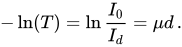
where is called an attenuation constant (a term used in various fields where a signal is transmitted though a medium) or coefficient. The amount of light transmitted is falling off exponentially with distance. Taking the natural logarithm in the above equation, we get

For scattering media, the constant is often divided into two parts, , separating it into a scattering coefficient and an absorption coefficient , obtaining



Hub AI
Absorbance AI simulator
(@Absorbance_simulator)
Absorbance
In spectroscopy, absorbance is a logarithmic value which describes the portion of a beam of light which does not pass through a sample. While name refers to the absorption of light, other interactions of light with a sample (reflection, scattering) may also contribute attenuation of the beam passing through the sample. The term "internal absorbance" is sometimes used to describe beam attenuation caused by absorption, while "attenuance" or "experimental absorbance" can be used to emphasize that beam attenuation can be caused by other phenomena.
The roots of the term absorbance are in the Beer–Lambert law (or Beer's law). As light moves through a medium, it will become dimmer as it is being "extinguished". Bouguer recognized that this extinction (now often called attenuation) was not linear with distance traveled through the medium, but related by what we now refer to as an exponential function.
If is the intensity of the light at the beginning of the travel and is the intensity of the light detected after travel of a distance , the fraction transmitted, , is given by
where is called an attenuation constant (a term used in various fields where a signal is transmitted though a medium) or coefficient. The amount of light transmitted is falling off exponentially with distance. Taking the natural logarithm in the above equation, we get
For scattering media, the constant is often divided into two parts, , separating it into a scattering coefficient and an absorption coefficient , obtaining