
Recent from talks
Spectrophotometry
Knowledge base stats:
Talk channels stats:
Members stats:
Spectrophotometry
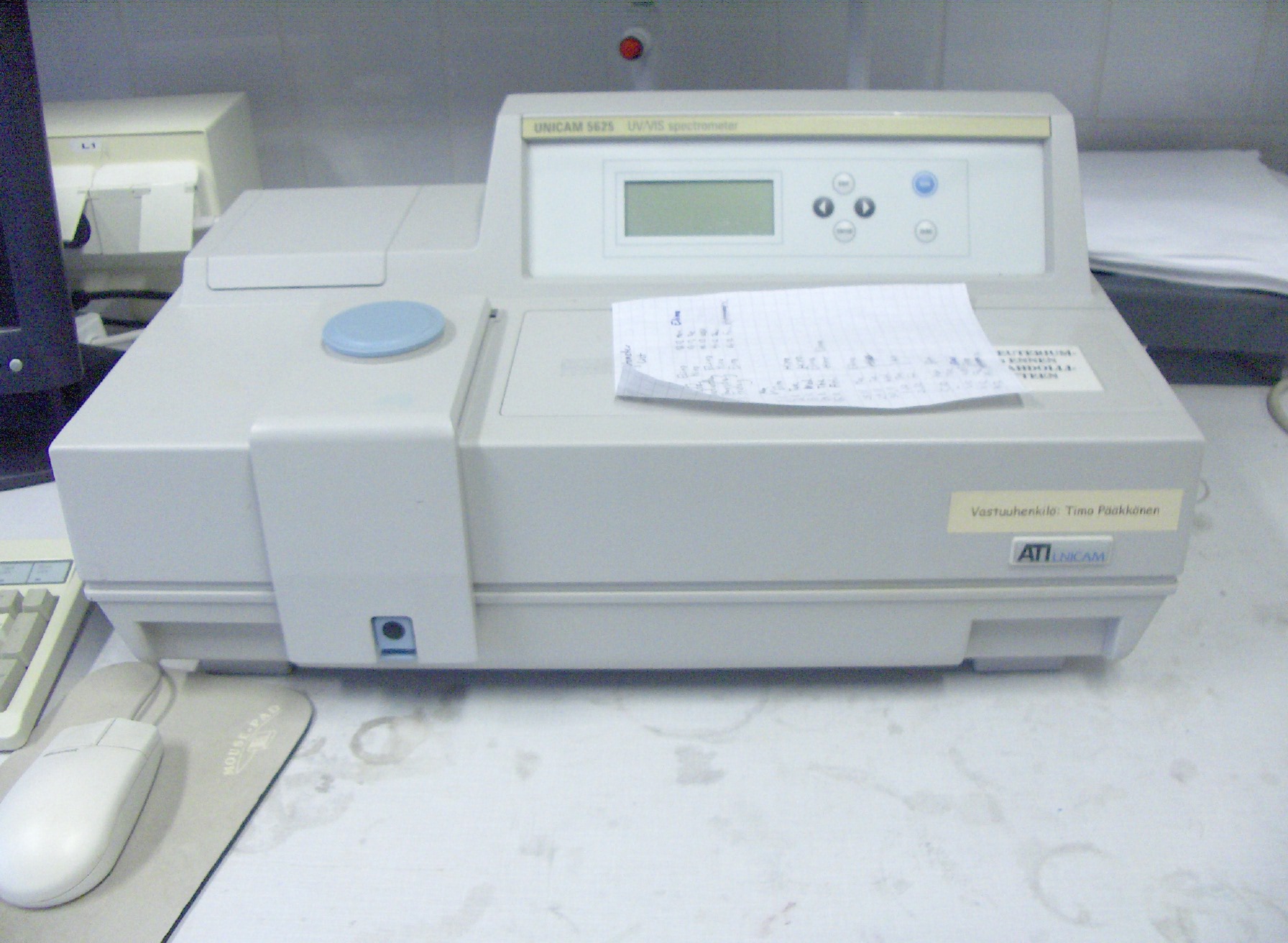
Spectrophotometry is a branch of electromagnetic spectroscopy concerned with the quantitative measurement of the reflection or transmission properties of a material as a function of wavelength. Spectrophotometry uses photometers, known as spectrophotometers, that can measure the intensity of a light beam at different wavelengths. Although spectrophotometry is most commonly applied to ultraviolet, visible, and infrared radiation, modern spectrophotometers can interrogate wide swaths of the electromagnetic spectrum, including x-ray, ultraviolet, visible, infrared, or microwave wavelengths.
Spectrophotometry is a tool that hinges on the quantitative analysis of molecules depending on how much light is absorbed by colored compounds. Important features of spectrophotometers are spectral bandwidth (the range of colors it can transmit through the test sample), the percentage of sample transmission, the logarithmic range of sample absorption, and sometimes a percentage of reflectance measurement.
A spectrophotometer is commonly used for the measurement of transmittance or reflectance of solutions, transparent or opaque solids, such as polished glass, or gases. Although many biochemicals are colored, as in, they absorb visible light and therefore can be measured by colorimetric procedures, even colorless biochemicals can often be converted to colored compounds suitable for chromogenic color-forming reactions to yield compounds suitable for colorimetric analysis. However, they can also be designed to measure the diffusivity on any of the listed light ranges that usually cover around 200–2500 nm using different controls and calibrations. Within these ranges of light, calibrations are needed on the machine using standards that vary in type depending on the wavelength of the photometric determination.
An example of an experiment in which spectrophotometry is used is the determination of the equilibrium constant of a solution. A certain chemical reaction within a solution may occur in a forward and reverse direction, where reactants form products and products break down into reactants. At some point, this chemical reaction will reach a point of balance called an equilibrium point. To determine the respective concentrations of reactants and products at this point, the light transmittance of the solution can be tested using spectrophotometry. The amount of light that passes through the solution is indicative of the concentration of certain chemicals that do not allow light to pass through.
The absorption of light is due to the interaction of light with the electronic and vibrational modes of molecules. Each type of molecule has an individual set of energy levels associated with the makeup of its chemical bonds and nuclei and thus will absorb light of specific wavelengths, or energies, resulting in unique spectral properties. This is based upon its specific and distinct makeup.
The use of spectrophotometers spans various scientific fields, such as physics, materials science, chemistry, biochemistry, chemical engineering, and molecular biology. They are widely used in many industries including semiconductors, laser and optical manufacturing, printing and forensic examination, as well as in laboratories for the study of chemical substances. Spectrophotometry is often used in measurements of enzyme activities, determinations of protein concentrations, determinations of enzymatic kinetic constants, and measurements of ligand binding reactions. Ultimately, a spectrophotometer is able to determine, depending on the control or calibration, what substances are present in a target and exactly how much through calculations of observed wavelengths.
In astronomy, the term spectrophotometry refers to the measurement of the spectrum of a celestial object in which the flux scale of the spectrum is calibrated as a function of wavelength, usually by comparison with an observation of a spectrophotometric standard star, and corrected for the absorption of light by the Earth's atmosphere.
Invented by Arnold O. Beckman in 1940 [disputed – discuss], the spectrophotometer was created with the aid of his colleagues at his company National Technical Laboratories founded in 1935 which would become Beckman Instrument Company and ultimately Beckman Coulter. This would come as a solution to the previously created spectrophotometers which were unable to absorb the ultraviolet correctly. He would start with the invention of Model A where a glass prism was used to absorb the UV light. It would be found that this did not give satisfactory results, therefore in Model B, there was a shift from a glass to a quartz prism which allowed for better absorbance results. From there, Model C was born with an adjustment to the wavelength resolution which ended up having three units of it produced. The last and most popular model became Model D which is better recognized now as the DU spectrophotometer which contained the instrument case, hydrogen lamp with ultraviolet continuum, and a better monochromator. It was produced from 1941 to 1976 where the price for it in 1941 was US$723 (far-UV accessories were an option at additional cost). In the words of Nobel chemistry laureate Bruce Merrifield, it was "probably the most important instrument ever developed towards the advancement of bioscience."
Hub AI
Spectrophotometry AI simulator
(@Spectrophotometry_simulator)
Spectrophotometry
Spectrophotometry is a branch of electromagnetic spectroscopy concerned with the quantitative measurement of the reflection or transmission properties of a material as a function of wavelength. Spectrophotometry uses photometers, known as spectrophotometers, that can measure the intensity of a light beam at different wavelengths. Although spectrophotometry is most commonly applied to ultraviolet, visible, and infrared radiation, modern spectrophotometers can interrogate wide swaths of the electromagnetic spectrum, including x-ray, ultraviolet, visible, infrared, or microwave wavelengths.
Spectrophotometry is a tool that hinges on the quantitative analysis of molecules depending on how much light is absorbed by colored compounds. Important features of spectrophotometers are spectral bandwidth (the range of colors it can transmit through the test sample), the percentage of sample transmission, the logarithmic range of sample absorption, and sometimes a percentage of reflectance measurement.
A spectrophotometer is commonly used for the measurement of transmittance or reflectance of solutions, transparent or opaque solids, such as polished glass, or gases. Although many biochemicals are colored, as in, they absorb visible light and therefore can be measured by colorimetric procedures, even colorless biochemicals can often be converted to colored compounds suitable for chromogenic color-forming reactions to yield compounds suitable for colorimetric analysis. However, they can also be designed to measure the diffusivity on any of the listed light ranges that usually cover around 200–2500 nm using different controls and calibrations. Within these ranges of light, calibrations are needed on the machine using standards that vary in type depending on the wavelength of the photometric determination.
An example of an experiment in which spectrophotometry is used is the determination of the equilibrium constant of a solution. A certain chemical reaction within a solution may occur in a forward and reverse direction, where reactants form products and products break down into reactants. At some point, this chemical reaction will reach a point of balance called an equilibrium point. To determine the respective concentrations of reactants and products at this point, the light transmittance of the solution can be tested using spectrophotometry. The amount of light that passes through the solution is indicative of the concentration of certain chemicals that do not allow light to pass through.
The absorption of light is due to the interaction of light with the electronic and vibrational modes of molecules. Each type of molecule has an individual set of energy levels associated with the makeup of its chemical bonds and nuclei and thus will absorb light of specific wavelengths, or energies, resulting in unique spectral properties. This is based upon its specific and distinct makeup.
The use of spectrophotometers spans various scientific fields, such as physics, materials science, chemistry, biochemistry, chemical engineering, and molecular biology. They are widely used in many industries including semiconductors, laser and optical manufacturing, printing and forensic examination, as well as in laboratories for the study of chemical substances. Spectrophotometry is often used in measurements of enzyme activities, determinations of protein concentrations, determinations of enzymatic kinetic constants, and measurements of ligand binding reactions. Ultimately, a spectrophotometer is able to determine, depending on the control or calibration, what substances are present in a target and exactly how much through calculations of observed wavelengths.
In astronomy, the term spectrophotometry refers to the measurement of the spectrum of a celestial object in which the flux scale of the spectrum is calibrated as a function of wavelength, usually by comparison with an observation of a spectrophotometric standard star, and corrected for the absorption of light by the Earth's atmosphere.
Invented by Arnold O. Beckman in 1940 [disputed – discuss], the spectrophotometer was created with the aid of his colleagues at his company National Technical Laboratories founded in 1935 which would become Beckman Instrument Company and ultimately Beckman Coulter. This would come as a solution to the previously created spectrophotometers which were unable to absorb the ultraviolet correctly. He would start with the invention of Model A where a glass prism was used to absorb the UV light. It would be found that this did not give satisfactory results, therefore in Model B, there was a shift from a glass to a quartz prism which allowed for better absorbance results. From there, Model C was born with an adjustment to the wavelength resolution which ended up having three units of it produced. The last and most popular model became Model D which is better recognized now as the DU spectrophotometer which contained the instrument case, hydrogen lamp with ultraviolet continuum, and a better monochromator. It was produced from 1941 to 1976 where the price for it in 1941 was US$723 (far-UV accessories were an option at additional cost). In the words of Nobel chemistry laureate Bruce Merrifield, it was "probably the most important instrument ever developed towards the advancement of bioscience."
Recent media