Hubbry Logo
Orcadas BaseOrcadas BaseMain
Open search
Orcadas Base
Community hub
Orcadas Base
logo
8 pages, 0 posts
0 subscribers
Be the first to start a discussion here.
Orcadas Base
Orcadas Base
from Wikipedia

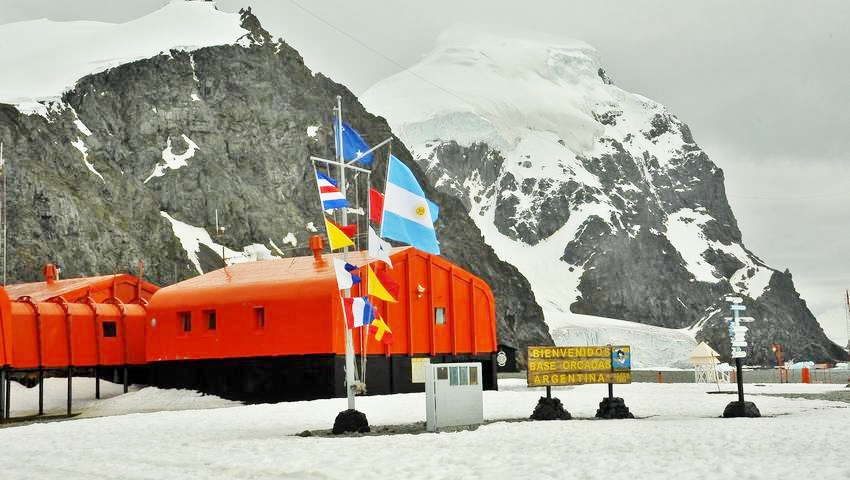
Base Orcadas is an Argentine scientific station in Antarctica, and the oldest of the stations in Antarctica still in operation. It is located on Laurie Island, one of the South Orkney Islands (Spanish: Islas Orcadas del Sur), at 4 meters (13 ft) above sea level and 170 meters (558 ft) from the coastline. Established by the Scottish National Antarctic Expedition in 1903 and transferred to the Argentine government in 1904, the base has been permanently populated since, being one of six Argentine permanent bases in Argentina's claim to Antarctica, and the first permanently inhabited base in Antarctica.

Key Information

The nearest Argentine port is Ushuaia, which is 1,502 km (811 nmi) away. The base has 11 buildings and four main topics of research: continental glaciology, seismology, sea-ice-zone glaciology (since 1985) and meteorological observations (since 1903).

Orcadas was the only station on the islands for 40 years until the British established a small summer base, Cape Geddes Station in Laurie Island in 1946, replaced by Signy Research Station in Signy Island in 1947. It also had the first radiotelegraph in the continent in 1927. The 11 buildings of the station house up to 65 people during the summer, and an average of 17 during winter.[1] The scientific activities are carried out at the Laboratorio Antártico Mutidisciplinario en Base Orcadas (LABORC), the "Multidisciplinary Antarctic Laboratory at Base Orcadas".

History

[edit]
"Omond House", the beginning of Orcadas, the first and oldest permanent Antarctic base, constructed in 1903 by the Scottish National Antarctic Expedition

In 1903 Dr William S. Bruce's Scottish National Antarctic Expedition established Omond House, a meteorological station on Laurie Island. During the expedition, however, the crew became stuck in the ice and, unable to sail off, were trapped in the station for the winter.[2]

Bruce left the station in December of that year for Buenos Aires to fix the ship and obtain supplies, leaving meteorologist Robert C. Mossman in charge of the base to continue the observations.[3]

Bruce offered to the Government of President Julio Argentino Roca the transfer of the station and instruments for the sum of 5.000 pesos, on the condition that the government committed itself to the continuation of the scientific mission.[4] He also offered to transport in his ship the appointed personnel back to the station.

Bruce had informed the British officer William Haggard of his intentions in December 1903. On 29 December, Haggard sent a note to the Argentine Foreign Minister, José Terry, ratifying the terms of Bruce's proposition.[4] Roca submitted the matter to the Oficina Meteorológica Nacional (National Office of Meteorology) who advised him to accept the offer. On January 2, 1904, the installations were accepted through a presidential decree.[5]

Orcadas Base in 1970

The Scotia sailed back for Laurie Island on 14 January 1904 carrying on board Luciano H. Valette, from the Office of Zoology of the Ministry of Agriculture, Edgard C. Szmula, employee of the National Meteorological Office, and Hugo Acuña, from the Ministry of Livestock, who was also designated Postal Chief of the Orkney Islands by the Director General of the National Postal and Telegraphs Office, Manuel García Fernández. Mossman was left in charge of the expedition, along with William Smith as cook.

In 1906, Argentina communicated to the international community the establishment of a permanent base on the South Orkney Islands. On August 26, Haggard sent a letter to Foreign Minister Manuel Montes de Oca reminding him that South Orkneys Islands were British. The British position was that Argentine personnel was granted permission only for the period of one year. Argentine government ignored the note, "considering it out of time".[4]

Orcadas Base, c. 1927

On March 30, 1927, naval non-commissioned officer Emilio Baldoni established the first radio telegraph link with Ushuaia. Up to that point, the Orcadas Base remained isolated from the rest of the world until the yearly relief arrived. The radio station (coded LRT in Argentina) allowed for a permanent communication link.

The station depended on the Ministry of Agriculture until Argentine Navy relieved the crew with navy personnel on March 3, 1951. Formal transfer occurred on December 23, 1952, when by presidential decree the base was put under the Service of Maritime Hydrography as Destacamento Naval Orcadas ("Orcadas naval Detachment").

Climate

[edit]
Annual mean temperatures measured at Orcadas Base, 1901–2007

Under the Köppen climate classification system, the station is located under a tundra climate (ET), very close to an ice cap climate (EF).[6] The base is influenced by the cold Antarctic Circumpolar Current that runs past the Weddell Sea and the strong westerly winds, creating a colder climate than the coastal areas in the northwestern parts of the Antarctic Peninsula.[7] Weather conditions can vary widely from year to year and day to day since low pressure systems frequently pass through the islands, which influences the climate.[7]

Mean monthly temperatures range from −9.4 °C (15.1 °F) in June to 1.0 °C (33.8 °F) in February.[7] In summer, the average high is 2.7 °C (36.9 °F) while the average low is −1.1 °C (30.0 °F).[7] During winter, the average high is −4.9 °C (23.2 °F) while the average low is −13.0 °C (8.6 °F).[7] Temperatures can occasionally rise above freezing during winter.[7] When low pressure systems pass to the south of the base, they can result in exceptionally mild temperatures, with the highest temperature recorded being 15.2 °C (59.4 °F) in 1987.[7] However, when this occurs, the weather is stormy and cloudy with reduced visibility.[7] In contrast, when low pressure systems pass to the north, it results in cold and dry conditions with good visibility, causing temperatures to fall to −44.0 °C (−47.2 °F).[7]

Fog is a frequent occurrence in the base, averaging 110 days.[7] This can vary from year to year with 1987 being the foggiest year when there were 252 days with fog to only 30 days with fog in 1963.[7] Being located in the path of low pressure systems throughout the year, the base experiences high cloud cover, particularly in summer.[7] December and January are the cloudiest months, averaging 29 cloudy days each month.[7] Winters are less cloudy, averaging 20 cloudy days in June and July.[7] Clear days are extremely rare and only occur between May and October, averaging 1–3 days.[7] As a result, the base only averages 483.0 hours of sunshine per year or 13.5% of possible sunshine (possibly the lowest on earth), ranging from a low of 9.3% in January to a high of 22.5% in August.[8]

December and January are the least windy months, averaging 19 to 21 km/h (12 to 13 mph) while August and September are the windiest months, averaging more than 25 km/h (16 mph).[7] The base is subjected to strong winds throughout the year, with each month averaging 20 days with strong winds (wind speeds above 46 km/h (29 mph)).[7] Occasionally, it can experience gusts above 150 km/h (93 mph).[7]

The average annual precipitation is 398.4 mm (15.69 in), which is fairly evenly distributed throughout the year.[8] March is the wettest month while June is the driest month.[8] Due to the cold climate and exposure to maritime westerlies, snowfall occurs frequently throughout the year.[7] Based on the 1961–1990 period, the base averages 227 days with snow, with February having the least days with snow (averaging 14 days with snow) and May having the most days with snow (averaging 22 days).[7]

Climate data for Orcadas Base (1991−2020 normals, extremes 1903−present)
Month Jan Feb Mar Apr May Jun Jul Aug Sep Oct Nov Dec Year
Record high °C (°F) 12.0
(53.6)
12.3
(54.1)
10.9
(51.6)
12.6
(54.7)
8.8
(47.8)
9.8
(49.6)
10.0
(50.0)
9.0
(48.2)
10.5
(50.9)
9.6
(49.3)
12.6
(54.7)
11.6
(52.9)
12.6
(54.7)
Mean daily maximum °C (°F) 3.6
(38.5)
3.4
(38.1)
2.4
(36.3)
0.4
(32.7)
−2.0
(28.4)
−3.9
(25.0)
−5.3
(22.5)
−4.1
(24.6)
−2.0
(28.4)
0.6
(33.1)
2.5
(36.5)
3.0
(37.4)
−0.1
(31.8)
Daily mean °C (°F) 1.3
(34.3)
1.4
(34.5)
0.3
(32.5)
−1.8
(28.8)
−5.0
(23.0)
−7.5
(18.5)
−9.4
(15.1)
−8.1
(17.4)
−5.6
(21.9)
−2.7
(27.1)
−0.6
(30.9)
0.5
(32.9)
−3.1
(26.4)
Mean daily minimum °C (°F) −0.7
(30.7)
−0.4
(31.3)
−1.6
(29.1)
−4.1
(24.6)
−8.1
(17.4)
−11.3
(11.7)
−14.1
(6.6)
−12.4
(9.7)
−9.8
(14.4)
−6.0
(21.2)
−3.2
(26.2)
−1.7
(28.9)
−6.1
(21.0)
Record low °C (°F) −7.7
(18.1)
−7.9
(17.8)
−14.4
(6.1)
−24.0
(−11.2)
−30.2
(−22.4)
−39.8
(−39.6)
−36.0
(−32.8)
−44.0
(−47.2)
−30.8
(−23.4)
−27.6
(−17.7)
−16.7
(1.9)
−8.7
(16.3)
−44.0
(−47.2)
Average precipitation mm (inches) 43.9
(1.73)
73.5
(2.89)
73.0
(2.87)
73.4
(2.89)
62.6
(2.46)
52.1
(2.05)
44.8
(1.76)
51.6
(2.03)
48.0
(1.89)
48.2
(1.90)
44.7
(1.76)
46.4
(1.83)
662.2
(26.07)
Average precipitation days (≥ 0.1 mm) 18 20 21 20 20 18 17 18 19 20 19 18 228
Average snowy days 15.6 12.9 16.8 18.6 19.2 20.5 18.9 19.8 19.5 21.5 19.0 19.8 221.9
Average relative humidity (%) 85 86 86 86 85 85 83 84 84 86 86 86 86
Mean monthly sunshine hours 49.6 36.8 34.1 24.0 12.4 3.0 6.2 31.0 45.0 52.7 60.0 58.9 413.7
Mean daily sunshine hours 1.6 1.3 1.1 0.8 0.4 0.1 0.2 1.0 1.5 1.7 2.0 1.9 1.1
Percentage possible sunshine 9.3 9.8 9.9 10.1 10.8 15.2 13.2 22.5 21.8 17.6 11.2 12.0 13.5
Source 1: Servicio Meteorológico Nacional (temperature/snowy days/sun 1991–2020, precipitation days 1961–1990, humidity/percent sunshine 1903–1950)[9][10][11][8]
Source 2: NOAA (precipitation 1961–1990),[12] Meteo Climat (record highs and lows)[13]

Lighthouse

[edit]
Destacamento Lighthouse
Map
LocationLaurie Island, Orcadas Base, Argentine Antarctica, Argentina Edit this at Wikidata
Coordinates60°44′16″S 44°44′21″W / 60.7378°S 44.7392°W / -60.7378; -44.7392
Tower
FoundationConcrete base
ConstructionMetal skeletal tower
ShapeSquare pyramidal skeletal radio tower with lantern atop[14]
MarkingsWhite and red horizontal bands
OperatorArgentine Navy Edit this on Wikidata
Light
CharacteristicFl W 3s Edit this on Wikidata

Orcadas Base is the site of the Destacamento Lighthouse, a navigation light mounted on a communications tower.[14] It is maintained by the Argentine Navy.[15]

See also

[edit]

References

[edit]
[edit]
Revisions and contributorsEdit on WikipediaRead on Wikipedia
from Grokipedia
Orcadas Base is an Argentine scientific research station located on Laurie Island in the South Orkney Islands of Antarctica. Established in 1903–1904 by the Scottish National Antarctic Expedition as the Omond House meteorological station, it was transferred to Argentina in 1904, marking the beginning of continuous human occupation in Antarctica. As the oldest Antarctic station still in operation without interruption, it has maintained year-round staffing for over 117 years, even through global conflicts. Operated under the Argentine Antarctic Program, primarily by naval personnel, Orcadas Base conducts long-term observations in , geomagnetism, and other disciplines, providing the region's longest continuous weather and magnetic records dating back to the early . The station's enduring presence underscores Argentina's historical commitment to polar science amid overlapping territorial claims in the sector, regulated by the since 1961. Key achievements include pioneering radio communications with the mainland in the and sustained data collection essential for and geophysical studies.

History

Establishment and Early Operations

The origins of Orcadas Base trace to the (SNAE) led by William Speirs Bruce, which constructed Omond House on Laurie Island in the during 1903 as a meteorological and magnetic . The structure served as the expedition's primary station for scientific observations amid harsh sub-Antarctic conditions, marking the first permanent facility of its kind in the region. Unable to relieve the overwintering party due to logistical constraints, Bruce offered the station to in early January 1904, an arrangement accepted to ensure continuity of operations. On February 22, 1904, the Argentine naval transport arrived with a detachment of personnel under the command of Lieutenant Hipólito Nicolás Pierre, formally transferring control and renaming the site Orcadas Base after the Orcadian (Orkney) archipelago. This event established 's enduring Antarctic foothold, with the base maintained by Navy detachments for sovereignty assertion and scientific purposes. Early operations focused on meteorological and geomagnetic monitoring, building on SNAE records initiated in 1903 with daily surface observations of , , and . Argentine teams, typically comprising 10 to 15 members, conducted uninterrupted measurements despite isolation and , including katabatic winds and prolonged darkness, with annual resupply via naval vessels from . These efforts yielded the longest continuous dataset, underscoring the base's role in foundational polar before expansions in the mid-20th century.

Continuous Argentine Administration

On February 22, 1904, Argentina assumed control of the meteorological observatory on Laurie Island, originally constructed by the under William Speirs Bruce as Omond House in 1903. This transfer followed Bruce's offer of the facilities, formalized by Argentine Executive Decree No. 3073 on January 2, 1904, which accepted the installations for ongoing scientific operations under Argentine auspices. The handover occurred aboard the , with Argentine personnel, including Navy lieutenant Eduardo Otilio Álvarez, raising the Argentine flag and initiating permanent occupation. Argentine administration has persisted without interruption since 1904, with year-round staffing by military and civilian personnel primarily from the and the Instituto Antártico Argentino (IAA). This continuity spans over 120 years as of 2025, distinguishing Orcadas as the oldest permanently manned station in and the sole facility with unbroken annual operations from the early . Initial teams focused on meteorological observations, expanding to seismic and magnetic recordings, with resupply missions via naval vessels ensuring logistical support amid the region's isolation. Throughout the 20th and 21st centuries, administration emphasized self-sufficiency and adaptation to harsh conditions, including reinforcements during and post-war expansions under Argentina's sovereignty claims. Personnel rotations, typically 11-15 members per summer and fewer in winter, have been coordinated from , , with the base serving as a hub for territorial assertion and data collection compliant with international agreements like the Treaty of 1959. No evacuations or closures have occurred, even during global conflicts or logistical challenges, underscoring the robustness of Argentine oversight.

Modern Upgrades and Adaptations

In January 2012, the magnetic observatory at Orcadas Base underwent significant upgrades, including the installation of new absolute magnetometers, fluxgate variometers, and advanced recording hardware to improve the monitoring and data collection of variations. These enhancements ensured higher precision and reliability in geomagnetic observations, contributing to global INTERMAGNET standards for long-term . As part of Argentina's expanded research infrastructure, construction of multidisciplinary laboratories began at Orcadas Base following a 2022 announcement to equip three permanent stations—Orcadas, Esperanza, and San Martín—with advanced facilities for biological, geological, and atmospheric studies. By early 2023, these laboratories were reported as installed, enabling enhanced on-site analysis and reducing reliance on sample transport to mainland facilities. The upgrades support interdisciplinary projects under the Argentine Program, adapting the base to modern scientific demands amid increasing international collaboration. Ongoing adaptations include routine maintenance of and integration of cooperative efforts, such as annual support from national park rangers for since the . These measures address the base's exposure to extreme conditions, ensuring operational continuity in a facility that has maintained year-round presence for over a century.

Location and Environment

Geographical Setting

Orcadas Base is located on Laurie Island, the second-largest island in the archipelago, situated in the of the . The archipelago lies approximately 604 kilometers northeast of the northern tip of the and about 1,240 kilometers southeast of , . The comprise four principal islands—Coronation, Laurie, Powell, and Signy—along with various smaller islets, spanning a total land area of roughly 620 square kilometers. These islands feature rugged, mountainous terrain with elevations reaching up to 1,265 meters on Coronation Island, predominantly mantled by permanent ice caps and glaciers that descend to steep coastal cliffs and fjords. The base itself occupies a site on a coastal isthmus of Laurie Island at coordinates 60°44′S 44°44′W, approximately 9 kilometers southwest of Cape Geddes, the island's northeastern extremity. This positioning places it at a low elevation of about 4 meters above and roughly 170 meters inland from the shoreline, facilitating access for resupply vessels while exposing it to the surrounding maritime influences of the to the south and the to the north.

Climate Characteristics

The climate at Orcadas Base features a polar maritime regime, tempered by the adjacent , which prevents the extreme cold of interior while introducing high and persistent . Annual mean air temperature averages -3.8 °C, with monthly means ranging from approximately 1 °C in midsummer () to -9 °C in midwinter (July–August). Precipitation occurs mainly as , totaling about 662 mm of water equivalent per year, distributed fairly evenly across seasons but often accompanied by or sleet in milder periods. The region experiences over 200 foggy or cloudy days annually, limiting solar radiation and contributing to a consistently damp environment. Winds are a defining feature, driven by cyclonic systems from the ; mean speeds reach 30 km/h, with frequent gales surpassing 100 km/h and occasional hurricane-force gusts. These conditions exacerbate chill factors and pose logistical challenges, though the coastal location mitigates extremes seen farther south. Extreme temperatures have been recorded as low as -32 °C and as high as +12 °C, reflecting the variability of maritime polar patterns. Orcadas Base's meteorological observations, continuous since , provide one of the longest datasets for the region, documenting gradual warming of about 1–2 °C over the amid broader hemispheric trends.

Infrastructure and Facilities

Core Buildings and Logistics

The foundational structure of Orcadas Base is Omond House, erected between 1903 and 1904 from local stone as the inaugural permanent edifice in , subsequently maintained by Argentine authorities as a preserved historical element integral to the station's operations. This building exemplifies early polar designed for extreme conditions, featuring thick walls for insulation and durability against . Modern expansions include dedicated laboratories, personnel accommodations, and operational support facilities to sustain year-round habitation and activities. In August 2022, the Argentine government announced plans to construct a new multidisciplinary at Orcadas Base, alongside similar upgrades at other stations, aimed at bolstering scientific infrastructure and affirming national presence in the region. These enhancements reflect ongoing adaptations to improve research efficiency amid logistical challenges inherent to the site's isolation. Auxiliary structures encompass storage depots, workshops, and a for , contributing to the base's self-sufficiency. Logistical support relies predominantly on seasonal maritime resupply expeditions departing from , , covering roughly 1,500 kilometers to deliver fuel, provisions, and equipment during the austral summer window when permits access. These operations are coordinated under the Argentine Antarctic Program, utilizing ice-strengthened vessels to navigate the treacherous route. Energy requirements are met through on-site diesel-powered generators, ensuring continuous power for heating, lighting, and scientific instruments despite the absence of renewable alternatives at this remote outpost. and water supply further demand meticulous planning, with and systems supplementing limited freshwater sources from .

Lighthouse and Auxiliary Structures

The Destacamento Lighthouse at Orcadas Base serves as a key , featuring an active mounted on a communications tower with a focal plane elevation of 12 meters, emitting a white flash every 3 seconds. Operated by the , it is located at the head of Scotia Bay on Laurie Island in the , supporting maritime safety in the region. Auxiliary structures at the base include the preserved Omond House, constructed in 1903 by the led by William Speirs Bruce as Antarctica's first permanent habitation. This wooden building, clad in stone for insulation, originally functioned as living quarters, kitchen, dining area, and laboratory, and remains maintained by Argentine authorities as a historical site adjacent to the main facilities. Additional auxiliary facilities encompass the Casa de Emergencia, providing ; a capilla for religious observances; and the Casa Museo , dedicated to exhibiting artifacts and historical items related to the base's operations. Early auxiliary installations from 1903, such as a magnetic instrument depot for storing scientific equipment and meteorological shelters on Scotia Bay beach, supported initial geomagnetic and weather monitoring efforts. These structures complement the base's core infrastructure, enhancing operational resilience and preserving its legacy since Argentine assumption of control on February 22, 1904.

Scientific Operations

Meteorological and Atmospheric Research

Orcadas Base has conducted continuous meteorological observations since February 22, 1904, establishing it as the site of Antarctica's oldest operational with unbroken surface records spanning over 120 years. These measurements encompass air temperature, , and direction, precipitation, and , enabling detailed analysis of regional dynamics in the maritime . The station's temperature dataset, covering 110 years through 2014, documents seasonal variability with pronounced multidecadal oscillations, including warming trends in austral summer linked to strengthened westerly winds and reduced extent in the surrounding . Extreme warm events, such as those exceeding 10°C in summer, correlate with atmospheric blocking patterns that facilitate northward heat from lower latitudes. Annual mean temperatures average around -5.5°C, with records showing increased frequency of positive anomalies since the mid-20th century amid broader warming. Atmospheric research at Orcadas extends to monitoring geomagnetic variations through an upgraded operational since the early , capturing data on solar-terrestrial interactions that influence ionospheric disturbances and auroral activity. Monthly bulletins from the Argentine Servicio Meteorológico Nacional detail these fluctuations, providing baselines for studying impacts on polar atmospheric layers. Such observations complement surface meteorology by revealing couplings between tropospheric circulation and upper atmospheric responses during geomagnetic storms.

Long-Term Data Contributions

Orcadas Base maintains Antarctica's longest continuous record of daily surface meteorological observations, commencing in April 1903 and encompassing , , , and data. This dataset, spanning over 120 years as of 2025, represents the sole southern high-latitude site with century-scale daily records, enabling detailed analysis of multidecadal climate variability in the maritime region near the . The station's temperature series reveals no statistically significant trends from 1903 to 1950, followed by evident warming thereafter, with quasi-50-year and quasi-20-year oscillatory bands identified in seasonal records. data indicate substantial increases, approaching 50% over 75-year periods in summer and autumn, contributing to assessments of regional hydrological shifts. These observations underpin reconstructions of near-surface air temperatures and inform broader climate models, highlighting natural variability alongside anthropogenic influences without presuming causality from short-term fluctuations. By providing a benchmark for validating satellite-derived and proxy-based datasets, Orcadas records facilitate causal analysis of patterns, such as influences from the Southern Annular Mode, on weather. Their persistence amid logistical challenges underscores their value for empirical trend detection over speculative narratives, with data integrated into international archives for global studies.

Current Research Programs

Orcadas Base maintains continuous meteorological observations as its primary ongoing program, recording atmospheric since to support global analysis and trend detection in the region. These efforts include daily measurements of , , , and , integrated into international datasets for long-term . Seismological research operates through the Antarctic Seismographic Argentinean Network (ASAIN), with instruments at Orcadas capturing to study tectonic activity and crustal dynamics in the Scotia Plate area; the network's deployments, including recent ASAIN23 initiatives, enhance real-time monitoring capabilities. Geodetic programs utilize GPS stations for precise positioning and crustal deformation tracking, contributing to international collaborations under the Scientific Committee on Antarctic Research (SCAR); these dry laboratory activities run year-round, aiding models of stability and sea-level rise projections. Biological monitoring focuses on avian and populations as part of the Commission for the Conservation of Antarctic Marine Living Resources (CCAMLR) Ecosystem Monitoring Program (CEMP), tracking metrics such as penguin breeding success and arrival weights to assess and krill-dependent food webs. Recent summer campaigns, including 2024/25, have emphasized trophic studies on local bird species. A multidisciplinary , established following upgrades announced in 2022, supports integrated fieldwork in and , enabling on-site analysis of samples and sediment records for paleoclimate reconstruction.

Argentine Territorial Claims

asserts sovereignty over the South Orkney Islands, including Laurie Island and the site of Orcadas Base, incorporating them into its claimed sector bounded by 25° W and 74° W longitudes south of 60° S . This claim draws on historical occupation, inheritance from Spanish colonial titles, and principles of extending South American boundaries southward. The cornerstone of 's position regarding the islands is the continuous operation of Orcadas Base since its takeover in 1904 from the Scottish expedition, which views as establishing effective and uninterrupted control. On 22 February 1904, Argentine authorities raised the national flag at the station, marking the formal start of permanent presence and symbolic assertion of jurisdiction over the archipelago. This occupation has been maintained without interruption for over 120 years, supporting arguments of prescriptive through sustained administrative and scientific activity. Administrative measures reinforcing the claim followed promptly; in December 1906, decrees under President José Figueroa Alcorta appointed commissioners to govern the , subordinating them to the National Territory of and signaling integration into Argentine administration. These actions prompted protests from the , which formalized its own overlapping claim in 1908, highlighting early contestation but underscoring Argentina's reliance on prior factual presence at Orcadas. Although the 1959 Antarctic Treaty suspends recognition of territorial sovereignty and prohibits new claims, Argentina reserves its rights under Article IV, continuing to exercise symbolic authority through the base's operations, including official map depictions and naval logistics. The station's role in meteorological data collection and personnel rotations thus serves dual scientific and jurisdictional purposes, bolstering continuity amid the treaty's framework.

Overlapping Claims and Disputes

The , site of Orcadas Base on Laurie Island, lie within overlapping territorial claims asserted by and the . 's claim encompasses the islands as part of its sector (roughly 25°W to 74°W longitude), justified by the continuous occupation and administration of Orcadas Base since November 22, 1904, when Argentine personnel assumed control of the meteorological observatory originally established by the under William Speirs Bruce. This effective occupation, maintained without interruption for over 120 years, forms the core of 's legal argument for sovereignty, supplemented by proximity to the South American mainland and historical papal bulls granting Spanish inheritance rights transferred post-independence. The claims the within its (20°W to 80°W longitude), proclaimed in 1908 as part of the following British assertions of discovery by George Powell in 1821 and subsequent administrative ordinances; the territory was formally separated from the Falklands in 1962 to focus on Antarctic governance. The UK's position relies on prior occupation of nearby whaling stations, exploratory voyages, and issued under , rejecting Argentine inheritance from Spanish titles as legally invalid under principles like . No other nation, including , formally claims the , though Chile's overlapping sector (53°W to 90°W) has fueled broader tripartite disputes in adjacent areas during the , involving naval standoffs and base occupations that nearly escalated to conflict before diplomatic resolutions. These bilateral claims over the Orcadas site remain unresolved and unrecognized by most states, with neither party acknowledging the other's title; views claims as colonial relics, while the deems Argentine assertions expansionist encroachments on Falklands-related domains. Tensions peaked post-World War II with incidents like the 1948 Hope Bay clash elsewhere, but no armed confrontations have occurred at Orcadas itself. The 1959 Antarctic , ratified by both claimants as original signatories on June 23, 1961, indefinitely suspends all territorial disputes under Article IV, which freezes claims, bars new assertions or enlargements, and ensures activities occur without prejudice to underlying rights. This framework has enabled cooperative science at Orcadas, with researchers occasionally participating via Treaty exchanges, though underlying assertions persist in domestic legislation—Argentina integrates the base into Tierra del Fuego Province, while the maintains administrative oversight through its polar research programs. Recent geopolitical strains, including post-1982 rhetoric, have prompted to reinforce Orcadas logistics, but no violations of Treaty demilitarization or provisions have been recorded there.

Role Under the Antarctic Treaty System

Orcadas Base functions as a scientific facility under the (ATS), to which acceded as an original signatory in 1959, with the Treaty entering into force in 1961. The station's operations align with the Treaty's core principles, including demilitarization, exclusive peaceful use, and promotion of international scientific cooperation, as stipulated in Articles I and III. Administered by the Argentine Antarctic Institute within the framework of 's consultative party status, Orcadas supports ongoing meteorological and atmospheric observations that contribute to the ATS's emphasis on free exchange of scientific data and personnel. The base's long-term datasets, particularly from its meteorological observatory established in 1904, have been integrated into international analyses, such as studies on variability, demonstrating compliance with ATS recommendations for . Elements of the station, including the Laurie Island observatories, are designated as Historic Site and Monument No. 42 under the ATS, preserving their historical significance while ensuring activities do not compromise obligations outlined in the 1991 Protocol on . Recent environmental impact assessments (EIAs) submitted to Antarctic Treaty Consultative Meetings (ATCMs), such as the 2023 proposal to replace above-ground electricity lines with underground cabling, reflect adherence to the Protocol's requirements for minimizing environmental impacts from station infrastructure. As with all ATS stations, Orcadas is subject to inspections under Article VII of the Treaty and Article 14 of the Environmental Protocol to verify compliance with peaceful purposes and regulatory standards. While specific inspection reports for Orcadas are documented in the ATS database, these mechanisms underscore the station's role in fostering transparency and mutual assurance among the 29 consultative parties. Through participation in ATCMs and related bodies, utilizes Orcadas to advance collective governance, prioritizing empirical research over territorial assertions frozen by the Treaty.

Significance and Impact

Historical Legacy

Orcadas Base originated from the Omond House, constructed in 1903 by the under Speirs Bruce on in the South Orkney Islands, marking the establishment of the first permanent scientific outpost in . In February 1904, assumed control of the station from the Scottish expedition, renaming it Orcadas and initiating continuous operations that have endured without interruption, distinguishing it as the oldest continuously staffed research facility on the continent. This handover on February 22, 1904—commemorated annually in as the start of national endeavors—laid the groundwork for sustained human presence amid extreme conditions, with original structures like preserved as tangible links to early . The base's foundational role extended beyond logistics, symbolizing 's early assertion of interests in the region predating formalized territorial claims by other nations, including the United Kingdom's overlapping assertions based on discovery. Orcadas' enduring legacy manifests most prominently in its meteorological archive, with daily surface observations beginning in April 1903 providing 's longest uninterrupted climate record, spanning over 120 years by 2025. These data have enabled rigorous analyses of multidecadal temperature variability, extreme warm events, and atmospheric patterns in the maritime , informing broader reconstructions of evolution and anti-phasing trends between the and interior. By maintaining operational continuity through geopolitical shifts, including the 1959 Antarctic Treaty, Orcadas exemplifies resilient institutional commitment to empirical polar science.

Contributions to Antarctic Science

Orcadas Base maintains the longest continuous meteorological record in , with daily surface observations commencing in April 1903, enabling detailed analyses of temperature variability, patterns, and atmospheric pressure trends over more than a century. These data have revealed multidecadal oscillations in near-surface air temperatures, including significant warming trends since 1950 averaging 2°C overall and up to 5°C in cold extremes, contrasting with minimal changes prior to that period. records indicate a slight decline since 1935, interpreted as reduced storm activity in the region. The station's temperature series has informed reconstructions of Antarctic-wide patterns, highlighting anti-phasing between continental cooling and warming, and contributed to assessments of extreme events, such as record highs exceeding 15°C in recent decades. Long-term datasets from Orcadas have been integrated into broader hemispheric studies, supporting validations of ice-core proxies and model simulations of influences on global dynamics. Beyond , biological research at the base emphasizes monitoring populations, including reproductive cycles and foraging behaviors of cormorants and , alongside studies of , (Euphausiacea), and marine mammals to track ecosystem responses to environmental shifts. Geomagnetic observations, enhanced by equipment upgrades, provide continuous magnetic field data essential for modeling ionospheric disturbances and auroral phenomena. Geodetic programs employ GPS receivers for long-term monitoring of crustal deformation and sea-level changes, aiding geophysical models of Antarctic plate .

Challenges and Criticisms

The remote location of Orcadas Base on Laurie Island exposes operations to severe maritime weather, characterized by frequent eastward-moving storms over the , persistent snowfall throughout the year, and exposure to strong that hinder supply deliveries, equipment functionality, and . These conditions contribute to logistical difficulties, including reliance on seasonal sea access that can be impeded by formation and high winds, as evidenced by the base's historical continuity despite interruptions in resupply during extreme events. Overwintering personnel, numbering around 14 annually, encounter psychological and physiological strains from prolonged isolation, including phase-delayed onset due to extreme photoperiod variations and the cumulative effects of confinement in a small group setting. General studies of stations highlight elevated risks of mood disturbances and challenges during winter-over periods, though Orcadas-specific data underscore the added complexity of its maritime climate amplifying these issues compared to continental sites. strategies, such as structured routines and communication upgrades via , mitigate but do not eliminate these difficulties. Maintenance of the base's poses ongoing challenges, given its origins in the 1904 Scottish expedition structures, which have required periodic upgrades like the 2013 modernization of the magnetic to combat , instrumentation degradation, and power reliability in sub-zero temperatures. Environmental management under the Antarctic Treaty Protocol demands strict waste handling and fuel storage protocols to minimize impacts on local soils and habitats, with trace element mobilization from thaw representing a broader regional concern potentially exacerbated by base activities. Criticisms of Orcadas Base primarily revolve around its role in sustaining Argentina's territorial claims to the , which overlap with British assertions and remain frozen under the 1959 ; detractors, including some historical accounts from rival claimants, view the station's permanence—dating to pre- occupation—as a symbolic reinforcement of sovereignty rather than unalloyed scientific pursuit, despite compliance with regimes. The 's emphasis on demilitarization and has not quelled debates over whether such bases prioritize national prestige amid suspended claims, though empirical s have found no major violations. Recent operational strains, such as quarantines disrupting 2020-2021 campaigns, further highlight vulnerabilities in international coordination without drawing systemic critique.

References

Add your contribution
Related Hubs
User Avatar
No comments yet.