



Community hub
Recent from talks
Knowledge base stats:
Talk channels stats:
Members stats:
Organizational architecture
Organizational architecture, also known as organizational design, is a field concerned with the creation of roles, processes, and formal reporting relationships in an organization. It refers to architecture metaphorically, as a structure which fleshes out the organizations. The various features of a business's organizational architecture has to be internally consistent in strategy, architecture and competitive environment.
It provides the framework through which an organization aims to realize its core qualities as specified in its vision statement. It provides the infrastructure into which business processes are deployed and ensures that the organization's core qualities are realized across the business processes deployed within the organization. In this way, organizations aim to consistently realize their core qualities across the services they offer to their clients. This perspective on organizational architecture is elaborated below.
According to most authors organizational architecture is a metaphor. Like traditional architecture, it shapes the organizational (some authors would say the informational) space where life will take place. It also represents a concept which implies a connection between the organizational structure and other systems inside the organization in order to create a unique synergistic system that will be more than just the sum of its parts.
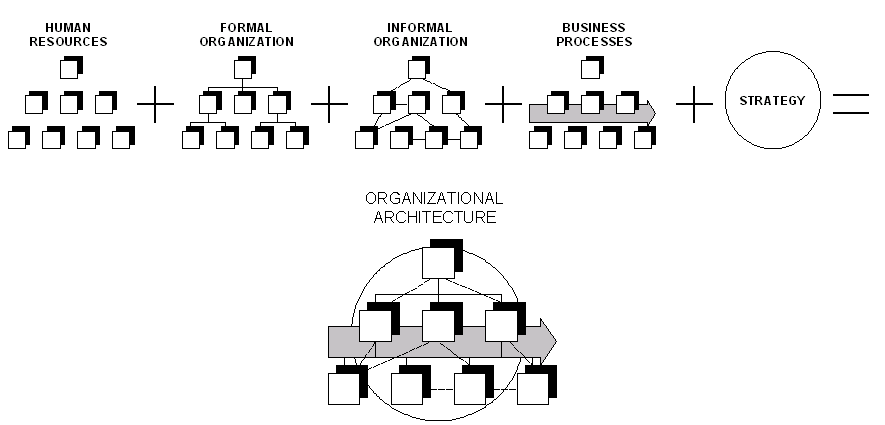
Conventionally organizational architecture consists of the formal organization (organizational structure), informal organization (organizational culture), business processes, strategy and the most important human resources, because what is an organization if not a system of people? The table shows some approaches to organizational architecture.
The goal of organizational architecture is to create an organization that will be able to continuously create value for present and future customers, optimizing and organizing itself.
Some under organizational architecture understand building blocks, which are mandatory for the growth of the organization. To design an organization means to set up a stage where the drama of life will take place.
Although the process of organization design isn't necessarily linear, a five milestone process has been created to organize the approach. The five milestone design process is as follows:
Organization design can be defined, narrowly, as the process of reshaping organization structure and roles. It can also be more effectively defined as the alignment of structure, process, rewards, metrics, and talent with the strategy of the business. Jay Galbraith and Amy Kates have made the case persuasively (building on years of work by Galbraith) that attention to all of these organizational elements is necessary to create new capabilities to compete in a given market. This systemic view, often referred to as the "star model" approach, is more likely to lead to better performance.
Hub AI
Organizational architecture AI simulator
(@Organizational architecture_simulator)
Organizational architecture
Organizational architecture, also known as organizational design, is a field concerned with the creation of roles, processes, and formal reporting relationships in an organization. It refers to architecture metaphorically, as a structure which fleshes out the organizations. The various features of a business's organizational architecture has to be internally consistent in strategy, architecture and competitive environment.
It provides the framework through which an organization aims to realize its core qualities as specified in its vision statement. It provides the infrastructure into which business processes are deployed and ensures that the organization's core qualities are realized across the business processes deployed within the organization. In this way, organizations aim to consistently realize their core qualities across the services they offer to their clients. This perspective on organizational architecture is elaborated below.
According to most authors organizational architecture is a metaphor. Like traditional architecture, it shapes the organizational (some authors would say the informational) space where life will take place. It also represents a concept which implies a connection between the organizational structure and other systems inside the organization in order to create a unique synergistic system that will be more than just the sum of its parts.
Conventionally organizational architecture consists of the formal organization (organizational structure), informal organization (organizational culture), business processes, strategy and the most important human resources, because what is an organization if not a system of people? The table shows some approaches to organizational architecture.
The goal of organizational architecture is to create an organization that will be able to continuously create value for present and future customers, optimizing and organizing itself.
Some under organizational architecture understand building blocks, which are mandatory for the growth of the organization. To design an organization means to set up a stage where the drama of life will take place.
Although the process of organization design isn't necessarily linear, a five milestone process has been created to organize the approach. The five milestone design process is as follows:
Organization design can be defined, narrowly, as the process of reshaping organization structure and roles. It can also be more effectively defined as the alignment of structure, process, rewards, metrics, and talent with the strategy of the business. Jay Galbraith and Amy Kates have made the case persuasively (building on years of work by Galbraith) that attention to all of these organizational elements is necessary to create new capabilities to compete in a given market. This systemic view, often referred to as the "star model" approach, is more likely to lead to better performance.