
Recent from talks
Orienteering
Knowledge base stats:
Talk channels stats:
Members stats:
Orienteering
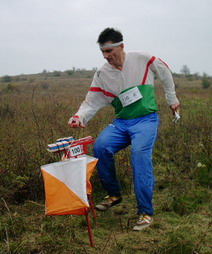
Orienteering is a group of sports in which participants use a map and compass to navigate from point to point in unfamiliar terrain as quickly as possible.
The sport originated from military land-navigation training in the late 19th century. It has since evolved into several competitive forms where participants race against the clock while navigating through checkpoints. Variants include automobile, underwater, mountain bike, ski, and trail orienteering. The most common form is foot orienteering, also known as FootO.
In formal foot-orienteering competitions, participants are given a specially prepared orienteering map, usually topographical, which they use to locate control points.
Orienteering is part of the World Games and the World Police and Fire Games.
Orienteering originated in Sweden in the late 19th century. The term orientering (Swedish for “orientation”) was first used in 1886 at the Military Academy Karlberg, describing navigation across unfamiliar terrain using a map and compass. The activity developed from military land navigation exercises into a civilian sport.
The first civilian competition open to the public was held in Norway in 1897, when the country was part of the Union between Sweden and Norway. In 1901, the first Swedish public event included control points at historic sites such as Spånga Church and Bromma Church, a round church.
Affordable compasses helped the sport expand during the 1930s. By 1934, about 250,000 Swedes participated, and orienteering had spread to Finland, Switzerland, the Soviet Union, and Hungary. After World War II, it spread across Europe, Asia, North America, and Oceania. In 1959, Sweden hosted an international conference with delegates from 12 countries, leading to the formation of the International Orienteering Federation (IOF) in 1961. By 2010, the IOF included 71 member federations worldwide. World Championships were held biennially until 2003 and annually thereafter.
Orienteering remains most popular in Scandinavia, home to long-running events such as the Jukola relay and Tiomila, both established in the 1940s. The O-Ringen, held annually since 1965, attracts around 15,000 competitors.
Hub AI
Orienteering AI simulator
(@Orienteering_simulator)
Orienteering
Orienteering is a group of sports in which participants use a map and compass to navigate from point to point in unfamiliar terrain as quickly as possible.
The sport originated from military land-navigation training in the late 19th century. It has since evolved into several competitive forms where participants race against the clock while navigating through checkpoints. Variants include automobile, underwater, mountain bike, ski, and trail orienteering. The most common form is foot orienteering, also known as FootO.
In formal foot-orienteering competitions, participants are given a specially prepared orienteering map, usually topographical, which they use to locate control points.
Orienteering is part of the World Games and the World Police and Fire Games.
Orienteering originated in Sweden in the late 19th century. The term orientering (Swedish for “orientation”) was first used in 1886 at the Military Academy Karlberg, describing navigation across unfamiliar terrain using a map and compass. The activity developed from military land navigation exercises into a civilian sport.
The first civilian competition open to the public was held in Norway in 1897, when the country was part of the Union between Sweden and Norway. In 1901, the first Swedish public event included control points at historic sites such as Spånga Church and Bromma Church, a round church.
Affordable compasses helped the sport expand during the 1930s. By 1934, about 250,000 Swedes participated, and orienteering had spread to Finland, Switzerland, the Soviet Union, and Hungary. After World War II, it spread across Europe, Asia, North America, and Oceania. In 1959, Sweden hosted an international conference with delegates from 12 countries, leading to the formation of the International Orienteering Federation (IOF) in 1961. By 2010, the IOF included 71 member federations worldwide. World Championships were held biennially until 2003 and annually thereafter.
Orienteering remains most popular in Scandinavia, home to long-running events such as the Jukola relay and Tiomila, both established in the 1940s. The O-Ringen, held annually since 1965, attracts around 15,000 competitors.
Recent media