



Community hub
Recent from talks
Knowledge base stats:
Talk channels stats:
Members stats:
Orlando Power Station
Orlando Power Station is a decommissioned coal-fired power station in Soweto, South Africa. The power station was commissioned at the end of the Second World War and served Johannesburg for over 50 years.
Planning for the construction of Orlando started in 1935, as the electricity demand of Johannesburg was rising faster than what could be met with the existing City Generating Station located in downtown Johannesburg. The location for the station was selected due to its proximity to water supply for coolant and railway lines for the delivery of coal. Construction started in 1939 with Merz & McLellan as consulting engineers, but completion was delayed due to the outbreak of the Second World War. The last phase of construction was completed in 1955. Until 1990 two Robert Stephenson & Hawthorns saddle-tank steam engines (Nos. 7805 Elizabeth an 0-6-0ST and 7398 George an 0-4-0ST were used to move incoming coal trains through a wagon tipper at the power plant.
The station was decommissioned in 1998 after 56 years of service.
In 2006 work was started to transform the site of the power station into an entertainment and business centre.
On 25 June 2014, the decommissioned power plant collapsed, killing 1 and trapping 5 others in the rubble.
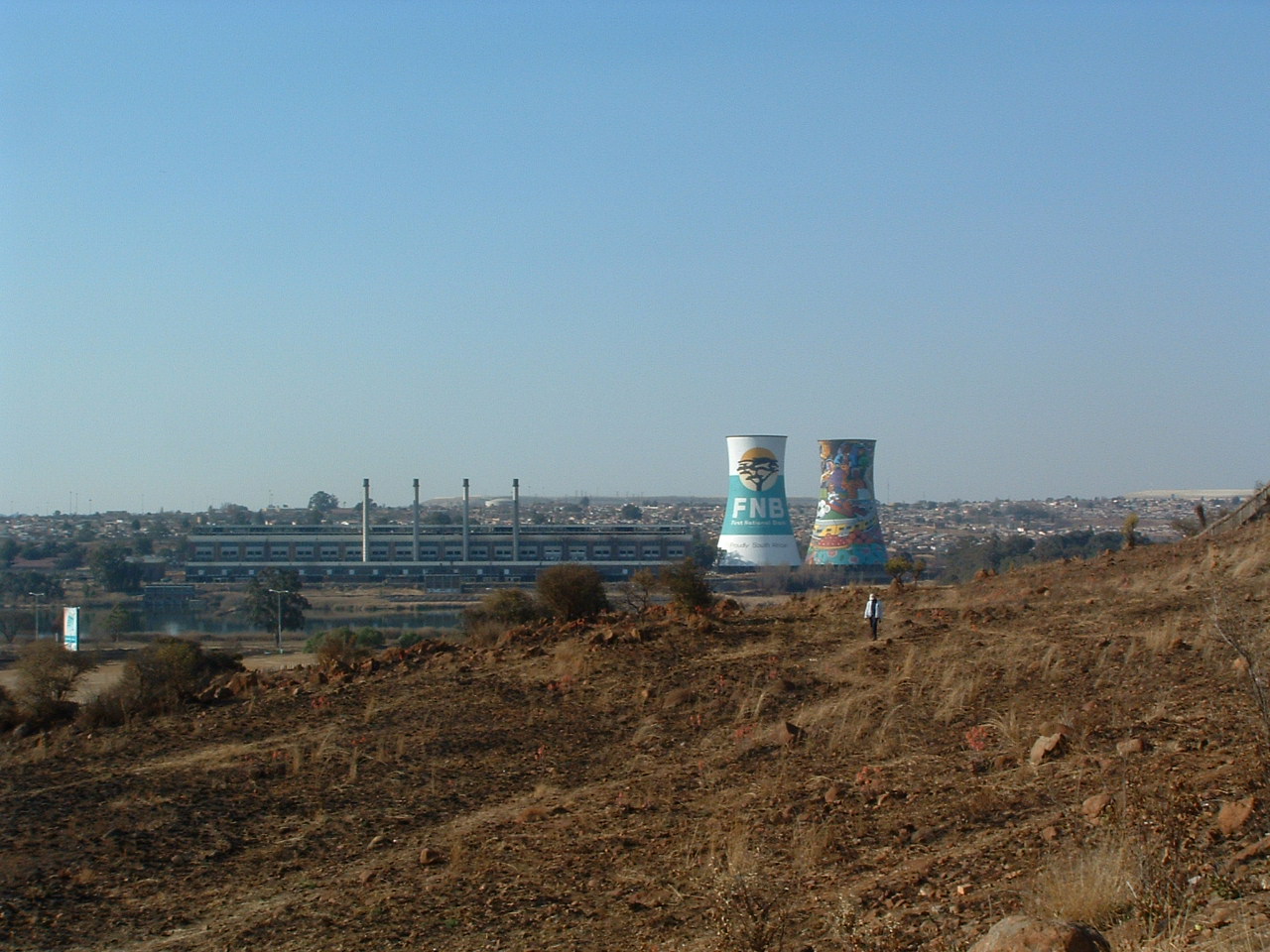
The two cooling towers are a prominent landmark in Soweto. They were built in 1951 to supplement the spray pond cooling system as this source of cooling was running at its capacity.
Being supplied by sewage effluent from the Klipspruit Sewage Works, the spray ponds at Orlando were the first in South Africa to make use of this ready supply of coolant liquid.
Both towers are painted, one functioning as an advertising billboard and the other containing the largest mural painting in South Africa. The towers are also used for bungee and BASE jumping from a platform between the top of the two towers as well as a bungee swing into one of the towers.
Hub AI
Orlando Power Station AI simulator
(@Orlando Power Station_simulator)
Orlando Power Station
Orlando Power Station is a decommissioned coal-fired power station in Soweto, South Africa. The power station was commissioned at the end of the Second World War and served Johannesburg for over 50 years.
Planning for the construction of Orlando started in 1935, as the electricity demand of Johannesburg was rising faster than what could be met with the existing City Generating Station located in downtown Johannesburg. The location for the station was selected due to its proximity to water supply for coolant and railway lines for the delivery of coal. Construction started in 1939 with Merz & McLellan as consulting engineers, but completion was delayed due to the outbreak of the Second World War. The last phase of construction was completed in 1955. Until 1990 two Robert Stephenson & Hawthorns saddle-tank steam engines (Nos. 7805 Elizabeth an 0-6-0ST and 7398 George an 0-4-0ST were used to move incoming coal trains through a wagon tipper at the power plant.
The station was decommissioned in 1998 after 56 years of service.
In 2006 work was started to transform the site of the power station into an entertainment and business centre.
On 25 June 2014, the decommissioned power plant collapsed, killing 1 and trapping 5 others in the rubble.
The two cooling towers are a prominent landmark in Soweto. They were built in 1951 to supplement the spray pond cooling system as this source of cooling was running at its capacity.
Being supplied by sewage effluent from the Klipspruit Sewage Works, the spray ponds at Orlando were the first in South Africa to make use of this ready supply of coolant liquid.
Both towers are painted, one functioning as an advertising billboard and the other containing the largest mural painting in South Africa. The towers are also used for bungee and BASE jumping from a platform between the top of the two towers as well as a bungee swing into one of the towers.