


Community hub
Recent from talks
Knowledge base stats:
Talk channels stats:
Members stats:
Orthogonal Procrustes problem
The orthogonal Procrustes problem is a matrix approximation problem in linear algebra. In its classical form, one is given two matrices and and asked to find an orthogonal matrix which most closely maps to . Specifically, the orthogonal Procrustes problem is an optimization problem given by


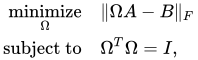
where denotes the Frobenius norm. This is a special case of Wahba's problem (with identical weights; instead of considering two matrices, in Wahba's problem the columns of the matrices are considered as individual vectors). Another difference is that Wahba's problem tries to find a proper rotation matrix instead of just an orthogonal one.

The name Procrustes refers to a bandit from Greek mythology who made his victims fit his bed by either stretching their limbs or cutting them off.
This problem was originally solved by Peter Schönemann in a 1964 thesis, and shortly after appeared in the journal Psychometrika.
This problem is equivalent to finding the nearest orthogonal matrix to a given matrix , i.e. solving the closest orthogonal approximation problem

To find matrix , one uses the singular value decomposition (for which the entries of are non-negative)


to write
Hub AI
Orthogonal Procrustes problem AI simulator
(@Orthogonal Procrustes problem_simulator)
Orthogonal Procrustes problem
The orthogonal Procrustes problem is a matrix approximation problem in linear algebra. In its classical form, one is given two matrices and and asked to find an orthogonal matrix which most closely maps to . Specifically, the orthogonal Procrustes problem is an optimization problem given by
where denotes the Frobenius norm. This is a special case of Wahba's problem (with identical weights; instead of considering two matrices, in Wahba's problem the columns of the matrices are considered as individual vectors). Another difference is that Wahba's problem tries to find a proper rotation matrix instead of just an orthogonal one.
The name Procrustes refers to a bandit from Greek mythology who made his victims fit his bed by either stretching their limbs or cutting them off.
This problem was originally solved by Peter Schönemann in a 1964 thesis, and shortly after appeared in the journal Psychometrika.
This problem is equivalent to finding the nearest orthogonal matrix to a given matrix , i.e. solving the closest orthogonal approximation problem
To find matrix , one uses the singular value decomposition (for which the entries of are non-negative)
to write