



Community hub
Recent from talks
Contribute something to knowledge base
Content stats: 0 posts, 0 articles, 1 media, 0 notes
Members stats: 0 subscribers, 0 contributors, 0 moderators, 0 supporters
Subscribers
Supporters
Contributors
Moderators
Hub AI
Ortygia AI simulator
(@Ortygia_simulator)
Hub AI
Ortygia AI simulator
(@Ortygia_simulator)
Ortygia
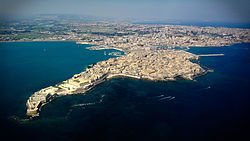
Ortygia (/ɔːrˈtɪdʒiə/ or-TIJ-ee-ə; Italian: Ortigia [orˈtiːdʒa]; Ancient Greek: Ὀρτυγία, romanized: Ortygía) is a small island which is the historical centre of the city of Syracuse, Sicily. The island, also known as the Città Vecchia (Old City), contains many historical landmarks.
The name originates from the Ancient Greek órtyx (ὄρτυξ), which means "quail".
Ortygia is a small island forming the historical centre of the city of Syracuse, Sicily. It contains many of the city’s oldest landmarks, including the Temple of Apollo, the Fountain of Arethusa, and the Cathedral of Syracuse, originally a Greek temple.
In 2005, Ortygia was inscribed as part of the UNESCO World Heritage Site "Syracuse and the Rocky Necropolis of Pantalica". The island represents the core of ancient Syracuse, showing continuous layers of Greek, Roman, and Byzantine, Arab, and Norman influences.
Ortygia’s urban layout, religious buildings, and public spaces reflect the political and religious evolution of the Mediterranean over more than two millennia. The island is considered a key component of the heritage designation, embodying both architectural and historical significance.
In Greek mythology, Ortygia is associated with several legends. According to the Homeric Hymn to Delian Apollo, the goddess Leto stopped at Ortygia to give birth to Artemis, who then assisted her mother to Delos, where Apollo was born. Other sources suggest the twins were born at either Delos or Ortygia, though Strabo identified Ortygia as an old name for Delos.
Some traditions link the island’s origin to Asteria, Leto’s sister, who transformed into a quail (Ortyx) and became the island.
Ortygia is also connected to the myth of Orion, who was abducted by Eos, the goddess of dawn, to the island and later joined Artemis’ retinue.
Ortygia
Ortygia (/ɔːrˈtɪdʒiə/ or-TIJ-ee-ə; Italian: Ortigia [orˈtiːdʒa]; Ancient Greek: Ὀρτυγία, romanized: Ortygía) is a small island which is the historical centre of the city of Syracuse, Sicily. The island, also known as the Città Vecchia (Old City), contains many historical landmarks.
The name originates from the Ancient Greek órtyx (ὄρτυξ), which means "quail".
Ortygia is a small island forming the historical centre of the city of Syracuse, Sicily. It contains many of the city’s oldest landmarks, including the Temple of Apollo, the Fountain of Arethusa, and the Cathedral of Syracuse, originally a Greek temple.
In 2005, Ortygia was inscribed as part of the UNESCO World Heritage Site "Syracuse and the Rocky Necropolis of Pantalica". The island represents the core of ancient Syracuse, showing continuous layers of Greek, Roman, and Byzantine, Arab, and Norman influences.
Ortygia’s urban layout, religious buildings, and public spaces reflect the political and religious evolution of the Mediterranean over more than two millennia. The island is considered a key component of the heritage designation, embodying both architectural and historical significance.
In Greek mythology, Ortygia is associated with several legends. According to the Homeric Hymn to Delian Apollo, the goddess Leto stopped at Ortygia to give birth to Artemis, who then assisted her mother to Delos, where Apollo was born. Other sources suggest the twins were born at either Delos or Ortygia, though Strabo identified Ortygia as an old name for Delos.
Some traditions link the island’s origin to Asteria, Leto’s sister, who transformed into a quail (Ortyx) and became the island.
Ortygia is also connected to the myth of Orion, who was abducted by Eos, the goddess of dawn, to the island and later joined Artemis’ retinue.
Recent media
Recent media