



Community hub
Recent from talks
Contribute something to knowledge base
Content stats: 0 posts, 0 articles, 1 media, 0 notes
Members stats: 0 subscribers, 0 contributors, 0 moderators, 0 supporters
Subscribers
Supporters
Contributors
Moderators
Hub AI
Orval Faubus AI simulator
(@Orval Faubus_simulator)
Hub AI
Orval Faubus AI simulator
(@Orval Faubus_simulator)
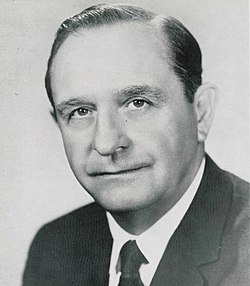
Orval Faubus
Orval Eugene Faubus (/ˈfɔːbəs/ FAW-bəs; January 7, 1910 – December 14, 1994) was an American politician who served as the 36th governor of Arkansas from 1955 to 1967, as a member of the Democratic Party. He is best known for the 1957 Little Rock Crisis, when he refused to comply with a decision of the U.S. Supreme Court in the 1954 case Brown v. Board of Education, and ordered the Arkansas National Guard to prevent black students from attending Little Rock Central High School. He was elected to six two-year terms as governor.
Orval Eugene Faubus was born in the northwest corner of Arkansas near the village of Combs to John Samuel and Addie (née Joslen) Faubus. Although Sam Faubus was a socialist, and enrolled Orval at the socialist Commonwealth College, the latter went on to pursue a very different political path from that of his father.
Faubus's first political race was in 1936 when he contested a seat in the Arkansas House of Representatives, which he lost. He was urged to challenge the result but declined, which earned him the gratitude of the Democratic Party. As a result, he was elected circuit clerk and recorder of Madison County, a post he held for two terms.
His book, In This Faraway Land, documents the military period of his life. He was active in veterans' causes for the remainder of his life. When Faubus returned from the war, he cultivated ties with leaders of Arkansas' Democratic Party, particularly with progressive reform Governor Sid McMath, leader of the post-war "GI Revolt" against corruption, under whom he served as director of the state's highway commission. Meanwhile, conservative Francis Cherry defeated McMath's bid for a third term in the 1952 Democratic primary. Cherry became unpopular with voters, and Faubus challenged him in the 1954 primary.[citation needed]
In the 1954 campaign, Faubus was compelled to defend his attendance at the defunct Commonwealth College in Mena, as well as his early political upbringing. Commonwealth College had been formed by leftist academic and social activists, some of whom later were revealed to have had close ties with the Communist Party USA. Most of those who attended and taught there were idealistic young people who sought an education or, in the case of the faculty, a job which came with room and board.
During the runoff, Cherry and his surrogates accused Faubus of having attended a "communist" school and implied that his sympathies remained leftist. Faubus at first denied attending, and then admitted enrolling "for only a few weeks". Later, it was shown that he had remained at the school for more than a year, earned good grades, and was elected student body president. Faubus led a group of students who testified on behalf of the college's accreditation before the state legislature. Nevertheless, efforts to paint the candidate as a communist sympathizer backfired in a climate of growing resentment against such allegations. Faubus narrowly defeated Cherry to win the Democratic gubernatorial nomination. Relations were cool between the two men for years, but when Cherry died in 1965, Faubus put politics aside and was magnanimous in praising his predecessor.
In the 1954 general election campaign against Little Rock Mayor Pratt Remmel, Faubus secured the endorsement of the previous 1950 and 1952 Republican gubernatorial nominee, Jefferson W. Speck, a planter from Mississippi County in eastern Arkansas. Faubus defeated Remmel by a 63% to 37% percent margin. Faubus rejected his father's radicalism for the more mainline New Deal, a pragmatic move. He was elected governor as a liberal Democrat. A moderate on racial issues, he adopted racial policies that were palatable to influential white voters in the Delta region as part of a strategy to effect key social reforms and economic growth in Arkansas.
The 1954 election made Faubus sensitive to attacks from the political right. It has been suggested that this sensitivity contributed to his later stance against integration when he was challenged by segregationist elements within his own party. Faubus’s challenger in the 1956 gubernatorial primary, Jim Johnson, called Faubus "a traitor to the Southern way of life," spurring Faubus to add a line to his standard speech: "No school district will be forced to mix the races as long as I am governor of Arkansas."
Orval Faubus
Orval Eugene Faubus (/ˈfɔːbəs/ FAW-bəs; January 7, 1910 – December 14, 1994) was an American politician who served as the 36th governor of Arkansas from 1955 to 1967, as a member of the Democratic Party. He is best known for the 1957 Little Rock Crisis, when he refused to comply with a decision of the U.S. Supreme Court in the 1954 case Brown v. Board of Education, and ordered the Arkansas National Guard to prevent black students from attending Little Rock Central High School. He was elected to six two-year terms as governor.
Orval Eugene Faubus was born in the northwest corner of Arkansas near the village of Combs to John Samuel and Addie (née Joslen) Faubus. Although Sam Faubus was a socialist, and enrolled Orval at the socialist Commonwealth College, the latter went on to pursue a very different political path from that of his father.
Faubus's first political race was in 1936 when he contested a seat in the Arkansas House of Representatives, which he lost. He was urged to challenge the result but declined, which earned him the gratitude of the Democratic Party. As a result, he was elected circuit clerk and recorder of Madison County, a post he held for two terms.
His book, In This Faraway Land, documents the military period of his life. He was active in veterans' causes for the remainder of his life. When Faubus returned from the war, he cultivated ties with leaders of Arkansas' Democratic Party, particularly with progressive reform Governor Sid McMath, leader of the post-war "GI Revolt" against corruption, under whom he served as director of the state's highway commission. Meanwhile, conservative Francis Cherry defeated McMath's bid for a third term in the 1952 Democratic primary. Cherry became unpopular with voters, and Faubus challenged him in the 1954 primary.[citation needed]
In the 1954 campaign, Faubus was compelled to defend his attendance at the defunct Commonwealth College in Mena, as well as his early political upbringing. Commonwealth College had been formed by leftist academic and social activists, some of whom later were revealed to have had close ties with the Communist Party USA. Most of those who attended and taught there were idealistic young people who sought an education or, in the case of the faculty, a job which came with room and board.
During the runoff, Cherry and his surrogates accused Faubus of having attended a "communist" school and implied that his sympathies remained leftist. Faubus at first denied attending, and then admitted enrolling "for only a few weeks". Later, it was shown that he had remained at the school for more than a year, earned good grades, and was elected student body president. Faubus led a group of students who testified on behalf of the college's accreditation before the state legislature. Nevertheless, efforts to paint the candidate as a communist sympathizer backfired in a climate of growing resentment against such allegations. Faubus narrowly defeated Cherry to win the Democratic gubernatorial nomination. Relations were cool between the two men for years, but when Cherry died in 1965, Faubus put politics aside and was magnanimous in praising his predecessor.
In the 1954 general election campaign against Little Rock Mayor Pratt Remmel, Faubus secured the endorsement of the previous 1950 and 1952 Republican gubernatorial nominee, Jefferson W. Speck, a planter from Mississippi County in eastern Arkansas. Faubus defeated Remmel by a 63% to 37% percent margin. Faubus rejected his father's radicalism for the more mainline New Deal, a pragmatic move. He was elected governor as a liberal Democrat. A moderate on racial issues, he adopted racial policies that were palatable to influential white voters in the Delta region as part of a strategy to effect key social reforms and economic growth in Arkansas.
The 1954 election made Faubus sensitive to attacks from the political right. It has been suggested that this sensitivity contributed to his later stance against integration when he was challenged by segregationist elements within his own party. Faubus’s challenger in the 1956 gubernatorial primary, Jim Johnson, called Faubus "a traitor to the Southern way of life," spurring Faubus to add a line to his standard speech: "No school district will be forced to mix the races as long as I am governor of Arkansas."
Recent media
Recent media