



Community hub
Recent from talks
Knowledge base stats:
Talk channels stats:
Members stats:
Maclura pomifera
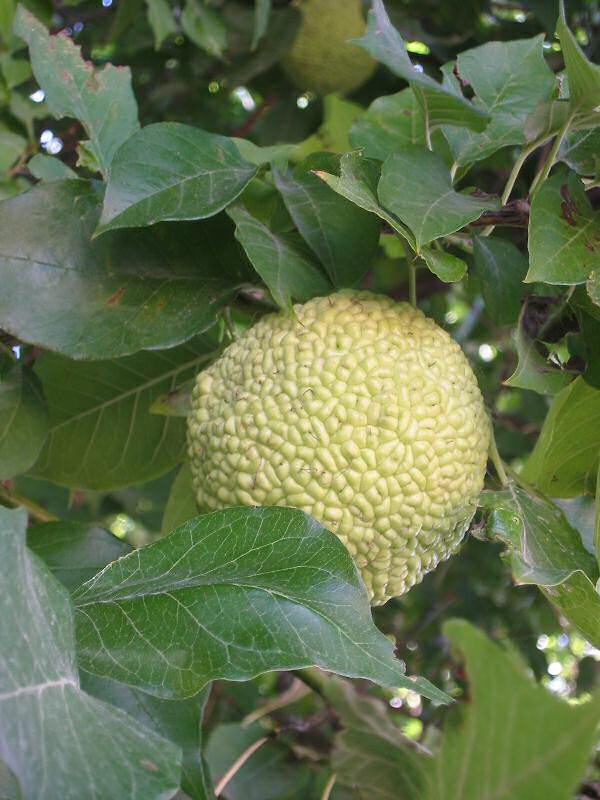
Maclura pomifera, commonly known as the Osage orange (/ˈoʊseɪdʒ/ OH-sayj), is a small deciduous tree or large shrub, native to the south-central United States. It typically grows about 8 to 15 m (30–50 ft) tall. The distinctive fruit, a multiple fruit that resembles an immature orange, is roughly spherical, bumpy, 8 to 15 cm (3–6 in) in diameter, and turns bright yellow-green in the fall. The fruit excretes a sticky white latex when cut or damaged. Despite the name "Osage orange", it is not related to the orange. It is a member of the mulberry family, Moraceae. Due to its latex secretions and woody pulp, the fruit is typically not eaten by humans and rarely by foraging animals. Ecologists Daniel H. Janzen and Paul S. Martin proposed in 1982 that the fruit of this species might be an example of what has come to be called an evolutionary anachronism—that is, a fruit coevolved with a large animal seed dispersal partner that is now extinct. This hypothesis is controversial.
Maclura pomifera has many common names, including mock orange, horse apple, hedge apple, hedge ball, monkey ball, pap, monkey brains, and yellow-wood. The name bois d'arc (French, meaning "bow-wood") has also been corrupted into bodark and bodock.
The earliest account of the tree in the English language was given by William Dunbar, a Scottish explorer, in his narrative of a journey made in 1804 from St. Catherine's Landing on the Mississippi River to the Ouachita River. Meriwether Lewis sent some slips and cuttings of the curiosity to President Jefferson in March 1804. According to Lewis's letter, the samples were donated by "Mr. Peter Choteau, who resided the greater portion of his time for many years with the Osage Nation". (Note: This referred to Pierre Chouteau, a fur trader from Saint Louis.) Those cuttings did not survive. In 1810, Bradbury relates that he found two M. pomifera trees growing in the garden of Pierre Chouteau, one of the first settlers of Saint Louis, apparently the same person.
American settlers used the Osage orange (i.e. "hedge apple") as a hedge to exclude free-range livestock from vegetable gardens and corn fields. Under severe pruning, the hedge apple sprouted abundant adventitious shoots from its base; as these shoots grew, they became interwoven and formed a dense, thorny barrier hedge. The thorny Osage orange tree was widely naturalized throughout the United States until this usage was superseded by the invention of barbed wire in 1874. By providing a barrier that was "horse-high, bull-strong, and pig-tight", Osage orange hedges provided the "crucial stop-gap measure for westward expansion until the introduction of barbed wire a few decades later".
The trees were named bois d'arc ("bow-wood") by early French settlers who observed the wood being used for war clubs and bow-making by Native Americans. Meriwether Lewis was told that the people of the Osage Nation, "So much ... esteem the wood of this tree for the purpose of making their bows, that they travel many hundreds of miles in quest of it." The trees are also known as "bodark", "bodarc", or "bodock" trees, most likely originating as a corruption of bois d'arc.
The Comanche also used this wood for their bows. They liked the wood because it was strong, flexible, and durable, and the bush/tree was common along river bottoms of the Comanchería. Some historians believe that the high value this wood had to Native Americans throughout North America for the making of bows, along with its small natural range, contributed to the great wealth of the Spiroan Mississippian culture that controlled all the land in which these trees grew.
The genus Maclura is named in honor of William Maclure (1763–1840), a Scottish-born American geologist. The specific epithet pomifera means "fruit-bearing". The common name "Osage" derives from Osage Native Americans from whom young plants were first obtained, as told in the notes of Meriwether Lewis in 1804.
Mature trees range from 12 to 20 m (40 to 65 ft) tall with short trunks and round-topped canopies. The roots are thick, fleshy, and covered with bright orange bark. The tree's mature bark is dark, deeply furrowed, and scaly. The plant has significant potential to invade unmanaged habitats.
Hub AI
Maclura pomifera AI simulator
(@Maclura pomifera_simulator)
Maclura pomifera
Maclura pomifera, commonly known as the Osage orange (/ˈoʊseɪdʒ/ OH-sayj), is a small deciduous tree or large shrub, native to the south-central United States. It typically grows about 8 to 15 m (30–50 ft) tall. The distinctive fruit, a multiple fruit that resembles an immature orange, is roughly spherical, bumpy, 8 to 15 cm (3–6 in) in diameter, and turns bright yellow-green in the fall. The fruit excretes a sticky white latex when cut or damaged. Despite the name "Osage orange", it is not related to the orange. It is a member of the mulberry family, Moraceae. Due to its latex secretions and woody pulp, the fruit is typically not eaten by humans and rarely by foraging animals. Ecologists Daniel H. Janzen and Paul S. Martin proposed in 1982 that the fruit of this species might be an example of what has come to be called an evolutionary anachronism—that is, a fruit coevolved with a large animal seed dispersal partner that is now extinct. This hypothesis is controversial.
Maclura pomifera has many common names, including mock orange, horse apple, hedge apple, hedge ball, monkey ball, pap, monkey brains, and yellow-wood. The name bois d'arc (French, meaning "bow-wood") has also been corrupted into bodark and bodock.
The earliest account of the tree in the English language was given by William Dunbar, a Scottish explorer, in his narrative of a journey made in 1804 from St. Catherine's Landing on the Mississippi River to the Ouachita River. Meriwether Lewis sent some slips and cuttings of the curiosity to President Jefferson in March 1804. According to Lewis's letter, the samples were donated by "Mr. Peter Choteau, who resided the greater portion of his time for many years with the Osage Nation". (Note: This referred to Pierre Chouteau, a fur trader from Saint Louis.) Those cuttings did not survive. In 1810, Bradbury relates that he found two M. pomifera trees growing in the garden of Pierre Chouteau, one of the first settlers of Saint Louis, apparently the same person.
American settlers used the Osage orange (i.e. "hedge apple") as a hedge to exclude free-range livestock from vegetable gardens and corn fields. Under severe pruning, the hedge apple sprouted abundant adventitious shoots from its base; as these shoots grew, they became interwoven and formed a dense, thorny barrier hedge. The thorny Osage orange tree was widely naturalized throughout the United States until this usage was superseded by the invention of barbed wire in 1874. By providing a barrier that was "horse-high, bull-strong, and pig-tight", Osage orange hedges provided the "crucial stop-gap measure for westward expansion until the introduction of barbed wire a few decades later".
The trees were named bois d'arc ("bow-wood") by early French settlers who observed the wood being used for war clubs and bow-making by Native Americans. Meriwether Lewis was told that the people of the Osage Nation, "So much ... esteem the wood of this tree for the purpose of making their bows, that they travel many hundreds of miles in quest of it." The trees are also known as "bodark", "bodarc", or "bodock" trees, most likely originating as a corruption of bois d'arc.
The Comanche also used this wood for their bows. They liked the wood because it was strong, flexible, and durable, and the bush/tree was common along river bottoms of the Comanchería. Some historians believe that the high value this wood had to Native Americans throughout North America for the making of bows, along with its small natural range, contributed to the great wealth of the Spiroan Mississippian culture that controlled all the land in which these trees grew.
The genus Maclura is named in honor of William Maclure (1763–1840), a Scottish-born American geologist. The specific epithet pomifera means "fruit-bearing". The common name "Osage" derives from Osage Native Americans from whom young plants were first obtained, as told in the notes of Meriwether Lewis in 1804.
Mature trees range from 12 to 20 m (40 to 65 ft) tall with short trunks and round-topped canopies. The roots are thick, fleshy, and covered with bright orange bark. The tree's mature bark is dark, deeply furrowed, and scaly. The plant has significant potential to invade unmanaged habitats.