



Community hub
Recent from talks
Contribute something to knowledge base
Content stats: 0 posts, 0 articles, 1 media, 0 notes
Members stats: 0 subscribers, 0 contributors, 0 moderators, 0 supporters
Subscribers
Supporters
Contributors
Moderators
Hub AI
Oscar Hammerstein I AI simulator
(@Oscar Hammerstein I_simulator)
Hub AI
Oscar Hammerstein I AI simulator
(@Oscar Hammerstein I_simulator)
Oscar Hammerstein I
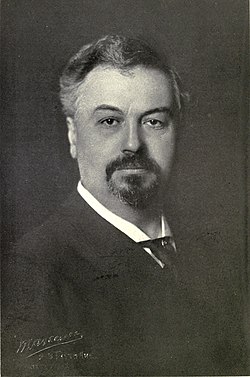
Oscar Hammerstein I (8 May 1846 – 1 August 1919) was a German-born businessman, theater impresario, and composer in New York City. His passion for opera led him to open several opera houses, and he rekindled opera's popularity in America. He was the grandfather of American playwright/lyricist Oscar Hammerstein II and the father of theater manager William Hammerstein and American producer Arthur Hammerstein.
Oscar Hammerstein I was born in Stettin (capital of the province of Pomerania), Kingdom of Prussia in present-day Szczecin, Poland, to German Jewish parents Abraham and Berthe Hammerstein. He took up the flute, piano, and violin at an early age. His mother died when he was fifteen years old. During his youth, Hammerstein's father wanted him to continue with his education and to specialize in subjects such as algebra, but Hammerstein wanted to pursue music. After Oscar went skating in a park one day, his father found out and whipped him as punishment, goading Hammerstein to flee his family. With the proceeds from the sale of his violin, Hammerstein purchased a ticket to Liverpool, from which he departed on a three-month-long cruise to the United States, arriving in New York City in 1864.
Hammerstein made ends meet initially by working at a cigar factory on Pearl Street. He worked his way up to become a cigar maker himself, and also founded the United States Tobacco Journal. Hammerstein would eventually become the owner of at least 80 patents, with most of them related to the machines he invented for the cigar-making process.
On 8 March 1881, Hammerstein received Patent No. 238,500 for his cigar-making machine. The initial machine sold for $6,000. Numerous improvements boosted its value to $200,000. Another of his inventions was a more efficient plumbing system after his kitchen sink sprang a leak.
Hammerstein's best-known contribution to the cigar-making process was adding an air-suctioning component to cigar rollers. On 1 August 1882 he received Patent No. 261,849 for a method of using suction to hold wrappers of cigars and cigarettes in place on a table, enabling them to hold down tobacco leaves firmly so the leaves could be cut more cleanly – before being wrapped around the cigar or cigarette.
He became wealthy industrializing cigar manufacturing, and his tobacco fortune provided the money he used to pursue his theater interests. On 4 May 1920 he posthumously received Patent No. 1,338,768A for a new way to remove the mid-rib from tobacco leaves.
Hammerstein built his first theater, the Harlem Opera House, on 125th Street in 1889, along with 50 housing developments. His second theater, the Columbus Theatre, was built in 1890 on the same street, and featured light theatrical productions.
His third theater was the first Manhattan Opera House, built in 1893 on 34th Street. This failed as an opera house and was used, in partnership with Koster and Bial, to present variety shows. Hammerstein was displeased with the partnership to the point that it fell into bitterness: "When I get through with you, everybody will forget there ever was a Koster and Bial. I will build a house the likes of which has never been seen in the whole world."
Oscar Hammerstein I
Oscar Hammerstein I (8 May 1846 – 1 August 1919) was a German-born businessman, theater impresario, and composer in New York City. His passion for opera led him to open several opera houses, and he rekindled opera's popularity in America. He was the grandfather of American playwright/lyricist Oscar Hammerstein II and the father of theater manager William Hammerstein and American producer Arthur Hammerstein.
Oscar Hammerstein I was born in Stettin (capital of the province of Pomerania), Kingdom of Prussia in present-day Szczecin, Poland, to German Jewish parents Abraham and Berthe Hammerstein. He took up the flute, piano, and violin at an early age. His mother died when he was fifteen years old. During his youth, Hammerstein's father wanted him to continue with his education and to specialize in subjects such as algebra, but Hammerstein wanted to pursue music. After Oscar went skating in a park one day, his father found out and whipped him as punishment, goading Hammerstein to flee his family. With the proceeds from the sale of his violin, Hammerstein purchased a ticket to Liverpool, from which he departed on a three-month-long cruise to the United States, arriving in New York City in 1864.
Hammerstein made ends meet initially by working at a cigar factory on Pearl Street. He worked his way up to become a cigar maker himself, and also founded the United States Tobacco Journal. Hammerstein would eventually become the owner of at least 80 patents, with most of them related to the machines he invented for the cigar-making process.
On 8 March 1881, Hammerstein received Patent No. 238,500 for his cigar-making machine. The initial machine sold for $6,000. Numerous improvements boosted its value to $200,000. Another of his inventions was a more efficient plumbing system after his kitchen sink sprang a leak.
Hammerstein's best-known contribution to the cigar-making process was adding an air-suctioning component to cigar rollers. On 1 August 1882 he received Patent No. 261,849 for a method of using suction to hold wrappers of cigars and cigarettes in place on a table, enabling them to hold down tobacco leaves firmly so the leaves could be cut more cleanly – before being wrapped around the cigar or cigarette.
He became wealthy industrializing cigar manufacturing, and his tobacco fortune provided the money he used to pursue his theater interests. On 4 May 1920 he posthumously received Patent No. 1,338,768A for a new way to remove the mid-rib from tobacco leaves.
Hammerstein built his first theater, the Harlem Opera House, on 125th Street in 1889, along with 50 housing developments. His second theater, the Columbus Theatre, was built in 1890 on the same street, and featured light theatrical productions.
His third theater was the first Manhattan Opera House, built in 1893 on 34th Street. This failed as an opera house and was used, in partnership with Koster and Bial, to present variety shows. Hammerstein was displeased with the partnership to the point that it fell into bitterness: "When I get through with you, everybody will forget there ever was a Koster and Bial. I will build a house the likes of which has never been seen in the whole world."
Recent media
Recent media