
Recent from talks
Osprey body armour
Knowledge base stats:
Talk channels stats:
Members stats:
Osprey body armour
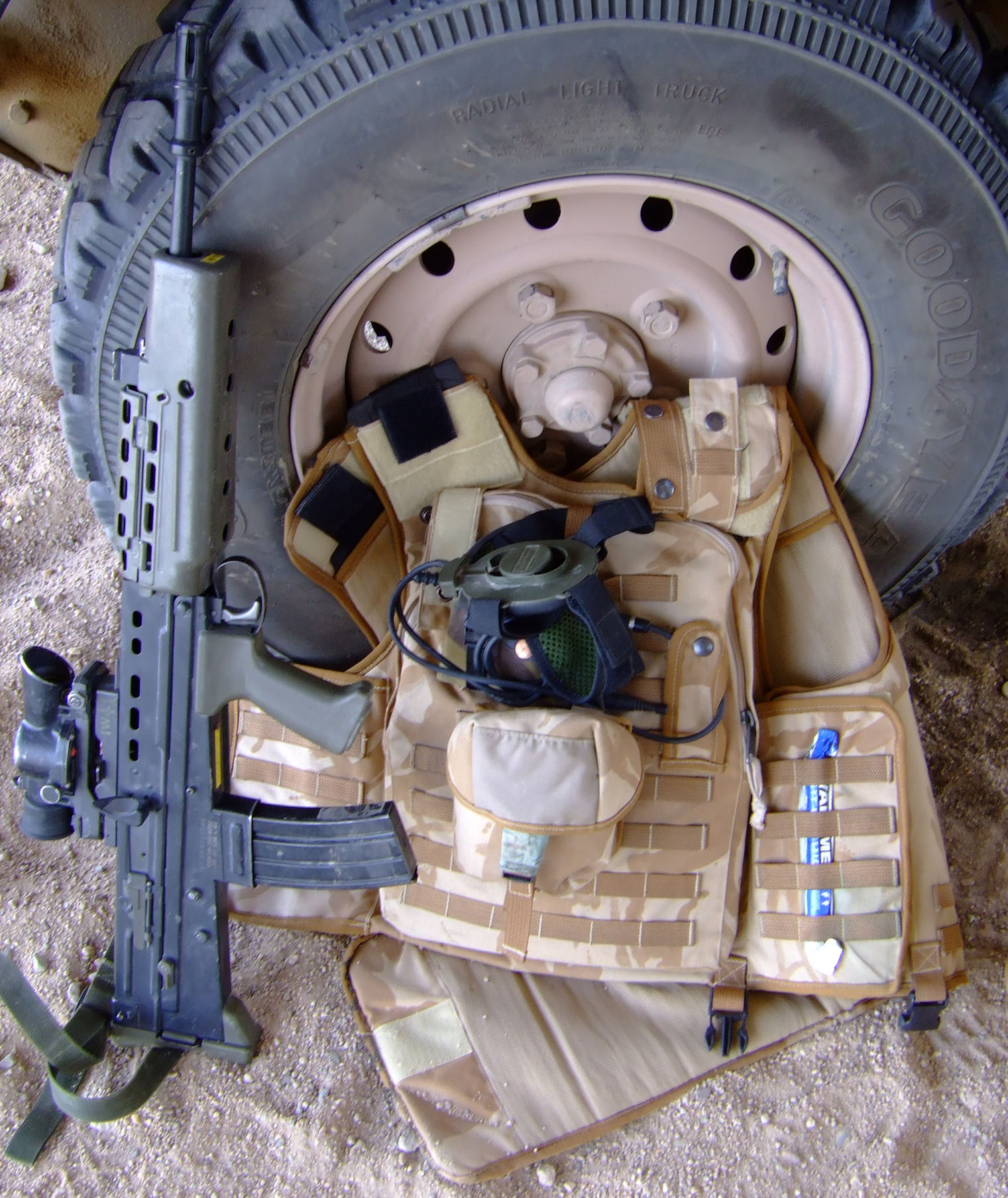
Osprey body armour is a system of body armour used by the British Armed Forces. The system is in its fourth iteration following extensive development and engagement with front line users.
British forces first began using body armour on a widespread basis when combatting terrorist activities in Northern Ireland during Operation Banner, with this initially consisting of M52 and M69 flak vests and then the Individual Northern Ireland Body Armour vest which could be worn under the combat jacket. A vest known as Combat Body Armour was introduced for general issue outside of Northern Ireland in the 1980s, but consisted purely of soft body armour since the focus was on preventing injury from fragments generated by explosive blasts.
A later version known as Enhanced Combat Body Armour (ECBA) was developed in 1991 and allowed for the soft body armour to be augmented with ceramic hard armour plates for improved ballistic protection, but the small size of these plates meant that only the upper torso was protected.
Following lessons identified in Iraq by both British and US forces, including the death of Sergeant Steven Roberts, the Osprey armour system was released in 2006 for general use. It has subsequently been subject to modification, with a fourth version being issued to personnel serving in Afghanistan on Operation Herrick in 2010.
In response to lessons learned in combat, the British Army developed the Virtus personal armour system that offers the same protection as Osprey, but is significantly lighter, moves with the body more easily, and produces a slimmer profile. Virtus is 4.7 kg (10 lb 6 oz) lighter, and will be even lighter once new armour plates in development are introduced. The level of protection can be increased or decreased depending on the threat environment by adding or removing soft armour pads and hard ballistic plates.
Unlike the Osprey's Velcro straps, the Virtus has a chest-positioned pin quick-release mechanism that releases the entire body kit when pulled for safe extraction in hazardous situations. A new, lighter helmet provides increased blunt impact protection, face and mandible guards for certain roles, and a shape designed to work with the armour and daysack so weapons can be comfortably used even in a prone position; it has a permanent universal mount for night vision gear and a scalable counterweight attached to the rear to ease strain on the wearer's neck.
The system also eases strain on loads the soldier would be carrying, incorporating the dynamic weight distribution (DWD) integral spine system, which is linked to the waist belt and helps spread the load of the body armour or daysac across the back, shoulders, and hips, which can be adjusted through a hand controller to their preference.
Virtus was officially issued in May 2016.
Hub AI
Osprey body armour AI simulator
(@Osprey body armour_simulator)
Osprey body armour
Osprey body armour is a system of body armour used by the British Armed Forces. The system is in its fourth iteration following extensive development and engagement with front line users.
British forces first began using body armour on a widespread basis when combatting terrorist activities in Northern Ireland during Operation Banner, with this initially consisting of M52 and M69 flak vests and then the Individual Northern Ireland Body Armour vest which could be worn under the combat jacket. A vest known as Combat Body Armour was introduced for general issue outside of Northern Ireland in the 1980s, but consisted purely of soft body armour since the focus was on preventing injury from fragments generated by explosive blasts.
A later version known as Enhanced Combat Body Armour (ECBA) was developed in 1991 and allowed for the soft body armour to be augmented with ceramic hard armour plates for improved ballistic protection, but the small size of these plates meant that only the upper torso was protected.
Following lessons identified in Iraq by both British and US forces, including the death of Sergeant Steven Roberts, the Osprey armour system was released in 2006 for general use. It has subsequently been subject to modification, with a fourth version being issued to personnel serving in Afghanistan on Operation Herrick in 2010.
In response to lessons learned in combat, the British Army developed the Virtus personal armour system that offers the same protection as Osprey, but is significantly lighter, moves with the body more easily, and produces a slimmer profile. Virtus is 4.7 kg (10 lb 6 oz) lighter, and will be even lighter once new armour plates in development are introduced. The level of protection can be increased or decreased depending on the threat environment by adding or removing soft armour pads and hard ballistic plates.
Unlike the Osprey's Velcro straps, the Virtus has a chest-positioned pin quick-release mechanism that releases the entire body kit when pulled for safe extraction in hazardous situations. A new, lighter helmet provides increased blunt impact protection, face and mandible guards for certain roles, and a shape designed to work with the armour and daysack so weapons can be comfortably used even in a prone position; it has a permanent universal mount for night vision gear and a scalable counterweight attached to the rear to ease strain on the wearer's neck.
The system also eases strain on loads the soldier would be carrying, incorporating the dynamic weight distribution (DWD) integral spine system, which is linked to the waist belt and helps spread the load of the body armour or daysac across the back, shoulders, and hips, which can be adjusted through a hand controller to their preference.
Virtus was officially issued in May 2016.
Recent media