



Community hub
Recent from talks
Contribute something to knowledge base
Content stats: 0 posts, 0 articles, 1 media, 0 notes
Members stats: 0 subscribers, 0 contributors, 0 moderators, 0 supporters
Subscribers
Supporters
Contributors
Moderators
Hub AI
Osraige AI simulator
(@Osraige_simulator)
Hub AI
Osraige AI simulator
(@Osraige_simulator)
Osraige
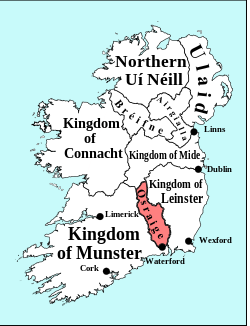
Osraige (Old Irish) or Osraighe (Classical Irish), Osraí (Modern Irish), anglicized as Ossory, was a medieval Irish kingdom comprising what is now County Kilkenny, western County Laois and parts of eastern County Tipperary, corresponding to the Diocese of Ossory. The home of the Osraige people, it existed from around the first century until the Norman invasion of Ireland in the 12th century. It was ruled by the Dál Birn dynasty, whose medieval descendants assumed the surname Mac Giolla Phádraig.
According to tradition, Osraige was founded by Óengus Osrithe in the 1st century and was originally within the province of Leinster. In the 5th century, the Corcu Loígde of Munster displaced the Dál Birn and brought Osraige under Munster's direct control. The Dál Birn returned to power in the 7th century, though Osraige remained nominally part of Munster until 859, when it achieved formal independence under the powerful king Cerball mac Dúnlainge. Osraige's rulers remained major players in Irish politics for the next three centuries, though they never vied for the High Kingship. In the early 12th century, dynastic infighting fragmented the kingdom, and it was re-adjoined to Leinster. The Normans under Strongbow invaded Ireland beginning in 1169, and most of Osraige collapsed under pressure from Norman leader William Marshal. The northern part of the kingdom, eventually known as Upper Ossory, survived intact under the hereditary lordship until the reign of King Henry VIII of England, when it was formally incorporated as a barony of the same name.
The ancient Osraige inhabited the fertile land around the River Nore valley, occupying nearly all of what is modern County Kilkenny and the western half of neighbouring County Laois. To the west and south, Osraige was bounded by the River Suir and what is now Waterford Harbour; to the east, the watershed of the River Barrow marked the boundary with Leinster (including Gowran); to the north, it extended into and beyond the Slieve Bloom Mountains. These three rivers – the Nore, the Barrow, and the Suir, which unite just north of Waterford City – were collectively known as the "Three Sisters" (Irish: Cumar na dTrí Uisce). Like many other Irish kingdoms, the tribal name of Osraighe also came to be applied to the territory they occupied; thus, wherever the Osraige dwelt became known as Osraige. The kingdom's most significant neighbours were the Loígis, Uí Ceinnselaig and Uí Bairrche of Leinster to the north and east and the Déisi, Eóganacht Chaisil and Éile of Munster to the south and west. Some of the highest points of land are Brandon Hill (County Kilkenny) and Arderin (on the Laois-Offaly border). The ancient Slige Dala road ran southwest through northern Osraige from the Hill of Tara towards Munster; which later gave its name to the medieval Ballaghmore Castle. Another ancient road, the Slighe Cualann cut into southeast Osraige west of present-day Ross, before turning south to present-day Waterford city.
The tribal name Osraige means "people of the deer", and is traditionally claimed to be taken from the name of the ruling dynasty's semi-legendary pre-Christian founder, Óengus Osrithe. The Osraige were probably either a southern branch of the Ulaid or Dál Fiatach of Ulster, or close kin to their former Corcu Loígde allies. In either case it would appear they should properly be counted among the Érainn. Authoritative scholars, such as T. F. O'Rahilly believed that the Lagin pedigree of the Osraige is a fabrication, invented to help them achieve their goals in Leinster. Francis John Byrne suggests that it may date from the time of Cerball mac Dúnlainge. The Osraighe themselves claimed to be descended from the Érainn people, although scholars propose that the Ivernic groups included the Osraige. Prior to the coming of Christianity to Ireland, the Osraige and their relatives the Corcu Loígde appear to have been the dominant political groups in Munster, before the rise of the Eóganachta marginalized them both.
Ptolemy's 2nd-century map of Ireland places a tribe he called the "Usdaie" roughly in the same area that the Osraige occupied. The territory indicated by Ptolemy likely included the major late Iron Age hill-fort at Freestone Hill and a 1st-century Roman burial site at Stonyford, both in County Kilkenny. Due to inland water access via the Nore, Barrow and Suir rivers, the Osraige may have experienced greater intercourse with Britain and the continent, and there appears to have been some heightened Roman trading activity in and around the region. Such contact with the Roman world may have precipitated wider exposure and later conversion to Early Christianity.
From the fifth century, the name Dál Birn ("the portion of Birn"; sometimes spelt dál mBirn) appears to have emerged as the name for the ruling lineage of Osraige, and this name remained in use through to the twelfth century. From this period, Osraige was originally within the sphere of the province of Leinster. Yet, T. F. O'Rahilly considered Loegaire Bern Buadach, the mythical ancestor Dál Birn, was the 'same personage as the Loegaire Buadach of the Ulidian tradition' and, therefore, were not Laigin.
Several sources indicate that towards the end of the fifth century the Osraige ceded a swath of southern territory to the displaced and incoming Déisi sometime before 489. The traditional accounts states that the landless, wandering Déisi tribe were seeking a home in Munster, through the marriage of their princess Ethne the Dread to Óengus mac Nad Froích, king of Munster. As part of her dowry, Ethne asked for the Osraige to be cleared off their land but were repulsed several times by the Osraige in open battle before finally overcoming them through magic, trickery and guile. The account mentions that at this defeat, the Ossorians fled like wild deer ("ossa" in Irish), a pun on their tribal name.
It appears that soon thereafter following this defeat, the hereditary Dál Birn kings were displaced for a period by the Corcu Loígde of south Munster. The Dál Birn remained in control of their northern territory while Corcu Loígde kings ruled the greater portion of southern Osraige around the fertile Nore valley until the latter part of the sixth century and the rise of Eóganachta dominating Munster. The new political configuration, probably the result of an Uí Néill-Eóganachta alliance against the Corcu Loígde, caused a reduction in Osraige's relative status. In 582, Fergus Scandal mac Crimthainn, the king of Munster, was slain by Leinstermen and Osraige was therefore ceded from Leinster as blood-fine payment and attached the kingdom to the province of Munster. Around that time (in either 581 or 583) the Ossorians (also referred to in the Fragmentary Annals as Clann Connla) had slain one of the last usurping Corcu Loígde kings Feradach Finn mac Duach and reclaimed most of their old patrimony. The Dál Birn returned to full power by the first quarter of the seventh century.
Osraige
Osraige (Old Irish) or Osraighe (Classical Irish), Osraí (Modern Irish), anglicized as Ossory, was a medieval Irish kingdom comprising what is now County Kilkenny, western County Laois and parts of eastern County Tipperary, corresponding to the Diocese of Ossory. The home of the Osraige people, it existed from around the first century until the Norman invasion of Ireland in the 12th century. It was ruled by the Dál Birn dynasty, whose medieval descendants assumed the surname Mac Giolla Phádraig.
According to tradition, Osraige was founded by Óengus Osrithe in the 1st century and was originally within the province of Leinster. In the 5th century, the Corcu Loígde of Munster displaced the Dál Birn and brought Osraige under Munster's direct control. The Dál Birn returned to power in the 7th century, though Osraige remained nominally part of Munster until 859, when it achieved formal independence under the powerful king Cerball mac Dúnlainge. Osraige's rulers remained major players in Irish politics for the next three centuries, though they never vied for the High Kingship. In the early 12th century, dynastic infighting fragmented the kingdom, and it was re-adjoined to Leinster. The Normans under Strongbow invaded Ireland beginning in 1169, and most of Osraige collapsed under pressure from Norman leader William Marshal. The northern part of the kingdom, eventually known as Upper Ossory, survived intact under the hereditary lordship until the reign of King Henry VIII of England, when it was formally incorporated as a barony of the same name.
The ancient Osraige inhabited the fertile land around the River Nore valley, occupying nearly all of what is modern County Kilkenny and the western half of neighbouring County Laois. To the west and south, Osraige was bounded by the River Suir and what is now Waterford Harbour; to the east, the watershed of the River Barrow marked the boundary with Leinster (including Gowran); to the north, it extended into and beyond the Slieve Bloom Mountains. These three rivers – the Nore, the Barrow, and the Suir, which unite just north of Waterford City – were collectively known as the "Three Sisters" (Irish: Cumar na dTrí Uisce). Like many other Irish kingdoms, the tribal name of Osraighe also came to be applied to the territory they occupied; thus, wherever the Osraige dwelt became known as Osraige. The kingdom's most significant neighbours were the Loígis, Uí Ceinnselaig and Uí Bairrche of Leinster to the north and east and the Déisi, Eóganacht Chaisil and Éile of Munster to the south and west. Some of the highest points of land are Brandon Hill (County Kilkenny) and Arderin (on the Laois-Offaly border). The ancient Slige Dala road ran southwest through northern Osraige from the Hill of Tara towards Munster; which later gave its name to the medieval Ballaghmore Castle. Another ancient road, the Slighe Cualann cut into southeast Osraige west of present-day Ross, before turning south to present-day Waterford city.
The tribal name Osraige means "people of the deer", and is traditionally claimed to be taken from the name of the ruling dynasty's semi-legendary pre-Christian founder, Óengus Osrithe. The Osraige were probably either a southern branch of the Ulaid or Dál Fiatach of Ulster, or close kin to their former Corcu Loígde allies. In either case it would appear they should properly be counted among the Érainn. Authoritative scholars, such as T. F. O'Rahilly believed that the Lagin pedigree of the Osraige is a fabrication, invented to help them achieve their goals in Leinster. Francis John Byrne suggests that it may date from the time of Cerball mac Dúnlainge. The Osraighe themselves claimed to be descended from the Érainn people, although scholars propose that the Ivernic groups included the Osraige. Prior to the coming of Christianity to Ireland, the Osraige and their relatives the Corcu Loígde appear to have been the dominant political groups in Munster, before the rise of the Eóganachta marginalized them both.
Ptolemy's 2nd-century map of Ireland places a tribe he called the "Usdaie" roughly in the same area that the Osraige occupied. The territory indicated by Ptolemy likely included the major late Iron Age hill-fort at Freestone Hill and a 1st-century Roman burial site at Stonyford, both in County Kilkenny. Due to inland water access via the Nore, Barrow and Suir rivers, the Osraige may have experienced greater intercourse with Britain and the continent, and there appears to have been some heightened Roman trading activity in and around the region. Such contact with the Roman world may have precipitated wider exposure and later conversion to Early Christianity.
From the fifth century, the name Dál Birn ("the portion of Birn"; sometimes spelt dál mBirn) appears to have emerged as the name for the ruling lineage of Osraige, and this name remained in use through to the twelfth century. From this period, Osraige was originally within the sphere of the province of Leinster. Yet, T. F. O'Rahilly considered Loegaire Bern Buadach, the mythical ancestor Dál Birn, was the 'same personage as the Loegaire Buadach of the Ulidian tradition' and, therefore, were not Laigin.
Several sources indicate that towards the end of the fifth century the Osraige ceded a swath of southern territory to the displaced and incoming Déisi sometime before 489. The traditional accounts states that the landless, wandering Déisi tribe were seeking a home in Munster, through the marriage of their princess Ethne the Dread to Óengus mac Nad Froích, king of Munster. As part of her dowry, Ethne asked for the Osraige to be cleared off their land but were repulsed several times by the Osraige in open battle before finally overcoming them through magic, trickery and guile. The account mentions that at this defeat, the Ossorians fled like wild deer ("ossa" in Irish), a pun on their tribal name.
It appears that soon thereafter following this defeat, the hereditary Dál Birn kings were displaced for a period by the Corcu Loígde of south Munster. The Dál Birn remained in control of their northern territory while Corcu Loígde kings ruled the greater portion of southern Osraige around the fertile Nore valley until the latter part of the sixth century and the rise of Eóganachta dominating Munster. The new political configuration, probably the result of an Uí Néill-Eóganachta alliance against the Corcu Loígde, caused a reduction in Osraige's relative status. In 582, Fergus Scandal mac Crimthainn, the king of Munster, was slain by Leinstermen and Osraige was therefore ceded from Leinster as blood-fine payment and attached the kingdom to the province of Munster. Around that time (in either 581 or 583) the Ossorians (also referred to in the Fragmentary Annals as Clann Connla) had slain one of the last usurping Corcu Loígde kings Feradach Finn mac Duach and reclaimed most of their old patrimony. The Dál Birn returned to full power by the first quarter of the seventh century.
Recent media
Recent media