


Community hub
Recent from talks
Contribute something to knowledge base
Content stats: 0 posts, 0 articles, 1 media, 0 notes
Members stats: 0 subscribers, 0 contributors, 0 moderators, 0 supporters
Subscribers
Supporters
Contributors
Moderators
Hub AI
Ossetian language AI simulator
(@Ossetian language_simulator)
Hub AI
Ossetian language AI simulator
(@Ossetian language_simulator)
Ossetian language
Ossetian (/ɒˈsɛtiən/ o-SET-ee-ən, /ɒˈsiːʃən/ o-SEE-shən, /oʊˈsiːʃən/ oh-SEE-shən), commonly referred to as Ossetic and rarely as Ossete, is an Eastern Iranian language that is spoken predominantly in Ossetia, a region situated on both sides of the Russian-Georgian border in the Greater Caucasus region. It is the native language of the Ossetian people, and a relative and possibly a descendant of the extinct Scythian, Sarmatian, and Alanic languages.
The northern half of the Ossetian region is part of Russia and is known as North Ossetia–Alania, while the southern half is part of the de facto country of South Ossetia (recognized by the United Nations as Russian-occupied territory that is de jure part of Georgia). Ossetian-speakers number about 614,350, with 451,000 recorded in Russia per the 2010 Russian census.
Despite Ossetian being the official languages of both North and South Ossetia, since 2009 UNESCO has listed Ossetian as "vulnerable".
Ossetian is the spoken and literary language of the Ossetians, an Iranian ethnic group living in the central part of the Caucasus and constituting the basic population of North Ossetia–Alania, which is part of the Russian Federation, and of the de facto country of South Ossetia (recognized by the United Nations as de jure part of the Republic of Georgia). The Ossetian language belongs to the Iranian group of the Indo-European family of languages (as hinted by its endonym: ирон, irōn). Within Iranian, it is placed in the Eastern subgroup and further to a Northeastern sub-subgroup, but these are areal rather than genetic groups. The other Eastern Iranian languages, such as Pashto (spoken in Afghanistan and Pakistan) and Yaghnobi (spoken in Tajikistan), show certain commonalities, but also deep-reaching divergences from Ossetian.
From the 7th–8th centuries BCE, the languages of the Iranian group were distributed across a vast territory spanning present-day Iran (Persia), Central Asia, Eastern Europe, and the Caucasus. Ossetian is the sole survivor of the branch of Iranian languages known as Scythian. The Scythian group included numerous tribes, known in ancient sources as the Scythians, the Massagetae, the Saka, the Sarmatians, the Alans, and the Roxolani. The more easterly Khwarazm and Sogdians were also closely affiliated in linguistic terms.
Ossetian, together with Kurdish, Tat, and Talysh, is one of the main Iranian languages with a sizable community of speakers in the Caucasus. As it is descended from Alanic, spoken by the Alan medieval tribes emerging from the earlier Sarmatians, it is believed to be the only surviving descendant of a Sarmatian language. The closest genetically related language may be the Yaghnobi language of Tajikistan, the only other living Northeastern Iranian language. Ossetian has a plural formed by the suffix -ta, a feature it shares with Yaghnobi, Sarmatian and the now-extinct Sogdian; this is taken as evidence of a formerly wide-ranging Iranian-language dialect continuum on the Central Asian steppe. The names of ancient Iranian tribes (as transmitted through Ancient Greek) in fact reflect this pluralization, e.g. Saromatae (Σαρομάται) and Masagetae (Μασαγέται).
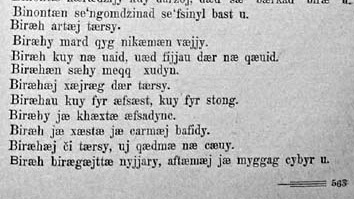
The earliest known written sample of Ossetian is an inscription (the Zelenchuk Inscription) which dates back to the 10th–12th centuries and named after the river near which it was found: the Bolshoy Zelenchuk River in Arkhyz, Russia. The text is written in the Greek alphabet, with special digraphs.
ΣΑΧΗΡΗ
Ossetian language
Ossetian (/ɒˈsɛtiən/ o-SET-ee-ən, /ɒˈsiːʃən/ o-SEE-shən, /oʊˈsiːʃən/ oh-SEE-shən), commonly referred to as Ossetic and rarely as Ossete, is an Eastern Iranian language that is spoken predominantly in Ossetia, a region situated on both sides of the Russian-Georgian border in the Greater Caucasus region. It is the native language of the Ossetian people, and a relative and possibly a descendant of the extinct Scythian, Sarmatian, and Alanic languages.
The northern half of the Ossetian region is part of Russia and is known as North Ossetia–Alania, while the southern half is part of the de facto country of South Ossetia (recognized by the United Nations as Russian-occupied territory that is de jure part of Georgia). Ossetian-speakers number about 614,350, with 451,000 recorded in Russia per the 2010 Russian census.
Despite Ossetian being the official languages of both North and South Ossetia, since 2009 UNESCO has listed Ossetian as "vulnerable".
Ossetian is the spoken and literary language of the Ossetians, an Iranian ethnic group living in the central part of the Caucasus and constituting the basic population of North Ossetia–Alania, which is part of the Russian Federation, and of the de facto country of South Ossetia (recognized by the United Nations as de jure part of the Republic of Georgia). The Ossetian language belongs to the Iranian group of the Indo-European family of languages (as hinted by its endonym: ирон, irōn). Within Iranian, it is placed in the Eastern subgroup and further to a Northeastern sub-subgroup, but these are areal rather than genetic groups. The other Eastern Iranian languages, such as Pashto (spoken in Afghanistan and Pakistan) and Yaghnobi (spoken in Tajikistan), show certain commonalities, but also deep-reaching divergences from Ossetian.
From the 7th–8th centuries BCE, the languages of the Iranian group were distributed across a vast territory spanning present-day Iran (Persia), Central Asia, Eastern Europe, and the Caucasus. Ossetian is the sole survivor of the branch of Iranian languages known as Scythian. The Scythian group included numerous tribes, known in ancient sources as the Scythians, the Massagetae, the Saka, the Sarmatians, the Alans, and the Roxolani. The more easterly Khwarazm and Sogdians were also closely affiliated in linguistic terms.
Ossetian, together with Kurdish, Tat, and Talysh, is one of the main Iranian languages with a sizable community of speakers in the Caucasus. As it is descended from Alanic, spoken by the Alan medieval tribes emerging from the earlier Sarmatians, it is believed to be the only surviving descendant of a Sarmatian language. The closest genetically related language may be the Yaghnobi language of Tajikistan, the only other living Northeastern Iranian language. Ossetian has a plural formed by the suffix -ta, a feature it shares with Yaghnobi, Sarmatian and the now-extinct Sogdian; this is taken as evidence of a formerly wide-ranging Iranian-language dialect continuum on the Central Asian steppe. The names of ancient Iranian tribes (as transmitted through Ancient Greek) in fact reflect this pluralization, e.g. Saromatae (Σαρομάται) and Masagetae (Μασαγέται).
The earliest known written sample of Ossetian is an inscription (the Zelenchuk Inscription) which dates back to the 10th–12th centuries and named after the river near which it was found: the Bolshoy Zelenchuk River in Arkhyz, Russia. The text is written in the Greek alphabet, with special digraphs.
ΣΑΧΗΡΗ
Recent media
Recent media