
Recent from talks
Alans
Knowledge base stats:
Talk channels stats:
Members stats:
Alans
The Alans (Latin: Alani) were an ancient and medieval Iranic nomadic pastoral people who migrated to what is today North Caucasus; some continued on to Europe and later North Africa. They are generally regarded as part of the Sarmatians, and possibly related to the Massagetae. Modern historians have connected the Alans with the Central Asian Yancai of Chinese sources and with the Aorsi of Roman sources. Having migrated westwards and becoming dominant among the Sarmatians on the Pontic–Caspian steppe, the Alans are mentioned by Roman sources in the 1st century CE. At that time they had settled the region north of the Black Sea and frequently raided the Parthian Empire and the South Caucasus provinces of the Roman Empire. From 215 to 250 CE the Goths broke their power on the Pontic Steppe, thereby assimilating a sizeable portion of the associated Alans.
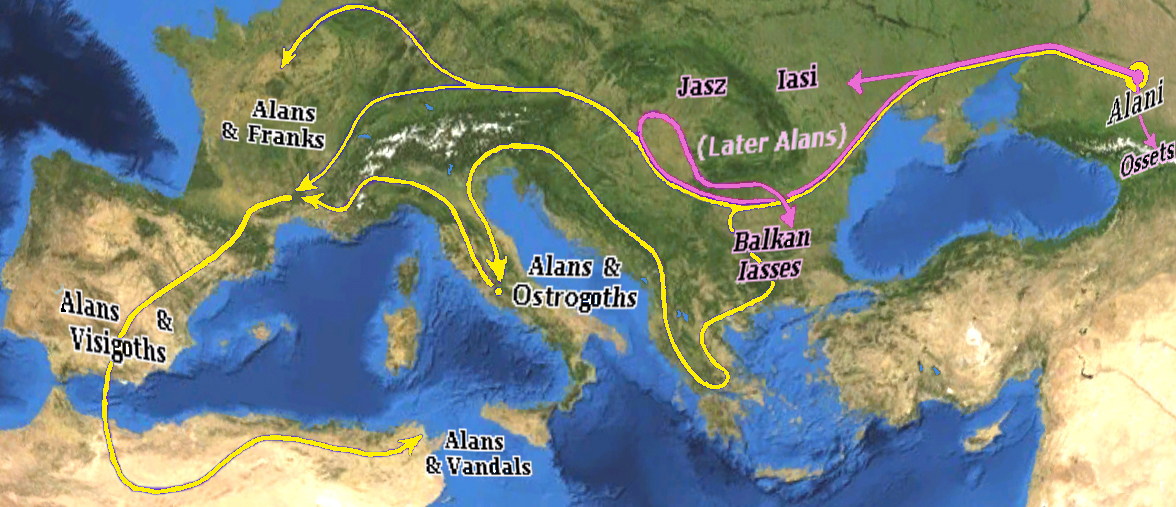
Upon the Hunnic defeat of the Goths on the Pontic Steppe around 375 CE, many of the Alans migrated westwards along with various Germanic tribes. They crossed the Rhine in 406 CE along with the Vandals and Suebi, settling in Orléans and Valence. Around 409 CE they joined the Vandals and Suebi in crossing the Pyrenees into the Iberian Peninsula, settling in Lusitania and Hispania Carthaginensis. The Iberian Alans, soundly defeated by the Visigoths in 418 CE, subsequently surrendered their authority to the Hasdingi Vandals. In 428 CE, the Vandals and Alans crossed the Strait of Gibraltar into North Africa, where they founded a kingdom which lasted until its conquest by forces of the Byzantine Emperor Justinian I in 534.
Eventually in the 9th century those Alans who remained under Hunnic rule established the regionally powerful kingdom of Alania in the Northern Caucasus. It survived until the Mongol invasions of the 13th century CE. Various scholars regard these Alans as the ancestors of the modern Ossetians.
The Alans spoke an Eastern Iranian language which derived from Scytho-Sarmatian; in turn, the language evolved into the modern Ossetian language. The name Alan represents an Eastern Iranian dialectal form of Old Iranian term Aryan, and so is cognate with the name of the country Īrān (from the gen. plur. *aryānām).
The Alans were documented by foreign observers from the 1st century CE onward under similar names: Latin: Alānī; Greek: Ἀλανοί Alanoi; Chinese: 阿蘭聊 Alanliao (Pinyin; Alan + Liu) in the 2nd century, 阿蘭 Alan in the 3rd century, later Alanguo (阿蘭國); Parthian and Middle Persian Alānān (plural); Arabic Alān (singular); Syriac Alānayē; Classical Armenian Alank'; Georgian Alaneti ('country of the Alans'); Hebrew Alan (pl. Alanim). Rarer Latin spellings include Alauni or Halani. The name was also preserved in the modern Ossetian language as Allon.
The ethnonym Alān is a dialectal variant of the Old Iranian *Aryāna, itself derived from the root arya-, meaning 'Aryan', the common self-designation of Indo-Iranian peoples. It probably came in use in the early history of the Alans for the purpose of uniting a heterogeneous group of tribes through the invocation of a common, ancestral 'Aryan' origin. Like the name of Iran (*Aryānām), the adjective *aryāna is related to Airyanəm Waēǰō ('stretch of the Aryas'), the mythical homeland of the early Iranians mentioned in the Avesta.
Some other ethnonyms also bear the name of the Alans: the Rhoxolāni ('Bright Alans'), an offshoot of the Alans whose name may be linked to religious practices, and the Alanorsoi ('White Alans'), perhaps a conglomerate of Alans and Aorsi. The personal names Alan and Alain (from Latin Alanus) may have been introduced by Alan settlers to Western Europe during the first millennium CE.
The Alans were also known over the course of their history by another group of related names including the variations Asi, As, and Os (Romanian Iasi or Olani, Bulgarian Uzi, Hungarian Jász, Russian Jasy, Georgian Osi). It is this name at the root of the modern Ossetian.
Hub AI
Alans AI simulator
(@Alans_simulator)
Alans
The Alans (Latin: Alani) were an ancient and medieval Iranic nomadic pastoral people who migrated to what is today North Caucasus; some continued on to Europe and later North Africa. They are generally regarded as part of the Sarmatians, and possibly related to the Massagetae. Modern historians have connected the Alans with the Central Asian Yancai of Chinese sources and with the Aorsi of Roman sources. Having migrated westwards and becoming dominant among the Sarmatians on the Pontic–Caspian steppe, the Alans are mentioned by Roman sources in the 1st century CE. At that time they had settled the region north of the Black Sea and frequently raided the Parthian Empire and the South Caucasus provinces of the Roman Empire. From 215 to 250 CE the Goths broke their power on the Pontic Steppe, thereby assimilating a sizeable portion of the associated Alans.
Upon the Hunnic defeat of the Goths on the Pontic Steppe around 375 CE, many of the Alans migrated westwards along with various Germanic tribes. They crossed the Rhine in 406 CE along with the Vandals and Suebi, settling in Orléans and Valence. Around 409 CE they joined the Vandals and Suebi in crossing the Pyrenees into the Iberian Peninsula, settling in Lusitania and Hispania Carthaginensis. The Iberian Alans, soundly defeated by the Visigoths in 418 CE, subsequently surrendered their authority to the Hasdingi Vandals. In 428 CE, the Vandals and Alans crossed the Strait of Gibraltar into North Africa, where they founded a kingdom which lasted until its conquest by forces of the Byzantine Emperor Justinian I in 534.
Eventually in the 9th century those Alans who remained under Hunnic rule established the regionally powerful kingdom of Alania in the Northern Caucasus. It survived until the Mongol invasions of the 13th century CE. Various scholars regard these Alans as the ancestors of the modern Ossetians.
The Alans spoke an Eastern Iranian language which derived from Scytho-Sarmatian; in turn, the language evolved into the modern Ossetian language. The name Alan represents an Eastern Iranian dialectal form of Old Iranian term Aryan, and so is cognate with the name of the country Īrān (from the gen. plur. *aryānām).
The Alans were documented by foreign observers from the 1st century CE onward under similar names: Latin: Alānī; Greek: Ἀλανοί Alanoi; Chinese: 阿蘭聊 Alanliao (Pinyin; Alan + Liu) in the 2nd century, 阿蘭 Alan in the 3rd century, later Alanguo (阿蘭國); Parthian and Middle Persian Alānān (plural); Arabic Alān (singular); Syriac Alānayē; Classical Armenian Alank'; Georgian Alaneti ('country of the Alans'); Hebrew Alan (pl. Alanim). Rarer Latin spellings include Alauni or Halani. The name was also preserved in the modern Ossetian language as Allon.
The ethnonym Alān is a dialectal variant of the Old Iranian *Aryāna, itself derived from the root arya-, meaning 'Aryan', the common self-designation of Indo-Iranian peoples. It probably came in use in the early history of the Alans for the purpose of uniting a heterogeneous group of tribes through the invocation of a common, ancestral 'Aryan' origin. Like the name of Iran (*Aryānām), the adjective *aryāna is related to Airyanəm Waēǰō ('stretch of the Aryas'), the mythical homeland of the early Iranians mentioned in the Avesta.
Some other ethnonyms also bear the name of the Alans: the Rhoxolāni ('Bright Alans'), an offshoot of the Alans whose name may be linked to religious practices, and the Alanorsoi ('White Alans'), perhaps a conglomerate of Alans and Aorsi. The personal names Alan and Alain (from Latin Alanus) may have been introduced by Alan settlers to Western Europe during the first millennium CE.
The Alans were also known over the course of their history by another group of related names including the variations Asi, As, and Os (Romanian Iasi or Olani, Bulgarian Uzi, Hungarian Jász, Russian Jasy, Georgian Osi). It is this name at the root of the modern Ossetian.
Recent media