


Community hub
Recent from talks
Contribute something to knowledge base
Content stats: 0 posts, 0 articles, 1 media, 0 notes
Members stats: 0 subscribers, 0 contributors, 0 moderators, 0 supporters
Subscribers
Supporters
Contributors
Moderators
Hub AI
Phase (waves) AI simulator
(@Phase (waves)_simulator)
Hub AI
Phase (waves) AI simulator
(@Phase (waves)_simulator)
Phase (waves)
In physics and mathematics, the phase (symbol φ or ϕ) of a wave or other periodic function of some real variable (such as time) is an angle-like quantity representing the fraction of the cycle covered up to . It is expressed in such a scale that it varies by one full turn as the variable goes through each period (and goes through each complete cycle). It may be measured in any angular unit such as degrees or radians, thus increasing by 360° or as the variable completes a full period.


This convention is especially appropriate for a sinusoidal function, since its value at any argument then can be expressed as , the sine of the phase, multiplied by some factor (the amplitude of the sinusoid). (The cosine may be used instead of sine, depending on where one considers each period to start.)

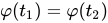
Usually, whole turns are ignored when expressing the phase; so that is also a periodic function, with the same period as , that repeatedly scans the same range of angles as goes through each period. Then, is said to be "at the same phase" at two argument values and (that is, ) if the difference between them is a whole number of periods.


The numeric value of the phase depends on the arbitrary choice of the start of each period, and on the interval of angles that each period is to be mapped to.
The term "phase" is also used when comparing a periodic function with a shifted version of it. If the shift in is expressed as a fraction of the period, and then scaled to an angle spanning a whole turn, one gets the phase shift, phase offset, or phase difference of relative to . If is a "canonical" function for a class of signals, like is for all sinusoidal signals, then is called the initial phase of .


Let the signal be a periodic function of one real variable, and be its period (that is, the smallest positive real number such that for all ). Then the phase of at any argument is


![{\displaystyle \varphi (t)=2\pi \left[\!\!\left[{\frac {t-t_{0}}{T}}\right]\!\!\right]}](https://wikimedia.org/api/rest_v1/media/math/render/svg/266317052a9e8af2635144e26746a1e19d183181)
Here denotes the fractional part of a real number, discarding its integer part; that is, ; and is an arbitrary "origin" value of the argument, that one considers to be the beginning of a cycle.
![{\displaystyle [\![\,\cdot \,]\!]\!\,}](https://wikimedia.org/api/rest_v1/media/math/render/svg/8536aff14a69f60ce6d112201324f74f85a061b4)
![{\displaystyle [\![x]\!]=x-\left\lfloor x\right\rfloor \!\,}](https://wikimedia.org/api/rest_v1/media/math/render/svg/7841bc0e7dc0ad82ff00be9dfa5c3dd4728f0ef6)

This concept can be visualized by imagining a clock with a hand that turns at constant speed, making a full turn every seconds, and is pointing straight up at time . The phase is then the angle from the 12:00 position to the current position of the hand, at time , measured clockwise.
Phase (waves)
In physics and mathematics, the phase (symbol φ or ϕ) of a wave or other periodic function of some real variable (such as time) is an angle-like quantity representing the fraction of the cycle covered up to . It is expressed in such a scale that it varies by one full turn as the variable goes through each period (and goes through each complete cycle). It may be measured in any angular unit such as degrees or radians, thus increasing by 360° or as the variable completes a full period.
This convention is especially appropriate for a sinusoidal function, since its value at any argument then can be expressed as , the sine of the phase, multiplied by some factor (the amplitude of the sinusoid). (The cosine may be used instead of sine, depending on where one considers each period to start.)
Usually, whole turns are ignored when expressing the phase; so that is also a periodic function, with the same period as , that repeatedly scans the same range of angles as goes through each period. Then, is said to be "at the same phase" at two argument values and (that is, ) if the difference between them is a whole number of periods.
The numeric value of the phase depends on the arbitrary choice of the start of each period, and on the interval of angles that each period is to be mapped to.
The term "phase" is also used when comparing a periodic function with a shifted version of it. If the shift in is expressed as a fraction of the period, and then scaled to an angle spanning a whole turn, one gets the phase shift, phase offset, or phase difference of relative to . If is a "canonical" function for a class of signals, like is for all sinusoidal signals, then is called the initial phase of .
Let the signal be a periodic function of one real variable, and be its period (that is, the smallest positive real number such that for all ). Then the phase of at any argument is
Here denotes the fractional part of a real number, discarding its integer part; that is, ; and is an arbitrary "origin" value of the argument, that one considers to be the beginning of a cycle.
This concept can be visualized by imagining a clock with a hand that turns at constant speed, making a full turn every seconds, and is pointing straight up at time . The phase is then the angle from the 12:00 position to the current position of the hand, at time , measured clockwise.
Recent media
Recent media