Hubbry Logo
RadianRadianMain
Open search
Radian
Community hub
Radian
logo
8 pages, 0 posts
0 subscribers
Be the first to start a discussion here.
Radian
Radian
from Wikipedia

Radian
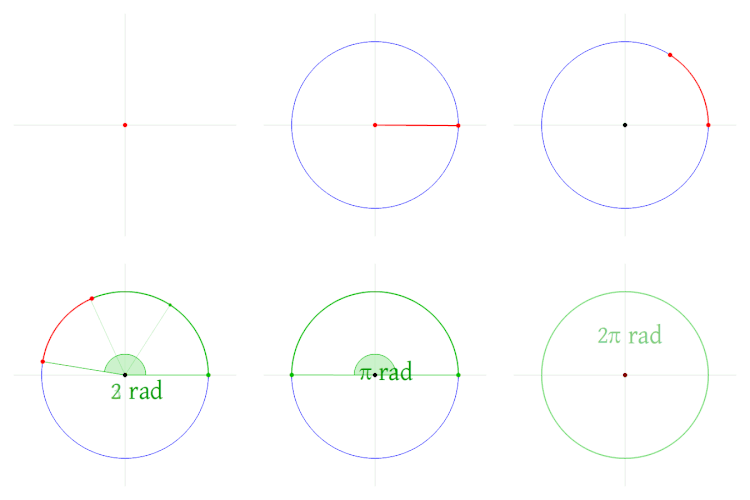
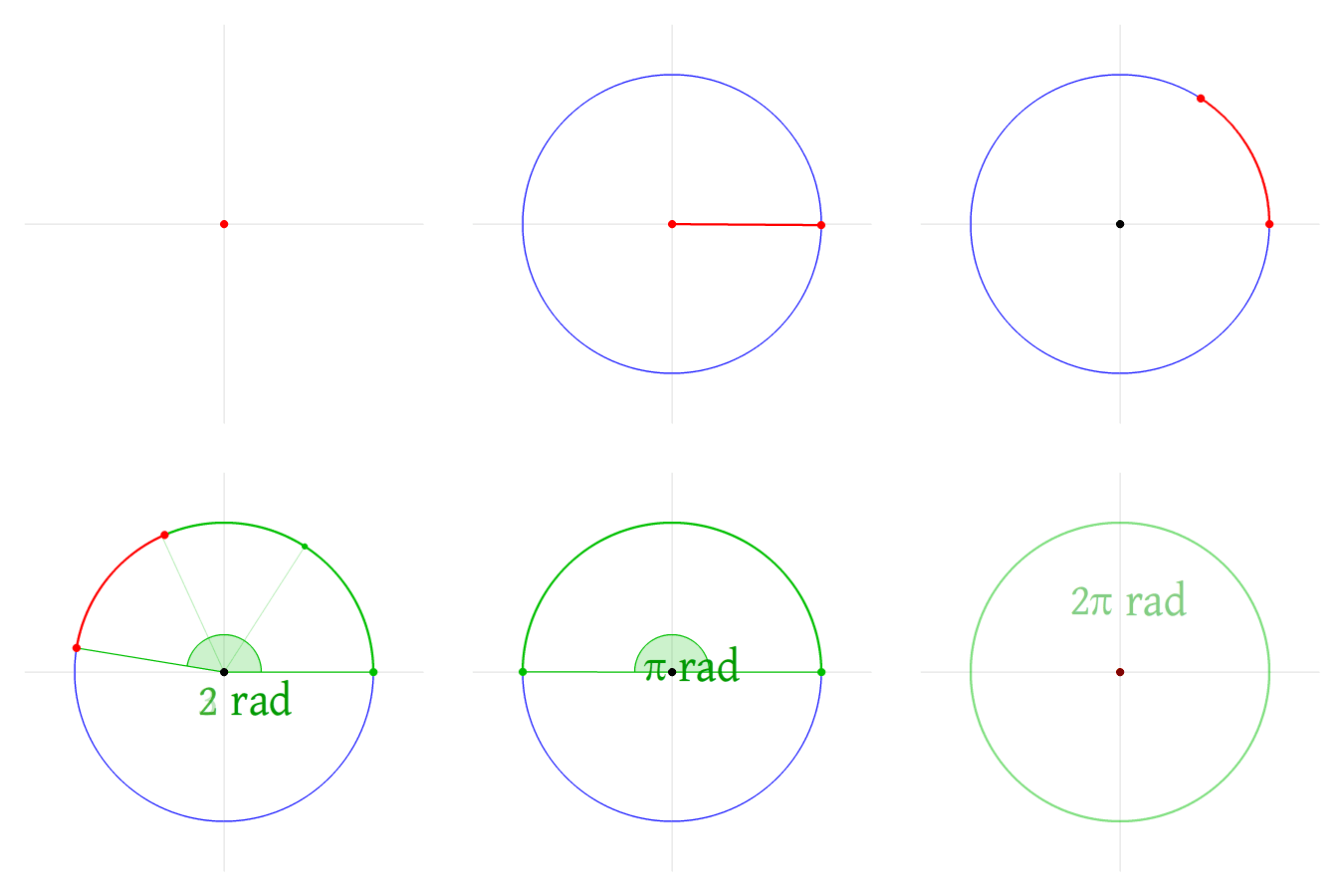
An arc of a circle with the same length as the radius of that circle subtends an angle of 1 radian. The circumference subtends an angle of 2π radians.
General information
Unit systemSI
Unit ofangle
Symbolrad
Conversions
1 rad in ...... is equal to ...
   milliradians   1000 mrad
   turns   1/2π turn ≈ 0.159154 turn
   degrees   180/π° ≈ 57.295779513°
   gradians   200/π grad ≈ 63.661977g

The radian, denoted by the symbol rad, is the unit of angle in the International System of Units (SI) and is the standard unit of angular measure used in many areas of mathematics. It is defined such that one radian is the angle subtended at the center of a plane circle by an arc that is equal in length to the radius.[1] The unit is defined in the SI as the coherent unit for plane angle, as well as for phase angle.[2] Angles without explicitly specified units are generally assumed to be measured in radians, especially in mathematical writing.[3]

Definition

[edit]

One radian is defined as the angle at the center of a circle in a plane that is subtended by an arc whose length equals the radius of the circle.[4] More generally, the magnitude in radians of a subtended angle is equal to the ratio of the arc length to the radius of the circle; that is, θ = s/r, where θ is the magnitude in radians of the subtended angle, s is arc length, and r is radius. A right angle is exactly π/2 radians.[5]

One complete revolution, expressed as an angle in radians, is the length of the circumference divided by the radius, which is 2πr/r, or 2π. Thus, 2π radians is equal to 360 degrees. The relation 2π rad = 360° can be derived using the formula for arc length, . Since radian is the measure of an angle that is subtended by an arc of a length equal to the radius of the circle, . This can be further simplified to . Multiplying both sides by 360° gives 360° = 2π rad.

Unit symbol

[edit]

The International Bureau of Weights and Measures[6] and International Organization for Standardization[7] specify rad as the symbol for the radian. Alternative symbols that were in use in 1909 are c (the superscript letter c, for "circular measure"), the letter r, or a superscript R,[8] but these variants are infrequently used, as they may be mistaken for a degree symbol (°) or a radius (r). Hence an angle of 1.2 radians would be written today as 1.2 rad; archaic notations include 1.2 r, 1.2rad, 1.2c, or 1.2R.

In mathematical writing, the symbol "rad" is often omitted. When quantifying an angle in the absence of any symbol, radians are assumed, and when degrees are meant, the degree sign ° is used.

Dimensional analysis

[edit]

Plane angle may be defined as θ = s/r, where θ is the magnitude in radians of the subtended angle, s is circular arc length, and r is radius. One radian corresponds to the angle for which s = r, hence 1 radian = 1 m/m = 1.[9] However, rad is only to be used to express angles, not to express ratios of lengths in general.[10] A similar calculation using the area of a circular sector θ = 2A/r2 gives 1 radian as 1 m2/m2 = 1.[11] The key fact is that the radian is a dimensionless unit equal to 1. In SI 2019, the SI radian is defined accordingly as 1 rad = 1.[12] It is a long-established practice in mathematics and across all areas of science to make use of rad = 1.[13][14]

Giacomo Prando writes "the current state of affairs leads inevitably to ghostly appearances and disappearances of the radian in the dimensional analysis of physical equations".[15] For example, an object hanging by a string from a pulley will rise or drop by y = centimetres, where r is the magnitude of the radius of the pulley in centimetres and θ is the magnitude of the angle through which the pulley turns in radians. When multiplying r by θ, the unit radian does not appear in the product, nor does the unit centimetre—because both factors are magnitudes (numbers). Similarly in the formula for the angular velocity of a rolling wheel, ω = v/r, radians appear in the units of ω but not on the right hand side.[16] Anthony French calls this phenomenon "a perennial problem in the teaching of mechanics".[17] Oberhofer says that the typical advice of ignoring radians during dimensional analysis and adding or removing radians in units according to convention and contextual knowledge is "pedagogically unsatisfying".[18]

In 1993 the American Association of Physics Teachers Metric Committee specified that the radian should explicitly appear in quantities only when different numerical values would be obtained when other angle measures were used, such as in the quantities of angle measure (rad), angular speed (rad/s), angular acceleration (rad/s2), and torsional stiffness (N⋅m/rad), and not in the quantities of torque (N⋅m) and angular momentum (kg⋅m2/s).[19]

At least a dozen scientists between 1936 and 2022 have made proposals to treat the radian as a base unit of measurement for a base quantity (and dimension) of "plane angle".[20][21][22] Quincey's review of proposals outlines two classes of proposal. The first option changes the unit of a radius to meters per radian, but this is incompatible with dimensional analysis for the area of a circle, πr2. The other option is to introduce a dimensional constant. According to Quincey this approach is "logically rigorous" compared to SI, but requires "the modification of many familiar mathematical and physical equations".[23] A dimensional constant for angle is "rather strange" and the difficulty of modifying equations to add the dimensional constant is likely to preclude widespread use.[22]

In particular, Quincey identifies Torrens' proposal to introduce a constant η equal to 1 inverse radian (1 rad−1) in a fashion similar to the introduction of the constant ε0.[23][a] With this change the formula for the angle subtended at the center of a circle, s = , is modified to become s = ηrθ, and the Taylor series for the sine of an angle θ becomes:[22][24] where is the angle in radians. The capitalized function Sin is the "complete" function that takes an argument with a dimension of angle and is independent of the units expressed,[24] while sin is the traditional function on pure numbers which assumes its argument is a dimensionless number in radians.[25] The capitalised symbol can be denoted if it is clear that the complete form is meant.[22][26]

Current SI can be considered relative to this framework as a natural unit system where the equation η = 1 is assumed to hold, or similarly, 1 rad = 1. This radian convention allows the omission of η in mathematical formulas.[27]

Defining radian as a base unit may be useful for software, where the disadvantage of longer equations is minimal.[28] For example, the Boost units library defines angle units with a plane_angle dimension,[29] and Mathematica's unit system similarly considers angles to have an angle dimension.[30][31]

Conversions

[edit]
Conversion of common angles
Turns Radians Degrees Gradians
0 turn 0 rad 0g
1/72 turn π/36 or 𝜏/72 rad ⁠5+5/9g
1/24 turn π/12 or 𝜏/24 rad 15° ⁠16+2/3g
1/16 turn π/8 or 𝜏/16 rad 22.5° 25g
1/12 turn π/6 or 𝜏/12 rad 30° ⁠33+1/3g
1/10 turn π/5 or 𝜏/10 rad 36° 40g
1/8 turn π/4 or 𝜏/8 rad 45° 50g
1/2π or 𝜏 turn 1 rad approx. 57.3° approx. 63.7g
1/6 turn π/3 or 𝜏/6 rad 60° ⁠66+2/3g
1/5 turn 2π or 𝜏/5 rad 72° 80g
1/4 turn π/2 or 𝜏/4 rad 90° 100g
1/3 turn 2π or 𝜏/3 rad 120° ⁠133+1/3g
2/5 turn 4π or 2𝜏 or α/5 rad 144° 160g
1/2 turn π or 𝜏/2 rad 180° 200g
3/4 turn 3π or ρ/2 or 3𝜏/4 rad 270° 300g
1 turn 𝜏 or 2π rad 360° 400g

Between degrees

[edit]

As stated, one radian is equal to . Thus, to convert from radians to degrees, multiply by .

For example:

Conversely, to convert from degrees to radians, multiply by .

For example:

Radians can be converted to turns (one turn is the angle corresponding to a revolution) by dividing the number of radians by 2π.

Between gradians

[edit]

One revolution corresponds to an angle of radians, which equals one turn, and to 400 gradians (400 gons or 400g). To convert from radians to gradians multiply by , and to convert from gradians to radians multiply by . For example,

Usage

[edit]

Mathematics

[edit]
Some common angles, measured in radians. All the large polygons in this diagram are regular polygons.

In calculus and most other branches of mathematics beyond practical geometry, angles are measured in radians. This is because radians have a mathematical naturalness that leads to a more elegant formulation of some important results.

Results in analysis involving trigonometric functions can be elegantly stated when the functions' arguments are expressed in radians. For example, the use of radians leads to the simple limit formula

which is the basis of many other identities in mathematics, including

Because of these and other properties, the trigonometric functions appear in solutions to mathematical problems that are not obviously related to the functions' geometrical meanings (for example, the solutions to the differential equation , the evaluation of the integral , and so on). In all such cases, it is appropriate that the arguments of the functions are treated as (dimensionless) numbers—without any reference to angles.

The trigonometric functions of angles also have simple and elegant series expansions when radians are used. For example, when x is the angle expressed in radians, the Taylor series for sin x becomes:

If y were the angle x but expressed in degrees, i.e. y = πx / 180, then the series would contain messy factors involving powers of π/180:

In a similar spirit, if angles are involved, mathematically important relationships between the sine and cosine functions and the exponential function (see, for example, Euler's formula) can be elegantly stated when the functions' arguments are angles expressed in radians (and messy otherwise). More generally, in complex-number theory, the arguments of these functions are (dimensionless, possibly complex) numbers—without any reference to physical angles at all.

Physics

[edit]

The radian is widely used in physics when angular measurements are required. For example, angular velocity is typically expressed in the unit radian per second (rad/s). One revolution per second corresponds to 2π radians per second.

Similarly, the unit used for angular acceleration is often radian per second per second (rad/s2).

For the purpose of dimensional analysis, the units of angular velocity and angular acceleration are s−1 and s−2 respectively.

Likewise, the phase angle difference of two waves can also be expressed using the radian as the unit. For example, if the phase angle difference of two waves is (n × 2π) radians, where n is an integer, they are considered to be in phase, whilst if the phase angle difference of two waves is (n × 2π + π) radians, with n an integer, they are considered to be in antiphase.

A unit of reciprocal radian or inverse radian (rad−1) is involved in derived units such as meter per radian (for angular wavelength) or newton-metre per radian (for torsional stiffness).

Prefixes and variants

[edit]

Metric prefixes for submultiples are used with radians. A milliradian (mrad) is a thousandth of a radian (0.001 rad), i.e. 1 rad = 103 mrad. There are 2π × 1000 milliradians (≈ 6283.185 mrad) in a circle. So a milliradian is just under 1/6283 of the angle subtended by a full circle. This unit of angular measurement of a circle is in common use by telescopic sight manufacturers using (stadiametric) rangefinding in reticles. The divergence of laser beams is also usually measured in milliradians.

The angular mil is an approximation of the milliradian used by NATO and other military organizations in gunnery and targeting. Each angular mil represents 1/6400 of a circle and is 15/8% or 1.875% smaller than the milliradian. For the small angles typically found in targeting work, the convenience of using the number 6400 in calculation outweighs the small mathematical errors it introduces. In the past, other gunnery systems have used different approximations to 1/2000π; for example Sweden used the 1/6300 streck and the USSR used 1/6000. Being based on the milliradian, the NATO mil subtends roughly 1 m at a range of 1000 m (at such small angles, the curvature is negligible).

Prefixes smaller than milli- are useful in measuring extremely small angles. Microradians (μrad, 10−6 rad) and nanoradians (nrad, 10−9 rad) are used in astronomy, and can also be used to measure the beam quality of lasers with ultra-low divergence. More common is the arc second, which is π/648000 rad (around 4.8481 microradians).

SI multiples of radian (rad)
Submultiples Multiples
Value SI symbol Name Value SI symbol Name
10−1 rad drad deciradian 101 rad darad decaradian
10−2 rad crad centiradian 102 rad hrad hectoradian
10−3 rad mrad milliradian 103 rad krad kiloradian
10−6 rad μrad microradian 106 rad Mrad megaradian
10−9 rad nrad nanoradian 109 rad Grad gigaradian
10−12 rad prad picoradian 1012 rad Trad teraradian
10−15 rad frad femtoradian 1015 rad Prad petaradian
10−18 rad arad attoradian 1018 rad Erad exaradian
10−21 rad zrad zeptoradian 1021 rad Zrad zettaradian
10−24 rad yrad yoctoradian 1024 rad Yrad yottaradian
10−27 rad rrad rontoradian 1027 rad Rrad ronnaradian
10−30 rad qrad quectoradian 1030 rad Qrad quettaradian

History

[edit]

Pre-20th century

[edit]

The idea of measuring angles by the length of the arc was in use by mathematicians quite early. For example, al-Kashi (c. 1400) used so-called diameter parts as units, where one diameter part was 1/60 radian. They also used sexagesimal subunits of the diameter part.[32] Newton in 1672 spoke of "the angular quantity of a body's circular motion", but used it only as a relative measure to develop an astronomical algorithm.[33]

The concept of the radian measure is normally credited to Roger Cotes, who died in 1716. By 1722, his cousin Robert Smith had collected and published Cotes' mathematical writings in a book, Harmonia mensurarum.[34] In a chapter of editorial comments, Smith gave what is probably the first published calculation of one radian in degrees, citing a note of Cotes that has not survived. Smith described the radian in everything but name – "Now this number is equal to 180 degrees as the radius of a circle to the semicircumference, this is as 1 to 3.141592653589" –, and recognized its naturalness as a unit of angular measure.[35][36]

In 1765, Leonhard Euler implicitly adopted the radian as a unit of angle.[33] Specifically, Euler defined angular velocity as "The angular speed in rotational motion is the speed of that point, the distance of which from the axis of gyration is expressed by one."[37] Euler was probably the first to adopt this convention, referred to as the radian convention, which gives the simple formula for angular velocity ω = v/r. As discussed in § Dimensional analysis, the radian convention has been widely adopted, while dimensionally consistent formulations require the insertion of a dimensional constant, for example ω = v/(ηr).[27]

Prior to the term radian becoming widespread, the unit was commonly called circular measure of an angle.[38] The term radian first appeared in print on 5 June 1873, in examination questions set by James Thomson (brother of Lord Kelvin) at Queen's College, Belfast. He had used the term as early as 1871, while in 1869, Thomas Muir, then of the University of St Andrews, vacillated between the terms rad, radial, and radian. In 1874, after a consultation with James Thomson, Muir adopted radian.[39][40][41] The name radian was not universally adopted for some time after this. Longmans' School Trigonometry still called the radian circular measure when published in 1890.[42]

In 1893 Alexander Macfarlane wrote "the true analytical argument for the circular ratios is not the ratio of the arc to the radius, but the ratio of twice the area of a sector to the square on the radius."[43] However, the paper was withdrawn from the published proceedings of mathematical congress held in connection with World's Columbian Exposition in Chicago (acknowledged at page 167), and privately published in his Papers on Space Analysis (1894). Macfarlane reached this idea or ratios of areas while considering the basis for hyperbolic angle which is analogously defined.[44]

As an SI unit

[edit]

As Paul Quincey et al. write, "The status of angles within the International System of Units (SI) has long been a source of controversy and confusion."[45] In 1960, the General Conference on Weights and Measures (CGPM) established the SI and the radian was classified as a "supplementary unit" along with the steradian. This special class was officially regarded "either as base units or as derived units", as the CGPM could not reach a decision on whether the radian was a base unit or a derived unit.[46] Richard Nelson writes "This ambiguity [in the classification of the supplemental units] prompted a spirited discussion over their proper interpretation."[47] In May 1980 the Consultative Committee for Units (CCU) considered a proposal for making radians an SI base unit, using a constant α0 = 1 rad,[48][27] but turned it down to avoid an upheaval to current practice.[27]

In October 1980 the CGPM decided that supplementary units were dimensionless derived units for which the CGPM allowed the freedom of using them or not using them in expressions for SI derived units,[47] on the basis that "[no formalism] exists which is at the same time coherent and convenient and in which the quantities plane angle and solid angle might be considered as base quantities" and that "[the possibility of treating the radian and steradian as SI base units] compromises the internal coherence of the SI based on only seven base units".[49] In 1995 the CGPM eliminated the class of supplementary units and defined the radian and the steradian as "dimensionless derived units, the names and symbols of which may, but need not, be used in expressions for other SI derived units, as is convenient".[50] Mikhail Kalinin writing in 2019 has criticized the 1980 CGPM decision as "unfounded" and says that the 1995 CGPM decision used inconsistent arguments and introduced "numerous discrepancies, inconsistencies, and contradictions in the wordings of the SI".[51]

At the 2013 meeting of the CCU, Peter Mohr gave a presentation on alleged inconsistencies arising from defining the radian as a dimensionless unit rather than a base unit. CCU President Ian M. Mills declared this to be a "formidable problem" and the CCU Working Group on Angles and Dimensionless Quantities in the SI was established.[52] The CCU met in 2021, but did not reach a consensus. A small number of members argued strongly that the radian should be a base unit, but the majority felt the status quo was acceptable or that the change would cause more problems than it would solve. A task group was established to "review the historical use of SI supplementary units and consider whether reintroduction would be of benefit", among other activities.[53][54]

See also

[edit]

Notes

[edit]

References

[edit]
[edit]
Revisions and contributorsEdit on WikipediaRead on Wikipedia
from Grokipedia
The radian (symbol: rad) is the standard unit of plane angle in the (SI), defined as the subtended by an arc of a whose equals the circle's . This makes it a , representing the ratio of to radius, with one radian approximately equal to 57.2958 degrees. A complete around a circle measures radians, or about 6.2832 radians, providing a natural connection to the circle's formula C = 2πr. To convert between radians and the more familiar degree measure, the formulas are θ in radians = θ in degrees × (π/180) and θ in degrees = θ in radians × (180/π), where π radians equals 180 degrees exactly. Radians originated conceptually in the early through the work of mathematician , who collaborated with , though the term "radian" was coined around 1870 by James Thomson (brother of ) and first appeared in print in 1873. In and physics, radians are preferred over degrees because they align seamlessly with and ; for instance, the derivatives of —d(sin x)/dx = cos x and d(cos x)/dx = -sin x—hold true without additional conversion factors only when angles are in radians. This property also simplifies expansions, such as sin x = x - x³/3! + x⁵/5! - ..., and frequency analyses in fields like , where angular frequency in radians per second directly relates to cycles without scaling. The radian was formally recognized as an SI coherent derived unit in , when supplementary units were eliminated from the system, affirming its fundamental role in scientific measurements.

Definition and Fundamentals

Formal Definition

The radian (rad) is the of plane angle, defined as the angle subtended at the center of a by an arc whose is equal to the of the circle. This establishes the radian as a coherent unit within the (SI), ensuring consistency in angular measurements derived from geometric properties. Mathematically, the measure of an θ\theta in radians is given by the θ=sr\theta = \frac{s}{r}, where ss is the of the arc and rr is the radius of the circle. This expression directly follows from the geometric , providing a precise quantification of plane based on linear dimensions.

Geometric Interpretation

The radian provides a geometric measure of an based on the properties of a , where the θ at the center is defined as the of the s subtended by the to the radius r of the circle, θ = s / r. For a full , the equals the C = 2πr, so θ = C / r = 2πr / r = 2π radians. This derivation ties the angular measure directly to the circle's intrinsic , making the radian a natural unit independent of the circle's size. A corresponds to an of πr, yielding θ = πr / r = π radians, while a quarter-circle spans an arc of (πr)/2, resulting in θ = π/2 radians. For instance, an of 1 radian subtends an arc equal to the radius, which geometrically approximates 57.3 degrees without relying on degree-based divisions. These examples illustrate how radian measures scale proportionally with the fraction of the circle's , providing an intuitive visualization of angular size. The radian's geometric foundation ensures that the angle measure directly reflects the proportion of the circle's arc, promoting uniformity in angular quantification across different scales. Unlike the degree system, which divides the circle into 360 arbitrary parts based on historical conventions, the radian avoids such artificial segmentation by deriving from the fundamental ratio of to .

Properties and Notation

Dimensional Analysis

The radian is a because it is defined as the ratio of the ss to the rr of a , where both ss and rr possess the dimension of [L][L], yielding [θ]=[L]/[L]=1[\theta] = [L]/[L] = 1. In the (SI), the radian is treated as a dimensionless derived unit equivalent to the number one, although the symbol "rad" is retained to explicitly indicate plane quantities for clarity and historical convention. While the SI does not include a base dimension for , an dimension [][\angle] is sometimes used informally in certain dimensional analyses to distinguish angular quantities. This dimensionless nature has key implications in calculations involving derived quantities; for instance, , expressed in rad/s, effectively carries the dimension of inverse time [T1][T^{-1}], as the radian contributes no additional dimensionality. Similarly, , with SI unit N·m, shares the same dimensions as (joule, J), since mechanical work is the product of and , and the dimensionless angle introduces no extra factors. Like other dimensionless quantities such as the Reynolds number, the radian lacks inherent dimensions but is explicitly retained as a unit in the SI to provide clarity in equations, avoid ambiguity in physical interpretations, and maintain coherence in trigonometric and exponential functions where numerical scaling would otherwise be required.

Unit Symbol and Notation

The radian is the SI coherent unit for plane angle, classified as a dimensionless derived unit rather than a base or supplementary unit, with the official symbol rad. This symbol is lowercase and printed in roman (upright) typeface, consistent with SI conventions for unit symbols in both textual descriptions and mathematical expressions; for instance, in equations, the variable for angle (such as θ\theta) is italicized, while the unit remains roman as rad. The radian received its special name and symbol through decisions of the General Conference on Weights and Measures (CGPM), notably at the 11th CGPM in 1960. In usage, the radian symbol rad is applied after numerical values with a space separator (e.g., 1 rad), and its inclusion is optional when eliminates ambiguity, as the unit is dimensionless and equivalent to the number one. This omission is common in mathematics and physics, particularly for arguments of , where sin(θ)\sin(\theta) or cos(θ)\cos(\theta) implicitly assumes θ\theta in radians without stating the unit. Explicit notation, however, is recommended for precision in interdisciplinary or applied s, such as θ=2π\theta = 2\pi rad to denote a full . The unit name follows standard English pluralization: "radian" for singular values and "radians" for plural values greater than one, while the symbol rad remains unchanged regardless of quantity. Representative examples include expressions like "π\pi radians" for 180 degrees or "2π\pi rad" for 360 degrees, ensuring clarity in both verbal and symbolic forms. These conventions align with the radian's dimensionless nature, allowing seamless integration into equations without altering dimensional consistency.

Conversions

To and From Degrees

The radian and degree are interconnected through the of the circle, where a full measures 360° or equivalently 2π radians, leading to the fundamental conversion factor of 180° = π radians. This relation arises because half a , a , spans 180° and corresponds to an of π times the when measured in radians. To convert an angle from degrees to radians, multiply the degree measure by the factor π/180\pi / 180; the formula is θrad=θ×π180\theta_{\text{rad}} = \theta^\circ \times \frac{\pi}{180}. Conversely, to convert from radians to degrees, multiply the radian measure by 180/π180 / \pi; the formula is θ=θrad×180π\theta^\circ = \theta_{\text{rad}} \times \frac{180}{\pi}. These conversions preserve the angular magnitude while switching between the two units. An approximation derived from the full circle relation is that 1 radian equals approximately 57.2958°. This value comes directly from 180/π57.29577951180 / \pi \approx 57.29577951, rounded for practical use, and underscores the radian's basis in the circle's of 2πr2\pi r. Common examples illustrate these conversions: a of 90° equals π/2\pi/2 radians, since 90×π/180=π/21.570890 \times \pi / 180 = \pi/2 \approx 1.5708 rad; a straight of 180° equals π\pi radians; and a full of 360° equals 2π2\pi radians, which is equivalent to 0 radians 2π2\pi. Negative angles follow the same process, such as -90° = π/2-\pi/2 radians, maintaining the sign to indicate direction.

To and From Other Units

The gradian (also known as gon) divides a full circle into 400 equal parts, making it a metric-oriented alternative to the degree system. The conversion from gradians to radians is given by multiplying the angle in gradians by π/200\pi / 200, since 400400 gradians correspond to 2π2\pi radians. In practical applications, such as land surveying in Europe and other regions using metric standards, gradians facilitate calculations aligned with decimal divisions, where a right angle measures exactly 100100 gradians. A revolution, or turn, quantifies a complete rotation around a point or axis, equivalent to 2π2\pi radians. The formula to convert revolutions to radians is θrad=θrev×2π\theta_{\text{rad}} = \theta_{\text{rev}} \times 2\pi, reflecting the circumference of the unit circle in radians. In computing contexts, particularly in web development and graphics programming, turns provide a normalized scale for angles, as seen in CSS where 11 turn represents a full 360360^\circ rotation for intuitive property animations and transformations. Arcminutes and arcseconds offer subdivisions for precise measurements, often building on degree-based systems but with direct radian equivalents. One arcminute equals π/10,800\pi / 10{,}800 radians, while one arcsecond equals π/648,000\pi / 648{,}000 radians. Thus, 11 radian corresponds to approximately 206,264.8206{,}264.8 arcseconds, a relation central to fields like astronomy for resolving small angular separations without relying on degrees.

Mathematical Applications

Trigonometry and Functions

In trigonometry, the primary functions—sine, cosine, and tangent—are defined with their arguments measured in radians, aligning naturally with the of the unit circle where the radian measure equals the subtended by the . This unitless angular measure ensures that the functions map to coordinates on the unit circle without scaling factors, as the point at θ radians has coordinates (cos θ, θ). Consequently, the derivatives of these functions take simple forms: d( θ)/dθ = cos θ, d(cos θ)/dθ = - θ, and d(tan θ)/dθ = sec² θ, avoiding the π/180 conversion constant required when using degrees. Key identities highlight the elegance of radians in trigonometric expressions. For instance, sin(π/2) = 1 corresponds to the unit circle point (0, 1), and cos(π) = -1 to the point (-1, 0), reflecting quarter- and half-turns precisely as π/2 and π radians, respectively. The small-angle approximation, valid for θ near 0, states that sin θ ≈ θ, cos θ ≈ 1 - θ²/2, and tan θ ≈ θ, with errors on the order of θ³; this holds specifically in radians because the approximation derives from the unit circle's arc length equaling θ, making it dimensionally consistent and accurate for θ ≪ 1 radian (about 57°). The periodicity of trigonometric functions is inherently tied to radians, with sine and cosine repeating every 2π radians, as sin(θ + 2π) = sin θ and cos(θ + 2π) = cos θ for any θ, while tan(θ + π) = tan θ. This 2π period arises directly from the full circumference of the unit circle, contrasting with the 360° measure in degrees and underscoring why radians provide a more intrinsic scale for graphing and analyzing periodic behavior, where one cycle spans from 0 to 2π on the horizontal axis. The expansions further illustrate the simplifying role of radians. For sine, sin θ = θ - θ³/3! + θ⁵/5! - θ⁷/7! + ⋯, and for cosine, cos θ = 1 - θ²/2! + θ⁴/4! - θ⁶/6! + ⋯, both centered at 0; these infinite series converge to the functions for all real θ and begin with powers of θ that match the radian without additional coefficients. Similarly, tan θ = θ + θ³/3 + 2θ⁵/15 + ⋯, derived from the of series, benefits from the same radian-based purity, enabling straightforward approximations and analytic continuations in . For introductory purposes, these radian-based functions can be related to degree measures via θ_rad = θ_deg · π/180, but the core definitions and properties remain rooted in radians.

Calculus and Approximations

In calculus, the radian measure facilitates straightforward computation of arc length for circular arcs and polar curves without additional scaling constants. For a circle of constant radius rr, the arc length ss subtended by an angle θ\theta in radians is simply s=rθs = r \theta, directly reflecting the radian's definition as the ratio of arc length to radius. In more general polar coordinates, where the radius rr may vary with θ\theta, the arc length is given by the integral s=αβr(θ)2+(drdθ)2dθ,s = \int_{\alpha}^{\beta} \sqrt{r(\theta)^2 + \left( \frac{dr}{d\theta} \right)^2} \, d\theta,
Add your contribution
Related Hubs
User Avatar
No comments yet.