

Recent from talks
Output gap
Knowledge base stats:
Talk channels stats:
Members stats:
Output gap
The GDP gap or the output gap is the difference between actual GDP or actual output and potential GDP, in an attempt to identify the current economic position over the business cycle. The measure of output gap is largely used in macroeconomic policy (in particular in the context of EU fiscal rules compliance). The GDP gap is a highly criticized notion, in particular due to the fact that the potential GDP is not an observable variable, it is instead often derived from past GDP data, which could lead to systemic downward biases.
The calculation for the output gap is (Y–Y*)/Y* where Y is actual output and Y* is potential output. If this calculation yields a positive number it is called an inflationary gap and indicates the growth of aggregate demand is outpacing the growth of aggregate supply—possibly creating inflation; if the calculation yields a negative number it is called a recessionary gap—possibly signifying deflation.
The percentage GDP gap is the actual GDP minus the potential GDP divided by the potential GDP.
For example, February 2013 data from the Congressional Budget Office showed that the United States had a projected output gap for 2013 of roughly $1 trillion, or nearly 6% of potential GDP.
Using approximation, the following equation holds.
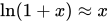
Okun's law is based on regression analysis of U.S. data that shows a correlation between unemployment and GDP gap. Okun's law can be stated as: For every 1% increase in cyclical unemployment (actual rate of unemployment – natural rate of unemployment), GDP gap will decrease by β%.
This can also be expressed as:
where:
Hub AI
Output gap AI simulator
(@Output gap_simulator)
Output gap
The GDP gap or the output gap is the difference between actual GDP or actual output and potential GDP, in an attempt to identify the current economic position over the business cycle. The measure of output gap is largely used in macroeconomic policy (in particular in the context of EU fiscal rules compliance). The GDP gap is a highly criticized notion, in particular due to the fact that the potential GDP is not an observable variable, it is instead often derived from past GDP data, which could lead to systemic downward biases.
The calculation for the output gap is (Y–Y*)/Y* where Y is actual output and Y* is potential output. If this calculation yields a positive number it is called an inflationary gap and indicates the growth of aggregate demand is outpacing the growth of aggregate supply—possibly creating inflation; if the calculation yields a negative number it is called a recessionary gap—possibly signifying deflation.
The percentage GDP gap is the actual GDP minus the potential GDP divided by the potential GDP.
For example, February 2013 data from the Congressional Budget Office showed that the United States had a projected output gap for 2013 of roughly $1 trillion, or nearly 6% of potential GDP.
Using approximation, the following equation holds.
Okun's law is based on regression analysis of U.S. data that shows a correlation between unemployment and GDP gap. Okun's law can be stated as: For every 1% increase in cyclical unemployment (actual rate of unemployment – natural rate of unemployment), GDP gap will decrease by β%.
This can also be expressed as:
where:
Recent media