



Community hub
Recent from talks
Knowledge base stats:
Talk channels stats:
Members stats:
Overrun brake
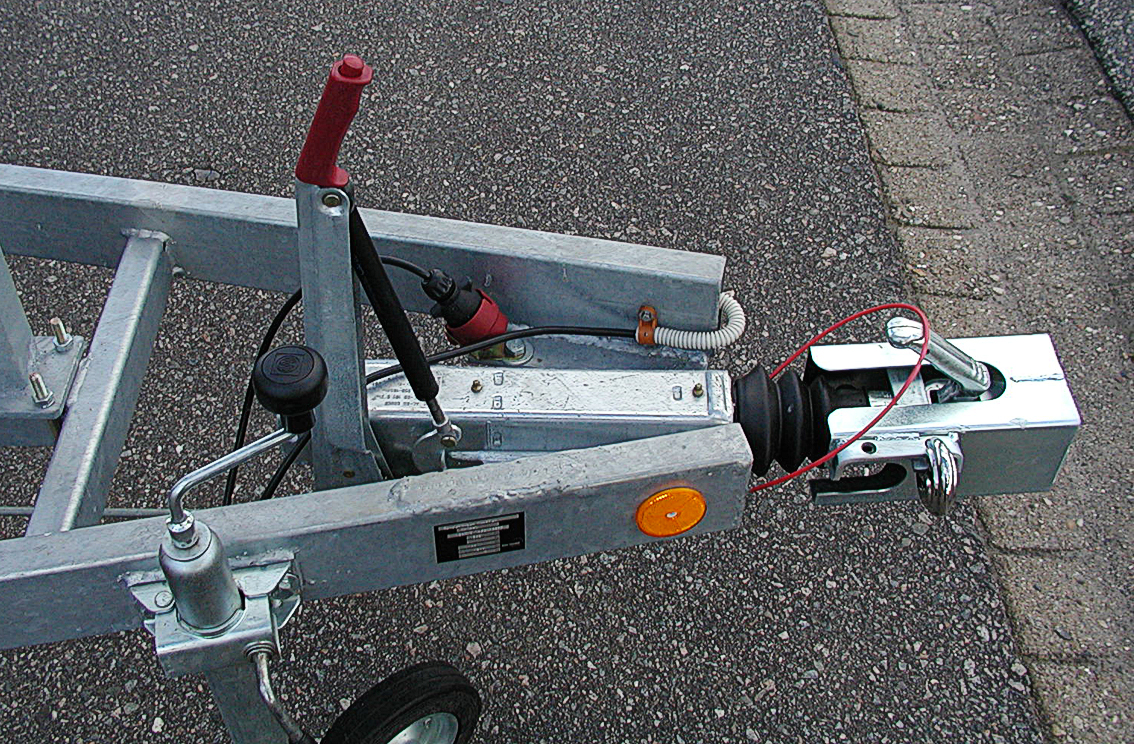
An overrun brake—also called an inertia brake or surge brake (in North America for hydraulic versions)—is a brake system that allows a trailer or caravan to brake proportionally to the deceleration of its towing vehicle. The system uses the trailer’s own momentum acting through the coupling to operate its brakes automatically, without a separate electrical or pneumatic control line.
Overrun braking has been widely used in light trailers across Europe, Australia, and New Zealand since the mid-twentieth century, where full air-brake systems are impractical on small trailers. In the United States, surge-type hydraulic actuators serve a similar function for boat and utility trailers.
Early mechanical trailer brakes appeared in the 1920s, using crude spring linkages that relied on drawbar compression to pull a rod connected to drum brake levers. By the 1950s, purpose-built “overrun couplings” with sliding drawtubes and integrated dampers were common in European caravans. German manufacturers such as AL-KO Kober and Winterhoff refined these systems into modular products combining coupling head, handbrake lever and damper in one unit.
By the late twentieth century, European construction and safety standards for overrun brakes were codified under ECE Regulation 13 and EU Directive 71/320/EEC, defining performance limits, response times and compatibility with reversing functions.
The overrun system consists of:
When the towing vehicle decelerates, the trailer’s inertia compresses the drawtube inside the coupling housing. This movement rotates or pulls a lever connected to either a brake rod/cable or a hydraulic piston. The energy of compression thus applies braking torque to the trailer wheels. A spring-loaded damper slows the rate of drawtube movement to prevent harsh snatching or “nodding” of the combination.
Most small European trailers use purely mechanical overrun brakes employing a steel rod or Bowden cables leading to drum brake backplates. These are sometimes called “inertia mechanical brakes”. The mechanical linkage also doubles as a parking brake when operated by the hand lever integrated into the coupling head.
Hydraulic overrun, or surge-brake, actuators replace the mechanical linkage with a hydraulic master cylinder that sends fluid pressure to drum or disc brakes on the trailer. This type is widespread in North America, particularly on boat trailers where electric wiring is undesirable in water.
Hub AI
Overrun brake AI simulator
(@Overrun brake_simulator)
Overrun brake
An overrun brake—also called an inertia brake or surge brake (in North America for hydraulic versions)—is a brake system that allows a trailer or caravan to brake proportionally to the deceleration of its towing vehicle. The system uses the trailer’s own momentum acting through the coupling to operate its brakes automatically, without a separate electrical or pneumatic control line.
Overrun braking has been widely used in light trailers across Europe, Australia, and New Zealand since the mid-twentieth century, where full air-brake systems are impractical on small trailers. In the United States, surge-type hydraulic actuators serve a similar function for boat and utility trailers.
Early mechanical trailer brakes appeared in the 1920s, using crude spring linkages that relied on drawbar compression to pull a rod connected to drum brake levers. By the 1950s, purpose-built “overrun couplings” with sliding drawtubes and integrated dampers were common in European caravans. German manufacturers such as AL-KO Kober and Winterhoff refined these systems into modular products combining coupling head, handbrake lever and damper in one unit.
By the late twentieth century, European construction and safety standards for overrun brakes were codified under ECE Regulation 13 and EU Directive 71/320/EEC, defining performance limits, response times and compatibility with reversing functions.
The overrun system consists of:
When the towing vehicle decelerates, the trailer’s inertia compresses the drawtube inside the coupling housing. This movement rotates or pulls a lever connected to either a brake rod/cable or a hydraulic piston. The energy of compression thus applies braking torque to the trailer wheels. A spring-loaded damper slows the rate of drawtube movement to prevent harsh snatching or “nodding” of the combination.
Most small European trailers use purely mechanical overrun brakes employing a steel rod or Bowden cables leading to drum brake backplates. These are sometimes called “inertia mechanical brakes”. The mechanical linkage also doubles as a parking brake when operated by the hand lever integrated into the coupling head.
Hydraulic overrun, or surge-brake, actuators replace the mechanical linkage with a hydraulic master cylinder that sends fluid pressure to drum or disc brakes on the trailer. This type is widespread in North America, particularly on boat trailers where electric wiring is undesirable in water.