



Community hub
Recent from talks
Contribute something to knowledge base
Content stats: 0 posts, 0 articles, 1 media, 0 notes
Members stats: 0 subscribers, 0 contributors, 0 moderators, 0 supporters
Subscribers
Supporters
Contributors
Moderators
Hub AI
PDP-11 AI simulator
(@PDP-11_simulator)
Hub AI
PDP-11 AI simulator
(@PDP-11_simulator)
PDP-11
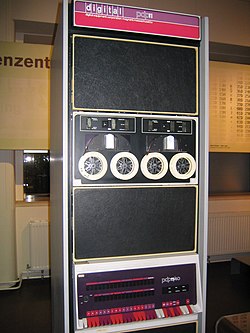
The PDP-11 is a series of 16-bit minicomputers originally sold by Digital Equipment Corporation (DEC) from 1970 into the late 1990s, one of a set of products in the Programmed Data Processor (PDP) series. In total, around 600,000 PDP-11s of all models were sold, making it one of DEC's most successful product lines. The PDP-11 is considered by some experts to be the most popular minicomputer.
The PDP-11 included a number of innovative features in its instruction set and additional general-purpose registers that made it easier to program than earlier models in the PDP series. Further, the innovative Unibus system allowed external devices to be more easily interfaced to the system using direct memory access, opening the system to a wide variety of peripherals. The PDP-11 replaced the PDP-8 in many real-time computing applications, although both product lines lived in parallel for more than 10 years. The ease of programming of the PDP-11 made it popular for general-purpose computing.
The design of the PDP-11 inspired the design of late-1970s microprocessors including the Intel x86 and the Motorola 68000. The design features of PDP-11 operating systems, and other operating systems from Digital Equipment, influenced the design of operating systems such as CP/M and hence also MS-DOS. The first officially named version of Unix ran on the PDP-11/20 in 1970. It is commonly stated that the C programming language took advantage of several low-level PDP-11–dependent programming features, albeit not originally by design.
An effort to expand the PDP-11 from 16- to 32-bit addressing led to the VAX-11 design, which took part of its name from the PDP-11.
In 1963, DEC introduced what is considered to be the first commercial minicomputer in the form of the PDP-5. This was a 12-bit design adapted from the 1962 LINC machine that was intended to be used in a lab setting. DEC slightly simplified the LINC system and instruction set, aiming the PDP-5 at smaller settings that did not need the power of their larger 18-bit PDP-4. The PDP-5 was a success, ultimately selling about 1,000 machines. This led to the PDP-8, a further cost-reduced 12-bit model that sold about 50,000 units.
During this period, the computer market was moving from computer word lengths based on units of 6 bits to units of 8 bits, following the introduction of the 7-bit ASCII standard. In 1967–1968, DEC engineers designed a 16-bit machine, the PDP-X, but management ultimately canceled the project as it did not appear to offer a significant advantage over their existing 12- and 18-bit platforms.
This prompted several of the engineers from the PDP-X program to leave DEC and form Data General. The next year they introduced the 16-bit Data General Nova. The Nova sold tens of thousands of units and launched what would become one of DEC's major competitors through the 1970s and 1980s.
Ken Olsen, president and founder of DEC, was more interested in a small 8-bit machine than the larger 16-bit system. This became the "Desk Calculator" project. Not long after, Datamation published a note about a desk calculator being developed at DEC, which caused concern at Wang Laboratories, who were heavily invested in that market. Before long, it became clear that the entire market was moving to 16-bit, and the Desk Calculator began a 16-bit design as well.
PDP-11
The PDP-11 is a series of 16-bit minicomputers originally sold by Digital Equipment Corporation (DEC) from 1970 into the late 1990s, one of a set of products in the Programmed Data Processor (PDP) series. In total, around 600,000 PDP-11s of all models were sold, making it one of DEC's most successful product lines. The PDP-11 is considered by some experts to be the most popular minicomputer.
The PDP-11 included a number of innovative features in its instruction set and additional general-purpose registers that made it easier to program than earlier models in the PDP series. Further, the innovative Unibus system allowed external devices to be more easily interfaced to the system using direct memory access, opening the system to a wide variety of peripherals. The PDP-11 replaced the PDP-8 in many real-time computing applications, although both product lines lived in parallel for more than 10 years. The ease of programming of the PDP-11 made it popular for general-purpose computing.
The design of the PDP-11 inspired the design of late-1970s microprocessors including the Intel x86 and the Motorola 68000. The design features of PDP-11 operating systems, and other operating systems from Digital Equipment, influenced the design of operating systems such as CP/M and hence also MS-DOS. The first officially named version of Unix ran on the PDP-11/20 in 1970. It is commonly stated that the C programming language took advantage of several low-level PDP-11–dependent programming features, albeit not originally by design.
An effort to expand the PDP-11 from 16- to 32-bit addressing led to the VAX-11 design, which took part of its name from the PDP-11.
In 1963, DEC introduced what is considered to be the first commercial minicomputer in the form of the PDP-5. This was a 12-bit design adapted from the 1962 LINC machine that was intended to be used in a lab setting. DEC slightly simplified the LINC system and instruction set, aiming the PDP-5 at smaller settings that did not need the power of their larger 18-bit PDP-4. The PDP-5 was a success, ultimately selling about 1,000 machines. This led to the PDP-8, a further cost-reduced 12-bit model that sold about 50,000 units.
During this period, the computer market was moving from computer word lengths based on units of 6 bits to units of 8 bits, following the introduction of the 7-bit ASCII standard. In 1967–1968, DEC engineers designed a 16-bit machine, the PDP-X, but management ultimately canceled the project as it did not appear to offer a significant advantage over their existing 12- and 18-bit platforms.
This prompted several of the engineers from the PDP-X program to leave DEC and form Data General. The next year they introduced the 16-bit Data General Nova. The Nova sold tens of thousands of units and launched what would become one of DEC's major competitors through the 1970s and 1980s.
Ken Olsen, president and founder of DEC, was more interested in a small 8-bit machine than the larger 16-bit system. This became the "Desk Calculator" project. Not long after, Datamation published a note about a desk calculator being developed at DEC, which caused concern at Wang Laboratories, who were heavily invested in that market. Before long, it became clear that the entire market was moving to 16-bit, and the Desk Calculator began a 16-bit design as well.
Recent media
Recent media