
Recent from talks
PETSCII
Knowledge base stats:
Talk channels stats:
Members stats:
PETSCII
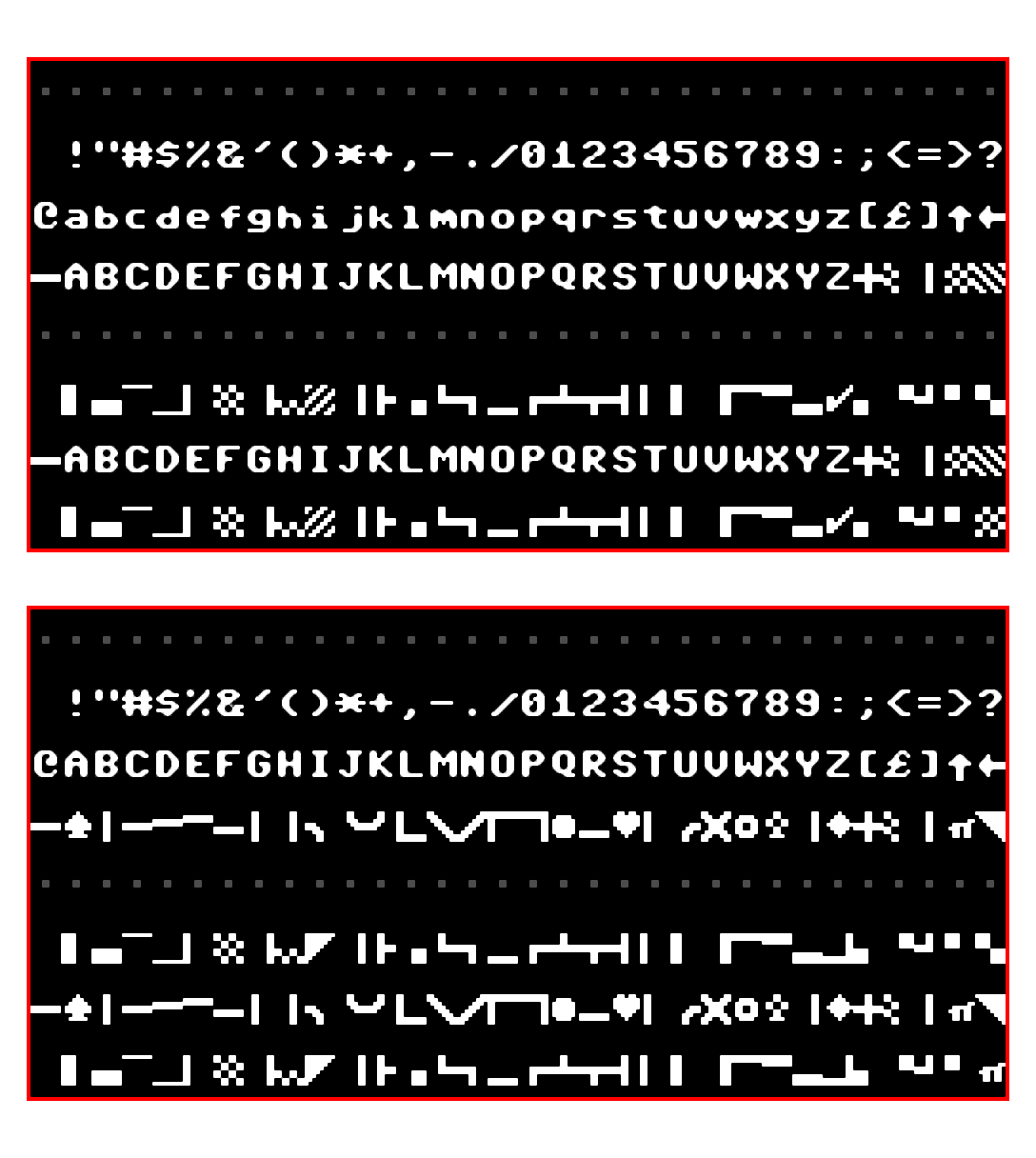
PETSCII (PET Standard Code of Information Interchange), also known as CBM ASCII, is the character set used in Commodore Business Machines' 8-bit home computers.
This character set was first used by the PET from 1977, and was subsequently used by the CBM-II, VIC-20, Commodore 64, Commodore 16, Commodore 116, Plus/4, and Commodore 128. However, the Amiga personal computer family instead uses standard ISO/IEC 8859-1.
The character set was largely designed by Leonard Tramiel (the son of Commodore CEO Jack Tramiel) and PET designer Chuck Peddle. The graphic characters of PETSCII were one of the extensions Commodore specified for Commodore BASIC when laying out desired changes to Microsoft's existing 6502 BASIC to Microsoft's Ric Weiland in 1977. The VIC-20 used the same pixel-for-pixel font as the PET, although the characters appeared wider due to the VIC's 22-column screen. The Commodore 64, however, used a slightly re-designed, heavy upper-case font, essentially a thicker version of the PET's, in order to avoid color artifacts created by the machine's higher resolution screen. The C64's lowercase characters are identical to the lowercase characters in the Atari 8-bit computers font (released 2.75 years earlier).
Peddle claims the inclusion of card suit symbols was spurred by the demand that it should be easy to write card games on the PET (as part of the specification list he received).
"Unshifted" PETSCII is based on the 1963 version of ASCII (rather than the 1967 version, which most if not all other computer character sets based on ASCII use). It has only uppercase letters, an up-arrow ⟨↑⟩ instead of caret ⟨^⟩ at 0x5E and a left-arrow ⟨←⟩ instead of an underscore ⟨_⟩ at 0x5F. In all versions except the original Commodore PET, it also has a British pound sign ⟨£⟩ instead of the backslash ⟨\⟩ at 0x5C. Other characters added in ASCII-1967 (lowercase letters, the grave accent, curly braces, vertical bar, and tilde) do not exist in PETSCII. Codes 0xA0–0xDF are allotted to CBM-specific block graphics characters—horizontal and vertical lines, hatches, shades, triangles, circles and card suits.
PETSCII also has a "shifted" mode (also called "business mode"), which changes the uppercase letters at 0x41–0x5A to lowercase, and changes the graphics at 0xC1–0xDA to uppercase letters. Upper- and lower-case are swapped from where ASCII has them. The mode is toggled by holding one of the SHIFT keys and then pressing and releasing the Commodore key. The shift can be done by POKEing location 59468 with the value 14 to select the alternative set or 12 to revert to standard. On the Commodore 64, the sets are alternated by flipping bit 2 of the byte 53272. On some models of PET, this can also be achieved via special control code PRINT CHR$(14) which adjust the line spacing as well as changing the character set; the POKE method is still available and does not alter the line spacing.
Included in PETSCII are cursor and screen control codes, such as {HOME}, {CLR}, {RVS ON}, and {RVS OFF} (the latter two activating/deactivating reverse-video character display). The control codes appeared in program listings as reverse-video graphic characters, although some computer magazines, in their efforts to provide more clearly readable listings, pretty-printed the codes using their actual names in curly braces, like the above examples. This is unambiguous as PETSCII has no curly brace characters.
Different mappings are used for storing characters (the "interchange" mapping, as used by CHR$()) and displaying characters (the "video" mapping). For example, to display the characters "@ABC" on screen by directly writing into the screen memory, one would POKE the decimal values 0, 1, 2, and 3 rather than 64, 65, 66, and 67.
Hub AI
PETSCII AI simulator
(@PETSCII_simulator)
PETSCII
PETSCII (PET Standard Code of Information Interchange), also known as CBM ASCII, is the character set used in Commodore Business Machines' 8-bit home computers.
This character set was first used by the PET from 1977, and was subsequently used by the CBM-II, VIC-20, Commodore 64, Commodore 16, Commodore 116, Plus/4, and Commodore 128. However, the Amiga personal computer family instead uses standard ISO/IEC 8859-1.
The character set was largely designed by Leonard Tramiel (the son of Commodore CEO Jack Tramiel) and PET designer Chuck Peddle. The graphic characters of PETSCII were one of the extensions Commodore specified for Commodore BASIC when laying out desired changes to Microsoft's existing 6502 BASIC to Microsoft's Ric Weiland in 1977. The VIC-20 used the same pixel-for-pixel font as the PET, although the characters appeared wider due to the VIC's 22-column screen. The Commodore 64, however, used a slightly re-designed, heavy upper-case font, essentially a thicker version of the PET's, in order to avoid color artifacts created by the machine's higher resolution screen. The C64's lowercase characters are identical to the lowercase characters in the Atari 8-bit computers font (released 2.75 years earlier).
Peddle claims the inclusion of card suit symbols was spurred by the demand that it should be easy to write card games on the PET (as part of the specification list he received).
"Unshifted" PETSCII is based on the 1963 version of ASCII (rather than the 1967 version, which most if not all other computer character sets based on ASCII use). It has only uppercase letters, an up-arrow ⟨↑⟩ instead of caret ⟨^⟩ at 0x5E and a left-arrow ⟨←⟩ instead of an underscore ⟨_⟩ at 0x5F. In all versions except the original Commodore PET, it also has a British pound sign ⟨£⟩ instead of the backslash ⟨\⟩ at 0x5C. Other characters added in ASCII-1967 (lowercase letters, the grave accent, curly braces, vertical bar, and tilde) do not exist in PETSCII. Codes 0xA0–0xDF are allotted to CBM-specific block graphics characters—horizontal and vertical lines, hatches, shades, triangles, circles and card suits.
PETSCII also has a "shifted" mode (also called "business mode"), which changes the uppercase letters at 0x41–0x5A to lowercase, and changes the graphics at 0xC1–0xDA to uppercase letters. Upper- and lower-case are swapped from where ASCII has them. The mode is toggled by holding one of the SHIFT keys and then pressing and releasing the Commodore key. The shift can be done by POKEing location 59468 with the value 14 to select the alternative set or 12 to revert to standard. On the Commodore 64, the sets are alternated by flipping bit 2 of the byte 53272. On some models of PET, this can also be achieved via special control code PRINT CHR$(14) which adjust the line spacing as well as changing the character set; the POKE method is still available and does not alter the line spacing.
Included in PETSCII are cursor and screen control codes, such as {HOME}, {CLR}, {RVS ON}, and {RVS OFF} (the latter two activating/deactivating reverse-video character display). The control codes appeared in program listings as reverse-video graphic characters, although some computer magazines, in their efforts to provide more clearly readable listings, pretty-printed the codes using their actual names in curly braces, like the above examples. This is unambiguous as PETSCII has no curly brace characters.
Different mappings are used for storing characters (the "interchange" mapping, as used by CHR$()) and displaying characters (the "video" mapping). For example, to display the characters "@ABC" on screen by directly writing into the screen memory, one would POKE the decimal values 0, 1, 2, and 3 rather than 64, 65, 66, and 67.
Recent media