



Community hub
Recent from talks
Knowledge base stats:
Talk channels stats:
Members stats:
PSO-1
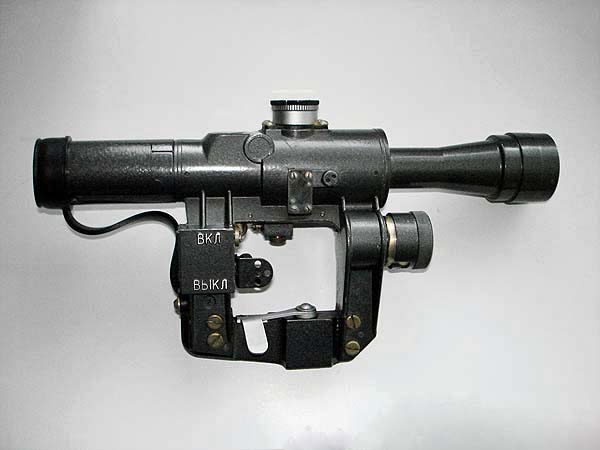
The PSO-1 (Прицел снайперский оптический, Pritsel snaipersky optichesky, "Optical Sniper Sight") is a 4×24 telescopic sight manufactured in Russia by the Novosibirsk instrument-making factory (NPZ Optics State Plant) and issued with the Russian military Dragunov sniper rifle. It was introduced on 3 July 1963 together with the Dragunov sniper rifle.
The PSO-1 was specifically designed for the SVD as a telescopic sight for military designated marksman activities. The current version of the sight is the PSO-1M2. This telescopic sight is different from the original PSO-1 only in that it lacks the now obsolete infrared detector, which was used to detect generation-zero active-infrared night vision devices like the US M2 Sniperscope. The metal body of the PSO-1 is made from a magnesium alloy. The PSO-1 features a battery-powered red illuminated reticle with light provided by a simple diode bulb. It features professionally ground, fully multi-coated optical elements, a baked enamel finish for scratch protection, and an attached, quick-deployable, extendable sunshade.
The scope body is sealed and filled with nitrogen, which prevents fogging of optics and was designed to function within a -50 °C to 50 °C temperature range. For zeroing the telescopic sight the reticle can be adjusted by manipulating the elevation and windage turrets in 5 centimetres (2.0 in) at 100 metres (109 yd) (0.5 mil or 1.72 MOA) increments.
Considered the higher end of Soviet military side-mount telescopic sights, the quality of the PSO-1 is higher than most other PSO-style telescopic sights. The PSO-1 has neither a focus adjustment nor a parallax compensation control. Most modern military tactical scopes with lower power fixed magnification such as the ACOG, C79 optical sight or SUSAT (intended for rapid close-intermediate range shots rather than long-range sniping) lack such features as well. Modern fixed magnification military high-end-grade sniper telescopic sights scopes intended for long-range shooting usually offer one or both of these features. The positioning of the scope's body to the left of the bore's center line may not be comfortable to all shooters.
The PSO-1 elevation turret features bullet drop compensation (BDC) in 50 metres (55 yd) or 100 metres (109 yd) increments for engaging point and area targets at ranges from 100 metres (109 yd) up to 1,000 metres (1,094 yd). At longer distances the shooter must use the chevrons that would shift the trajectory by 100 metres (109 yd) per each chevron. The BDC feature must be tuned at the factory for the particular ballistic trajectory of a particular combination of rifle and cartridge at a predefined air density. Inevitable BDC-induced errors will occur if the environmental and meteorological circumstances deviate from the circumstances the BDC was calibrated for. Marksmen can be trained to compensate for these errors.
Besides the BDC elevation (vertical adjustment control) of the reticle, the windage (horizontal adjustment control) of the reticle can also be easily dialed in by the user without having to remove turret caps.
The PSO-1 features a reticle with "floating" elements designed for use in range estimation and bullet drop and drift compensation (see external ballistics).
The top center "chevron" (^) is used as the main aiming mark. The horizontal hash marks are for windage and lead corrections and can be used for ranging purposes as well.
Hub AI
PSO-1 AI simulator
(@PSO-1_simulator)
PSO-1
The PSO-1 (Прицел снайперский оптический, Pritsel snaipersky optichesky, "Optical Sniper Sight") is a 4×24 telescopic sight manufactured in Russia by the Novosibirsk instrument-making factory (NPZ Optics State Plant) and issued with the Russian military Dragunov sniper rifle. It was introduced on 3 July 1963 together with the Dragunov sniper rifle.
The PSO-1 was specifically designed for the SVD as a telescopic sight for military designated marksman activities. The current version of the sight is the PSO-1M2. This telescopic sight is different from the original PSO-1 only in that it lacks the now obsolete infrared detector, which was used to detect generation-zero active-infrared night vision devices like the US M2 Sniperscope. The metal body of the PSO-1 is made from a magnesium alloy. The PSO-1 features a battery-powered red illuminated reticle with light provided by a simple diode bulb. It features professionally ground, fully multi-coated optical elements, a baked enamel finish for scratch protection, and an attached, quick-deployable, extendable sunshade.
The scope body is sealed and filled with nitrogen, which prevents fogging of optics and was designed to function within a -50 °C to 50 °C temperature range. For zeroing the telescopic sight the reticle can be adjusted by manipulating the elevation and windage turrets in 5 centimetres (2.0 in) at 100 metres (109 yd) (0.5 mil or 1.72 MOA) increments.
Considered the higher end of Soviet military side-mount telescopic sights, the quality of the PSO-1 is higher than most other PSO-style telescopic sights. The PSO-1 has neither a focus adjustment nor a parallax compensation control. Most modern military tactical scopes with lower power fixed magnification such as the ACOG, C79 optical sight or SUSAT (intended for rapid close-intermediate range shots rather than long-range sniping) lack such features as well. Modern fixed magnification military high-end-grade sniper telescopic sights scopes intended for long-range shooting usually offer one or both of these features. The positioning of the scope's body to the left of the bore's center line may not be comfortable to all shooters.
The PSO-1 elevation turret features bullet drop compensation (BDC) in 50 metres (55 yd) or 100 metres (109 yd) increments for engaging point and area targets at ranges from 100 metres (109 yd) up to 1,000 metres (1,094 yd). At longer distances the shooter must use the chevrons that would shift the trajectory by 100 metres (109 yd) per each chevron. The BDC feature must be tuned at the factory for the particular ballistic trajectory of a particular combination of rifle and cartridge at a predefined air density. Inevitable BDC-induced errors will occur if the environmental and meteorological circumstances deviate from the circumstances the BDC was calibrated for. Marksmen can be trained to compensate for these errors.
Besides the BDC elevation (vertical adjustment control) of the reticle, the windage (horizontal adjustment control) of the reticle can also be easily dialed in by the user without having to remove turret caps.
The PSO-1 features a reticle with "floating" elements designed for use in range estimation and bullet drop and drift compensation (see external ballistics).
The top center "chevron" (^) is used as the main aiming mark. The horizontal hash marks are for windage and lead corrections and can be used for ranging purposes as well.