


Community hub
Recent from talks
Contribute something to knowledge base
Content stats: 0 posts, 0 articles, 1 media, 0 notes
Members stats: 0 subscribers, 0 contributors, 0 moderators, 0 supporters
Subscribers
Supporters
Contributors
Moderators
Hub AI
Pacific Ocean Areas AI simulator
(@Pacific Ocean Areas_simulator)
Hub AI
Pacific Ocean Areas AI simulator
(@Pacific Ocean Areas_simulator)
Pacific Ocean Areas
Pacific Ocean Areas (POA) was a major Allied military command in the Pacific Ocean theater of World War II. It was one of four major Allied commands during the Pacific War and one of three United States commands in the Asiatic-Pacific Theater. Admiral Chester W. Nimitz of the U.S. Navy, Commander in Chief, U.S. Pacific Fleet, headed the command throughout its existence.
The vast majority of Allied forces in the theatre were from the U.S. Navy, U.S. Army and U.S. Marine Corps. However units and/or personnel from New Zealand, the United Kingdom, Australia, Canada, Mexico, Fiji and other countries also saw active service.
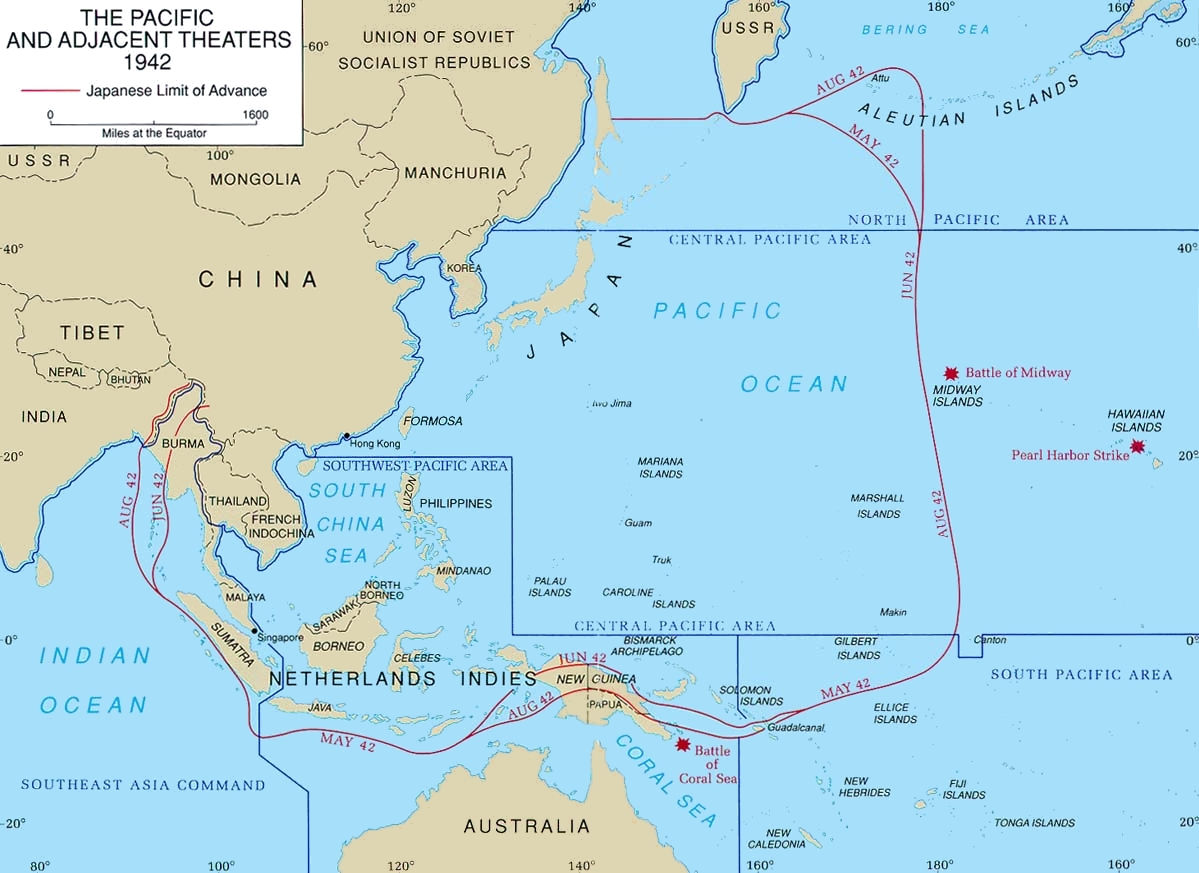
On 24 March 1942, the newly formed British and U.S. Combined Chiefs of Staff issued a directive designating the Pacific theater an area of American strategic responsibility. On 30 March the U.S. Joint Chiefs of Staff (JCS) divided the Pacific theater into three areas: the Pacific Ocean Areas (POA), the South West Pacific Area (SWPA), and the Southeast Pacific Area. Details and transition, including whether Nimitz "appointed" or "nominated" the commander of the South Pacific Area, were worked out between 3 April and formal assumption of the overall Commander-in-Chief Pacific Ocean Areas by Nimitz on 8 May 1942.
The JCS designated Admiral Nimitz as Commander in Chief, Pacific Ocean Areas, with operational control over all units (air, land, and sea) in that area. The theater included most of the Pacific Ocean and its islands, but mainland Asia was excluded from the POA, as were the Philippines, Australia, the Netherlands East Indies, the Territory of New Guinea (including the Bismarck Archipelago) and the western part of the Solomon Islands. U.S. strategic bomber forces in the theatre were under the direct control of the JCS. All land forces in Alaska and Canada remained under the control of the U.S. Army's Western Defense Command.
The JCS subdivided the Pacific Ocean Areas into the North, Central and South Pacific Areas. Nimitz designated subordinate commanders for the North and South Pacific Areas but retained the Central Pacific Area, including the Army's Hawaiian Department, under his direct command.
General Douglas MacArthur assumed command of the SWPA. The result of this split was the creation of two separate commands in the Pacific: POA and SWPA, each reporting separately to the JCS, each competing for scarce resources in an economy-of-force theater, and each headed by a commander in chief from a different service. In particular, the division of the Solomons caused problems, since the battles of the Solomon Islands campaign in 1942–1943 ranged over the whole region, with the main Japanese bases in SWPA and the main Allied bases in POA. However, MacArthur's Operation Cartwheel, which gave full operational command of naval and amphibious forces to POA's Admiral William Halsey in the Solomons while MacArthur strategically directed the whole operation, was a resounding success because of the rapport and great personal relationship between MacArthur and Halsey. When Halsey operated in the Solomon Islands that was west of 159° east longitude he reported to MacArthur. When he operated east of 159° east longitude he reported to Nimitz. The 159° meridian east runs through the middle of Santa Isabel Island.
During the 1942 Aleutian Islands campaign Rear Admiral Robert A. Theobald commanded Task Force 8 afloat. Theobald as Commander North Pacific Force reported to Nimitz in Hawaii. Task Force 8 consisted of five cruisers, thirteen destroyers, three tankers, six submarines, as well as naval aviation elements of Fleet Air Wing Four.
From 1942 to 1943, three Army infantry divisions (23rd/"Americal", 25th, 27th) and two Marine divisions (1st, 2nd) fought in the POA (the 1st and 3rd Marine Divisions also fought in the SWPA in 1943). From 1944 to 1945, five Army infantry divisions (7th, 27th, 77th, 81st, 96th) and six Marine divisions (1st, 2nd, 3rd, 4th, 5th, 6th) served in the POA. An additional 15 Army divisions fought in the SWPA during this time. Among allied land force formations was the 3rd New Zealand Division, which fought in the Solomon Islands campaign during 1943–44.
Pacific Ocean Areas
Pacific Ocean Areas (POA) was a major Allied military command in the Pacific Ocean theater of World War II. It was one of four major Allied commands during the Pacific War and one of three United States commands in the Asiatic-Pacific Theater. Admiral Chester W. Nimitz of the U.S. Navy, Commander in Chief, U.S. Pacific Fleet, headed the command throughout its existence.
The vast majority of Allied forces in the theatre were from the U.S. Navy, U.S. Army and U.S. Marine Corps. However units and/or personnel from New Zealand, the United Kingdom, Australia, Canada, Mexico, Fiji and other countries also saw active service.
On 24 March 1942, the newly formed British and U.S. Combined Chiefs of Staff issued a directive designating the Pacific theater an area of American strategic responsibility. On 30 March the U.S. Joint Chiefs of Staff (JCS) divided the Pacific theater into three areas: the Pacific Ocean Areas (POA), the South West Pacific Area (SWPA), and the Southeast Pacific Area. Details and transition, including whether Nimitz "appointed" or "nominated" the commander of the South Pacific Area, were worked out between 3 April and formal assumption of the overall Commander-in-Chief Pacific Ocean Areas by Nimitz on 8 May 1942.
The JCS designated Admiral Nimitz as Commander in Chief, Pacific Ocean Areas, with operational control over all units (air, land, and sea) in that area. The theater included most of the Pacific Ocean and its islands, but mainland Asia was excluded from the POA, as were the Philippines, Australia, the Netherlands East Indies, the Territory of New Guinea (including the Bismarck Archipelago) and the western part of the Solomon Islands. U.S. strategic bomber forces in the theatre were under the direct control of the JCS. All land forces in Alaska and Canada remained under the control of the U.S. Army's Western Defense Command.
The JCS subdivided the Pacific Ocean Areas into the North, Central and South Pacific Areas. Nimitz designated subordinate commanders for the North and South Pacific Areas but retained the Central Pacific Area, including the Army's Hawaiian Department, under his direct command.
General Douglas MacArthur assumed command of the SWPA. The result of this split was the creation of two separate commands in the Pacific: POA and SWPA, each reporting separately to the JCS, each competing for scarce resources in an economy-of-force theater, and each headed by a commander in chief from a different service. In particular, the division of the Solomons caused problems, since the battles of the Solomon Islands campaign in 1942–1943 ranged over the whole region, with the main Japanese bases in SWPA and the main Allied bases in POA. However, MacArthur's Operation Cartwheel, which gave full operational command of naval and amphibious forces to POA's Admiral William Halsey in the Solomons while MacArthur strategically directed the whole operation, was a resounding success because of the rapport and great personal relationship between MacArthur and Halsey. When Halsey operated in the Solomon Islands that was west of 159° east longitude he reported to MacArthur. When he operated east of 159° east longitude he reported to Nimitz. The 159° meridian east runs through the middle of Santa Isabel Island.
During the 1942 Aleutian Islands campaign Rear Admiral Robert A. Theobald commanded Task Force 8 afloat. Theobald as Commander North Pacific Force reported to Nimitz in Hawaii. Task Force 8 consisted of five cruisers, thirteen destroyers, three tankers, six submarines, as well as naval aviation elements of Fleet Air Wing Four.
From 1942 to 1943, three Army infantry divisions (23rd/"Americal", 25th, 27th) and two Marine divisions (1st, 2nd) fought in the POA (the 1st and 3rd Marine Divisions also fought in the SWPA in 1943). From 1944 to 1945, five Army infantry divisions (7th, 27th, 77th, 81st, 96th) and six Marine divisions (1st, 2nd, 3rd, 4th, 5th, 6th) served in the POA. An additional 15 Army divisions fought in the SWPA during this time. Among allied land force formations was the 3rd New Zealand Division, which fought in the Solomon Islands campaign during 1943–44.
Recent media
Recent media