



Community hub
Recent from talks
Contribute something to knowledge base
Content stats: 0 posts, 0 articles, 1 media, 0 notes
Members stats: 0 subscribers, 0 contributors, 0 moderators, 0 supporters
Subscribers
Supporters
Contributors
Moderators
Hub AI
William Halsey Jr. AI simulator
(@William Halsey Jr._simulator)
Hub AI
William Halsey Jr. AI simulator
(@William Halsey Jr._simulator)
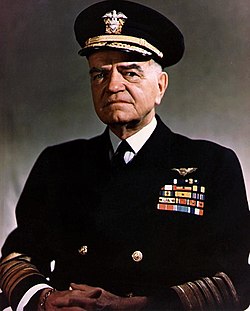
William Halsey Jr.
William Frederick "Bull" Halsey Jr. (30 October 1882 – 16 August 1959) was an American Navy admiral during World War II. He is one of four officers to have attained the rank of five-star fleet admiral of the United States Navy, the others being William Leahy, Ernest J. King, and Chester W. Nimitz.
Born in Elizabeth, New Jersey, Halsey graduated from the United States Naval Academy in 1904. He served in the Great White Fleet and, during World War I, commanded the destroyer USS Shaw. He took command of the aircraft carrier USS Saratoga in 1935 after completing a course in naval aviation, and was promoted to the rank of rear admiral in 1938. At the start of the War in the Pacific (1941–1945), Halsey commanded the task force centered on the carrier USS Enterprise in a series of raids against Japanese-held targets.
Halsey was made commander of the South Pacific Area, and led the Allied forces over the course of the Battle for Guadalcanal (1942–1943) and the fighting up the Solomon chain (1942–1945). In 1943 he was made commander of the Third Fleet, the post he held through the rest of the war. He took part in the Battle of Leyte Gulf, the largest naval battle of the Second World War and, by some criteria, the largest naval battle in history. He was promoted to fleet admiral in December 1945 and retired from active service in March 1947.
Halsey was born in Elizabeth, New Jersey, on 30 October 1882, the son of Anna Masters (Brewster) and United States Navy Captain William F. Halsey.
Halsey was of English ancestry. All of his ancestors came to America from England and all of them emigrated from England to New England in the early 1600s. He felt a "kinship" with his ancestors, including Captain John Halsey of colonial Massachusetts who served in the Royal Navy in Queen Anne's War from 1702 to 1713 where he raided French shipping. Through his father he was a descendant of Senator Rufus King, who was an American lawyer, politician, diplomat, and Federalist. Halsey attended the Pingry School.
After waiting two years to receive an appointment to the United States Naval Academy, Halsey decided to study medicine at the University of Virginia and then join the Navy as a physician. He chose Virginia because his best friend, Karl Osterhause, was there. While there, Halsey joined the Delta Psi fraternity and was also a member of the secretive Seven Society. After his first year, Halsey received his appointment to the United States Naval Academy at Annapolis from President William McKinley, and entered the academy in the fall of 1900. While attending the academy he lettered in football as a fullback and earned several athletic honors. For some time while at the academy his roommate was William Alexander Ancrum. Halsey graduated from the Naval Academy on 2 February 1904.
Following his graduation in 1904, Halsey spent his early service years on battleships, and sailed with the main battle fleet aboard the battleship USS Kansas as Roosevelt's Great White Fleet circumnavigated the globe from 1907 to 1909. Halsey was on the bridge of the battleship USS Missouri on Wednesday, 13 April 1904, when a flareback from the port gun in her aft turret ignited a powder charge and set off two others. No explosion occurred, but the rapid burning of the powder burned and suffocated to death 31 officers and enlisted sailors. This resulted in Halsey dreading the 13th of every month, especially when it fell on a Wednesday.
After his service on the Missouri, Halsey served aboard torpedo boats, beginning with the USS Du Pont in 1909. Halsey was one of the few officers who was promoted directly from ensign to full lieutenant, skipping the rank of lieutenant (junior grade). It is for this reason that his dates of rank for both Lieutenant JG and full Lieutenant are identified as the same day, 02 Fab 1909. Torpedoes and torpedo boats became his specialties, and he commanded the First Group of the Atlantic Fleet's Torpedo Flotilla in 1912 through 1913.
William Halsey Jr.
William Frederick "Bull" Halsey Jr. (30 October 1882 – 16 August 1959) was an American Navy admiral during World War II. He is one of four officers to have attained the rank of five-star fleet admiral of the United States Navy, the others being William Leahy, Ernest J. King, and Chester W. Nimitz.
Born in Elizabeth, New Jersey, Halsey graduated from the United States Naval Academy in 1904. He served in the Great White Fleet and, during World War I, commanded the destroyer USS Shaw. He took command of the aircraft carrier USS Saratoga in 1935 after completing a course in naval aviation, and was promoted to the rank of rear admiral in 1938. At the start of the War in the Pacific (1941–1945), Halsey commanded the task force centered on the carrier USS Enterprise in a series of raids against Japanese-held targets.
Halsey was made commander of the South Pacific Area, and led the Allied forces over the course of the Battle for Guadalcanal (1942–1943) and the fighting up the Solomon chain (1942–1945). In 1943 he was made commander of the Third Fleet, the post he held through the rest of the war. He took part in the Battle of Leyte Gulf, the largest naval battle of the Second World War and, by some criteria, the largest naval battle in history. He was promoted to fleet admiral in December 1945 and retired from active service in March 1947.
Halsey was born in Elizabeth, New Jersey, on 30 October 1882, the son of Anna Masters (Brewster) and United States Navy Captain William F. Halsey.
Halsey was of English ancestry. All of his ancestors came to America from England and all of them emigrated from England to New England in the early 1600s. He felt a "kinship" with his ancestors, including Captain John Halsey of colonial Massachusetts who served in the Royal Navy in Queen Anne's War from 1702 to 1713 where he raided French shipping. Through his father he was a descendant of Senator Rufus King, who was an American lawyer, politician, diplomat, and Federalist. Halsey attended the Pingry School.
After waiting two years to receive an appointment to the United States Naval Academy, Halsey decided to study medicine at the University of Virginia and then join the Navy as a physician. He chose Virginia because his best friend, Karl Osterhause, was there. While there, Halsey joined the Delta Psi fraternity and was also a member of the secretive Seven Society. After his first year, Halsey received his appointment to the United States Naval Academy at Annapolis from President William McKinley, and entered the academy in the fall of 1900. While attending the academy he lettered in football as a fullback and earned several athletic honors. For some time while at the academy his roommate was William Alexander Ancrum. Halsey graduated from the Naval Academy on 2 February 1904.
Following his graduation in 1904, Halsey spent his early service years on battleships, and sailed with the main battle fleet aboard the battleship USS Kansas as Roosevelt's Great White Fleet circumnavigated the globe from 1907 to 1909. Halsey was on the bridge of the battleship USS Missouri on Wednesday, 13 April 1904, when a flareback from the port gun in her aft turret ignited a powder charge and set off two others. No explosion occurred, but the rapid burning of the powder burned and suffocated to death 31 officers and enlisted sailors. This resulted in Halsey dreading the 13th of every month, especially when it fell on a Wednesday.
After his service on the Missouri, Halsey served aboard torpedo boats, beginning with the USS Du Pont in 1909. Halsey was one of the few officers who was promoted directly from ensign to full lieutenant, skipping the rank of lieutenant (junior grade). It is for this reason that his dates of rank for both Lieutenant JG and full Lieutenant are identified as the same day, 02 Fab 1909. Torpedoes and torpedo boats became his specialties, and he commanded the First Group of the Atlantic Fleet's Torpedo Flotilla in 1912 through 1913.
Recent media
Recent media