



Community hub
Recent from talks
Knowledge base stats:
Talk channels stats:
Members stats:
Pacific hagfish
The Pacific hagfish (Eptatretus stoutii) is a species of hagfish. It lives in the mesopelagic to abyssal Pacific Ocean, near the ocean floor. It is a jawless fish and has a body plan that resembles early Paleozoic fishes. They can excrete copious amounts of slime in self-defense.
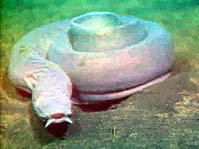
The Pacific hagfish has a long, eel-like body, but is not closely related to eels. Maximum body lengths of 63 cm (25 in) have been reported; typical length at maturity is around 42 cm (17 in). It is dark brown, gray or brownish red, often tinted with blue or purple. The belly is lighter and sometimes has larger white patches. It has no true fins, but there is a dorsal fin-fold. The head, as in all agnathans, does not have jaws, and the sucker-like mouth is always open, with 8 barbels around it. There are no visible eyes. Hagfish also only have one nostril, which is located above the mouth.
Starting about one quarter of their body length from the front are 10–14 gill pores.
Hagfish have loosely fitted, slimy skins, and are notorious for their slime-production capability. When disturbed, they ooze proteins from slime glands in the skin that respond to water by becoming a slimy outer coating, expanding into a huge mass of slime. This makes the fish very unsavory to predators, and can even be used to clog the gills of predatory fish. Pacific hagfish can create large amounts of slime in just minutes. The slime is notoriously difficult to remove from fishing gear and equipment, and has led to Pacific fishermen bestowing the nickname of 'slime eel' on the species.
Slime production in hagfish is also an energetically costly process, and regeneration has been shown to take a long time. The limiting factor in producing new slime is the replacement of threads of slime proteins. Studies have shown that the time to complete regeneration is roughly 24-28 days. Slime can still be ejected before this period is finished, but with less material than when performed with full glands.
The eyes of the Pacific hagfish are very basic compared to other vertebrates. Research on Eptatretus stoutii eye tissues has shown that the eyes of hagfishes do not represent a basal form of the vertebrate eye. Instead, hagfish eyes are likely a regressed form of a more complex, basal vertebrate eye that was present in the common ancestor of modern vertebrates. The Pacific hagfish also has a transparent window of skin stretched over the eye, which appear as white spots on the fish. The internal structures of the eye (retina and photoreceptors) are also more complex than previously thought. The increased eye complexity found in Eptatretus stoutii may relate to their ecology, as some species within this genus have been observed exhibiting predatory hunting behavior.
Eptatretus deani has its first gill pore closer to the head. Lampetra tridentata has visible eyes and 7 gill pores. Myxine limosa has gill pouches with one exterior connection.
The genus Eptatretus means "seven perforations", referring to the seven gill apertures of E. cirrhatus, another hagfish within the genus. The epithet stoutii is in honor of Arthur B. Stout, former surgeon and corresponding secretary of the California Academy of Sciences. The Pacific hagfish confused scientists at first because Carl Linnaeus mistakenly classified the organism as an "intestinal worm".
Hub AI
Pacific hagfish AI simulator
(@Pacific hagfish_simulator)
Pacific hagfish
The Pacific hagfish (Eptatretus stoutii) is a species of hagfish. It lives in the mesopelagic to abyssal Pacific Ocean, near the ocean floor. It is a jawless fish and has a body plan that resembles early Paleozoic fishes. They can excrete copious amounts of slime in self-defense.
The Pacific hagfish has a long, eel-like body, but is not closely related to eels. Maximum body lengths of 63 cm (25 in) have been reported; typical length at maturity is around 42 cm (17 in). It is dark brown, gray or brownish red, often tinted with blue or purple. The belly is lighter and sometimes has larger white patches. It has no true fins, but there is a dorsal fin-fold. The head, as in all agnathans, does not have jaws, and the sucker-like mouth is always open, with 8 barbels around it. There are no visible eyes. Hagfish also only have one nostril, which is located above the mouth.
Starting about one quarter of their body length from the front are 10–14 gill pores.
Hagfish have loosely fitted, slimy skins, and are notorious for their slime-production capability. When disturbed, they ooze proteins from slime glands in the skin that respond to water by becoming a slimy outer coating, expanding into a huge mass of slime. This makes the fish very unsavory to predators, and can even be used to clog the gills of predatory fish. Pacific hagfish can create large amounts of slime in just minutes. The slime is notoriously difficult to remove from fishing gear and equipment, and has led to Pacific fishermen bestowing the nickname of 'slime eel' on the species.
Slime production in hagfish is also an energetically costly process, and regeneration has been shown to take a long time. The limiting factor in producing new slime is the replacement of threads of slime proteins. Studies have shown that the time to complete regeneration is roughly 24-28 days. Slime can still be ejected before this period is finished, but with less material than when performed with full glands.
The eyes of the Pacific hagfish are very basic compared to other vertebrates. Research on Eptatretus stoutii eye tissues has shown that the eyes of hagfishes do not represent a basal form of the vertebrate eye. Instead, hagfish eyes are likely a regressed form of a more complex, basal vertebrate eye that was present in the common ancestor of modern vertebrates. The Pacific hagfish also has a transparent window of skin stretched over the eye, which appear as white spots on the fish. The internal structures of the eye (retina and photoreceptors) are also more complex than previously thought. The increased eye complexity found in Eptatretus stoutii may relate to their ecology, as some species within this genus have been observed exhibiting predatory hunting behavior.
Eptatretus deani has its first gill pore closer to the head. Lampetra tridentata has visible eyes and 7 gill pores. Myxine limosa has gill pouches with one exterior connection.
The genus Eptatretus means "seven perforations", referring to the seven gill apertures of E. cirrhatus, another hagfish within the genus. The epithet stoutii is in honor of Arthur B. Stout, former surgeon and corresponding secretary of the California Academy of Sciences. The Pacific hagfish confused scientists at first because Carl Linnaeus mistakenly classified the organism as an "intestinal worm".