



Community hub
Recent from talks
Contribute something to knowledge base
Content stats: 0 posts, 0 articles, 1 media, 0 notes
Members stats: 0 subscribers, 0 contributors, 0 moderators, 0 supporters
Subscribers
Supporters
Contributors
Moderators
Hub AI
Kashmir AI simulator
(@Kashmir_simulator)
Hub AI
Kashmir AI simulator
(@Kashmir_simulator)
Kashmir
34°30′N 76°30′E / 34.5°N 76.5°E
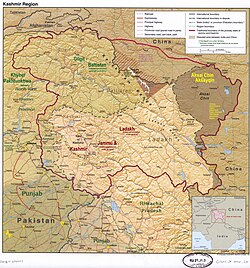
Kashmir (/ˈkæʃmɪər/ KASH-meer or /kæʃˈmɪər/ kash-MEER) is the northernmost geographical region of the Indian subcontinent. Until the mid-19th century, the term Kashmir denoted only the Kashmir Valley between the Great Himalayas and the Pir Panjal Range. The term has since also come to encompass a larger area that formerly comprised the princely state of Jammu and Kashmir, and includes the Indian-administered territories of Jammu and Kashmir and Ladakh, the Pakistani-administered territories of Azad Kashmir and Gilgit-Baltistan, and the Chinese-administered territories of Aksai Chin and the Trans-Karakoram Tract.
In 1819, the Sikh Empire, under Ranjit Singh, annexed the Kashmir valley. In 1846, after the Sikh defeat in the First Anglo-Sikh War, and upon the purchase of the region from the British under the Treaty of Amritsar, the Raja of Jammu, Gulab Singh, became the new ruler of Jammu and Kashmir. The rule of his descendants, under the paramountcy (or tutelage) of the British Crown, lasted until the Partition of India in 1947, when the former princely state of the British Indian Empire became a disputed territory, now administered by three countries: China, India, and Pakistan.
The word Kashmir is thought to have been derived from Sanskrit and was referred to as káśmīra. A popular local etymology of Kashmir is that it is land desiccated from water.
An alternative etymology derives the name from the name of the Vedic sage Kashyapa who is believed to have settled people in this land. Accordingly, Kashmir would be derived from either kashyapa-mir (Kashyapa's Lake) or kashyapa-meru (Kashyapa's Mountain).
The word has been referenced to in a Hindu scripture mantra worshipping the Hindu goddess Sharada and is mentioned to have resided in the land of kashmira, or which might have been a reference to the Sharada Peeth.
The Ancient Greeks called the region Kasperia, which has been identified with Kaspapyros of Hecataeus of Miletus (apud Stephanus of Byzantium) and Kaspatyros of Herodotus (3.102, 4.44). Kashmir is also believed to be the country meant by Ptolemy's Kaspeiria. The earliest text which directly mentions the name Kashmir is in Ashtadhyayi written by the Sanskrit grammarian Pāṇini during the 5th century BC. Pāṇini called the people of Kashmir Kashmirikas. Some other early references to Kashmir can also be found in Mahabharata in Sabha Parva and in puranas like Matsya Purana, Vayu Purana, Padma Purana and Vishnu Purana and Vishnudharmottara Purana.
Huientsang, the Buddhist scholar and Chinese traveller, called Kashmir kia-shi-milo, while some other Chinese accounts referred to Kashmir as ki-pin (or Chipin or Jipin) and ache-pin.
Kashmir
34°30′N 76°30′E / 34.5°N 76.5°E
Kashmir (/ˈkæʃmɪər/ KASH-meer or /kæʃˈmɪər/ kash-MEER) is the northernmost geographical region of the Indian subcontinent. Until the mid-19th century, the term Kashmir denoted only the Kashmir Valley between the Great Himalayas and the Pir Panjal Range. The term has since also come to encompass a larger area that formerly comprised the princely state of Jammu and Kashmir, and includes the Indian-administered territories of Jammu and Kashmir and Ladakh, the Pakistani-administered territories of Azad Kashmir and Gilgit-Baltistan, and the Chinese-administered territories of Aksai Chin and the Trans-Karakoram Tract.
In 1819, the Sikh Empire, under Ranjit Singh, annexed the Kashmir valley. In 1846, after the Sikh defeat in the First Anglo-Sikh War, and upon the purchase of the region from the British under the Treaty of Amritsar, the Raja of Jammu, Gulab Singh, became the new ruler of Jammu and Kashmir. The rule of his descendants, under the paramountcy (or tutelage) of the British Crown, lasted until the Partition of India in 1947, when the former princely state of the British Indian Empire became a disputed territory, now administered by three countries: China, India, and Pakistan.
The word Kashmir is thought to have been derived from Sanskrit and was referred to as káśmīra. A popular local etymology of Kashmir is that it is land desiccated from water.
An alternative etymology derives the name from the name of the Vedic sage Kashyapa who is believed to have settled people in this land. Accordingly, Kashmir would be derived from either kashyapa-mir (Kashyapa's Lake) or kashyapa-meru (Kashyapa's Mountain).
The word has been referenced to in a Hindu scripture mantra worshipping the Hindu goddess Sharada and is mentioned to have resided in the land of kashmira, or which might have been a reference to the Sharada Peeth.
The Ancient Greeks called the region Kasperia, which has been identified with Kaspapyros of Hecataeus of Miletus (apud Stephanus of Byzantium) and Kaspatyros of Herodotus (3.102, 4.44). Kashmir is also believed to be the country meant by Ptolemy's Kaspeiria. The earliest text which directly mentions the name Kashmir is in Ashtadhyayi written by the Sanskrit grammarian Pāṇini during the 5th century BC. Pāṇini called the people of Kashmir Kashmirikas. Some other early references to Kashmir can also be found in Mahabharata in Sabha Parva and in puranas like Matsya Purana, Vayu Purana, Padma Purana and Vishnu Purana and Vishnudharmottara Purana.
Huientsang, the Buddhist scholar and Chinese traveller, called Kashmir kia-shi-milo, while some other Chinese accounts referred to Kashmir as ki-pin (or Chipin or Jipin) and ache-pin.
Recent media
Recent media