
Recent from talks
Pale Blue Dot
Knowledge base stats:
Talk channels stats:
Members stats:
Pale Blue Dot
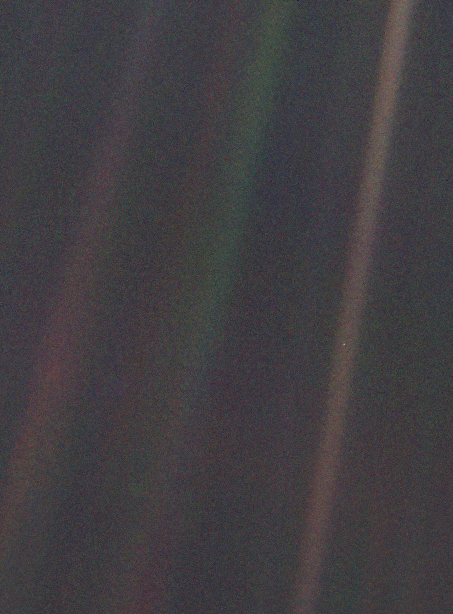
Pale Blue Dot is a photograph of Earth taken on February 14, 1990, by the Voyager 1 space probe from an unprecedented distance of over 6 billion kilometers (3.7 billion miles, 40.5 AU), as part of that day's Family Portrait series of images of the Solar System.
In the photograph, Earth's apparent size is less than a pixel; the planet appears as a tiny dot against the vastness of space, among bands of sunlight reflected by the camera. Commissioned by NASA and resulting from the advocacy of astronomer and author Carl Sagan, the photograph was interpreted in Sagan's 1994 book, Pale Blue Dot, as representing humanity's minuscule and ephemeral place amidst the cosmos.
Voyager 1 was launched on September 5, 1977, with the initial purpose of studying the outer Solar System. After fulfilling its primary mission and as it ventured out of the Solar System, the decision was made to turn its camera around and capture one last image of Earth emerged, in part due to Sagan's proposition.
Over the years, the photograph has been revisited and celebrated on multiple occasions, with NASA acknowledging its anniversaries and presenting updated versions, enhancing its clarity and detail.
Voyager 1 is a 722-kilogram (1,592 lb) robotic spacecraft on a mission to study the outer Solar System and eventually interstellar space. After encountering the Jovian system in 1979 and the Saturnian system in 1980, the primary mission was declared complete in November of the same year. Voyager 1 was the first space probe to provide detailed images of the two largest planets and their major moons.
The spacecraft, still traveling at 64,000 km/h (40,000 mph), is the most distant human-made object from Earth and the first to leave the Solar System. Its mission has been extended and continues, with the aim of investigating the boundaries of the Solar System, including the Kuiper belt, the heliosphere and interstellar space. Since its launch, it receives routine commands and transmits data back to the Deep Space Network.
Voyager 1 was expected to communicate only through the Saturn encounter. When the spacecraft passed the planet in 1980, Sagan proposed the idea of the space probe taking one last picture of Earth. He acknowledged that such a picture would not have much scientific value, as the Earth would appear too small for Voyager's cameras to make out any detail, but it would be meaningful as a perspective on humanity's place in the universe.
Many in NASA's Voyager program were already supportive of the idea. Unaware of Sagan's proposal, University of Arizona's planetary scientist Carolyn Porco had a similar idea after becoming a member of the program in 1983, and had been inquiring openly about its possibility as early as 1985. However, there were concerns that taking a picture of Earth so close to the Sun risked damaging the spacecraft's imaging system irreparably. It was not until 1989 that the idea was put in motion, but then instrument calibrations delayed the operation further, and the personnel who devised and transmitted the radio commands to Voyager 1 were also being laid off or transferred to other projects. Richard Truly, then the NASA Administrator, interceded to ensure that the photograph was taken. A proposal to continue to photograph Earth as it orbited the Sun was rejected.
Hub AI
Pale Blue Dot AI simulator
(@Pale Blue Dot_simulator)
Pale Blue Dot
Pale Blue Dot is a photograph of Earth taken on February 14, 1990, by the Voyager 1 space probe from an unprecedented distance of over 6 billion kilometers (3.7 billion miles, 40.5 AU), as part of that day's Family Portrait series of images of the Solar System.
In the photograph, Earth's apparent size is less than a pixel; the planet appears as a tiny dot against the vastness of space, among bands of sunlight reflected by the camera. Commissioned by NASA and resulting from the advocacy of astronomer and author Carl Sagan, the photograph was interpreted in Sagan's 1994 book, Pale Blue Dot, as representing humanity's minuscule and ephemeral place amidst the cosmos.
Voyager 1 was launched on September 5, 1977, with the initial purpose of studying the outer Solar System. After fulfilling its primary mission and as it ventured out of the Solar System, the decision was made to turn its camera around and capture one last image of Earth emerged, in part due to Sagan's proposition.
Over the years, the photograph has been revisited and celebrated on multiple occasions, with NASA acknowledging its anniversaries and presenting updated versions, enhancing its clarity and detail.
Voyager 1 is a 722-kilogram (1,592 lb) robotic spacecraft on a mission to study the outer Solar System and eventually interstellar space. After encountering the Jovian system in 1979 and the Saturnian system in 1980, the primary mission was declared complete in November of the same year. Voyager 1 was the first space probe to provide detailed images of the two largest planets and their major moons.
The spacecraft, still traveling at 64,000 km/h (40,000 mph), is the most distant human-made object from Earth and the first to leave the Solar System. Its mission has been extended and continues, with the aim of investigating the boundaries of the Solar System, including the Kuiper belt, the heliosphere and interstellar space. Since its launch, it receives routine commands and transmits data back to the Deep Space Network.
Voyager 1 was expected to communicate only through the Saturn encounter. When the spacecraft passed the planet in 1980, Sagan proposed the idea of the space probe taking one last picture of Earth. He acknowledged that such a picture would not have much scientific value, as the Earth would appear too small for Voyager's cameras to make out any detail, but it would be meaningful as a perspective on humanity's place in the universe.
Many in NASA's Voyager program were already supportive of the idea. Unaware of Sagan's proposal, University of Arizona's planetary scientist Carolyn Porco had a similar idea after becoming a member of the program in 1983, and had been inquiring openly about its possibility as early as 1985. However, there were concerns that taking a picture of Earth so close to the Sun risked damaging the spacecraft's imaging system irreparably. It was not until 1989 that the idea was put in motion, but then instrument calibrations delayed the operation further, and the personnel who devised and transmitted the radio commands to Voyager 1 were also being laid off or transferred to other projects. Richard Truly, then the NASA Administrator, interceded to ensure that the photograph was taken. A proposal to continue to photograph Earth as it orbited the Sun was rejected.
Recent media