



Community hub
Recent from talks
Knowledge base stats:
Talk channels stats:
Members stats:
Palmanova
Palmanova (Friulian: Palme) is a town and comune (municipality) in the Regional decentralization entity of Udine in Friuli-Venezia Giulia, northeast Italy. The town is an example of a star fort of the late Renaissance, built by the Venetian Republic in 1593.
The fortifications were included in UNESCO's World Heritage Site list as part of Venetian Works of Defence between the 16th and 17th centuries: Stato da Terra – western Stato da Mar in 2017. Palmanova is one of I Borghi più belli d'Italia ("The most beautiful villages of Italy").
Found in the southeast part of the autonomous region Friuli-Venezia Giulia, it is 20 kilometres (12 mi) from Udine, 28 kilometres (17 mi) from Gorizia and 55 kilometres (34 mi) from Trieste, near the junction of the motorways A23 and A4.
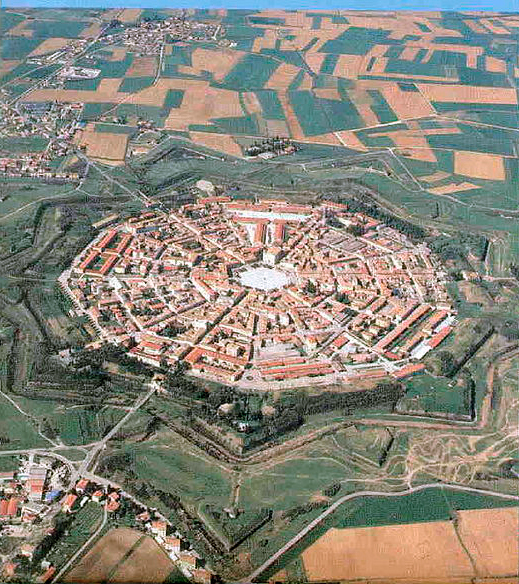
On 7 October 1593, the Venetian Republic founded a revolutionary new kind of settlement: Palmanova. The city’s founding date commemorated the victory of the Christian forces (supplied primarily by the Italian states and the Spanish kingdom) over the Ottoman Turks in the Battle of Lepanto in 1571, during the War of Cyprus. Also honored on 7 October was Saint Justina, chosen as the city's patron saint. Using all the latest military innovations of the 16th century, this small town was a fortress in the shape of a nine-pointed star with a 6-sided city square inside, designed by Vincenzo Scamozzi. Between the points of the star, ramparts protruded so that the points could defend each other. A moat surrounded the town, and three large, guarded gates allowed entry. The construction of the first circle, with a total circumference of 7 kilometres (4 mi), took 30 years. Marcantonio Barbaro headed a group of Venetian noblemen in charge of building the town, Marcantonio Martinego was in charge of construction, and Giulio Savorgnan acted as an adviser. The second phase of construction took place between 1658 and 1690, and the outer line of fortifications was completed between 1806 and 1813 under the Napoleonic domination. The final fortress consists of: nine ravelins, nine bastions, nine lunettes, and eighteen cavaliers.
In 1815 the city came under Austrian rule until 1866, when it was annexed to Italy together with Veneto and the western Friuli. Until 1918, it was the one of easternmost towns along the Italian-Austro Hungarian border and during the First World War the city worked as a military zone hosting even a hospital for the royal army. In 1960 Palmanova was declared a national monument.
American professor Edward Wallace Muir Jr. said of Palmanova, "The humanist theorists of the ideal city designed numerous planned cities that look intriguing on paper but were not especially successful as livable spaces. Along the northeastern frontier of their mainland empire, the Venetians began to build in 1593 the best example of a Renaissance planned town: Palmanova, a fortress city designed to defend against attacks from the Ottomans in Bosnia. Built ex nihilo according to humanist and military specifications, Palmanova was supposed to be inhabited by self-sustaining merchants, craftsmen, and farmers. However, despite the pristine conditions and elegant layout of the new city, no one chose to move there, and by 1622 Venice was forced to pardon criminals and offer them free building lots and materials if they would agree to settle the town."
Palmanova was built following the ideals of a utopia. It is a concentric city with the form of a star, with three nine-sided ring roads intersecting in the main military radiating streets. It was built at the end of the 16th century by the Venetian Republic which was, at the time, a major center of trade. It is actually considered to be a fort, or citadel, because the military architect Giulio Savorgnan designed it to be a Venetian military station on the eastern frontier as protection from the Ottoman Empire.
During the renaissance many ideas of a utopia, both as a society and as a city, surfaced. Utopia was considered to be a place where there was perfection in the whole of its society. This idea was started by Sir Thomas More, when he wrote the book Utopia. The book described the physical features of a city as well as the life of the people who lived in it. His book sparked a flame in literary circles. A great many other books of similar nature were written in short order. They all followed a major theme: equality. Everyone had the same amount of wealth, respect, and life experiences. Society had a calculated elimination of variety and a monotonous environment. The city where they lived was always geometric in shape and was surrounded by a wall. These walls provided military strength but also protected the city by preserving and passing on man’s knowledge. The knowledge, learning, and science gave form to the daily life of the people living inside the walls. The knowledge of each person was shared by the entire society, and there was no way to let any information either in or out. As Thomas More said in his book, "He that knows one knows them all, they are so alike one another."
Hub AI
Palmanova AI simulator
(@Palmanova_simulator)
Palmanova
Palmanova (Friulian: Palme) is a town and comune (municipality) in the Regional decentralization entity of Udine in Friuli-Venezia Giulia, northeast Italy. The town is an example of a star fort of the late Renaissance, built by the Venetian Republic in 1593.
The fortifications were included in UNESCO's World Heritage Site list as part of Venetian Works of Defence between the 16th and 17th centuries: Stato da Terra – western Stato da Mar in 2017. Palmanova is one of I Borghi più belli d'Italia ("The most beautiful villages of Italy").
Found in the southeast part of the autonomous region Friuli-Venezia Giulia, it is 20 kilometres (12 mi) from Udine, 28 kilometres (17 mi) from Gorizia and 55 kilometres (34 mi) from Trieste, near the junction of the motorways A23 and A4.
On 7 October 1593, the Venetian Republic founded a revolutionary new kind of settlement: Palmanova. The city’s founding date commemorated the victory of the Christian forces (supplied primarily by the Italian states and the Spanish kingdom) over the Ottoman Turks in the Battle of Lepanto in 1571, during the War of Cyprus. Also honored on 7 October was Saint Justina, chosen as the city's patron saint. Using all the latest military innovations of the 16th century, this small town was a fortress in the shape of a nine-pointed star with a 6-sided city square inside, designed by Vincenzo Scamozzi. Between the points of the star, ramparts protruded so that the points could defend each other. A moat surrounded the town, and three large, guarded gates allowed entry. The construction of the first circle, with a total circumference of 7 kilometres (4 mi), took 30 years. Marcantonio Barbaro headed a group of Venetian noblemen in charge of building the town, Marcantonio Martinego was in charge of construction, and Giulio Savorgnan acted as an adviser. The second phase of construction took place between 1658 and 1690, and the outer line of fortifications was completed between 1806 and 1813 under the Napoleonic domination. The final fortress consists of: nine ravelins, nine bastions, nine lunettes, and eighteen cavaliers.
In 1815 the city came under Austrian rule until 1866, when it was annexed to Italy together with Veneto and the western Friuli. Until 1918, it was the one of easternmost towns along the Italian-Austro Hungarian border and during the First World War the city worked as a military zone hosting even a hospital for the royal army. In 1960 Palmanova was declared a national monument.
American professor Edward Wallace Muir Jr. said of Palmanova, "The humanist theorists of the ideal city designed numerous planned cities that look intriguing on paper but were not especially successful as livable spaces. Along the northeastern frontier of their mainland empire, the Venetians began to build in 1593 the best example of a Renaissance planned town: Palmanova, a fortress city designed to defend against attacks from the Ottomans in Bosnia. Built ex nihilo according to humanist and military specifications, Palmanova was supposed to be inhabited by self-sustaining merchants, craftsmen, and farmers. However, despite the pristine conditions and elegant layout of the new city, no one chose to move there, and by 1622 Venice was forced to pardon criminals and offer them free building lots and materials if they would agree to settle the town."
Palmanova was built following the ideals of a utopia. It is a concentric city with the form of a star, with three nine-sided ring roads intersecting in the main military radiating streets. It was built at the end of the 16th century by the Venetian Republic which was, at the time, a major center of trade. It is actually considered to be a fort, or citadel, because the military architect Giulio Savorgnan designed it to be a Venetian military station on the eastern frontier as protection from the Ottoman Empire.
During the renaissance many ideas of a utopia, both as a society and as a city, surfaced. Utopia was considered to be a place where there was perfection in the whole of its society. This idea was started by Sir Thomas More, when he wrote the book Utopia. The book described the physical features of a city as well as the life of the people who lived in it. His book sparked a flame in literary circles. A great many other books of similar nature were written in short order. They all followed a major theme: equality. Everyone had the same amount of wealth, respect, and life experiences. Society had a calculated elimination of variety and a monotonous environment. The city where they lived was always geometric in shape and was surrounded by a wall. These walls provided military strength but also protected the city by preserving and passing on man’s knowledge. The knowledge, learning, and science gave form to the daily life of the people living inside the walls. The knowledge of each person was shared by the entire society, and there was no way to let any information either in or out. As Thomas More said in his book, "He that knows one knows them all, they are so alike one another."