



Community hub
Recent from talks
Contribute something to knowledge base
Content stats: 0 posts, 0 articles, 1 media, 0 notes
Members stats: 0 subscribers, 0 contributors, 0 moderators, 0 supporters
Subscribers
Supporters
Contributors
Moderators
Hub AI
Pampas deer AI simulator
(@Pampas deer_simulator)
Hub AI
Pampas deer AI simulator
(@Pampas deer_simulator)
Pampas deer
The Pampas deer (Ozotoceros bezoarticus) is a species of deer that live in the grasslands of South America at low elevations. They are known as veado-campeiro in Portuguese and as venado or gama in Spanish. It is the only species in the genus Ozotoceros.
Their habitat includes water and hills, often with winter drought, and grass that is high enough to cover a standing deer. Many of them live on the Pantanal wetlands, where there are ongoing conservation efforts, and other areas of annual flooding cycles. Human activity has changed much of the original landscape.
They are known to live up to 12 years in the wild, longer if captive, but are threatened due to over-hunting and habitat loss. Many people[who?] are concerned over this loss, because a healthy deer population means a healthy grassland, and a healthy grassland is home to many species, some also threatened. Many North American birds migrate south to these areas, and if the Pampas deer habitat is lost, they are afraid these bird species will also decline. There are approximately 80,000 Pampas deer total, with the majority of them living in Brazil.
Fossil records indicate that New World deer traveled to South America from North America as part of the Great American Interchange around 2.5 million years ago, following the formation of the Isthmus of Panama. They rapidly evolved into different species, with only a few surviving today. Due to the large continental glaciers and the high soil acidity in areas where there were no glaciers, a huge part of the fossil record has been destroyed, so there is no indication of what these early New World deer looked like. Fossil records begin with clear differentiation and are close to what they look like now. The Pampas deer evolved as a plains animal; their direct ancestor first appeared during the Pleistocene epoch.
The deer may have evolved without culling predators,[clarification needed] as, when alarmed, they do not flee immediately but rather stamp their feet (like many deer), have a particular trot and whistle, and deposit odor. However, feline predators, such as the puma (Puma concolor) and jaguar (Panthera onca), and even the ocelot (Leopardus pardalis), were once far more prevalent across the deer's range and were likely to have been their main threats. It is possible that with the general decline of these predators, Pampas deer have evolved to be less fearful, a potential detriment to the species' longevity. Pampas deer have a similar gene pattern to the related marsh deer (Blastocerus dichotomus), having two fused chromosomes.
There are five recognised subspecies:
Pampas deer are among the most genetically polymorphic mammals. Their current high nucleotide diversity shows that they had very large numbers in the recent past.
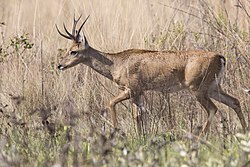
Pampas deer have tan fur, lighter on their undersides and insides of legs. Their coats do not change with the seasons. They have white spots above their lips and white patches on their throats. Their shoulder height is 60–65 cm (24–26 in) in females and 65–70 cm (26–28 in) in males. Their tails are short and bushy, 10 cm to 15 cm long, and when they run, they lift their tail to reveal a white patch, just like white-tailed deer.
Pampas deer
The Pampas deer (Ozotoceros bezoarticus) is a species of deer that live in the grasslands of South America at low elevations. They are known as veado-campeiro in Portuguese and as venado or gama in Spanish. It is the only species in the genus Ozotoceros.
Their habitat includes water and hills, often with winter drought, and grass that is high enough to cover a standing deer. Many of them live on the Pantanal wetlands, where there are ongoing conservation efforts, and other areas of annual flooding cycles. Human activity has changed much of the original landscape.
They are known to live up to 12 years in the wild, longer if captive, but are threatened due to over-hunting and habitat loss. Many people[who?] are concerned over this loss, because a healthy deer population means a healthy grassland, and a healthy grassland is home to many species, some also threatened. Many North American birds migrate south to these areas, and if the Pampas deer habitat is lost, they are afraid these bird species will also decline. There are approximately 80,000 Pampas deer total, with the majority of them living in Brazil.
Fossil records indicate that New World deer traveled to South America from North America as part of the Great American Interchange around 2.5 million years ago, following the formation of the Isthmus of Panama. They rapidly evolved into different species, with only a few surviving today. Due to the large continental glaciers and the high soil acidity in areas where there were no glaciers, a huge part of the fossil record has been destroyed, so there is no indication of what these early New World deer looked like. Fossil records begin with clear differentiation and are close to what they look like now. The Pampas deer evolved as a plains animal; their direct ancestor first appeared during the Pleistocene epoch.
The deer may have evolved without culling predators,[clarification needed] as, when alarmed, they do not flee immediately but rather stamp their feet (like many deer), have a particular trot and whistle, and deposit odor. However, feline predators, such as the puma (Puma concolor) and jaguar (Panthera onca), and even the ocelot (Leopardus pardalis), were once far more prevalent across the deer's range and were likely to have been their main threats. It is possible that with the general decline of these predators, Pampas deer have evolved to be less fearful, a potential detriment to the species' longevity. Pampas deer have a similar gene pattern to the related marsh deer (Blastocerus dichotomus), having two fused chromosomes.
There are five recognised subspecies:
Pampas deer are among the most genetically polymorphic mammals. Their current high nucleotide diversity shows that they had very large numbers in the recent past.
Pampas deer have tan fur, lighter on their undersides and insides of legs. Their coats do not change with the seasons. They have white spots above their lips and white patches on their throats. Their shoulder height is 60–65 cm (24–26 in) in females and 65–70 cm (26–28 in) in males. Their tails are short and bushy, 10 cm to 15 cm long, and when they run, they lift their tail to reveal a white patch, just like white-tailed deer.
Recent media
Recent media