


Community hub
Recent from talks
Contribute something to knowledge base
Content stats: 0 posts, 0 articles, 1 media, 0 notes
Members stats: 0 subscribers, 0 contributors, 0 moderators, 0 supporters
Subscribers
Supporters
Contributors
Moderators
Hub AI
Pandanus tectorius AI simulator
(@Pandanus tectorius_simulator)
Hub AI
Pandanus tectorius AI simulator
(@Pandanus tectorius_simulator)
Pandanus tectorius
Pandanus tectorius is a species of Pandanus (screwpine) that is native to Malesia, Papuasia, eastern Australia, and the Pacific Islands. It grows in the coastal lowlands typically near the edge of the ocean. Common names in English include thatch screwpine, Tahitian screwpine, hala tree (pū hala in Hawaiian) and pandanus. The fruit is edible and sometimes known as hala fruit.
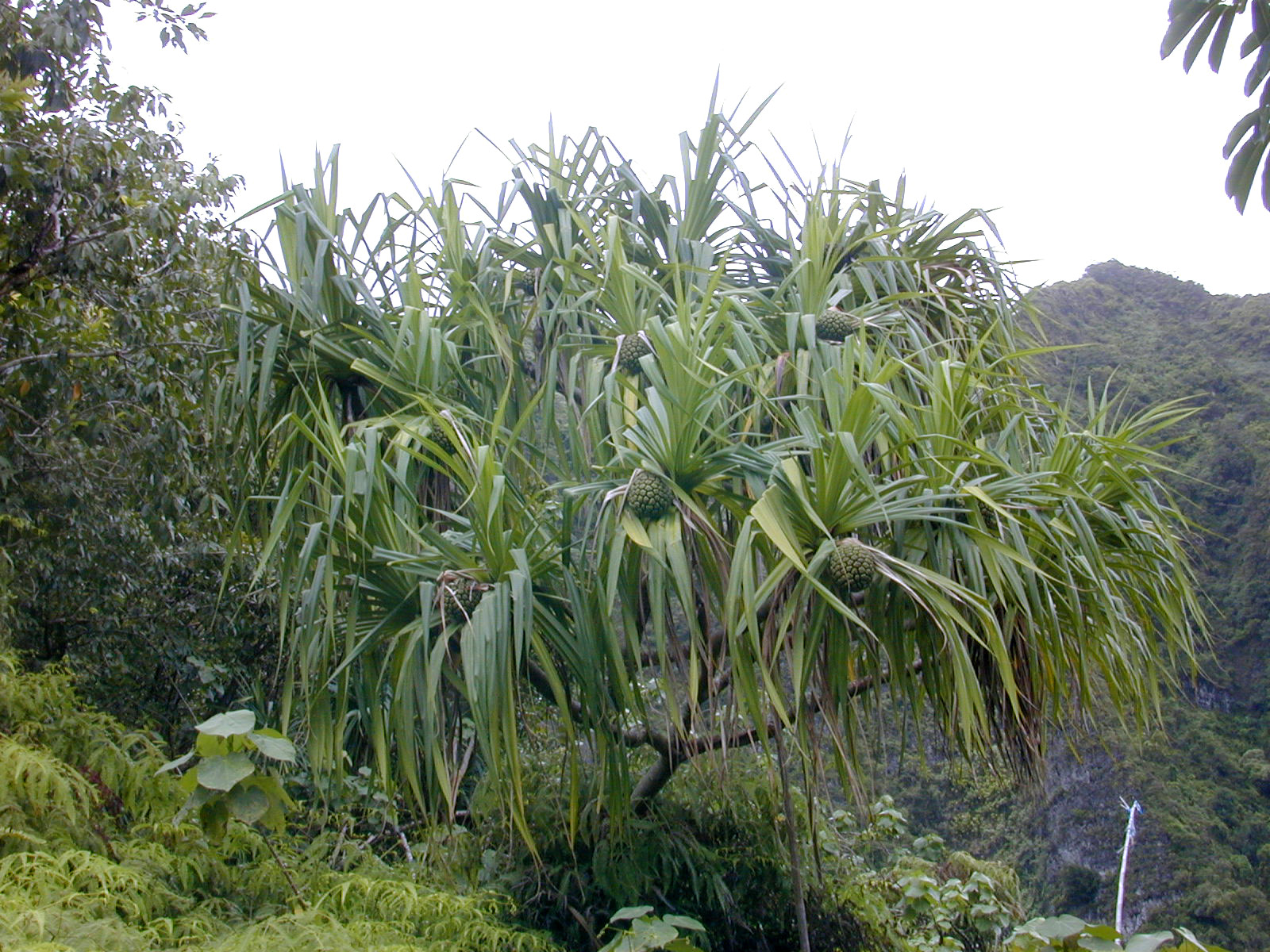
P. tectorius is a small tree that grows upright to reach 4–14 m (13–46 ft) in height. The single trunk is slender with brown ringed bark. It is spiny, grows to 4.5–11 m (15–35 ft) in width, and forks at a height of 4–8 metres (13–26 ft). It is supported by aerial roots (prop roots) that firmly anchors the tree to the ground. Roots sometimes grow along the branch, and they grow at wide angles in proportion to the trunk.
The leaves are usually 90–150 cm (3–5 ft) in length and 5–7 cm (2–2+3⁄4 in) in width. They possess saw-like margins. Some varieties have spines along the edges and ribs throughout the leaves. The leaves are spirally arranged at the end of the branches.
Pandanus tectorius is dioecious, meaning male and female flowers are borne on separate trees, with very different male and female flowers. Male flowers, known as racemes, are small, fragrant, and short-lived, lasting only a single day. The flowers are grouped in 3 and gathered in large clusters surrounded by big, white bracts. these clusters are about 1 ft in length and are fragrant. Female flowers resemble pineapples.
In Hawaiʻi the male flower is called hīnano and the bracts are used for making very fine mats (moena hīnano' or ʻahu hīnano).
The female P. tectorius trees produce a segmented, large fruit. Although not closely related, the fruit resembles a pineapple. The fruit of P. tectorius is either ovoid, ellipsoid, subglobose or globose with a diameter of 4–20 cm (1+1⁄2–7+3⁄4 in) and a length of 8–30 cm (3+1⁄4–11+3⁄4 in). The fruit is made up of 38–200 wedge-like phalanges, often referred to as keys or carpels, which have an outer fibrous husk and are 8 inches in length. There are roughly 40 to 80 keys in each fruit and the color of the fruit can be yellow, orange, or red with a green top. Phalanges contain two seeds on average, with a maximum of eight reported. The phalanges are buoyant, and the seeds within them can remain viable for many months while being transported by ocean currents.
Pandanus tectorius was first described by Sydney Parkinson in 1774. It is an angiosperm belonging to the genus Pandanus of the family Pandanaceae.
Pandanus tectorius grows natively from the Philippines through the Pacific Ocean to Hawaii. It is found in parts of Malesia (the Cocos (Keeling) Islands, Java, the Lesser Sunda Islands, the Maluku Islands and the Philippines), throughout Papuasia, and in most of the tropical Pacific. In Australia, it is native to an area from Port Macquarie in New South Wales to northern Queensland. Both the US and the Hawaiian Islands recognize only one indigenous species, P. tectorius. Its exact native range is unknown due to extensive cultivation; it may be an early Polynesian introduction to many of the more isolated Pacific islands on which it occurs. These islands include Micronesia and Melanesia. In Hawaii, P. tectorius is found natively on all the main islands except Kahoʻolawe, and it is known to have predated human settlement, based on seed and pollen samples taken from Kauaʻi's Makauwahi Cave.
Pandanus tectorius
Pandanus tectorius is a species of Pandanus (screwpine) that is native to Malesia, Papuasia, eastern Australia, and the Pacific Islands. It grows in the coastal lowlands typically near the edge of the ocean. Common names in English include thatch screwpine, Tahitian screwpine, hala tree (pū hala in Hawaiian) and pandanus. The fruit is edible and sometimes known as hala fruit.
P. tectorius is a small tree that grows upright to reach 4–14 m (13–46 ft) in height. The single trunk is slender with brown ringed bark. It is spiny, grows to 4.5–11 m (15–35 ft) in width, and forks at a height of 4–8 metres (13–26 ft). It is supported by aerial roots (prop roots) that firmly anchors the tree to the ground. Roots sometimes grow along the branch, and they grow at wide angles in proportion to the trunk.
The leaves are usually 90–150 cm (3–5 ft) in length and 5–7 cm (2–2+3⁄4 in) in width. They possess saw-like margins. Some varieties have spines along the edges and ribs throughout the leaves. The leaves are spirally arranged at the end of the branches.
Pandanus tectorius is dioecious, meaning male and female flowers are borne on separate trees, with very different male and female flowers. Male flowers, known as racemes, are small, fragrant, and short-lived, lasting only a single day. The flowers are grouped in 3 and gathered in large clusters surrounded by big, white bracts. these clusters are about 1 ft in length and are fragrant. Female flowers resemble pineapples.
In Hawaiʻi the male flower is called hīnano and the bracts are used for making very fine mats (moena hīnano' or ʻahu hīnano).
The female P. tectorius trees produce a segmented, large fruit. Although not closely related, the fruit resembles a pineapple. The fruit of P. tectorius is either ovoid, ellipsoid, subglobose or globose with a diameter of 4–20 cm (1+1⁄2–7+3⁄4 in) and a length of 8–30 cm (3+1⁄4–11+3⁄4 in). The fruit is made up of 38–200 wedge-like phalanges, often referred to as keys or carpels, which have an outer fibrous husk and are 8 inches in length. There are roughly 40 to 80 keys in each fruit and the color of the fruit can be yellow, orange, or red with a green top. Phalanges contain two seeds on average, with a maximum of eight reported. The phalanges are buoyant, and the seeds within them can remain viable for many months while being transported by ocean currents.
Pandanus tectorius was first described by Sydney Parkinson in 1774. It is an angiosperm belonging to the genus Pandanus of the family Pandanaceae.
Pandanus tectorius grows natively from the Philippines through the Pacific Ocean to Hawaii. It is found in parts of Malesia (the Cocos (Keeling) Islands, Java, the Lesser Sunda Islands, the Maluku Islands and the Philippines), throughout Papuasia, and in most of the tropical Pacific. In Australia, it is native to an area from Port Macquarie in New South Wales to northern Queensland. Both the US and the Hawaiian Islands recognize only one indigenous species, P. tectorius. Its exact native range is unknown due to extensive cultivation; it may be an early Polynesian introduction to many of the more isolated Pacific islands on which it occurs. These islands include Micronesia and Melanesia. In Hawaii, P. tectorius is found natively on all the main islands except Kahoʻolawe, and it is known to have predated human settlement, based on seed and pollen samples taken from Kauaʻi's Makauwahi Cave.
Recent media
Recent media