




Community hub
Recent from talks
Contribute something to knowledge base
Content stats: 0 posts, 0 articles, 1 media, 0 notes
Members stats: 0 subscribers, 0 contributors, 0 moderators, 0 supporters
Subscribers
Supporters
Contributors
Moderators
Pandrol
Pandrol is a global railway infrastructure equipment and technology company. It is presently a member of the Delachaux Group and based in Colombes, France and has 1,700 employees globally in over 40 locations. Pandrol has sold its various products to over 400 railway systems around the world.
The company was founded as the Elastic Rail Spike Company (ERS) in London during 1937 to produce and sell an innovative rail fastening developed by the German engineer, Max Rüping. In the subsequent decades, it focused on the development and manufacture of such fastenings for securing rails to railway sleepers, being awarded numerous patents for this work. During the 1950s, the Norwegian railway engineer, Per Pande-Rolfsen, designed the Pandrol clip. This product became so successful that, in 1972, the business was renamed Pandrol.
Over time, the company had branched out into other product lines and activities, including maintenance personnel training, and the design and manufacture of tooling and other equipment to make the construction and maintenance of railways easier and more efficient. In 2003, the company was acquired by the French conglomerate Delachaux. On 17 November 2017, all entities under Delachaux were unified under the Pandrol identity. During the 21st century, it has expanded considerably in Asia, a large portion of this growth coming from the Pandrol Rahee Technologies joint venture with the Indian railway manufacturer Rahee.
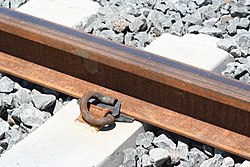
The Pandrol clip was patented in 1957 by a Norwegian railways engineer, Per Pande-Rolfsen. It is now common worldwide. The original clip is now called the PR-clip, which was superseded by a system called E-Clip. Numerous other products made by Pandrol have been designed to work in conjunction with the E-Clip.
A key areas of product development for the company has been greater sustainability. As a part of this ambition, Pandrol has a range of sustainable resilient systems and battery-powered tools called E+. Each E+ product has been designed to cut carbon emissions without compromising power. A focus on reducing noise and eliminating dangerous fumes will contribute to reduced environmental impact, particularly in urban and under-tunnel areas.
The company has focused on aspects such as noise reduction and vibration reduction in recent years as numerous customers have approached Pandrol with concerns in this area. Amongst other solutions, Pandrol has launched Under-Ballast mats (UBMs) and Under Sleeper Pads (USPs) that partially resolve such problems upon ballasted track; the QTrack (for embedded track) and Floating Slab Mat (FSM) are amongst the fastening system solutions that have been developed for use on slabtrack. During 2023, Pandrol launched a Common Interface System for ballastless track; it is designed to accept a variety of different screwed and non-screwed rail fastening assemblies so that they can be adapted quickly and affordably to suit different requirements and restrictions.
During the 1930s, a German engineer, Max Rüping, developed a resilient fastening to secure a rail to a sleeper. In 1933, Rüping went into business with an American importer of creosote named Oscar Max von Bernuth (O. M. Bernuth), founder of Bernuth-Lembcke Company. At the time, the fastening was known as the Elastic Rail Spike. The product proved to be successful in track tests and the Elastic Rail Spike Company (ERS) was formed in London in 1937.
Throughout the 1940s, the business expanded internationally, led by General Manager Stewart Sanson. Patents were registered across the globe, including in India and Burma in 1943. Immediately after the Second World War, ERS acquired a lease on a government-owned factory in Worksop to undertake spike production. This site has remained Pandrol’s UK manufacturing base to the present day.
Pandrol
Pandrol is a global railway infrastructure equipment and technology company. It is presently a member of the Delachaux Group and based in Colombes, France and has 1,700 employees globally in over 40 locations. Pandrol has sold its various products to over 400 railway systems around the world.
The company was founded as the Elastic Rail Spike Company (ERS) in London during 1937 to produce and sell an innovative rail fastening developed by the German engineer, Max Rüping. In the subsequent decades, it focused on the development and manufacture of such fastenings for securing rails to railway sleepers, being awarded numerous patents for this work. During the 1950s, the Norwegian railway engineer, Per Pande-Rolfsen, designed the Pandrol clip. This product became so successful that, in 1972, the business was renamed Pandrol.
Over time, the company had branched out into other product lines and activities, including maintenance personnel training, and the design and manufacture of tooling and other equipment to make the construction and maintenance of railways easier and more efficient. In 2003, the company was acquired by the French conglomerate Delachaux. On 17 November 2017, all entities under Delachaux were unified under the Pandrol identity. During the 21st century, it has expanded considerably in Asia, a large portion of this growth coming from the Pandrol Rahee Technologies joint venture with the Indian railway manufacturer Rahee.
The Pandrol clip was patented in 1957 by a Norwegian railways engineer, Per Pande-Rolfsen. It is now common worldwide. The original clip is now called the PR-clip, which was superseded by a system called E-Clip. Numerous other products made by Pandrol have been designed to work in conjunction with the E-Clip.
A key areas of product development for the company has been greater sustainability. As a part of this ambition, Pandrol has a range of sustainable resilient systems and battery-powered tools called E+. Each E+ product has been designed to cut carbon emissions without compromising power. A focus on reducing noise and eliminating dangerous fumes will contribute to reduced environmental impact, particularly in urban and under-tunnel areas.
The company has focused on aspects such as noise reduction and vibration reduction in recent years as numerous customers have approached Pandrol with concerns in this area. Amongst other solutions, Pandrol has launched Under-Ballast mats (UBMs) and Under Sleeper Pads (USPs) that partially resolve such problems upon ballasted track; the QTrack (for embedded track) and Floating Slab Mat (FSM) are amongst the fastening system solutions that have been developed for use on slabtrack. During 2023, Pandrol launched a Common Interface System for ballastless track; it is designed to accept a variety of different screwed and non-screwed rail fastening assemblies so that they can be adapted quickly and affordably to suit different requirements and restrictions.
During the 1930s, a German engineer, Max Rüping, developed a resilient fastening to secure a rail to a sleeper. In 1933, Rüping went into business with an American importer of creosote named Oscar Max von Bernuth (O. M. Bernuth), founder of Bernuth-Lembcke Company. At the time, the fastening was known as the Elastic Rail Spike. The product proved to be successful in track tests and the Elastic Rail Spike Company (ERS) was formed in London in 1937.
Throughout the 1940s, the business expanded internationally, led by General Manager Stewart Sanson. Patents were registered across the globe, including in India and Burma in 1943. Immediately after the Second World War, ERS acquired a lease on a government-owned factory in Worksop to undertake spike production. This site has remained Pandrol’s UK manufacturing base to the present day.
Recent media
Recent media