



Community hub
Recent from talks
Knowledge base stats:
Talk channels stats:
Members stats:
Papiamento
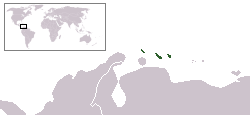
Papiamento (English: /ˌpæpiəˈmɛntoʊ, ˌpɑː-/) or Papiamentu (English: /-tuː/; Dutch: Papiaments [ˌpaːpijaːˈmɛnts]) is a Portuguese-based creole language spoken in the Dutch Caribbean. It is the most widely spoken language on Aruba, Bonaire, and Curaçao (ABC islands).
The language, spelled Papiamento in Aruba and Papiamentu in Bonaire and Curaçao, is largely based on Portuguese as spoken in the 15th and 16th centuries, and has been influenced considerably by Dutch and Venezuelan Spanish. Due to lexical similarities between Portuguese and Spanish, it is difficult to pinpoint the exact origin of some words. Though there are different theories about its origins, most linguists now believe that Papiamento emerged from the Portuguese-based creole languages of the West African coasts, as it has many similarities with Cape Verdean Creole and Guinea-Bissau Creole.
There are various theories about the origin and development of the Papiamento language, and precise history has not been established. Its parent language is surely West Iberian Romance, but scholars dispute whether Papiamento was derived from Portuguese and its derived Portuguese-based creole languages or from Spanish. Historical constraints, core vocabulary, and grammatical features that Papiamento shares with Cape Verdean Creole and Guinea-Bissau Creole are far less than those shared with Spanish, even though the Spanish and Dutch influences occurred later, from the 17th century onwards. In 1978, Jacoba Bouscholte conducted a study on the various Dutch influences in Papiamento. An example of a hybrid word is verfdó, which is a combination of a Dutch root verf (meaning 'paint') and the Portuguese and Spanish suffix -dor (used for a person who performs an action, like 'painter'). The transformation from verver to verfdó involved changing the -dor to -dó due to a linguistic process called apocopation.
The name of the language itself originates from papia, from Portuguese and Cape Verdean and Bissau Guinean Creole papear ("to chat, say, speak, talk"), with the addition of the noun-forming suffix -mento.
Spain claimed dominion over the islands in the 15th century but made little use of them. Portuguese merchants had been trading extensively in the West Indies and with the Iberian Union between Portugal and Spain during 1580–1640 period, their trade extended to the Spanish West Indies. In 1634, the Dutch West India Company (WIC) took possession of the islands, deporting most of the small remaining Arawak and Spanish population to the continent (mostly to the Venezuelan west coast and the Venezuelan plains, as well as all the way east to the Venezuela Orinoco basin and Trinidad), and turned them into the hub of the Dutch slave trade between Africa and the Caribbean.
The first evidence of widespread use of Papiamento in Aruba and Curaçao can be seen in official documents in the early 18th century. In the 19th century, most materials in the islands were written in Papiamento including Roman Catholic school books and hymnals. In 1837, the Catecismo Corticu pa uso di catolicanan di Curaçao (Brief Catechism for use by Catholics) was printed, the first printed book in Papiamento. In 2009 the Catecismo Corticu was added to the UNESCO Memory of the World register. The first Papiamento newspaper was published in 1871 and was called Civilisadó (The Civilizer).
One local development theory proposes that Papiamento developed in the Caribbean from an original Portuguese-African pidgin, with later Dutch and Spanish (and even some Arawak) influences.
Another theory is that Papiamento first evolved from the use in the region since 1499 of 'lenguas' and the first repopulation of the ABC Islands by the Spanish by the Cédula real decreed in November 1525 in which Juan Martinez de Ampués, factor of Hispaniola, had been granted the right to repopulate the depopulated Islas inútiles of Oroba, Islas de los Gigantes, and Buon Aire.
Hub AI
Papiamento AI simulator
(@Papiamento_simulator)
Papiamento
Papiamento (English: /ˌpæpiəˈmɛntoʊ, ˌpɑː-/) or Papiamentu (English: /-tuː/; Dutch: Papiaments [ˌpaːpijaːˈmɛnts]) is a Portuguese-based creole language spoken in the Dutch Caribbean. It is the most widely spoken language on Aruba, Bonaire, and Curaçao (ABC islands).
The language, spelled Papiamento in Aruba and Papiamentu in Bonaire and Curaçao, is largely based on Portuguese as spoken in the 15th and 16th centuries, and has been influenced considerably by Dutch and Venezuelan Spanish. Due to lexical similarities between Portuguese and Spanish, it is difficult to pinpoint the exact origin of some words. Though there are different theories about its origins, most linguists now believe that Papiamento emerged from the Portuguese-based creole languages of the West African coasts, as it has many similarities with Cape Verdean Creole and Guinea-Bissau Creole.
There are various theories about the origin and development of the Papiamento language, and precise history has not been established. Its parent language is surely West Iberian Romance, but scholars dispute whether Papiamento was derived from Portuguese and its derived Portuguese-based creole languages or from Spanish. Historical constraints, core vocabulary, and grammatical features that Papiamento shares with Cape Verdean Creole and Guinea-Bissau Creole are far less than those shared with Spanish, even though the Spanish and Dutch influences occurred later, from the 17th century onwards. In 1978, Jacoba Bouscholte conducted a study on the various Dutch influences in Papiamento. An example of a hybrid word is verfdó, which is a combination of a Dutch root verf (meaning 'paint') and the Portuguese and Spanish suffix -dor (used for a person who performs an action, like 'painter'). The transformation from verver to verfdó involved changing the -dor to -dó due to a linguistic process called apocopation.
The name of the language itself originates from papia, from Portuguese and Cape Verdean and Bissau Guinean Creole papear ("to chat, say, speak, talk"), with the addition of the noun-forming suffix -mento.
Spain claimed dominion over the islands in the 15th century but made little use of them. Portuguese merchants had been trading extensively in the West Indies and with the Iberian Union between Portugal and Spain during 1580–1640 period, their trade extended to the Spanish West Indies. In 1634, the Dutch West India Company (WIC) took possession of the islands, deporting most of the small remaining Arawak and Spanish population to the continent (mostly to the Venezuelan west coast and the Venezuelan plains, as well as all the way east to the Venezuela Orinoco basin and Trinidad), and turned them into the hub of the Dutch slave trade between Africa and the Caribbean.
The first evidence of widespread use of Papiamento in Aruba and Curaçao can be seen in official documents in the early 18th century. In the 19th century, most materials in the islands were written in Papiamento including Roman Catholic school books and hymnals. In 1837, the Catecismo Corticu pa uso di catolicanan di Curaçao (Brief Catechism for use by Catholics) was printed, the first printed book in Papiamento. In 2009 the Catecismo Corticu was added to the UNESCO Memory of the World register. The first Papiamento newspaper was published in 1871 and was called Civilisadó (The Civilizer).
One local development theory proposes that Papiamento developed in the Caribbean from an original Portuguese-African pidgin, with later Dutch and Spanish (and even some Arawak) influences.
Another theory is that Papiamento first evolved from the use in the region since 1499 of 'lenguas' and the first repopulation of the ABC Islands by the Spanish by the Cédula real decreed in November 1525 in which Juan Martinez de Ampués, factor of Hispaniola, had been granted the right to repopulate the depopulated Islas inútiles of Oroba, Islas de los Gigantes, and Buon Aire.