Hubbry Logo
PapiamentoPapiamentoMain
Open search
Papiamento
Community hub
Papiamento
logo
8 pages, 0 posts
0 subscribers
Be the first to start a discussion here.
Papiamento
Papiamento
from Wikipedia

Papiamento
Papiamento (Aruba)
Papiamentu (Curaçao and Bonaire)
Native toDutch Caribbean
Native speakers
350,000 (2025)[1]
Portuguese Creole
Latin (Papiamento orthography)
Official status
Official language in
Aruba
Bonaire
Curaçao[a]
Regulated byPapiamento Academy Foundation
Language codes
ISO 639-2pap
ISO 639-3pap
Glottologpapi1253
ELPNE
Linguasphere51-AAC-be
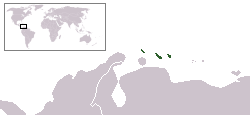
Location map of Aruba, Bonaire, and Curaçao, where Papiamento is spoken

Papiamento (English: /ˌpæpiəˈmɛnt, ˌpɑː-/)[3] or Papiamentu (English: /-t/; Dutch: Papiaments [ˌpaːpijaːˈmɛnts]) is a Portuguese-based creole language spoken in the Dutch Caribbean. It is the most widely spoken language on Aruba, Bonaire, and Curaçao (ABC islands).[4]

The language, spelled Papiamento in Aruba and Papiamentu in Bonaire and Curaçao, is largely based on Portuguese as spoken in the 15th and 16th centuries, and has been influenced considerably by Dutch and Venezuelan Spanish. Due to lexical similarities between Portuguese and Spanish, it is difficult to pinpoint the exact origin of some words. Though there are different theories about its origins, most linguists now believe that Papiamento emerged from the Portuguese-based creole languages of the West African coasts,[5] as it has many similarities with Cape Verdean Creole and Guinea-Bissau Creole.[6][7][8]

History

[edit]
Burial site and monument to Doctor Moises Frumencio da Costa Gomez, the first prime minister of the Netherlands Antilles, with a message inscribed in Papiamento: No hasi ku otro loke bo no ke pa otro hasi ku bo, roughly meaning: "Do not do unto others what you do not want others do unto you"
Catecismo Corticu – the first printed book in Papiamento in 1837
Papiamentu Bible, prologue

There are various theories about the origin and development of the Papiamento language, and precise history has not been established. Its parent language is surely West Iberian Romance, but scholars dispute whether Papiamento was derived from Portuguese and its derived Portuguese-based creole languages or from Spanish. Historical constraints, core vocabulary, and grammatical features that Papiamento shares with Cape Verdean Creole and Guinea-Bissau Creole are far less than those shared with Spanish, even though the Spanish and Dutch influences occurred later, from the 17th century onwards. In 1978, Jacoba Bouscholte conducted a study on the various Dutch influences in Papiamento. An example of a hybrid word is verfdó, which is a combination of a Dutch root verf (meaning 'paint') and the Portuguese and Spanish suffix -dor (used for a person who performs an action, like 'painter'). The transformation from verver to verfdó involved changing the -dor to -dó due to a linguistic process called apocopation.[9]

The name of the language itself originates from papia, from Portuguese and Cape Verdean and Bissau Guinean Creole papear ("to chat, say, speak, talk"), with the addition of the noun-forming suffix -mento.

Spain claimed dominion over the islands in the 15th century but made little use of them. Portuguese merchants had been trading extensively in the West Indies and with the Iberian Union between Portugal and Spain during 1580–1640 period, their trade extended to the Spanish West Indies. In 1634, the Dutch West India Company (WIC) took possession of the islands, deporting most of the small remaining Arawak and Spanish population to the continent (mostly to the Venezuelan west coast and the Venezuelan plains, as well as all the way east to the Venezuela Orinoco basin and Trinidad), and turned them into the hub of the Dutch slave trade between Africa and the Caribbean.

The first evidence of widespread use of Papiamento in Aruba and Curaçao can be seen in official documents in the early 18th century. In the 19th century, most materials in the islands were written in Papiamento including Roman Catholic school books and hymnals. In 1837, the Catecismo Corticu pa uso di catolicanan di Curaçao (Brief Catechism for use by Catholics) was printed, the first printed book in Papiamento. In 2009 the Catecismo Corticu was added to the UNESCO Memory of the World register.[10] The first Papiamento newspaper was published in 1871 and was called Civilisadó (The Civilizer).

Local development theory

[edit]

One local development theory proposes that Papiamento developed in the Caribbean from an original Portuguese-African pidgin, with later Dutch and Spanish (and even some Arawak) influences.

Another theory is that Papiamento first evolved from the use in the region since 1499 of 'lenguas' and the first repopulation of the ABC Islands by the Spanish by the Cédula real decreed in November 1525 in which Juan Martinez de Ampués, factor of Hispaniola, had been granted the right to repopulate the depopulated Islas inútiles of Oroba, Islas de los Gigantes, and Buon Aire.

The evolution of Papiamento continued under the Dutch colonisation under the influence of 16th-century Dutch, Portuguese (Brazilian) and Native American languages (Arawak and Taíno), with the second repopulation of the ABC islands with immigrants who arrived from the ex-Dutch Brazilian colonies.

The Judaeo-Portuguese population of the ABC islands increased substantially after 1654, when the Portuguese recovered the Dutch-held territories in Northeast Brazil, causing most Portuguese-speaking Jews and their Portuguese-speaking Dutch allies and Dutch-speaking Portuguese Brazilian allies in those lands to flee from religious persecution. The precise role of Sephardic Jews in the early development is unclear, but Jews certainly played a prominent role in the later development of Papiamento. Many early residents of Curaçao were Sephardic Jews from Portugal, Spain, Cape Verde or Portuguese Brazil. Also, after the Eighty Years' War, a group of Sephardic Jews immigrated from Amsterdam. Therefore, it can be assumed that Judaeo-Portuguese was brought to the island of Curaçao, where it gradually spread to other parts of the community. The Jewish community became the prime merchants and traders in the area and so business and everyday trading was conducted in Papiamento. While various nations owned the island, and official languages changed with ownership, Papiamento became the constant language of the residents.

When the Netherlands opened economic ties with Spanish colonies in what are now Venezuela and Colombia in the 18th century,[11] students on Curaçao, Aruba, and Bonaire were taught predominantly in Spanish, and Spanish began to influence the creole language.[7] Since there was a continuous Latinisation process (Hoetink, 1987), even the elite Dutch-Protestant settlers eventually communicated better in Spanish than in Dutch, as a wealth of local Spanish-language publications in the 19th century testify.

European and African origin theory

[edit]

According to the European and African origin theory the origins of Papiamento lie in the Afro-Portuguese creoles that arose in the 16th century in the west coast of Africa and in the Portuguese Cape Verde islands. From the 16th to the late 17th centuries, most of the slaves taken to the Caribbean came from Portuguese trading posts (feitorias, transl. factories) in those regions. Around those ports, several Portuguese-African pidgin and creole languages developed, such as Cape Verdean Creole, Guinea-Bissau Creole, Angolar, and Forro (from São Tomé).[12] The sister languages bear strong resemblance with Papiamento. According to this theory, Papiamento was derived from one or more of these older creoles or their predecessors, which were brought to the ABC islands by enslaved Africans and European traders from Cape Verde and West Africa. Later becoming the lingua franca between the various ethnic and religious groups of the islands.[13]

The similarity between Papiamento and the other Afro-Portuguese creoles can be seen in the same pronouns used, mi, bo, el, nos, bos(o), being Portuguese-based. Afro-Portuguese creoles often have a shift from "v" to "b" and from "o" to "u": bientu (transl. wind), instead of viento.[clarification needed] In creole and also in Spanish, ⟨v⟩ and ⟨b⟩ are pronounced the same. In creole, it is also written as a ⟨b⟩. Just as in Portuguese, an unaccented final ⟨o⟩ is pronounced as /u/.

Guene was the name given to four languages spoken by Africans on Western Curaçaoan plantations of Kenepa, Sabaneta, Lagun and Porto Marí.[14] The name derives from "Guinea" or "Geni", but that does not give much clear indication of African origin, because this name referred to different areas in West Africa in the 17th and 18th centuries. There were possibly hundreds of Guene work songs used to make work lighter, organize work rhythms, guide task execution through instructions, and comment on work situations.[15][page needed] Guene influence still exists in current Papiamentu in several domains.[16] Difficulties in understanding its relevance today lies in how to distinguish between Guene and non-Guene contributions from African languages, what role the language(s) had in shaping non-linguistic cultural materials (such as hierarchical relationships, solidarity networks, relations to the ancestors, knowledge of soil types) and how this has been re-encoded into what we know today as Papiamentu.

Linguistic and historical ties with Upper Guinea Portuguese Creole

[edit]

Since the late 1990s, research has been done that shines light on the ties between Papiamento and Upper Guinea Portuguese Creole.[15][page needed][17][page needed][18][page needed][19][page needed][19][page needed][20][page needed] focus specifically on the linguistic and historical relationships with the Upper Guinea Portuguese Creole, as spoken on the Santiago island of Cape Verde and in Guinea-Bissau and Casamance.

In Bart Jacob's study The Upper Guinea Origins of Papiamento[19][page needed] he defends the hypothesis that Papiamento is a relexified offshoot of an early Upper Guinea Portuguese Creole variety that was transferred from Senegambia to Curaçao in the second half of the 17th century, when the Dutch controlled the island of Gorée, a slave trading stronghold off the coast of Senegal. The Creole was used for communication among slaves and between slaves and slave holders.

On Curaçao, this variety underwent internal changes as well as contact-induced changes at all levels of the grammar, but particularly in the lexicon, due to contact with Spanish and, to a lesser extent, Dutch. Despite the changes, the morphosyntactic framework of Papiamento is still remarkably close to that of the Upper Guinea Creoles of Cape Verde and Guinea-Bissau. Parallels have also been identified between the development of Papiamento and Catholicism.[21][page needed]

Present status

[edit]

Papiamento is spoken in all aspects of society throughout Aruba, Curaçao and Bonaire.

A message in Boy Ecury Park written in Aruban Papiamento, English, and Spanish

Papiamento has been an official language of Aruba since May 2003.[22] In the former Netherlands Antilles, Papiamento was made an official language on 7 March 2007.[23] After the dissolution of the Netherlands Antilles on 10 October 2010, Papiamento's official status was confirmed in the newly formed Caribbean Netherlands.[24]

Venezuelan Spanish and American English are constant influences today. Code-switching and lexical borrowing from Spanish, Dutch and English among native speakers is common. This is considered as a threat to the development of the language because of the loss of the authentic and Creole "feel" of Papiamento.

Many immigrants from Latin America and the Caribbean choose to learn Papiamento because it is more practical in daily life on the islands. For Spanish-speakers, it is easier to learn than Dutch, because Papiamento uses many Spanish and Portuguese words.[25]

The first opera in Papiamento, adapted by Carel De Haseth [nl] from his novel Katibu di Shon, was performed at the Stadsschouwburg in Amsterdam on 1 July 2013, commemorating the 150th anniversary of the ending of slavery in the Dutch Caribbean.[26][27]

Old Papiamento texts

[edit]

The Papiamento language originates from about 1650. The oldest Papiamento texts that have been preserved are written letters. In the following three letters it can be seen that the words changed and the spelling became closer to the Dutch spelling. Although some words are no longer in use, the basis of Papiamento did not change much.

Piter May letter 1775

[edit]

The oldest letter dates from 1775.[28] It was sent by the Sephardic Jew Abraham Andrade to his mistress Sarah Vaz Parro, about a family meeting in the centre of Curaçao.

Old Papiamento Modern Papiamento English

Piter May the ora ky boso a biny. My a topa tio la, ku Sara meme. Nan taba biny Punta. My Dusie, bo pay a manda bo ruman Aronchy, ku Tony & Merca koge na kamina dy Piter May.
Es nigrita Antunyca & nan a ybel tras dy forty, & nan a manda sutel guatapana. Mas my no saby pa ky razon. Sy bo saby, manda gabla, ku my Dios pagabo.
Bida, manda gabla ku my, kico Bechy a biny busca na Punta & borbe bay asina presto.

Mi tabata na Pietermaai te ora ku boso a bini. Mi a topa tio aya, ku Sara meimei. Nan tabata bini na Punda. Mi dushi, bo pai a manda bo ruman Aronchy, ku Tony i Merka kohe na kaminda di Pietermaai.
E negrita Antunika... nan a hib'é tras di fòrti, i nan a manda sut'é na e watapana. Pero mi no sabi pa ki rason. Si bo sabi, manda palabra, ku mi Dios ta bai pagabo.
Mi Bida, manda palabra ku mi, kiko Becky a bini buska na Punda, i bolbe bai asina lihé.

I was in Pietermaai until the time you came. I met uncle there, and Sara halfway. They were coming to Punda. My sweetheart, your father sent your brother Aronchy, and Tony and Merka went on their way to Pietermaai.
That negress Antunika... they brought her behind the fort, sent to be whipped at the divi-divi tree. But I don't know for what reason. If you know, send me a message, and my God will reward you.
My Life, send me a word what Becky came looking for in Punda, and then return as quickly.

Boo Jantje letter 1783

[edit]

The next letter dates from 1783 and was recently discovered in an English archive.[29] It was sent by Anna Charje in the name of her baby Jantje Boufet to her husband Dirk Schermer in Rotterdam. (The final sentence is standard Dutch.)

Boo Jantje letter from 1783
Old Papiamento Modern Papiamento English

Mi papa, bieda die mi Courasson, bieni prees toe seeka bo joego doesje. Mi mama ta warda boo, mie jora toer dieja pa mie papa. Coemda Mie groot mama pa mie, ie mie tante nan toer. Papa doesje, treese oen boenieta sonbreer pa boo Jantje.
Adjoos mie papa, bieda die mi Courasson. Djoos naa boo saloer, pa mie i pa mie mama. Mie groot mama ta manda koemenda boo moetje moetje. Mie ta bo joego Doeje toe na mortoo. Dit heeft uw Jantje geschreeven, nogmals adjoos, vart wel.

Mi papa, bida di mi kurason, bini lihé serka bo yu dushi. Mi mama ta warda bo, mi ta yora tur dia pa mi papa. Kumindá mi wela pa mi, i mi tantanan tur. Papa dushi, trese un bunita sombré pa bo Jantje.

Ayó mi papa, bida di mi kurason. Dios duna bo salú, pa mi i pa mi mama. Mi wela ta manda kumindá bo muchu muchu. Mi ta bo yu dushi te na morto.
Dit heeft uw Jantje geschreven, nogmaals adios, vaarwel.

My father, life of my heart, come quickly close to your sweet son. My mother awaits you, I cry all day for my father. Greet my grandmother for me, and all my aunts. Dear father, bring a nice hat for your Jantje.
Goodbye my father, life of my heart. May God give you health, from me and from my mother. Send my grandmother many many greetings. I am your sweet son until death.
This is written by your Jantje, once again adios, goodbye.

Quant Court affidavit 1803

[edit]

The third text dates from 1803.[30] It is an affidavit (written testimony for use in a court of law as evidence) signed by 26 Aruban farm workers to support their supervisor Pieter Specht against false accusations by landowner B.G. Quant.

Old Papiamento Modern Papiamento English

Noos ta firma por la berdad, y para serbir na teenpoe qui lo llega die moosteer. Qui des die teempoe koe Señor B.G. Quant ta poner, na serbisje die tera...
Ta maltrata noos comandeur Pieter Specht pa toer soorto die koos. Y seemper el dho Quant ta precura die entreponeel deen toer gobierno die comandeur.
Por ees motibo, noos ta esprimenta koe eel ta causa die toer disunion.

Nos ta firma pa e berdad y pa sirbi den e tempo aki lo yega di mester. Cu di e tempo e cu señor B.G. Quant ta pone, na servicio di e tera...
Ta maltrata nos commandeur Pieter Specht pa tur sorto di cos. Y semper el señor Quandt ta percura di entremete den tur gobierno di commandeur.
Pa e motibo, nos ta experencia cu el ta causa di tur desunion.

We sign for the truth and to serve the coming time if necessary. About our time with B.G. Quant we declare, we were employed in land cultivation...
He always mistreated our commander Pieter Specht for all sort of things. And always mister Quant interfered with all instructions of the commander.
For that reason, we declare that he caused all the discord.

Orthography and spelling

[edit]

Papiamento is written using the Latin script.

Since the 1970s, two different orthographies have been developed and adopted. In 1976, Curaçao and Bonaire officially adopted the Römer-Maduro-Jonis version, a phonetic spelling.[31] In 1977, Aruba approved a more etymology-based spelling, presented by the Comision di Ortografia (Orthography Commission), presided by Jossy Mansur.[32]

Distribution and dialects

[edit]

Papiamento is primarily spoken on Aruba, Curaçao and Bonaire.[4] The language is also spoken by the respective diasporas of the ABC islands, most notably in the Netherlands,[33] and to a lesser extent Sint Maarten.[34] An earlier, now-extinct form of Papiamento was formerly spoken on the Paraguana peninsula of Venezuela.[35]

There are two main dialects of Papiamento, the dialect of Aruba (Papiamento) and the dialect of Curaçao and Bonaire (Papiamentu), with lexical and intonational differences.[36][page needed] There are also minor differences between Curaçao and Bonaire.

The most apparent difference between the two dialects is given away in the name difference. Whereas Bonaire and Curaçao opted for a phonology-based spelling, Aruba uses an etymology-based spelling. Many words in Aruba end with "o" while the same word ends with "u" in Bonaire and Curaçao. And even in Curaçao, the use of the u-ending is still more pronounced among the Sephardic Jewish population. Similarly, the use of "k" in Bonaire and Curaçao replaces "c" in Aruba.

For example:

English Curaçao and
Bonaire
Aruba Portuguese Spanish
Lead (metal) Chumbu Chumbo Chumbo Plomo
Stick Palu Palo Pau Palo
House Kas Cas Casa Casa
Knife Kuchú Cuchiu Faca (Cutelo, Cultro) Cuchillo

In the past, certain rural areas of Aruba and Curaçao featured the guttural R (a feature common in French) or omitted the letter S at the end of words (a feature common in Caribbean Spanish). However it is likely many of these rural features have either disappeared over time or are used by few speakers today.

Phonology

[edit]

Vowels and diphthongs

[edit]

Papiamento vowels are based on Ibero-Romance and Dutch vowels. Papiamento has the following nine vowels:[37]

Vowels
IPA Curaçao and
Bonaire
Aruba English
a a in kana a in cana walk
e e in efekto e in efecto effect
ɛ è in balèt e in ballet ballet
ǝ e in apel e in appel apple
i i in chikí i in chikito small
o o in obra o in obra work
ɔ ò in ònbeskòp o in onbeschoft impolite
u u in kunuku u in cunucu farm
ø ù in brùg u in brug bridge

Papiamento has diphthongs, two vowels in a single syllable that form one sound. Papiamento diphthongs are based on Ibero-Romance and Dutch diphthongs. It has the following diphthongs:

Diphthongs
IPA Papiamento English
ai̯ ai in baile dance
au̯ au in fauna fauna
ei̯ ei in esey that
ɛi̯ ei in prijs price
eu̯ eu in leu far
ɔi̯ oi in join join
oi̯ oi in morocoy tortoise
ɔu̯ ou in abou down
ʏi̯ ui in duim thumb

Stress and accent

[edit]

Stress is very important in Papiamento. Many words have a very different meaning when a different stress is used:

  • When both syllables are equally stressed, kome, it means "to eat".
  • When the first syllable is stressed, kome, it means "eat!" (imperative).
  • However, kom'é (short for kome é) means "eat it!"

There are general rules for the stress and accent but also a great many exceptions. When a word deviates from the rules, the stressed vowel is indicated by an acute accent ( ´ ), but it is often omitted in casual writing.

The main rules are:[38]

  • When a noun ends in a vowel (a, e, i, o, u), the stress is placed upon the penultimate (before last) syllable: buriku ("donkey").
  • When a noun ends in a consonant, the stress is placed upon the last syllable: hospital.
  • When a verb has two syllables, the syllables are about equally stressed: sòru ("to care"), falta ("to lack").
  • When a verb has more than two syllables, the stress is laid upon the last syllable: kontes ("to answer"), primin ("to promise").

Lexicon

[edit]
Poems in Papiamento, Leiden

Vocabulary

[edit]

Most of the vocabulary is derived from Portuguese and derived Portuguese-based creoles and (Early Modern) Spanish. Most of the remaining vocabulary derives from Dutch. The real origin is usually difficult to tell because the two Iberian languages are very similar, and adaptations were made in Papiamento. A list of 200 basic Papiamento words can be found in the standard Swadesh list, with etymological reference to the language of origin. There is a remarkable similarity between words in Papiamento, Cape Verdean Creole, and Guinea-Bissau Creole, which all belong to the same language family of the Upper Guinea Creoles. Most of the words can be connected with their Portuguese origin.

Linguistic studies have shown that roughly 80% of the words in Papiamento's present vocabulary are of Iberian origin, 20% are of Dutch origin, and some of Native American or African origin. A study by Van Buurt and Joubert inventoried the words of Taíno and Caquetío Arawak origin, mostly words for plants and animals.[39][page needed] Arawak is an extinct language that was spoken by Indigenous people throughout the Caribbean. The Arawak words were re-introduced in Papiamento by borrowing from the Spanish dialect of Venezuela[40] Some research indicates that some Papiamento vocabulary may derive from English and Caribbean English Creoles, such as Jamaican Patois.[41] There is also an English influence on Papiamento grammar.[42]

Many words are of Iberian origin, and it is impossible to label them as either Portuguese or Spanish:

  • por fabor ("please") – Portuguese: por favor – Spanish: por favor
  • señora ("madam") – Portuguese: senhora – Spanish: señora
  • kua ("which") – Portuguese: qual – Spanish: cuál
  • kuantu ("how much") – Portuguese: quanto – Spanish: cuánto

While the presence of word-final /u/ can easily be traced to Portuguese, the diphthongisation of some vowels is characteristic of Spanish. The use of /b/, rather than /v/, descends from its pronunciation in the dialects of northern Portugal as well as of Spanish. Also, a sound shift may have occurred in the direction of Spanish, whose influence on Papiamento came later than that of Portuguese: subrino ("nephew"): sobrinho in Portuguese, sobrino in Spanish. The pronunciation of o as /u/ is certainly Portuguese, but the use of n instead of nh (/ɲ/) in the ending -no is from Spanish.

Few Portuguese words come directly from Portuguese, but most come via the Portuguese-based creole; in the examples below, the Cape Verdean Creole equivalents are borboléta, katchor, prétu and fórsa.

Portuguese-origin words:

  • barbulètè ("butterfly") – Portuguese: borboleta
  • kachó ("dog") – Portuguese: cachorro
  • pretu ("black") – Portuguese: preto
  • forsa ("power") – Portuguese: força

Spanish-origin words:

  • siudat ("city") – Spanish: ciudad
  • sombré ("hat") – Spanish: sombrero
  • karson ("trousers") – Spanish: calzón
  • hòmber ("man") – Spanish: hombre

Dutch-origin words:

  • apel ("apple") – Dutch: appel
  • buki ("book") – Dutch: boek
  • lesa ("to read") – Dutch: lezen
  • mart ("March") – Dutch: maart

English-origin words:

  • bèk – English: back
  • bòter – English: bottle
  • beisbòl - English: baseball
  • baiskel – English: bicycle

African-origin words:

  • pinda ("peanut") – Kongo: mpinda
  • makamba ("Dutch person") – Bantu: ma-kamba
  • yongotá ("to kneel") – Wolof: djongotó
  • maribomba ("wasp") – Bantu: ma-rimbondo

Native American-origin words:

  • orkan ("hurricane") – Taíno: juracán
  • maishi ("corn") – Taíno: mahíz
  • kunuku ("farm") – Taíno: conuco
  • mahos ("ugly") – Arawak: muhusu

Literature and culture

[edit]

Aruba and Bonaire's national anthems are in Papiamento, "Aruba Dushi Tera" and "Tera di Solo y suave biento" respectively. The newspaper Diario is also in the language.

The 2013 films Abo So (Aruba) and Sensei Redenshon (Curaçao) were the first feature films in Papiamento; the comedy Bon Bini Holland (Curaçao and Netherlands) also contains some Papiamento.[43]

Examples

[edit]
The meaning of dushi explained in Caribbean style

Phrase and word samples

[edit]
  • Kon ta bai? (How are you?) – Portuguese: Como vai?
  • Kon ta k'e bida? (How is life?) – Spanish: ¿Cómo te va la vida? – Portuguese: Como está a vida?
  • Por fabor (please) – Spanish: Por favor – Portuguese: Por favor
  • Danki (Thank you) – Dutch: Dank je
  • Ainda no (Not yet) – Portuguese: Ainda não
  • Bo mama ta mashá bunita (Your mother is very beautiful) – Portuguese: Vossa mãe é muito bonita
  • Na epoka di mi añanan eskolar (During my school years) – Portuguese: Na época dos meus anos escolares
  • Bati boka (Argue) – Portuguese: Bate boca
  • Bringa (Fight) – Portuguese: Briga
  • Bon (Good) – Portuguese: Bom

Expressions

[edit]
  • Hopi skuma, tiki chukulati (A lot of foam, little chocolate): Too good to be true.
  • Einan e porko su rabo ta krul (That is where the pig's tail curls): That is where the problem lies.
  • Sopi pura ta sali salo (Quick soup turns salty): Good things take time.
  • E ke bula ku ala di manteka (He wants to fly with wings of butter): He wants to do more than he can handle.
  • Ora dia ta serka di habri, nochi ta mas skur (Just before dawn, the night is darkest): When need is greatest, salvation is near.

Lord's Prayer

[edit]

The Lord's Prayer in a register of Papiamento used liturgically by the Roman Catholic Church, compared with Spanish, Portuguese, and King James English:[44]

Papiamento Spanish Portuguese English
  • Nos Tata,
  • cu ta na shelo,
  • bo Nomber sea santifica,
  • laga bo Reino bini na nos.
  • Bo boluntad sea hasi na terra como na shelo.
  • Duna nos awe nos pan di cada dia
  • y pordona nos nos debe,
  • mescos cu nos ta pordona nos debedornan.
  • Y no laga nos cai den tentacion,
  • ma libra nos di malo.
  • Amèn.
  • Padre nuestro,
  • que estás en el cielo.
  • Santificado sea tu nombre.
  • Venga tu reino.
  • Hágase tu voluntad en la tierra como en el cielo.
  • Danos hoy nuestro pan de cada día.
  • Perdona nuestras ofensas,
  • como también nosotros perdonamos a los que nos ofenden.
  • No nos dejes caer en tentación
  • y líbranos del mal.
  • Amén.
  • Pai nosso,
  • que estais nos céus
  • Santificado seja o vosso nome.
  • Venha a nós o vosso Reino;
  • seja feita a vossa vontade, assim na terra como no céu.
  • O pão nosso de cada dia nos dai hoje.
  • Perdoai as nossas ofensas,
  • assim como perdoamos a quem nos tem ofendido.
  • E não nos deixeis cair em tentação,
  • mas livrai-nos do mal.
  • Amén.
  • Our Father,
  • who art in Heaven,
  • hallowed be Thy name.
  • Thy kingdom come.
  • Thy will be done on Earth as it is in Heaven.
  • Give us this day our daily bread,
  • and forgive our trespasses,
  • as we forgive those who trespass against us.
  • And lead us not into temptation,
  • but deliver us from the evil one.
  • Amen.

Comparison of vocabularies

[edit]

This section provides a comparison of the vocabularies of Papiamento, Portuguese, and the Portuguese creoles of Guinea-Bissau and Cape Verde. Spanish is shown for the contrast.

English Curaçao and
Bonaire
Aruba Portuguese Guinea-Bissau Cape Verdean Spanish
Good morning Bon dia Bon dia Bom dia Bon dia Bon dia Buen día - Buenos días
Thank you Danki Danki Obrigado Obrigadu Obrigadu Gracias
How are you? Kon ta bai? Con ta bay? Como estás? Como vais? - Kumá ku bu na bai?¹ Módi ki bu sta?² ¿Cómo estás? - ¿Cómo vás?
Very good Mashá bon Masha bon Muito bom Mutu bon Mutu bon Muy bueno
I am fine Mi ta bon Mi ta bon Estou bem N sta diritu N sta dretu Estoy bien
I Mi Mi Eu Yo
I am (A)Mi ta (A)Mi ta Eu sou (A)Mi i (A)Mi e Yo soy
Have a nice day Pasa un bon dia Pasa un bon dia Tem um bom dia Pasa un bon dia Pasa un bon dia Pasa un buen día
See you later Te aweró Te aworo Até logo Te logu Te lógu Hasta luego
Food Kuminda Cuminda Comida Kumida Kumida Comida
Bread Pan Pan Pão Pon Pon Pan
Not yet Ainda no Ainda no Ainda não Inda nau Inda nau² Aún no
I like Curaçao Mi gusta Kòrsou Mi gusta Corsou Eu gosto de Curaçau N gosta di Curaçau N gosta di Curaçau Me gusta Curazao

¹ Liter. “How are you going?”

² Santiago dialect

³ Unstressed (subject) form. The stressed (non-subject) form is “mi”.

See also

[edit]

Notes

[edit]

References

[edit]

Further reading

[edit]
[edit]
Revisions and contributorsEdit on WikipediaRead on Wikipedia
from Grokipedia
Papiamentu is a creole language spoken natively by approximately 300,000 people primarily on the ABC islands of Aruba, Bonaire, and Curaçao in the southern Caribbean. It developed during the Dutch colonial period as a contact language among enslaved Africans, Iberian traders and settlers, and European colonizers, featuring a core lexicon drawn from Portuguese and Spanish with significant African substrate influences and subsequent Dutch admixtures. Classified as a Portuguese-based creole by many linguists, though with debated Spanish contributions to its vocabulary, Papiamentu exhibits typical creole grammatical simplification and analytic structures while retaining phonetic and semantic traces of its diverse origins. The language achieved official status alongside Dutch in Aruba in 2003 and in Curaçao and Bonaire in 2007, underscoring its centrality to local identity despite persistent bilingualism with Dutch in education and administration.

Classification and Origins

Creole Language Characteristics

Papiamento qualifies as a creole language with Portuguese as its primary lexifier, drawing core vocabulary from Portuguese while incorporating substantial lexical elements from Spanish (up to 40-50% in some estimates), Dutch, African languages such as those from West Central African Bantu groups, and minor Amerindian contributions from Arawakan substrates, as evidenced by borrowing patterns in semantic fields like kinship, agriculture, and body parts. This hybrid lexicon reflects contact-induced evolution typical of creoles formed in plantation settings, where a pidgin expanded through nativization rather than direct inheritance from any single superstrate. Grammatical substrates manifest in calques and structural retentions, such as serialized verb constructions influenced by African serializing languages, distinguishing Papiamento from its lexifiers' fusional morphologies. Structurally, Papiamento exemplifies analytic , eschewing inflectional morphology for grammatical encoding and relying instead on invariant word order (subject-verb-object predominant), preverbal particles, and postpositional determiners to convey relations like tense, mood, aspect (TMA), possession, and plurality. The TMA system serializes markers preverbally—e.g., lo for irrealis/future, ta for imperfective/habitual aspect, and a for past/completive—allowing combinations like mi a ta yama ("I was calling") without morphological fusion, a hallmark of creole verbal systems derived from reduction and subsequent elaboration via innate linguistic universals and substrate transfer. Nominal morphology remains minimal, with plurality often unmarked or contextually inferred, and signaled by post-nominal articles (e, nan) rather than prefixes or suffixes, underscoring the language's departure from Indo-European synthetic paradigms toward isolative efficiency. Unlike pidgins, which remain auxiliary contact varieties with restricted grammar and no native acquisition, Papiamento demonstrates full creolization through generational transmission as a first language among over 70% of the ABC islands' population, yielding a stable, expanded system capable of expressing nuanced semantics without superstrate complexity. This nativization process stabilized core rules by the 18th century, enabling recursive embedding, question formation via fronted kiko ("what") or intonation, and relativization with invariant ku clauses, features absent in pidgins but emergent in creoles via child language acquisition mechanisms. Empirical metrics of analyticity, such as low morpheme-per-word ratios in comparable corpora, further affirm Papiamento's creole status over relexified dialects.

Theories of Origin

Scholars debate whether Papiamento emerged through local processes on Curaçao or was transported from external creole varieties. The local development hypothesis posits in-situ formation during the late 17th century, driven by interactions in a small-scale "société de habitation" economy involving Sephardic Jews, European colonists, and enslaved Africans, rather than large plantations. Proponents like Morris Goodman emphasize the role of Portuguese-speaking Sephardic Jews, who arrived in Curaçao around 1659 following their expulsion from Dutch Brazil, contributing a Portuguese lexical base that was later relexified toward Spanish and Dutch amid the island's Dutch colonial context after 1634. Historical demographics support this, with approximately 1,500 Sephardic Jews among 5,500 whites and 16,000 blacks (slaves and freedmen) by the late 18th century, and only 25% of 2,400 slaves in 1683 employed on plantations, favoring domestic and trade-based language contact over isolated maroon communities. Linguistic evidence includes 5–25% core vocabulary of Portuguese origin, retained Iberian grammatical patterns like passive constructions, and early attestations such as a 1775 love letter by a Sephardic Jew, predating widespread Spanish overlay. In contrast, the transported creole hypothesis traces Papiamento to an Afro-Portuguese variety from Upper Guinea, imported via the transatlantic slave trade. Bart Jacobs argues for descent from Upper Guinea Portuguese Creole (as in Cape Verdean), with slaves from and regions bringing pre-existing pidgin-creole structures to in the 17th century, where occurred under Dutch and Spanish superstrates. Historical evidence highlights Dutch slave voyages from West African ports, aligning with demographic inputs from Upper Guinea areas, while linguistic parallels include shared tense-mood-aspect systems, serial verb constructions, and substrate retentions atypical of purely local Iberian-African mixes. This view critiques local theories for underemphasizing Atlantic trade pidgins' role in providing a stable grammatical frame, rather than relying on ad-hoc relexification from European substrates alone. Comparative linguistics reveals challenges to uniform "maroon creolization" models, as Papiamento lacks the deep African substrate dominance seen in Surinamese creoles from fugitive slave societies, instead showing hybrid retention rates (e.g., African lexical items in 10–20% of basic vocabulary) consistent with trade-facilitated mixing over rebellion-driven isolation. Spanish-origin hypotheses, proposing a pan-Caribbean proto-creole precursor, have waned due to insufficient evidence for pre-1634 Spanish creolization on , with elements better explained by Jewish or African vectors. No consensus exists, as debates hinge on interpreting sparse early attestations (e.g., Padre Schabel's 1705 note of "broken Spanish") and substrate variability, underscoring the need for causal realism in weighing demographic influxes against endogenous evolution.

Linguistic Ties to Other Creoles

Papiamentu exhibits its closest phylogenetic affinities with the Upper Guinea Portuguese-based creoles, particularly those spoken in (such as Santiaguense Kabuverdianu) and , based on shared innovations in and that distinguish them from other Atlantic creoles. These include a unique emphatic system with at least five distinct forms (e.g., bo 'you emphatic' paralleling Upper Guinea bo-bó), TMA (tense-mood-aspect) markers derived from periphrastics like ta for , and lexical items reflecting Upper Guinea substrate influences, such as innovations in verbal derivations not found in Iberian lexifiers alone. Early attestations from texts dated 1775–1803 demonstrate these features predating significant local Spanish contact, supporting descent via Upper Guinea traders and enslaved speakers rather than independent formation. Lexical similarity indices between Papiamentu and Portuguese-based creoles hover around 60–70% for core vocabulary, with higher congruence in semantic fields like and body parts, exceeding matches with non-creolized due to parallel substrate calquing from West African languages (e.g., Kwa and Mande groups). Glottochronological estimates, informed by shared retentions and innovations, place from Upper Guinea prototypes at approximately 200–300 years ago, aligning with historical slave trade routes from to the . Claims of dominant African substrate origins, often advanced in pan-Africanist narratives without phylogenetic controls, overstate calques (e.g., serial verb influences) while ignoring lexifier continuity; empirical reconstructions prioritize superstrate mediation, as substrate features alone fail to account for the creole's bounded TMA inventory. Parallels with Caribbean Spanish-based creoles like or Chabacano are weaker and attributable to independent parallel evolution in contact ecologies, rather than direct descent or admixture. Shared traits, such as body-part reflexives (e.g., Papiamentu kurpa 'body' vs. Palenquero cuerpa), emerge from universal pressures like reduced and analytic marking, not exclusive inheritance, as evidenced by divergent etymologies and lower lexical overlap (under 40% rate). This convergence reflects areal diffusion in the post-formation, but phylogenetic clustering via Bayesian methods confirms Papiamentu's primary branching within the Luso-Atlantic group.

Historical Development

Early Attestations and Texts

The earliest known written attestations of Papiamento date to 1775, consisting of a love letter approximately 150 words long authored by a Sephardic Jewish resident of Curaçao and a shorter 60-word dialogue. These documents, preserved in archival records, demonstrate proto-Papiamento's creole syntax and lexicon, predominantly Portuguese-derived with emerging substrate influences from African languages spoken by enslaved populations. The love letter, referencing locations like Pietermaai, exhibits fluent usage among educated speakers, indicating the language's established role in informal communication by the late 18th century. In 1783, a personal note written in Papiamento by Dutch settler Anna Elisabeth Schermer-Charje on behalf of her young son Jantje to her husband Dirk Schermer further evidences the language's penetration beyond Jewish communities into settler households. Discovered in English archives among confiscated Dutch correspondence, this 80-word text highlights familial affection and daily life, with linguistic features aligning closely to the 1775 examples, including Portuguese lexical dominance tempered by syntactic innovations typical of creoles. Such attestations underscore Papiamento's oral-to-written transition, reflecting its utility in private spheres amid Dutch colonial administration. By the early , documentary evidence like court affidavits from 1803 reveals syntactic stabilization and lexical mixing, shifting from predominantly forms toward greater incorporation of Spanish elements due to regional and migration. This evolution is evident in legal texts where Papiamento served as a for , preserving substrate grammatical structures while adapting superstrate for precision. Catholic catechisms translated into Papiamento beginning in 1826 by Bishop Martin John Niewindt marked initial efforts at religious standardization, with the Catecismo corticu pa uso di catolicanan di facilitating doctrinal instruction among the predominantly Catholic population. These printed works, followed by a fuller version in , promoted orthographic consistency and lexical fixation in ecclesiastical contexts, influencing broader literacy without supplanting oral variants. Their impact stemmed from targeted use in and worship, providing a corpus for diachronic analysis of phonological and morphological shifts.

Colonial Period Influences

The captured from Spanish control in 1634, initiating a period of intensified plantation agriculture and transatlantic commerce that shaped Papiamento's lexical profile through contact with Dutch administrative terminology and residual Spanish trade vocabulary. Terms related to , such as those for official documents and legal proceedings, entered via Dutch colonial , while Spanish-derived words persisted in mercantile exchanges facilitated by 's role as a regional . This superstrate layering reflected pragmatic adaptations to economic operations rather than cultural imposition alone, with Dutch loans like those for "book" (buki) and "pen" (pena) integrating into everyday usage by the . The influx of enslaved laborers, comprising approximately one-third from the Congo-Angola region and two-thirds from the Togo-Benin area between the 17th and 19th centuries, introduced African substrate elements, notably serial verb constructions akin to those in Kongo languages, which structure multiple verbs into compact predicates for actions like motion or causation (e.g., "lo go tira e stéki" for "he went and threw the stick"). These features, absent in dominant European lexifiers, arose from communicative efficiencies in labor-intensive settings, where multilingual overseers and workers negotiated tasks without shared . Dutch colonial education policies, prioritizing instruction in Dutch from the onward, marginalized Papiamento in formal domains, fostering wherein Dutch served high functions like administration and schooling while Papiamento dominated commerce and home life. This bifurcation persisted into the early , with Papiamento's oral vitality sustained by its utility in interracial economic interactions on plantations and docks, despite official suppression that limited development until policy shifts post-1950.

Path to Official Recognition

In , Papiamento achieved official status on May 21, 2003, through a parliamentary establishing it alongside Dutch as one of the island's official languages, reflecting the creole's dominance in daily communication and amid growing local for linguistic autonomy. This step pragmatically aligned policy with empirical usage patterns, where Papiamento served as the primary for over 90% of the population. Curaçao and followed in 2007, declaring Papiamento an within the Netherlands Antilles framework, concurrent with constitutional reforms granting greater to the islands and reducing central Dutch oversight. This recognition, driven by political negotiations rather than grassroots ideological campaigns, codified the language's role in administration and education, responding to its established prevalence in media and public life. Following the 2010 , Bonaire's integration as a special Dutch municipality temporarily revoked Papiamento's official designation, prioritizing Dutch in official domains and prompting local resistance over cultural erosion. This status was reversed in January 2024 through compliance with the European Charter for Regional or Minority Languages, granting Papiamento protection under Part III, which mandates active promotion in , media, and public services. These milestones facilitated measurable expansions in Papiamento's institutional footprint by the 2010s, including broader incorporation into curricula—yielding higher reading scores in mother-tongue instruction compared to Dutch—and heightened presence in local , where it became the default for and entertainment to meet audience demands.

Recent Policy and Standardization Changes

In 2023, marked the 20th anniversary of Papiamento's designation as an , a milestone commemorated through parliamentary recognition on May 21 and issuance of postage stamps highlighting its cultural significance. This event underscored ongoing efforts to reinforce its institutional role amid persistent challenges in standardization across the . In July 2025, governments of , , and signed a joint agreement to promote Papiamento's integration into , , and cultural practices, aiming to address fragmented implementation post-2010 constitutional changes. Orthographic unification remains elusive, with employing a system favoring etymological spellings (e.g., "e" for schwa sounds) distinct from the phonetic-based Curaçao-Bonaire model, perpetuating divides despite proposals for hybrid systems. A 2017 reviewed proposal advocated a unified spelling to facilitate cross-island communication and digital accessibility, yet adoption has been limited by political inertia and varying educational priorities, resulting in continued variation in written materials. In January 2024, Bonaire's ratification of the European Charter for Regional or Minority Languages formally recognized Papiamento, prompting policy reviews but yielding uneven efficacy in standardizing orthographic practices across public signage and media. Bilingual education policies have responded to empirical evidence of challenges in Dutch-Papiamento acquisition, with 2024 studies revealing significant individual variation in children's spelling and development. on 146 primary students across the islands identified predictors like home environment and attitudes influencing L1 Papiamento and L2 Dutch proficiency, highlighting inefficacy of Dutch-dominant instruction in fostering balanced . Aruba's 2024 Comprehensive Policy summary advocates early multilingual exposure to Papiamento, Dutch, English, and Spanish, yet implementation faces hurdles, as evidenced by recommendations for structural Papiamento reading instruction to mitigate foreign- gaps. The June 2024 addition of Papiamento to has enhanced practical accessibility for digital communication and , potentially aiding efforts by exposing users to consistent forms, though its impact on formal efficacy remains under .

Geographic Distribution and Dialects

Primary Speaking Regions

Papiamento is primarily spoken in the ABC islands—Aruba, Bonaire, and Curaçao—where it serves as the dominant vernacular language for the majority of residents. These islands, formerly part of the Netherlands Antilles, have a combined population of approximately 280,000 as of recent estimates, with Papiamento functioning as the first language for about 70-80% of inhabitants depending on the island. In total, native speakers in these primary regions number around 200,000 to 250,000, reflecting its role as the mother tongue in everyday communication. In , with a of about 108,000, Papiamento is the primary language for roughly 70% of residents, though tourism-driven has introduced . , home to around 150,000 people, shows higher proficiency rates at approximately 80%, underscoring its vitality as the in both urban centers like and rural communities. , the smallest with about 20,000 inhabitants, similarly reports 80% primary use, maintaining strong local embeddedness despite its special municipality status within the . Usage gradients exist, with denser urban areas in exhibiting particularly robust intergenerational transmission compared to more transient populations elsewhere. Papiamento holds official status in since March 25, 2003, and in since March 7, 2007, where it coexists with Dutch in , education, and legal contexts. In , following its 2010 integration as a Dutch special municipality, Dutch became the sole , though Papiamento remains widely used in administration and daily life under recognition policies. This framework supports its practical dominance across sectors, with Dutch reserved for formal documentation.

Dialectal Variations

Papiamento displays notable dialectal variations across the ABC islands, distinguishing the Aruban variety (Papiamento) from those in Curaçao and Bonaire (Papiamentu). These variants remain highly mutually intelligible, with speakers generally understanding each other without significant barriers, though differences manifest in lexical choices and phonological features rather than deep structural divides. Lexical distinctions are prominent, such as Aruban forms ending in -o where Curaçaoan and Bonairian equivalents end in -u, exemplified by sinko ('five') versus sinku. These reflect historical divergences in vocabulary retention and external influences, without compromising core semantic overlap. Phonologically, the Aruban dialect limits /u/ to non-word-final positions, substituting /o/ in final syllables where Curaçaoan Papiamentu retains /u/, as evident in the names Papiamento and Papiamentu themselves. Prosodic variations further differentiate the dialects, particularly in speech melody and intonation, where Aruban Papiamento exhibits patterns influenced by prolonged Spanish contact, contrasting with the Dutch-inflected prosody in Curaçaoan and Bonairian forms. Substrate effects introduce minor lexical divergences, including limited loans more evident in Bonairian Papiamentu due to the island's stronger historical ties to indigenous populations, though such elements constitute only a small fraction of the lexicon overall.

Diaspora and External Use

Papiamento maintains a notable presence in diaspora communities, primarily in the Netherlands, where migration from the ABC islands since the mid-20th century has resulted in an estimated 70,000 native speakers among the Antillean population. This figure stems from economic migration tied to Dutch colonial links and labor opportunities, with earlier estimates from 2006 placing the number of Papiamentu-speaking Antilleans and Arubans at around 115,000. Smaller pockets exist in Venezuela, facilitated by the islands' proximity and historical interactions including trade and seasonal work, though speaker numbers remain unquantified and marginal compared to the Dutch community. In the United States, limited emigration has fostered minor groups, often in urban centers with Caribbean ties, but without significant demographic data. Maintenance efforts in these settings depend on informal channels like family conversations and digital streaming of ABC island media, including radio broadcasts and television programs accessible via online platforms. However, the prevalence of host languages—Dutch in the Netherlands, Spanish in Venezuela, and English in the US—drives intergenerational shift, with second- and third-generation speakers exhibiting reduced fluency as integration prioritizes dominant tongues. This vulnerability is heightened by scant institutional backing, such as the lack of Papiamento-medium schooling or government-funded preservation initiatives in host nations, contrasting with its status in the ABC islands.

Phonology

Consonant System

Papiamento possesses a consonant inventory comprising 19 core phonemes, with some analyses positing up to 21 when including marginal or dialect-specific realizations such as /ɲ/ and /v/. The system reflects substrates from Portuguese, Spanish, Dutch, and West African languages, featuring a balanced set of stops, fricatives, nasals, and approximants, but lacking implosives typical of some African languages. Prenasalized stops like [ᵐb], [ⁿd], and [ᵑɡ] appear in lexical items retaining African substrate influences, such as certain verbs or nouns, though these are not contrastive phonemes.
Manner/PlaceBilabialLabiodentalAlveolarPostalveolarVelarGlottal
Stopsp, bt, dk, g
Affricatest͡ʃ
Fricativesfsʃxh
Nasalsmnŋ
Lateralsl
Rhoticɾ, r
Glidesjw
This table represents the pulmonic consonants in the Curaçao variety, based on structural descriptions; /ɲ/ may occur palatally in Spanish loans, and /v/ marginally in Dutch-influenced words. Stops /p t k/ are voiceless and unaspirated, while voiced stops /b d g/ exhibit to [β ð ɰ] in intervocalic position, a pattern inherited from the lexical base and observed in acoustic realizations across varieties. Dialectal variation in the consonant system is limited but notable in affricate realizations: the Curaçao and Bonaire dialects favor a fricative [ʃ] for underlying /t͡ʃ/ in certain contexts (e.g., before high front vowels), whereas the Aruba dialect maintains a fuller affricate [t͡ʃ], leading to partial mergers in shared lexicon. Fricatives /s ʃ/ remain stable, with no widespread aspiration or deletion reported in instrumental studies of adult speech. These differences do not impede mutual intelligibility but influence orthographic choices, with Curaçao employing for /ʃ/ sounds.

Vowel System and Diphthongs

Papiamento's oral vowel inventory consists of seven phonemes: /i/, /e/, /ɛ/, /a/, /ɔ/, /o/, and /u/, reflecting a system expanded from the typical five-vowel Romance base through distinctions in mid-vowel height, as evidenced in acoustic analyses distinguishing tense /e o/ from lax /ɛ ɔ/. This contrasts with stricter five-vowel mergers in many Atlantic creoles but aligns with Ibero-Romance influences where mid-vowel contrasts persist in stressed positions. Spectrographic studies confirm values for these vowels, with /e/ showing higher F2 than /ɛ/ (around 2000-2200 Hz vs. 1700-1900 Hz), supporting phonemic status rather than allophonic variation alone. Nasal vowels arise phonetically before nasal consonants, as in bón /bɔn/ 'good', where the vowel acquires without contrastive phonemic in the core system; this optional nasal quality traces to substrate effects from West African languages like Yoruba, which feature phonemic nasals, rather than superstrate nasal diphthongs. Unlike obligatory nasal phonemes in some African-influenced creoles, Papiamento remains gradient and context-dependent, with minimal extension beyond nasal-adjacent positions, as confirmed by measurements in phonetic studies. Diphthongs include falling sequences /ai/, /au/, /ei/, and /ou/, primarily inherited from Portuguese lexical items, such as /ai/ in kaiba 'key' and /au/ in kausa 'cause', where the offglide approximates a glide /i̯ u̯/. These undergo reduction in unstressed syllables, often centralizing the nucleus (e.g., /a/ to [ə] in rapid speech), a pattern observable in formant transitions via spectrograms showing smoothed trajectories toward schwa-like midpoints. Vowel harmony is absent or minimal, lacking the regressive [ATR] effects common in West African creoles, thus preserving independent vowel realizations without systemic leveling.
VowelFrontCentralBack
Closeiu
Close-mideo
Open-midɛɔ
Opena

Prosody and Stress

Papiamentu primarily employs a -accent system, with the default placement of primary stress on the penultimate for words ending in a vowel, such as buriku (""), and on the final for consonant-final non-verbs, like . Verbs longer than two s typically receive final , though exceptions exist across lexical items of diverse etymologies. Deviations from these defaults are lexically specified and orthographically indicated via an (e.g., katóliko "Catholic"), reflecting influences from Romance adstrates rather than a rigid phonological rule akin to fixed stress languages. This pattern contrasts with substrate intonations from West African languages, which favor tone over , yet empirical acoustic analyses reveal Papiamentu's retention of predictable stress as the core prosodic anchor, augmented by secondary cues like duration and intensity. In the Curaçao dialect, Papiamentu manifests a mixed prosodic profile combining lexically distinctive with word-level tone contrasts, where high tone often aligns with or substitutes for stress on non-final syllables, as in certain verbs of European origin exhibiting high-low (HL) melodies (e.g., sunchi ""). Tone here functions grammatically, marking categories like nouns versus verbs, rather than purely lexically, differing from accounts positing tone as inherited substrate residue without interplay. Aruban and Bonairian varieties exhibit less robust tonal specification, leaning more toward stress dominance, potentially due to stronger Spanish adstrate pressures favoring syllable-timed rhythm over the Dutch-influenced, semi--timed contours observed in Curaçaoan speech via phonetic studies of bilingual production. Intonation in Papiamentu delineates illocutionary force through boundary tones: declarative statements conclude with a low fall, while yes-no questions feature a rising or high plateau on the final , as documented in recordings of native speakers. Wh-questions maintain declarative-like falls but with focal rises on elements. These contours, analyzed acoustically, prioritize pitch excursions over duration shifts, underscoring Papiamentu's deviation from purely stress-timed European models while avoiding the register-tone melodies of tonal substrates.

Grammar

Morphological Features

Papiamento morphology is largely analytic and isolating, characterized by the absence of inflectional affixes on nouns, verbs, or adjectives for categories such as tense, , number, , or case. Nouns remain invariant in form regardless of grammatical function or quantity; plurality is instead signaled by the definite plural article nan (e.g., e hende nan 'the people') or indefinite markers like algun nan, with singular forms unmarked as default. Grammatical is not encoded on nouns or agreeing elements like adjectives, which do not vary to match a noun's ; this lack of agreement distinguishes Papiamento from its Romance lexifiers, though semantic gender distinctions for animates employ classifiers such as muhé 'female' or homber '' (e.g., muhé-gato ''). Verbs exhibit no conjugation or agreement morphology, relying on invariant stems modified by preverbal particles for tense-mood-aspect distinctions, a trait shared with other Portuguese-based creoles. Derivational processes include limited suffixation, such as the -chi (e.g., kas 'house' to kaschi 'small '), borrowed from substrate or adstrate influences, and for new lexical items. functions as a key non-concatenative mechanism, primarily for intensification, , or distributivity across verbs, adjectives, and nouns; for example, adjectival blanku 'white' reduplicates to blanku blanku or blankublanku for 'very white', while verbal forms like biba 'live' may yield bibabiba for iterative or intensive senses. This process, less productive for strict plurality on nouns (where articles predominate), shows parallels to African substrate patterns in creoles, though Papiamento's implementation aligns closely with Upper Creole prototypes. Causative derivations occasionally arise via reduplication in verbs, potentially reflecting African linguistic transfers, as in forms extending a base verb to imply causation (e.g., adaptations of reading to 'teach'), but more commonly employ periphrastic constructions with auxiliaries like hasi 'do/make'. Overall, these features underscore Papiamento's creole origins, prioritizing functional particles and prosodic modifications over synthetic affixation.

Syntactic Structures

Papiamento exhibits a canonical subject--object (SVO) in declarative clauses, with preverbal tense-mood-aspect (TMA) particles intervening between the subject and verb, as in structures of the form Subject-TMA-Verb-Object. This rigid SVO pattern contrasts with the more flexible orders possible in its primary lexifiers, and Spanish, and aligns with analytic creole typologies that prioritize linear sequencing over inflectional marking. Unlike pro-drop languages, Papiamento requires overt subjects in finite clauses, though null subjects appear in coordinated or generic contexts. Serial verb constructions (SVCs) form a core syntactic feature, allowing multiple verbs to chain within a single predicate to encode causation, directionality, benefaction, or aspectual nuances without subordinating conjunctions or complementizers. For instance, a causative SVC might sequence a main verb with "hace" (make/do) to imply induced action, as in "E hòs bòm hòs" (He makes the child go), where verbs share arguments and tense. These constructions, analyzed as monoclausal with shared projections in generative frameworks, reflect substrate influences from West African languages and parallel patterns in other Atlantic creoles, though Papiamento's SVCs often incorporate Portuguese-derived verbs. Comparative studies highlight their productivity in resultative and directional roles, distinguishing them from simple juxtaposition. Wh-questions and focus constructions typically involve fronting of the questioned or focused element to clause-initial position, triggering verb movement or TMA copying for emphasis, while permitting in cases like relative or extractions with "ku" (with). Embedded clauses often omit complementizers in object positions, relying on verb selection for , as in "Mi ta kre ta e bòm ta bini" (I believe that the child is coming), though "ku" or "pa" may mark certain or purposive subordinates. This results in a relatively flat compared to European lexifiers, with minimal depth and reliance on prosodic cues for boundaries.

Tense, Aspect, and Modality

Papiamento's tense-aspect-modality (TAM) system relies primarily on preverbal particles positioned before the main , a feature shared with other Atlantic creoles but adapted to local substrates and superstrates. The unmarked form typically conveys perfective or completive aspect in non-past reference, as in Mi kompra e kas ('I bought the house'), indicating a completed action without ongoing duration. is marked by ta, which encompasses progressive, habitual, and iterative senses, such as Mi ta kompra ('I am buying' or 'I (habitually) buy'), deriving etymologically from estar for states or ongoing processes but generalized beyond progressive to non-punctual events. Past imperfective is expressed via tabata, a portmanteau of ta and a past marker ba, as in Mi tabata kompra ('I was buying'), while a signals perfective or anteriority, e.g., Mi a kompra ('I have bought' or 'I bought'). These markers can co-occur in limited ways, such as lo ta for future imperfective ('will be doing'), reflecting sequential layering rather than fused morphology. Modality integrates with tense and aspect through preverbal lo, primarily denoting or irrealis (Lo kompra 'will buy' or 'should buy'), but extending to in combinations like lo ta or lo a, where it conveys necessity conditional on aspectual context, as in El lo ta bay ('He must go' or 'He will have to go'). Independent modals such as mester ('must', from Dutch moeten) for deontic obligation and por ('can', from Spanish poder) for ability function as serialized verbs or auxiliaries, e.g., Mi mester kompra ('I must buy'), allowing aspectual modification via preceding TMA markers. Epistemic modality often relies on lexical verbs like sa ('know') for possibility (Mi sa kompra 'I can buy'), bypassing dedicated preverbals. Aspectual nuance beyond preverbals draws from substrate influences, particularly West African serial verb constructions, which encode completive or aspects through chaining, e.g., Kaba kompra ('finish buy' for 'have completely bought'), supplementing rather than replacing the . Dialectal corpora from , , and reveal stability in core markers but variability in frequency, with Aruban variants occasionally favoring ta over a for past reference in habitual contexts, attributable to contact with Spanish rather than systemic divergence. Empirical analyses of spoken data challenge universalist creole TMA models, such as Bickerton's bioprogram positing a prototypical non-punctual (ta-like), anterior (a-like), and irrealis (lo-like) triad as innate universals (Bickerton 1981). Papiamento deviates by subsuming multiple functions under ta (progressive/habitual/futurate) and allowing flexible temporal anchoring without strict tense hierarchies, as island-specific corpora demonstrate context-dependent interpretations over rigid categories. This variability underscores substrate-driven aspect prominence and superstrate borrowing, prioritizing causal contact explanations over biogenetic claims unsubstantiated by comparative creole data.

Orthography

Aruban Orthographic System

The Aruban orthographic system for Papiamento adopts an etymological principle, aligning spellings with those in the language's primary lexical sources, and Spanish, to preserve historical and cultural linguistic connections. This approach prioritizes the original forms of borrowed words over strict phonetic representation, distinguishing it from more phonological systems elsewhere. Developed and officially elaborated in by a commission appointed by the Aruban Island Council, the was approved to standardize writing amid growing emphasis on local identity and language promotion following the cultural and political shifts toward . Key conventions include retaining Spanish/ digraphs and letters such as before front vowels for /s/ (e.g., cerca for "near," mirroring Spanish cerca), for /ʃ/ (e.g., importancia versus phonological importansha), for the velar /x/ (as in /Spanish j), and to represent the mid-back /o/ or related diphthongs in etymological contexts, facilitating recognition of substrate influences. These choices reflect the creole's /Spanish-dominant vocabulary, estimated at over 70% from Iberian sources, promoting continuity with colonial-era texts and oral traditions. The system's implementation has supported literary production in , including newspapers, novels, and educational materials, where etymological transparency aids readers in tracing word origins to Romance roots, enhancing comprehension of semantic fields like or . Linguistic analyses note that this , while introducing some grapheme-phoneme inconsistencies compared to purely phonetic , improves access to etymological derivations, as evidenced in comparative spelling studies showing higher recognition rates among educated users familiar with source languages. has reinforced Papiamento's role in formal domains, with over 80% of Arubans using it daily in written forms by the early .

Curaçaoan and Bonairian System

The Curaçaoan and Bonairian orthographic system for Papiamento, known as Papiamentu in these territories, employs a phonemically based approach to standardize , prioritizing grapheme-phoneme correspondence over etymological conventions. This system, developed by linguist Raul Römer, was elaborated by a commission appointed by the of and officially adopted in 1976 following recommendations from earlier proposals. It features simplified representations such as the use of <ü> (u with diaeresis) for the high front rounded /y/, and diacritics like <è>, <ò>, and <ù> to distinguish qualities, alongside accent marks (<á>, <é>, etc.) for stress and tone. Unlike more conservative systems, it avoids redundant digraphs in favor of direct phonetic mapping, such as consistent for /k/ sounds, enhancing readability for native speakers. Post-1975 reforms solidified this framework through the Maduro-Jonis guidelines in 1983, which refined earlier drafts to promote uniformity across printed materials, educational texts, and official documents in and . The system's emphasis on phonological transparency supports acquisition by aligning written forms closely with spoken phonemes, reducing ambiguity in vowel and clusters derived from and Spanish substrates. As the official orthography in these islands, it is mandated for and public administration, where Papiamentu serves alongside Dutch. Empirical studies in the 2020s have documented benefits from this consistent phoneme-grapheme mapping, with showing that structured Papiamentu reading instruction in schools improves comprehension and among bilingual children. For instance, a 2024 analysis of found that integrating Papiamentu in early reading curricula enhances text understanding compared to Dutch-only approaches, attributing gains to the system's intuitive design. Similarly, 2025 investigations into bilingual development reported positive correlations between home environments using the Curaçaoan system and fourth-grade proficiency in Papiamentu reading, underscoring its role in fostering native-language skills without hindering Dutch acquisition. These findings highlight the orthography's practical efficacy in a post-colonial , though challenges persist in standardizing usage across .

Debates on Unification and Standardization

Proposals for unifying Papiamento's orthographies emerged prominently in the mid-2010s, with linguist Fred de Haas presenting a hybrid system in his June 2017 revised document that blends Aruban etymological conventions—such as retaining digraphs like "oe" for /o)—with Curaçaoan/Bonairian phonological simplifications, aiming to facilitate cross-island readability while preserving core phonetic representations. This approach sought to address inefficiencies in distant communication and resource sharing, positing that a single standard could reduce fragmentation without fully supplanting either variant. Resistance to such unification persists, rooted in empirical associations between orthographic forms and local identities; Arubans often perceive their etymological spelling (e.g., "Papiamento") as safeguarding historical ties to substrates, while Curaçaoans and Bonairians favor their phonological system (e.g., "Papiamentu") for its alignment with spoken norms, viewing mergers as potential impositions that dilute island-specific pride. Surveys of language attitudes indicate no widespread demand for change, with speakers prioritizing cultural distinctiveness over hypothetical gains in , as evidenced by sustained use of divergent systems in local media and education since their formalization in the . Practical drawbacks of non-unification manifest in digital domains, where tools like incorporated Papiamentu on June 27, 2024, defaulting to the Curaçaoan variant and thereby offering suboptimal support for Aruban spellings, which could exacerbate access disparities in and search algorithms without a common standard. Proponents claim unification would yield benefits like streamlined software development and broader content availability, yet empirical data on creole standardization elsewhere—such as Haitian Kreyòl's post-1980s reforms—shows mixed outcomes, with initial vitality boosts offset by resistance-driven inconsistencies in adoption. Critiques of unification emphasize causal risks over unproven upsides: imposing a hybrid could accelerate of the Aruban dialect's distinct features amid existing pressures from English and Spanish influxes, as no longitudinal studies demonstrate that orthographic convergence enhances overall speaker numbers or proficiency rates in Papiamento's stable 250,000-user base. Separate systems, by contrast, reinforce variant-specific corpora for local digital tools and , potentially sustaining vitality through identity-linked usage patterns rather than risking backlash that might undermine support. Absent rigorous cost-benefit analyses tailored to the islands' demographics, de facto divergence appears to impose minimal communicative friction relative to the cultural costs of convergence.

Lexicon

Etymological Composition

Papiamento's etymological composition, as revealed through analyses of its , features a predominance of Iberian lexical sources, with approximately 39% of basic terms deriving from Spanish and 24% from , totaling around 63% Romance influence. Dutch contributes about 7%, while substrate elements from African languages account for roughly 5% and for 2%, with the remainder including English loans and undetermined origins. These proportions underscore the language's creole genesis from Afro-Iberian contact, with later admixtures. Core function words, such as pronouns (mi 'I', bo 'you'), prepositions (di 'of', ku 'with'), and basic verbs (tin 'have', krea 'want'), are disproportionately Portuguese-derived, comprising a significant portion of the grammatical lexicon and evidencing retention from an early Portuguese creole substrate. Content words, by contrast, exhibit greater mixing, with Spanish forms often supplanting or blending alongside Portuguese equivalents (e.g., pretu < Portuguese preto 'black' versus Spanish-influenced variants in other terms). This pattern supports theories of partial relexification, wherein an original Portuguese-based creole underwent vocabulary replacement from Spanish while conserving functional elements. Lexical innovations include semantic shifts and calques drawn from African and substrates, adapting Iberian roots to local conceptual frameworks (e.g., extensions of terms for natural phenomena or social relations influenced by West-Central African semantics). Such adaptations represent creative integrations rather than wholesale borrowings, contributing to Papiamento's distinct expressive range without dominating the core inventory. Dutch elements, though minor in basic lists, appear more in technical or administrative domains, reflecting post-formation colonial overlays rather than foundational input.

Semantic Fields and Borrowings

Borrowings into Papiamento cluster in semantic domains tied to historical colonial administration, , and contemporary . Administrative, legal, educational, commercial, and technical fields feature dense Dutch loanwords, reflecting Dutch's role as the of and instruction since the in the . Studies of Papiamento-Dutch lexical overlap highlight these categories, where Dutch terms fill gaps in core Portuguese-derived vocabulary for bureaucratic and institutional concepts. Maritime and nautical terminology remains heavily influenced by Portuguese, the primary lexifier during Papiamento's formation in the 17th-century slave trade hubs, where Portuguese speakers dominated early contact. This domain preserves archaic Portuguese-derived forms for seafaring activities, supplemented by occasional later loans. Modern semantic fields like , , and show increasing English integrations, driven by post-1950s mass and global media exposure in the . Examples include direct adoptions such as "shop" for retail outlets, alongside other Anglophone terms entering via the sector. Urban varieties exhibit higher English density than rural ones, correlating with exposure to international visitors. African substrate contributions are sparse overall but evident in select cultural domains, including some kinship and social terms retained from West-Central African languages of enslaved populations, though these are outnumbered by superstrate forms. Papiamento forms neologisms predominantly through , yielding hybrid structures blending Iberian, Dutch, and occasionally English elements, as seen in classical texts. This process avoids rigid , favoring pragmatic integration of loans over native coinages, consistent with creole adaptability to contact-driven expansion.

Vocabulary Comparisons with Substrate Languages

Papiamentu's lexical substrate from African languages such as Kikongo and indigenous Arawak varieties contributes minimally to its overall vocabulary, estimated at 5-10% of core terms, with the majority deriving from Portuguese and later Spanish adstrates. Analyses of basic vocabulary, including approximations of Swadesh lists, show that substrate retentions are sparse, often confined to concrete nouns related to local flora, fauna, or cultural practices rather than high-frequency verbs or abstract concepts. For instance, verb forms predominantly retain Portuguese roots, while abstract terms like those for kinship or numerals align closely with Iberian sources, underscoring the lexifier's dominance in foundational semantics. This low retention rate challenges assertions of substantial African lexical dominance in Papiamentu, as substrate influences manifest more prominently in syntax and prosody than in lexicon. Parkvall (2000) catalogs only about 15 identifiable African etyma across small samples of basic vocabulary, spanning families like (1%), Mande, and Kwa, representing negligible penetration into everyday usage. substrate, from pre-colonial or related groups, is even more restricted, largely to toponyms and terms for native plants or animals, reflecting the demographic decline of indigenous speakers post-European contact.
Papiamentu TermEnglish MeaningSubstrate CognateSource Language Family
pindampindaBantu (Kikongo-related)
makambaDutch person (white outsider)ma-kambaBantu
yongotáto kneeldjongotóWolof ()
maribombawaspma-rimbondoBantu
Such examples highlight sporadic retentions, often adapted phonologically, but fail to account for the bulk of Papiamentu's 100-word basic lists, where over 80% align with Portuguese-derived forms like pretu (black, from Portuguese preto) versus rare substrate matches. This pattern aligns with creole formation models emphasizing superstrate lexical bases amid substrate grammatical transfer.

Sociolinguistic Status

Language Proficiency and Usage Patterns

Papiamento functions as the dominant vernacular language across the ABC islands (Aruba, Bonaire, and Curaçao), with structure datasets indicating it as the first language for more than 70% of the resident populations. In Curaçao, the 2001 census reported Papiamento as the primary household language in 80.3% of homes, while Bonaire recorded 72.3% for the same metric. Aruban surveys from 2023 similarly identify Papiamento as the most frequently used language irrespective of ethnic or socioeconomic backgrounds, underscoring its role in everyday interpersonal communication. Multilingualism prevails, with over 90% of residents proficient in multiple languages, yet Papiamento retains primacy in informal domains such as family interactions and local markets. Diglossic patterns emerge distinctly: Papiamento dominates spoken exchanges in and domestic settings, whereas Dutch prevails in governmental and professional spheres, and English supplements tourism-facing contexts due to the islands' visitor economies. Proficiency levels exhibit generational consistency, with no substantial erosion in core speaker bases as of recent assessments. Among youth, however, patterns of intensify, particularly blending Papiamento with English lexicon drawn from and international exposure, though this does not displace foundational . Demographic surveys reveal minimal gender-based disparities in overall proficiency, but usage data suggest women maintain higher consistency in home-centric applications across age cohorts.

Educational Policies and Bilingualism

In , primary education has utilized Papiamento as the since the late , with Dutch introduced progressively in higher grades to foster bilingual proficiency. In and , most schools employ a transitional bilingual model, starting with Papiamento in early primary grades before shifting to Dutch-dominant instruction, though a minority of Dutch-medium schools persist. These policies, formalized post-2000 amid recognition of Papiamento's role as the for most children, aim to balance local linguistic foundations with Dutch for and , as Dutch remains the language of higher administration and international ties. A July 2025 inter-island agreement among , , and governments commits to enhancing Papiamento's integration in curricula, including teacher training and material development, to promote additive bilingualism over subtractive models that prioritize Dutch immersion from the outset. Empirical studies since the support this shift: children demonstrate superior in L1 Papiamento compared to L2 Dutch, with early Papiamento instruction predicting stronger Dutch gains longitudinally from through upper primary grades. For instance, a 2022 analysis of students found that L1-medium initial literacy builds decoding and comprehension skills transferable to Dutch, yielding higher overall bilingual proficiency than direct Dutch-only exposure, which correlates with persistent L2 deficits. These outcomes challenge historical monolingual Dutch mandates, as 2024 research confirms linguistic interdependence—stronger Papiamento literacy fosters Dutch development—while subtractive approaches risk incomplete L1 maintenance and suboptimal L2 acquisition. Persistent challenges include inadequate teacher training for Papiamento-medium , with many educators underprepared for creole orthography and bilingual transitions, and scarcity of standardized Papiamento resources, exacerbating variability across schools. The 2025 agreement addresses these by prioritizing , though implementation gaps in remain evident from prior evaluations.

Vitality Assessment and Preservation Initiatives

Papiamento exhibits high vitality under the Language Vitality and Endangerment framework, with an average score of 4.5 across its nine evaluation factors, indicating low and robust intergenerational transmission within its primary speech communities of approximately 250,000 speakers across , , and . Despite this resilience, the language faces pressures from the dominance of English in tourism-driven economies, where expatriate workers and international visitors increase exposure to English in commercial and service sectors, potentially eroding exclusive Papiamento use among younger cohorts in urban areas. Empirical surveys reveal speakers' perceptions of threat from English, yet quantitative data on show stability, with Papiamento remaining the dominant home and community language, suggesting no imminent risk of loss. Preservation efforts emphasize digital archiving and technological innovation to document and revitalize the language. In 2024, the collaborated on initiatives to create extensive online text corpora of Papiamento materials, digitizing historical and contemporary works to ensure accessibility and combat potential cultural erosion from . Complementary projects, such as the Coleccion Aruba digital archive launched in collaboration with local institutions, provide open-access repositories of Papiamento texts, newspapers, and manuscripts, facilitating research and public engagement. AI-driven tools have emerged as key supports, including LengaGPT, a developed by Wintertuin and released in March 2025, trained specifically on Papiamento data to enable translation, generation, and preservation of texts amid limited resources for low-resource languages. Critiques of these initiatives highlight an overreliance on government-led policies, such as the July 2025 joint agreement among , , and governments to promote Papiamento in public domains, which may undervalue market-driven linguistic adaptations where English proficiency yields economic advantages in tourism-heavy islands. Observers argue that top-down efforts risk sidelining organic vitality, as evidenced by persistent in informal settings, and recommend prioritizing community-led digital tools over bureaucratic measures to align preservation with real-world usage patterns. This approach underscores causal factors like economic incentives over symbolic policy, ensuring initiatives reinforce rather than supplant the language's inherent adaptability.

Literature and Cultural Impact

Historical Literary Works

The earliest surviving written attestations of Papiamento date to the late , including a love letter authored by a Sephardic Jew and four letters from , one of which is fully composed in the language. These documents, originating from Curaçao's Sephardic Jewish community, represent variants of Judaeo-Papiamento, an incorporating Hebrew and elements alongside the creole base, primarily used in spoken form but evidenced in personal correspondence. Such texts highlight the language's role in private communication within insular ethnic groups, predating broader literary production and reflecting its emergence as a vehicle for everyday expression rather than formalized . The first printed book in Papiamento appeared in 1837 as the Catecismo Corticu pa uso di catolicanan di , a Roman Catholic translated by Martinus Joannes Niewindt, following an earlier 1826 manuscript version. This religious text, designed for use among enslaved Catholics and the local population, marked the onset of standardized written Papiamento, employing a phonetic suited to its Portuguese-influenced and morphology. Its content adapted doctrinal teachings to the creole's syntax, facilitating and basic among non-Dutch speakers in the colonies, thereby transitioning oral religious practices into durable printed form. Subsequent 19th-century religious works, such as partial including the Gospel of Matthew (Ewanhelie di San Mateo) published around the turn of the , continued this trajectory, embedding scriptural narratives in Papiamento's hybrid lexicon of , Spanish, Dutch, and African substrates. These texts prioritized doctrinal fidelity while accommodating local idiomatic expressions, serving as pedagogical tools that reinforced communal identity amid colonial hierarchies. Secular output remained sparse, dominated by unprinted oral traditions like Nanzi () folktales—trickster narratives of African origin—and proverbs, which began appearing in written compilations by the early but retained performative structures akin to spoken . This shift from predominantly oral to written forms in historical Papiamento , catalyzed by imperatives, laid foundational mechanisms for language standardization and cultural preservation, enabling the codification of shared narratives that bridged enslaved communities' resilience with emerging literate practices. Early works' creole syntax and substrate-derived vocabulary underscored causal links to Afro-Portuguese processes, distinct from imposed European tongues, fostering incipient independent of colonial Dutch dominance.

Contemporary Literature and Media

Contemporary Papiamento literature emerged prominently after the 1950s through initiatives like the Aruban magazine Simadan, founded to promote original works in the language amid resistance to colonial cultural dominance. Poetry has been the dominant genre, with contributions from authors such as Tip Marugg, who alongside his Dutch novels published verse in Papiamento exploring themes of insular alienation and postcolonial introspection. Other poets include Elis Juliana, whose 2003 collection Haiku in Papiamentu adapts the form to the language's rhythmic qualities, blending Afro-Caribbean elements with concise imagery. Prose fiction remains limited, with few full novels produced in Papiamento; instead, short stories and essays often appear in periodicals, reflecting the bilingual reality where many island writers, like Frank Martinus Arion, opt for Dutch for broader reach while advocating Papiamento's role in cultural expression. In media, Papiamento maintains strong presence in broadcast formats, particularly radio, where over 20 stations operate across the ABC islands, delivering news, music, and talk in the language to sustain daily usage. Local television, such as Curaçao's TeleCuraçao, features programming in Papiamento, including soaps and cultural shows that embed linguistic identity. The 2020s have seen expansion into digital streaming, with platforms hosting Papiamento podcasts, YouTube channels, and on-demand content, though quantitative growth data remains sparse; this shift broadens access beyond traditional airwaves, countering historical Dutch-language media influences in education and administration. These outlets collectively bolster endogamous cultural ties by prioritizing local narratives over assimilationist pressures.

Role in Identity and Cultural Preservation

Papiamento functions as a core emblem of ethnic and cultural distinctiveness for the populations of , , and , setting them apart from mainland Dutch nationals and immigrant communities through its everyday vernacular use and lexical divergence from Dutch, which retains only marginal influence despite colonial . This role fosters causal social cohesion by enabling in-group communication that excludes outsiders, such as Dutch expatriates, thereby reinforcing local amid bilingual policies favoring Dutch in formal domains. Immigrants, including those from non-local backgrounds, often adopt Papiamento to signal affiliation and integration, underscoring its function beyond mere symbolism as a practical barrier to full assimilation for non-speakers. The language embeds deeply in communal rituals, particularly festivals across the , where tumba music—a genre of African origin featuring conga rhythms—is performed exclusively in Papiamento, with winning compositions crowning a Tumba King or Queen to amplify its cultural prestige. These events, held annually from to , sustain Papiamento's vitality against encroaching global influences like English media and tourism-driven , as local broadcasts and performances prioritize it to maintain auditory traditions tied to island heritage. By channeling collective participation through Papiamento lyrics and calls, tumba and similar forms counteract linguistic erosion from youth preferences for Dutch or English in prestige contexts. Preservation initiatives, including media campaigns and cultural revitalization since the , aim to elevate Papiamento's status amid threats from Dutch-dominant and dilution, yet face internal critiques for elitist gatekeeping in standardization debates—such as disputes over orthographic variants like "" versus "haña"—which some argue impose rigid norms that alienate casual speakers and impede broader accessibility. These tensions highlight a trade-off: while prescriptive efforts seek to unify against fragmentation, they prioritizing purist ideals over pragmatic inclusivity, potentially weakening the language's organic in .

Examples

Common Phrases and Expressions

Common greetings in Papiamento include "bon dia" for good morning, "bon tardi" for good afternoon, and "bon nochi" for good evening or good night, often used interchangeably across dialects. "Bon bini" serves as a welcoming phrase meaning "welcome," frequently employed in hospitality settings on the . Informal alternatives like "halo" for hello reflect English and Dutch influences in casual interactions. Queries such as "con ta bai?" or "kiko ta?" inquire about or current status, akin to "how are you?" or "what's up?" in English, with "con ta?" noted in Aruban usage. Affirmative responses or expressions of satisfaction include "danki" for and "e ta dushi" for "it's delicious" or "it's nice," highlighting sensory appreciation in daily discourse. Proverbs in Papiamento embody pragmatic Creole wisdom, often drawing from everyday resilience amid historical adversities like colonial labor. "Paso pa paso, dia pa dia" advises incremental progress, "step by step, day by day." "Bida ta dushi" asserts "life is good," promoting despite challenges. Idioms like "hopi skuma, tiki chukulati" warn against superficiality, translating to "too much foam, little chocolate," critiquing excess without substance. Dialectal variations exist between Aruban Papiamento and Curaçao-Bonaire Papiamentu, primarily in intonation, minor lexical choices, and orthographic preferences, such as ending forms in -o versus -u, though core phrases remain mutually intelligible. For instance, resilience metaphors like "ora heru ta cayente larga strika" ("strike while the iron is hot") appear consistently, underscoring timely action in both variants.
PhraseGlossDialect Note
Bon biniWelcomeUniversal; used in .
Con ta bai?How are you?Aruban preference for "con ta."
E ta dushiIt's nice/deliciousCommon in Curaçaoan contexts.
Pasa un bon diaHave a good dayFarewell across islands.

Lexical Samples

Papiamento vocabulary draws heavily from Portuguese substrates, with notable Dutch superstrate influences evident in everyday terms, particularly those related to administration, education, and sensory descriptors. This lexical layering is apparent in basic categories like numbers, which predominantly reflect Portuguese roots (e.g., unu from Portuguese um), body parts showing a mix (e.g., Portuguese-derived kabes for "head" alongside Dutch skouder for "shoulder"), and colors where Dutch loans like blou ("blue," from Dutch blauw) coexist with Iberian forms.
EnglishPapiamentoPrimary Influence
OneunuPortuguese (um)
TwodosPortuguese (dois)
Threetres (três/tres)
FourkuaterSpanish/Portuguese (cuatro/quatro)
FivesinkuSpanish/Portuguese (cinco)
Sixseis (seis)
SevensheteSpanish (siete)
EightohtoSpanish/Portuguese (oito)
NinenoboSpanish/Portuguese (nove)
TendiesSpanish (diez)
Body part terms frequently preserve Portuguese etymologies, such as kabes ("head," from cabeça), but incorporate Dutch elements like skouder ("shoulder," from schouder), reflecting historical contact in the Dutch Caribbean. Usage notes indicate high frequency for core terms like wowo ("eye," from Portuguese olho, adapted as /ˈwo.wo/), which appears in daily expressions, while less common ones like múskulo ("muscle," direct Spanish/Portuguese loan) are more technical.
EnglishPapiamentoPrimary Influence
HeadkabesPortuguese (cabeça)
EyewowoPortuguese (olho)
EarorehaSpanish/ (oreja/orelha)
Mouthboka (boca)
NosenanishiDutch-influenced variant
HandmanSpanish/ (mano/mão)
FootpiaSpanish/ (pie/pé)
HeartkurasonSpanish/ (corazón/coração)
StomachstomaDutch (maag, adapted)
ShoulderskouderDutch (schouder)
Colors exhibit Dutch lexical dominance in perceptual terms, diverging from the Portuguese base, as in blou ("blue," /blau/, from Dutch blauw), which is more frequent in contemporary usage than Iberian alternatives like asul. Red (kòrá, from Portuguese cor) and white (blanku, from Portuguese branco) retain core substrate forms, used ubiquitously.
EnglishPapiamentoPrimary Influence
RedkòráPortuguese (cor)
BlueblouDutch (blauw)
GreenbèrdèSpanish/Portuguese (verde)
YellowamaríyoSpanish (amarillo)
BlackpretuPortuguese (preto)
WhiteblankuPortuguese (branco)
BrownbrunDutch (bruin)
For modern concepts, Papiamento innovates through hybrids combining substrate roots with Dutch or English loans, such as kompiuta ("computer," Dutch computer integrated into creole syntax) or e-mail (direct English adoption with Papiamento pluralization), reflecting adaptive borrowing amid technological ; these terms show high frequency in urban and media since the .

Translated Sample Text

The Lord's Prayer, known as "E Orashon di Dios" in Papiamento, serves as a standard sample text for illustrating the language's structure and vocabulary, drawn from :9-13 in the Beibel na Papiamentu Koriente (2013). This version reflects contemporary standardized orthography and usage across , , and .
PapiamentoEnglish TranslationApproximate Phonetic Transcription
Nos Tata, ku ta na shelu,Our Father, who is ,/nos 'tata, ku ta na 'ʃelu/
bo nòmber sea santifiká.hallowed be your name./bo 'nɔmber sea sani'tika/
Laga bo Reino bini.Your kingdom come./ˈlaɡa bo ˈreino ˈbini/
Laga bo bòluntad sea hasi na terra komo na shelu.Your will be done on earth ./ˈlaɡa bo bɔˈluntad sea ˈhasi na ˈtera ˈkomo na 'ʃelu/
Duna nos awe nos pan di kada dia.Give us today our daily bread./ˈduna nos ˈawe nos pan di ˈkada ˈdia/
I perdona nos nos debet, komo nos perdona aque ta debet nos.And forgive us our debts, as we forgive those who debt us./i perˈdona nos nos ˈdebet, ˈkomo nos perˈdona ˈake ta ˈdebet nos/
I no laga nos cay en tentashon, ma libena nos di mal.And lead us not into temptation, but deliver us from evil./i no ˈlaɡa nos kaj en ten'taʃon, ma liˈbena nos di mal/
Pa belonging bo ta e Reino i e potencia i e glòria, pa semper. Amen.For yours is the kingdom and the power and the glory, forever. Amen./pa be'lɔŋin bo ta e ˈreino i e poˈtensja i e ˈɡlɔrja, pa ˈsɛmpɛr. aˈmɛn/
The phonetic transcription approximates Papiamento's , where closely mirrors : 'sh' represents /ʃ/, 'ò' /ɔ/, and stress often falls on the penultimate syllable, with Portuguese-derived vocabulary evident in terms like "santifiká" (from "santificar") and Dutch influences in copula "ta." This interlinear format highlights creole features, such as the relativizer "ku" for "who/that" and subjunctive "sea" for , blending substrate African and Iberian elements with superstrate Dutch. Historical variants from 19th-20th century texts, such as Catholic prayer books, show minor orthographic differences like "shelo" for "shelu" () and "boluntat" for "bòluntad" (will), reflecting evolving before the reforms, but core structure remains consistent due to the language's relative stability since the .

References

  1. https://en.wiktionary.org/wiki/Appendix:Papiamento_Swadesh_list
Add your contribution
Related Hubs
User Avatar
No comments yet.